We consider the computational complexity of producing the best possible offspring in a crossover, given two solutions of the parents. The crossover operators are studied on the class of Boolean linear programming problems, where the Boolean vector of variables is used as the solution representation. By means of efficient reductions of the optimized gene transmitting crossover problems (OGTC) we show the polynomial solvability of the OGTC for the maximum weight set packing problem, the minimum weight set partition problem and for one of the versions of the simple plant location problem. We study a connection between the OGTC for linear Boolean programming problem and the maximum weight independent set problem on 2-colorable hypergraph and prove the NP-hardness of several special cases of the OGTC problem in Boolean linear programming.
Deep Dive into On complexity of optimized crossover for binary representations.
We consider the computational complexity of producing the best possible offspring in a crossover, given two solutions of the parents. The crossover operators are studied on the class of Boolean linear programming problems, where the Boolean vector of variables is used as the solution representation. By means of efficient reductions of the optimized gene transmitting crossover problems (OGTC) we show the polynomial solvability of the OGTC for the maximum weight set packing problem, the minimum weight set partition problem and for one of the versions of the simple plant location problem. We study a connection between the OGTC for linear Boolean programming problem and the maximum weight independent set problem on 2-colorable hypergraph and prove the NP-hardness of several special cases of the OGTC problem in Boolean linear programming.
In this paper, the computational complexity of producing the best possible offspring in a crossover, complying with the principle of respect (see e.g. [1]) is considered. The focus is on the gene transmitting crossover operators, where all alleles present in a child are transmitted from its parents. These operators are studied on the Boolean linear programming problems, and in most of the cases the Boolean vector of variables is used as the solution representation.
One of the well-known approaches to analysis of the genetic algorithms (GA) is based on the schemata, i.e. the sets of solutions in binary search space, where certain coordinates are fixed to zero or one. Each evaluation of a genotype in a GA can be regarded as a statistical sampling event for each of 2 n schemata, containing this genotype [2]. This parallelism can be used to explain why the schemata that are fitter than average of the current population are likely to increase their presence (e.g. in Schema Theorem in the case of Simple Genetic Algorithm).
An important task is to develop the recombination operators that efficiently manipulate the genotypes (and schemata) producing “good” offspring chromosomes for the new sampling points. An alternative to random sampling is to produce the best possible offspring, respecting the main principles of schemata recombination. One may expect that such a synergy of the randomized evolutionary search with the optimal offspring construction may lead to more reliable information on “potential” of the schemata represented by both of the parent genotypes and faster improvement of solutions quality as a function of the iterations number. The results in [3,4,5,6] and other works provide an experimental support to this reasoning.
The first examples of polynomially solvable optimized crossover problems for NP-hard optimization problems may be found in the works of C.C. Aggarwal, J.B. Orlin and R.P. Tai [3] and E. Balas and W. Niehaus [4], where the optimized crossover operators were developed and implemented in GAs for the maximum independent set and the maximum clique problems. We take these operators as a starting point in Section 2.
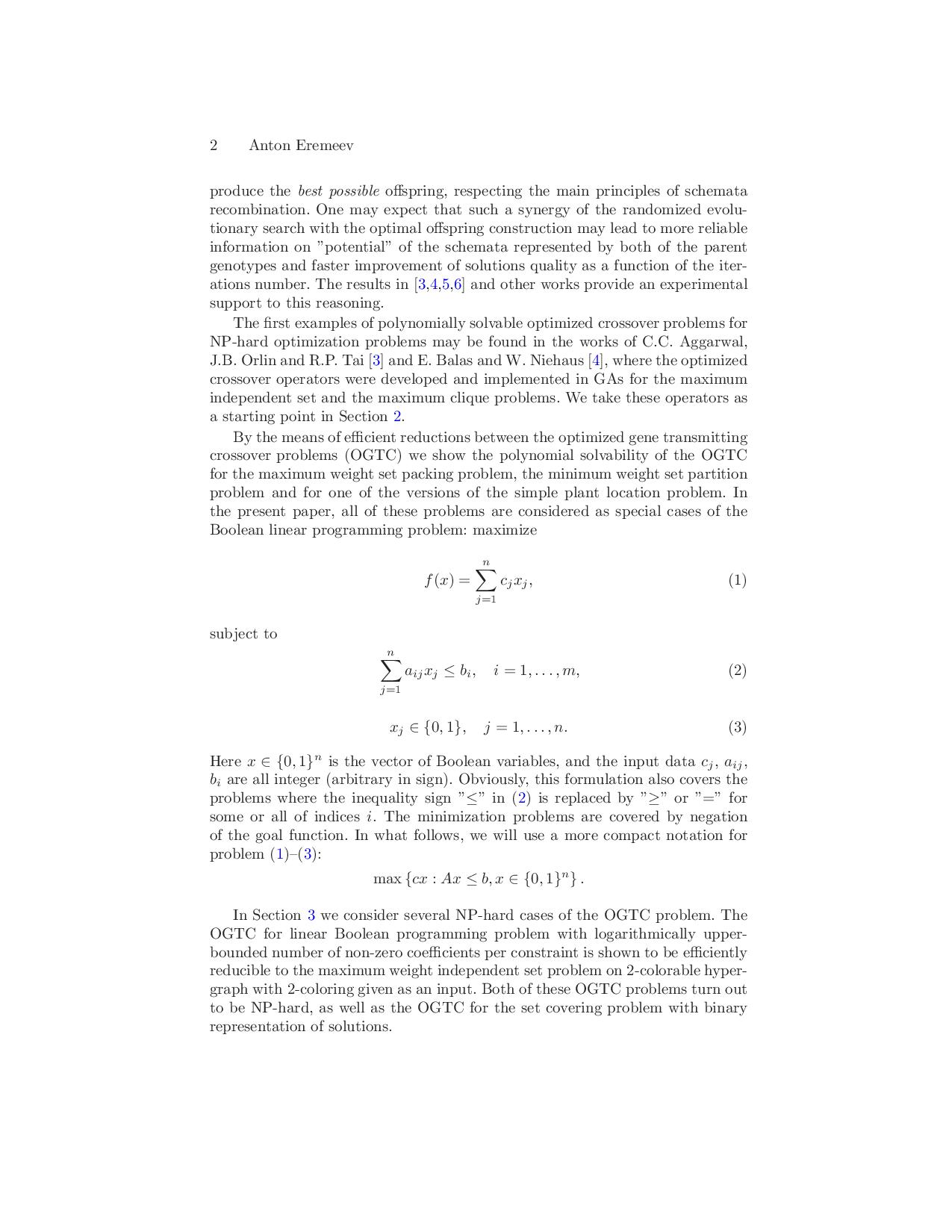
By the means of efficient reductions between the optimized gene transmitting crossover problems (OGTC) we show the polynomial solvability of the OGTC for the maximum weight set packing problem, the minimum weight set partition problem and for one of the versions of the simple plant location problem. In the present paper, all of these problems are considered as special cases of the Boolean linear programming problem: maximize
subject to
x j ∈ {0, 1}, j = 1, . . . , n.
Here x ∈ {0, 1} n is the vector of Boolean variables, and the input data c j , a ij , b i are all integer (arbitrary in sign). Obviously, this formulation also covers the problems where the inequality sign “≤” in (2) is replaced by “≥” or “=” for some or all of indices i. The minimization problems are covered by negation of the goal function. In what follows, we will use a more compact notation for problem (1)-( 3):
In Section 3 we consider several NP-hard cases of the OGTC problem. The OGTC for linear Boolean programming problem with logarithmically upperbounded number of non-zero coefficients per constraint is shown to be efficiently reducible to the maximum weight independent set problem on 2-colorable hypergraph with 2-coloring given as an input. Both of these OGTC problems turn out to be NP-hard, as well as the OGTC for the set covering problem with binary representation of solutions.
We will use the standard notation to define schemata. Each schema is identified by its indicator vector ξ ∈ {0, 1, * } n , implying the set of genotypes {x ∈ {0, 1} n : x j = ξ j for all j such that ξ j = 0 or ξ j = 1} attributed to this schema (the elements x are also called the instances of the schema).
Suppose, a set of schemata on Boolean genotypes is defined: Ξ ⊆ {0, 1, * } n . Analogously to N.J. Radcliffe [1], we can require the optimized crossover on Boolean strings to obey the principle of respect: crossing two instances of any schema from Ξ should produce an instance of that schema. In the case of Boolean genotypes and Ξ = {0, 1, * } n this automatically implies the gene transmission property: all alleles present in the child are to be transmitted from its parents.
In this paper, we will not consider the principle of ergodicity which requires that it should be possible, through a finite sequence of applications of the genetic operators, to access any point in the search space given any initial population. Often this property may be ensured by the means of mutation operators but they are beyond the scope of the paper. Besides that, we shall not discuss the principle of proper assortment: given instances of two compatible schemata, it should be possible to cross them to produce a child which is an instance of both schemata. This principle appears to be irrelevant to the optimized crossover.
In what follows we shal
…(Full text truncated)…
This content is AI-processed based on ArXiv data.