Notes on Schubert classes of a loop group
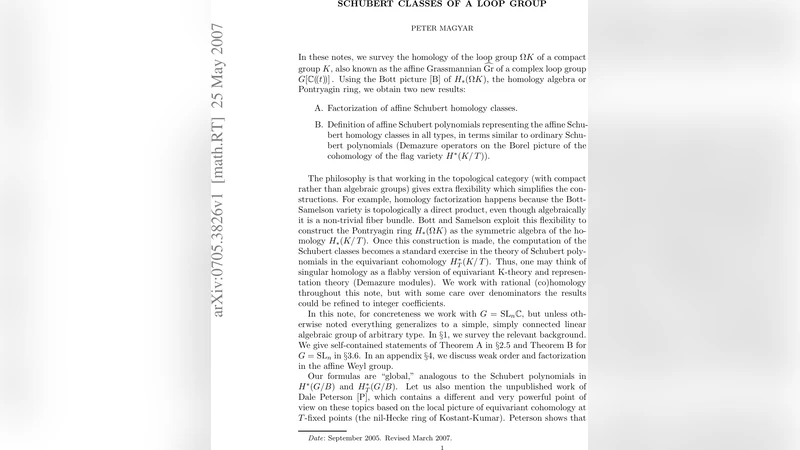
In these notes, we survey the homology of the loop group Omega(K) of a compact group K, also known as the affine Grassmannian of a complex loop group. Using the Bott picture of H_*(Omega(K)), the homology algebra or Pontryagin ring, we obtain two new results: A. Factorization of affine Schubert homology classes. B. Definition of affine Schubert polynomials representing the affine Schubert homology classes in all types, in terms similar to ordinary Schubert polynomials.
💡 Research Summary
The paper surveys the homology of the loop group Ω(K) of a compact Lie group K, which can be identified with the affine Grassmannian of the complex loop group G = Kℂ((t)). Using Bott’s classical description of H_*(Ω(K)) as a free commutative algebra generated by the homology classes corresponding to the coroot lattice of a maximal torus T ⊂ K, the authors study the Pontryagin product (induced by concatenation of loops) and its interaction with the Schubert cell decomposition indexed by the affine Weyl group W_aff.
The first major contribution is a factorization theorem for affine Schubert homology classes. For each element w ∈ W_aff, a reduced expression w = s_{i_1} … s_{i_ℓ} yields a Bott–Samelson resolution of the corresponding Schubert cell X_w as an iterated ℂℙ^1‑bundle. The homology class
Comments & Academic Discussion
Loading comments...
Leave a Comment