Analytic steady-state space use patterns and rapid computations in mechanistic home range analysis
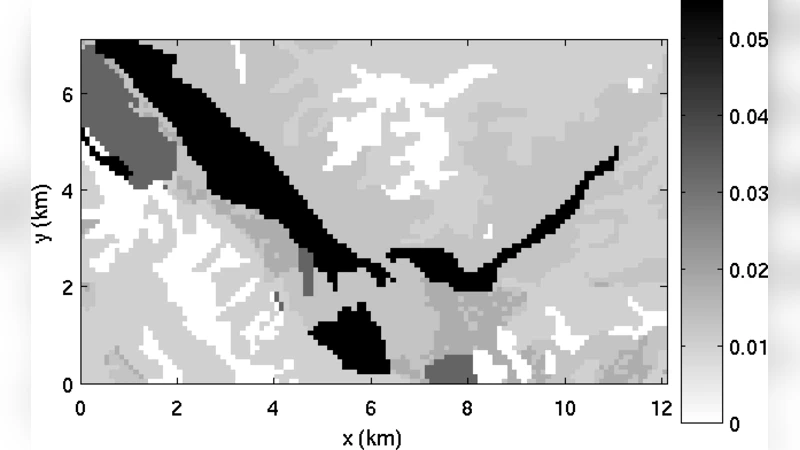
Mechanistic home range models are important tools in modeling animal dynamics in spatially-complex environments. We introduce a class of stochastic models for animal movement in a habitat of varying preference. Such models interpolate between spatially-implicit resource selection analysis (RSA) and advection-diffusion models, possessing these two models as limiting cases. We find a closed-form solution for the steady-state (equilibrium) probability distribution u* using a factorization of the redistribution operator into symmetric and diagonal parts. How space use is controlled by the preference function w then depends on the characteristic width of the redistribution kernel: when w changes rapidly compared to this width, u* ~ w, whereas on global scales large compared to this width, u* ~ w^2. We analyse the behavior at discontinuities in w which occur at habitat type boundaries. We simulate the dynamics of space use given two-dimensional prey-availability data and explore the effect of the redistribution kernel width. Our factorization allows such numerical simulations to be done extremely fast; we expect this to aid the computationally-intensive task of model parameter fitting and inverse modeling.
💡 Research Summary
The paper introduces a mechanistic stochastic framework for modelling animal space use in heterogeneous habitats where the preference for a location varies across space. Traditional resource‑selection analysis (RSA) assumes that the probability of use is directly proportional to a static preference function w, while advection‑diffusion models treat movement as a continuous stochastic process but do not provide an explicit link between w and the steady‑state distribution. The authors bridge these two extremes by defining a redistribution operator K that first moves an animal according to a symmetric kernel k (e.g., a Gaussian) and then re‑weights the move by the local preference w. Mathematically, K can be factorised as K = S D S, where S is the symmetric part (the pure movement kernel) and D is a diagonal matrix whose entries are proportional to w².
Using this factorisation, the steady‑state equation Ku* = u* reduces to a simple linear problem that can be solved analytically. The closed‑form solution is
u*(x) = C · w(x) ·
Comments & Academic Discussion
Loading comments...
Leave a Comment