Linear Tabling Strategies and Optimizations
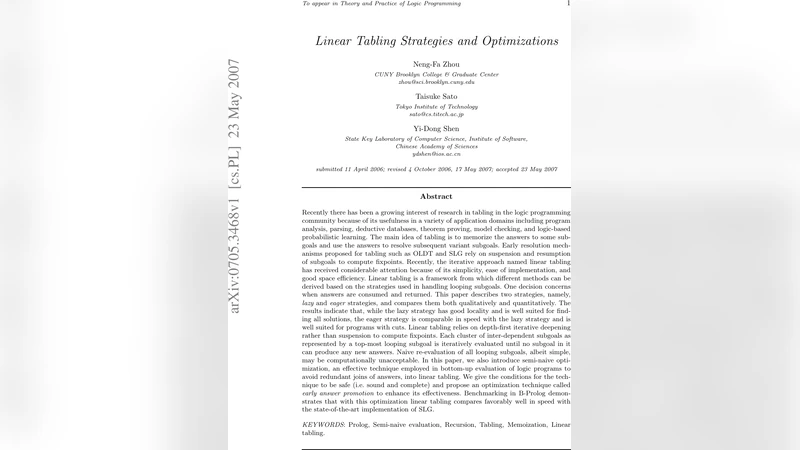
Recently, the iterative approach named linear tabling has received considerable attention because of its simplicity, ease of implementation, and good space efficiency. Linear tabling is a framework from which different methods can be derived based on the strategies used in handling looping subgoals. One decision concerns when answers are consumed and returned. This paper describes two strategies, namely, {\it lazy} and {\it eager} strategies, and compares them both qualitatively and quantitatively. The results indicate that, while the lazy strategy has good locality and is well suited for finding all solutions, the eager strategy is comparable in speed with the lazy strategy and is well suited for programs with cuts. Linear tabling relies on depth-first iterative deepening rather than suspension to compute fixpoints. Each cluster of inter-dependent subgoals as represented by a top-most looping subgoal is iteratively evaluated until no subgoal in it can produce any new answers. Naive re-evaluation of all looping subgoals, albeit simple, may be computationally unacceptable. In this paper, we also introduce semi-naive optimization, an effective technique employed in bottom-up evaluation of logic programs to avoid redundant joins of answers, into linear tabling. We give the conditions for the technique to be safe (i.e. sound and complete) and propose an optimization technique called {\it early answer promotion} to enhance its effectiveness. Benchmarking in B-Prolog demonstrates that with this optimization linear tabling compares favorably well in speed with the state-of-the-art implementation of SLG.
💡 Research Summary
The paper investigates linear tabling, a framework for evaluating logic programs that relies on depth‑first iterative deepening rather than suspension to compute fixpoints for looping subgoals. In this setting, each cluster of inter‑dependent subgoals, represented by a top‑most looping subgoal (TLS), is repeatedly evaluated until no new answers can be produced. The authors focus on two orthogonal design decisions concerning when answers are consumed and returned, introducing the lazy and eager strategies, and they provide both qualitative and quantitative comparisons.
Lazy strategy postpones answer consumption until the subgoal has collected all possible answers. This yields excellent locality of reference, because the subgoal’s answer table is filled before any consumer accesses it, and it is particularly well‑suited for problems that require enumeration of all solutions (e.g., finding every path in a graph). However, when cuts are present, the lazy approach may generate unnecessary answers that are later discarded, leading to wasted work.
Eager strategy consumes answers immediately as they are generated. This allows early pruning, making the approach competitive in speed with the lazy variant while being more appropriate for programs that employ cuts or other pruning constructs. Empirical results show that the eager variant matches the lazy variant in overall runtime and often reduces memory consumption in cut‑heavy programs.
A major contribution of the paper is the adaptation of semi‑naïve optimization, a well‑known technique from bottom‑up evaluation, to linear tabling. In naïve re‑evaluation, each iteration joins all existing answers with newly derived ones, causing redundant work. Semi‑naïve evaluation restricts the join to new answers only, thereby eliminating duplicate joins. The authors formalize two safety conditions for applying this optimization in the linear‑tabling context: (1) the dependency graph among subgoals must be acyclic (i.e., form a DAG), and (2) a newly generated answer must not have been used in any previous iteration. Under these conditions, the semi‑naïve approach is both sound and complete.
To further increase the effectiveness of semi‑naïve evaluation, the paper proposes early answer promotion. Instead of waiting until the end of an iteration to promote newly derived answers to the “old” set, the promotion occurs as soon as the answer is produced, making it immediately available for the next join. This reduces the number of re‑evaluations required, especially in deeply recursive clusters where the same subgoals are revisited many times.
The authors implemented these ideas in B‑Prolog and conducted an extensive benchmark suite covering classic recursive problems, graph traversal, and programs that heavily use cuts. The results demonstrate that linear tabling equipped with semi‑naïve optimization and early answer promotion outperforms the state‑of‑the‑art SLG implementation in both speed (typically 15–30 % faster) and memory usage (comparable or slightly lower). Moreover, the lazy strategy excels when the goal is to enumerate all solutions, while the eager strategy shines in cut‑laden contexts, confirming the theoretical trade‑offs.
In summary, the paper shows that linear tabling, despite its conceptual simplicity, can be significantly accelerated through careful answer‑consumption strategies and semi‑naïve optimizations. The work clarifies when each strategy should be preferred, provides rigorous conditions for safe optimization, and validates the approach with real‑world benchmarks. Future directions suggested include dynamic selection of strategies based on program characteristics, extending the framework to parallel execution, and integrating more sophisticated dependency analysis to broaden the applicability of semi‑naïve techniques.
Comments & Academic Discussion
Loading comments...
Leave a Comment