This paper proposes the response surface method for finite element model updating. The response surface method is implemented by approximating the finite element model surface response equation by a multi-layer perceptron. The updated parameters of the finite element model were calculated using genetic algorithm by optimizing the surface response equation. The proposed method was compared to the existing methods that use simulated annealing or genetic algorithm together with a full finite element model for finite element model updating. The proposed method was tested on an unsymmetri-cal H-shaped structure. It was observed that the proposed method gave the updated natural frequen-cies and mode shapes that were of the same order of accuracy as those given by simulated annealing and genetic algorithm. Furthermore, it was observed that the response surface method achieved these results at a computational speed that was more than 2.5 times as fast as the genetic algorithm and a full finite element model and 24 times faster than the simulated annealing.
Deep Dive into Finite Element Model Updating Using Response Surface Method.
This paper proposes the response surface method for finite element model updating. The response surface method is implemented by approximating the finite element model surface response equation by a multi-layer perceptron. The updated parameters of the finite element model were calculated using genetic algorithm by optimizing the surface response equation. The proposed method was compared to the existing methods that use simulated annealing or genetic algorithm together with a full finite element model for finite element model updating. The proposed method was tested on an unsymmetri-cal H-shaped structure. It was observed that the proposed method gave the updated natural frequen-cies and mode shapes that were of the same order of accuracy as those given by simulated annealing and genetic algorithm. Furthermore, it was observed that the response surface method achieved these results at a computational speed that was more than 2.5 times as fast as the genetic algorithm and a full finite
Finite element (FE) models are widely used to predict the dynamic characteristics of aerospace structures. These models often give results that differ from the measured results and therefore need to be updated to match the measured data. FE model updating entails tuning the model so that it can better reflect the measured data from the physical structure being modeled 1 . One fundamental characteristic of an FE model is that it can never be a true reflection of the physical structure but it will forever be an approximation. FE model updating fundamentally implies that we are identifying a better approximation model of the physical structure than the original model. The aim of this paper is to introduce updating of finite element models using Response Surface Method (RSM) 2 . Thus far, the RSM method has not been used to solve the FE updating problem 1 . This new approach to FE model updating is compared to methods that use simulated annealing (SA) or genetic algorithm (GA) together with full FE models for FE model updating. FE model updating methods have been implemented using different types of optimization methods such as genetic algorithm and conjugate gradient methods [3][4][5] . Levin and Lieven 5 proposed the use of SA and GA for FE updating.
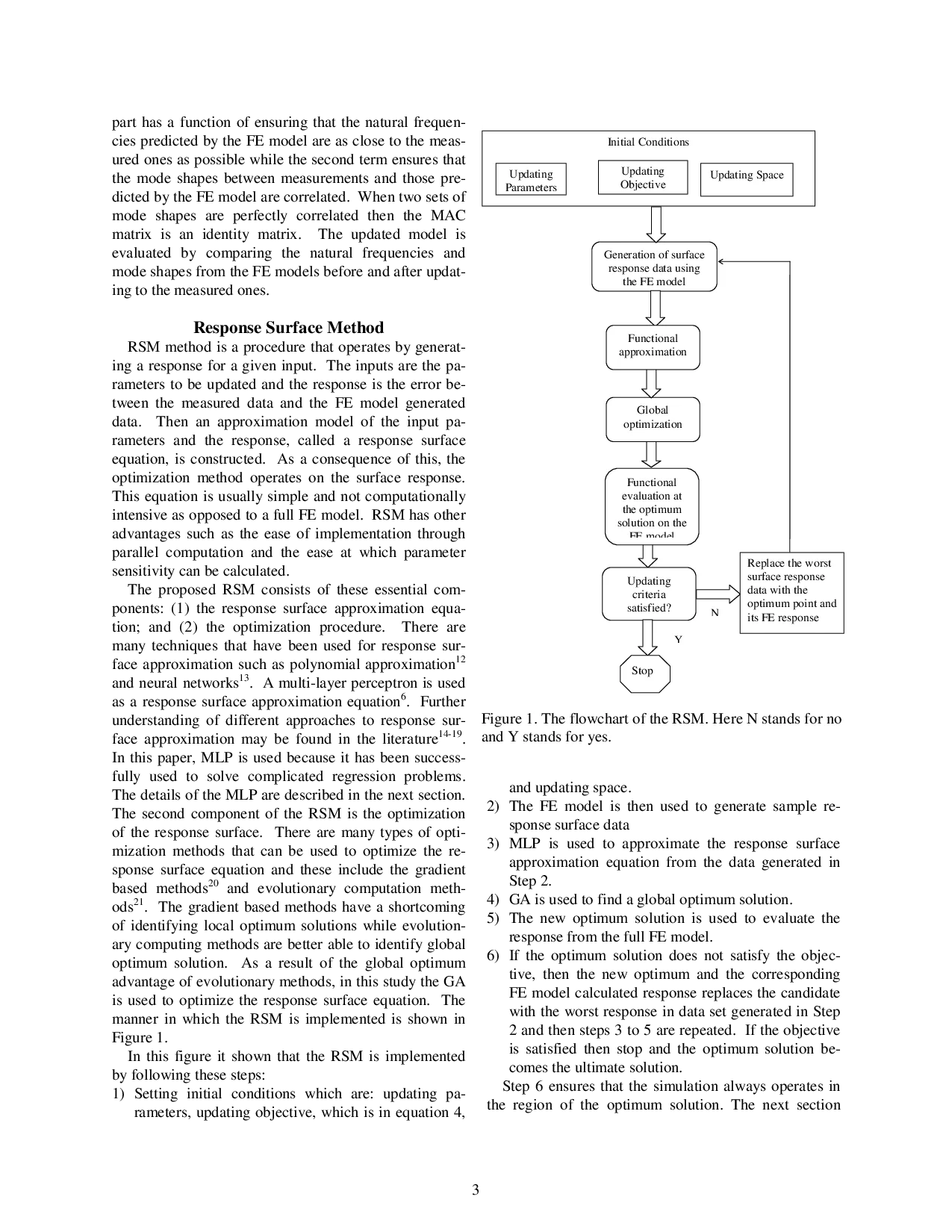
RSM is an approximate optimization method that looks at various design variables and their responses and identify the combination of design variables that give the best response. The best response, in this paper, is defined as the one that gives the minimum distance between the measured data and the data predicted by the FE model. RSM attempts to replace implicit functions of the original design optimization problem with an ap-methods 1 . Direct methods, which use the modal properties, are computationally efficient to implement and reproduce the measured modal data exactly. Furthermore, they do not take into account the physical parameters that are updated. Consequently, even though the FE model is able to predict measured quantities, the updated model is limited in the following ways: it may lack the connectivity of nodes -connectivity of nodes is a phenomenon that occurs naturally in finite element modeling because of the physical reality that the structure is connected; the updated matrices are populated instead of banded -the fact that structural elements are only connected to their neighbors ensures that the mass and stiffness matrices are diagonally dominated with few couplings between elements that are far apart; and there is a possible loss of symmetry of the systems matrices. Iterative procedures use changes in physical parameters to update FE models and produce models that are physically realistic. Iterative methods that use modal properties and the RSM for FE model updating are implemented in this paper. The FE models are updated so that the measured modal properties match the FE model predicted modal properties. The proposed RSM updating method is tested on an unsymmetrical H-shaped structure.
In this study, modal properties, i.e. natural frequencies and mode shapes, are used as a basis for FE model updating. For this reason these parameters are described in this section. Modal properties are related to the physical properties of the structure. All elastic structures may be described in terms of their distributed mass, damping and stiffness matrices in the time domain through the following expression 10 :
(1) where [M], [C] and [K] are the mass, damping and stiffness matrices respectively, and {X}, {X′} and {X′′} are the displacement, velocity and acceleration vectors respectively while {F} is the applied force vector. If equation 1 is transformed into the modal domain to form an eigenvalue equation for the i th mode, then 10 :
ω is the i th complex eigenvalue, with its imaginary part corresponding to the natural frequency
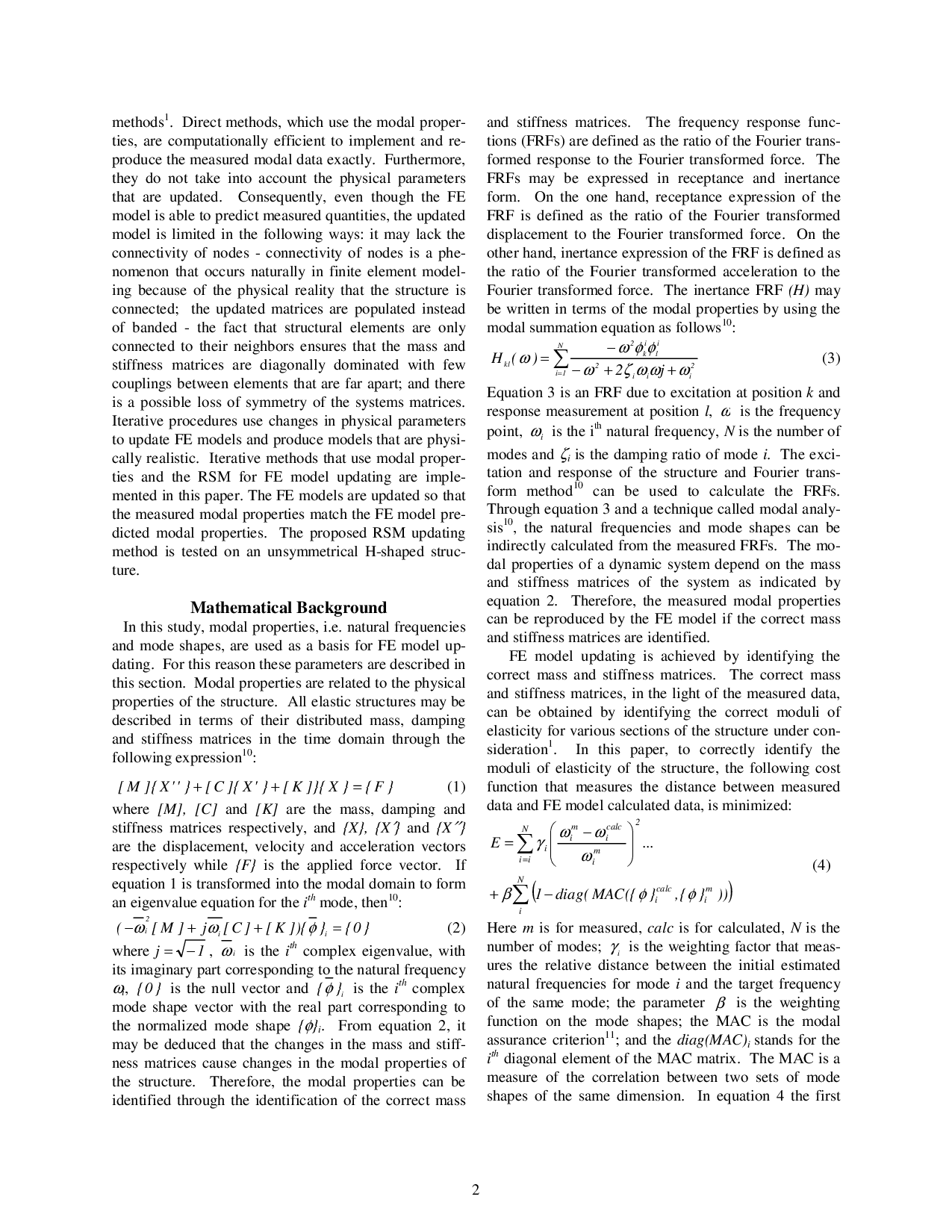
is the null vector and i } {φ is the i th complex mode shape vector with the real part corresponding to the normalized mode shape {φ} i . From equation 2, it may be deduced that the changes in the mass and stiffness matrices cause changes in the modal properties of the structure. Therefore, the modal properties can be identified through the identification of the correct mass and stiffness matrices. The frequency response functions (FRFs) are defined as the ratio of the Fourier transformed response to the Fourier transformed force. The FRFs may be expressed in receptance and inertance form. On the one hand, receptance expression of the FRF is defined as the ratio of the Fourier transformed displacement to the Fourier transformed force. On the other hand, inertance expression of the FRF is defined as the ratio of the Fourier transformed acceleration to the Fourier transformed force. The inertance FRF (H) may be written in terms of the modal properties by using the modal summation equation as follows 10 :
Equation 3 is an FRF due to excitation at position k and response measurement at position l, ω is the frequency point, i ω is
…(Full text truncated)…
This content is AI-processed based on ArXiv data.