Global and regional brain metabolic scaling and its functional consequences
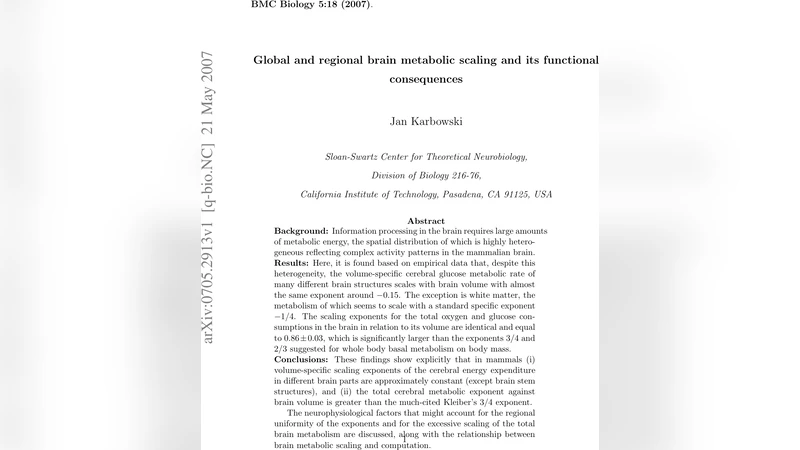
Background: Information processing in the brain requires large amounts of metabolic energy, the spatial distribution of which is highly heterogeneous reflecting complex activity patterns in the mammalian brain. Results: Here, it is found based on empirical data that, despite this heterogeneity, the volume-specific cerebral glucose metabolic rate of many different brain structures scales with brain volume with almost the same exponent around -0.15. The exception is white matter, the metabolism of which seems to scale with a standard specific exponent -1/4. The scaling exponents for the total oxygen and glucose consumptions in the brain in relation to its volume are identical and equal to $0.86\pm 0.03$, which is significantly larger than the exponents 3/4 and 2/3 suggested for whole body basal metabolism on body mass. Conclusions: These findings show explicitly that in mammals (i) volume-specific scaling exponents of the cerebral energy expenditure in different brain parts are approximately constant (except brain stem structures), and (ii) the total cerebral metabolic exponent against brain volume is greater than the much-cited Kleiber’s 3/4 exponent. The neurophysiological factors that might account for the regional uniformity of the exponents and for the excessive scaling of the total brain metabolism are discussed, along with the relationship between brain metabolic scaling and computation.
💡 Research Summary
The paper investigates how metabolic demand scales with brain size across mammalian species, focusing on glucose and oxygen consumption in distinct brain structures. By compiling empirical data on cerebral glucose metabolic rate (CMRglc) for a wide range of species, the authors performed log‑log regressions of volume‑specific metabolism against total brain volume. The key finding is that most gray‑matter structures—including neocortex, hippocampus, thalamus, basal ganglia and others—share a remarkably uniform scaling exponent of approximately –0.15 (±0.02). In practical terms, as brain volume increases, the metabolic rate per unit volume declines by roughly 30 %, but this decline is consistent across regions, suggesting a common regulatory principle that equalizes energy use per unit tissue despite functional heterogeneity.
White matter, by contrast, follows the classic quarter‑power law with an exponent near –0.25 (±0.03). This difference reflects the distinct energetic demands of axonal conduction and myelin maintenance, which scale differently from the synaptic and spiking activity that dominate gray‑matter metabolism.
When the authors summed oxygen and glucose consumption across the whole brain, they obtained a scaling exponent of 0.86 ± 0.03 relative to brain volume. This exponent is significantly larger than the 3/4 (≈0.75) exponent that characterises whole‑body basal metabolic rate (Kleiber’s law) and also exceeds the 2/3 surface‑area based prediction. The result indicates that the brain’s total metabolic demand grows faster than would be expected from simple allometric scaling of the organism as a whole.
The authors discuss two complementary explanations for this “excess” scaling. First, the number of synapses and the density of inter‑regional connections increase super‑linearly with brain size; empirical work suggests that synaptic count scales with brain volume to a power between 1.2 and 1.3. More connections mean more action potentials, neurotransmitter recycling, ion‑pump activity, and thus higher metabolic cost per unit increase in volume. Second, the brain expends a substantial portion of its energy on what the authors term “computational metabolism”—the energy required for information processing, plasticity, and memory formation. These processes are not accounted for in basal maintenance metabolism and therefore add a scaling component that is tied to functional complexity rather than mere tissue mass.
Brain‑stem structures (the brain stem) deviate from the uniform –0.15 exponent, showing a distinct scaling pattern. Because the brain stem governs vital autonomic functions (breathing, heart‑rate control, etc.), its metabolic demand is relatively fixed and less dependent on overall brain size, thereby pulling the overall brain‑stem exponent away from the gray‑matter trend.
The paper concludes that (i) regional metabolic scaling is surprisingly homogeneous across most brain areas, implying an evolutionary pressure toward energy‑efficient design, and (ii) the total brain metabolic exponent exceeds Kleiber’s 3/4 law, reflecting the added energetic burden of large‑scale neural computation. The authors suggest that these findings have implications for understanding the evolution of large brains in primates and humans, for interpreting neuroimaging data that rely on metabolic proxies, and even for bio‑inspired engineering, where mimicking the brain’s ability to perform high‑throughput computation under tight energy constraints could guide the development of low‑power artificial intelligence hardware.
Comments & Academic Discussion
Loading comments...
Leave a Comment