Rational torus-equivariant homotopy I: calculating groups of stable maps
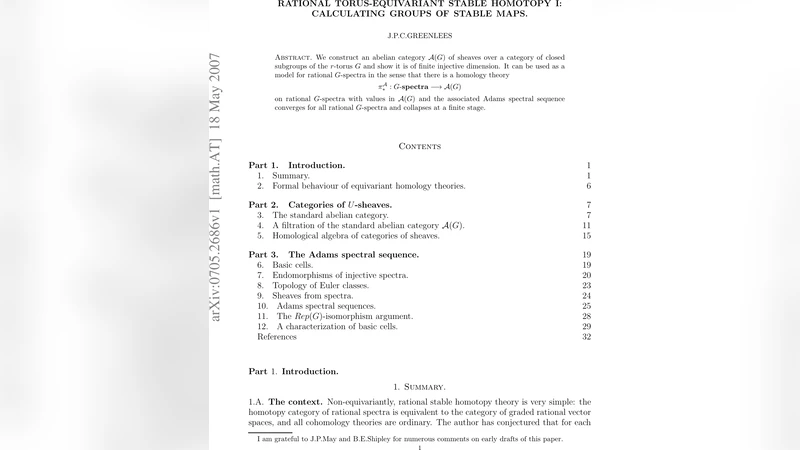
We construct an abelian category A(G) of sheaves over a category of closed subgroups of the r-torus G and show it is of finite injective dimension. It can be used as a model for rational $G$-spectra in the sense that there is a homology theory \piA_*: G-spectra/Q –> A(G) on rational G-spectra with values in A(G), and the associated Adams spectral sequence converges for all rational $G$-spectra and collapses at a finite stage.
💡 Research Summary
The paper establishes a comprehensive algebraic model for rational equivariant stable homotopy theory when the acting group G is an r‑dimensional torus. The authors begin by constructing a small indexing category 𝒪_G whose objects are the closed subgroups H ⊂ G and whose morphisms are inclusions. For each H they consider the rational cohomology ring H^(BH;ℚ), which is a polynomial algebra on rank(H) generators. An object of the new abelian category A(G) is a “sheaf” M that assigns to every H a module M(H) over H^(BH;ℚ) together with restriction maps res_K^H : M(H) → M(K) for each inclusion K ⊂ H, satisfying the obvious compatibility conditions. In this way A(G) encodes simultaneously the algebraic data attached to all closed subgroups and the way these data interact under restriction.
A central technical achievement is the proof that A(G) has finite injective dimension, bounded above by the rank r of the torus. The authors construct explicit injective objects I_H, each supported on a single subgroup H, by extending a free H^*(BH;ℚ)‑module to a sheaf that is zero on subgroups not containing H. Every sheaf M admits a finite resolution by direct sums of such I_H’s, which yields the finiteness of the global dimension of A(G). This property is crucial because it guarantees that Ext‑groups in A(G) are computable using finite length resolutions and that any spectral sequence built from them will collapse after finitely many pages.
With the category in hand the authors define a homology functor
π_A_* : (G‑spectra)ℚ → A(G)
by taking a rational G‑spectrum X, forming its Borel cohomology H_G^(X;ℚ), and then restricting this cohomology to each closed subgroup H. The resulting collection of modules, together with the natural restriction maps, is precisely a sheaf in A(G). The functor π_A_ is shown to be exact, conservative, and to detect rational equivalences, so it serves as a faithful algebraic invariant of rational G‑spectra.
The main computational tool is an Adams spectral sequence based on π_A_. For rational G‑spectra X and Y one has
E₂^{s,t} = Ext_{A(G)}^s(π_A_(X), π_A_*(Y))_t ⇒
Comments & Academic Discussion
Loading comments...
Leave a Comment