Densely ordered braid subgroups
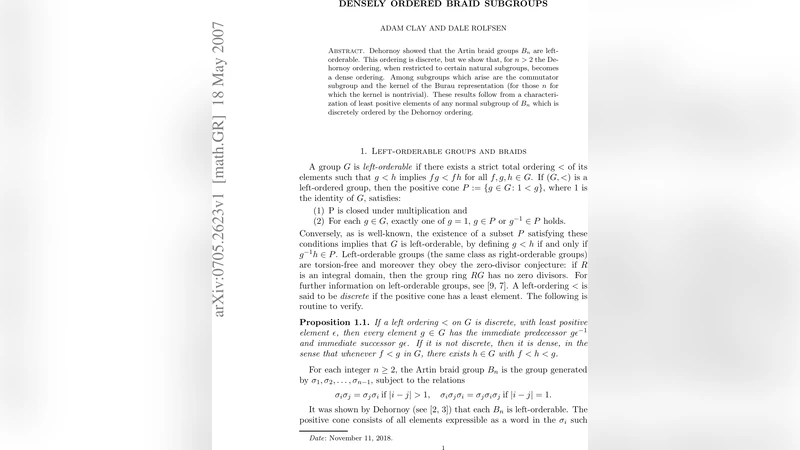
Dehornoy showed that the Artin braid groups $B_n$ are left-orderable. This ordering is discrete, but we show that, for $n >2$ the Dehornoy ordering, when restricted to certain natural subgroups, becomes a dense ordering. Among subgroups which arise are the commutator subgroup and the kernel of the Burau representation (for those $n$ for which the kernel is nontrivial). These results follow from a characterization of least positive elements of any normal subgroup of $B_n$ which is discretely ordered by the Dehornoy ordering.
💡 Research Summary
The paper investigates how the well‑known Dehornoy left‑ordering of the Artin braid groups (B_n) behaves when restricted to certain natural normal subgroups. Dehornoy’s ordering is discrete on the whole group: the smallest positive element is the standard generator (\sigma_1). The authors prove a structural theorem: if a normal subgroup (N\subset B_n) is discretely ordered by the Dehornoy order, then the only possible least positive elements of (N) are either powers of the central element (\Delta^2) (where (\Delta) is the half‑twist) or a conjugate of (\sigma_1). The proof proceeds by examining the intersection (N\cap\langle\sigma_1\rangle) and using the normality of (N) to show that any positive element smaller than a candidate must lie in the same coset of the center, forcing the candidate to be one of the two described forms.
Armed with this characterization, the authors turn to two prominent normal subgroups. First, the commutator subgroup (
Comments & Academic Discussion
Loading comments...
Leave a Comment