$p$-Adic Haar multiresolution analysis and pseudo-differential operators
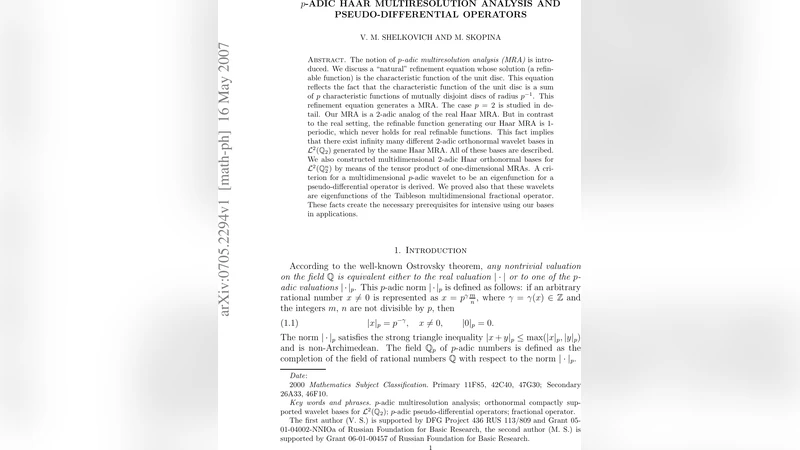
The notion of {\em $p$-adic multiresolution analysis (MRA)} is introduced. We discuss a ``natural’’ refinement equation whose solution (a refinable function) is the characteristic function of the unit disc. This equation reflects the fact that the characteristic function of the unit disc is a sum of $p$ characteristic functions of mutually disjoint discs of radius $p^{-1}$. This refinement equation generates a MRA. The case $p=2$ is studied in detail. Our MRA is a 2-adic analog of the real Haar MRA. But in contrast to the real setting, the refinable function generating our Haar MRA is 1-periodic, which never holds for real refinable functions. This fact implies that there exist infinity many different 2-adic orthonormal wavelet bases in ${\cL}^2(\bQ_2)$ generated by the same Haar MRA. All of these bases are described. We also constructed multidimensional 2-adic Haar orthonormal bases for ${\cL}^2(\bQ_2^n)$ by means of the tensor product of one-dimensional MRAs. A criterion for a multidimensional $p$-adic wavelet to be an eigenfunction for a pseudo-differential operator is derived. We proved also that these wavelets are eigenfunctions of the Taibleson multidimensional fractional operator. These facts create the necessary prerequisites for intensive using our bases in applications.
💡 Research Summary
The paper introduces a systematic framework for constructing a p‑adic multiresolution analysis (MRA) that mirrors the classical Haar MRA on the real line, but exploits the distinctive features of the p‑adic number field ℚₚ. The authors begin by defining a “natural” refinement (or scaling) equation
φ(x)=∑{r=0}^{p‑1}φ(p x−r)
and show that its unique solution is the characteristic function of the unit disc, φ=χ{𝔻₀}. This equation reflects the elementary p‑adic geometry: the unit disc can be partitioned into p disjoint sub‑discs of radius p⁻¹. Using φ as the scaling function, they generate a nested sequence of closed subspaces V_j⊂L²(ℚₚ) by dilation V_j={f(p^{‑j}·):f∈V₀}, where V₀ is the closure of the linear span of integer translates of φ. The four standard MRA axioms (nestedness, density, trivial intersection, existence of a scaling function) are verified, establishing a genuine p‑adic MRA.
The case p=2 receives special attention. Because the p‑adic absolute value is non‑Archimedean, φ is 1‑periodic—a property impossible for real refinable functions. This periodicity enables the construction of infinitely many distinct orthonormal wavelet bases from the same Haar MRA. For each 2‑adic integer s, the authors define a wavelet ψ^{(s)}(x)=χ_{𝔻₀}(x)·e^{2πi s·{x}_2}, where {x}_2 denotes the 2‑adic fractional part. The family {ψ^{(s)}:s∈ℤ₂} is orthonormal, each ψ^{(s)} generates a complete basis of L²(ℚ₂), and different choices of s give rise to different bases. This abundance of bases is a direct consequence of the 1‑periodicity of φ.
To handle higher dimensions, the authors take tensor products of the one‑dimensional MRAs. The n‑dimensional scaling function is Φ(x)=∏{k=1}^{n}χ{𝔻₀}(x_k) and the wavelets are Ψ_{α}(x)=∏{k=1}^{n}ψ{α_k}(x_k), where α=(α₁,…,α_n) indexes the one‑dimensional wavelet parameters. This construction preserves orthonormality and completeness in L²(ℚ₂ⁿ) while allowing independent scaling in each coordinate, which is essential for applications to multidimensional p‑adic data.
A major theoretical contribution is the analysis of how these wavelets interact with pseudo‑differential operators. The authors focus on the Taibleson fractional operator D^{β}, defined via the Fourier transform by \widehat{D^{β}f}(ξ)=|ξ|ₚ^{β}\widehat{f}(ξ). They prove that every multidimensional Haar wavelet Ψ_{α} is an eigenfunction of D^{β} with eigenvalue λ_{α}=p^{‑β·j(α)}, where j(α) denotes the scale level of Ψ_{α}. Consequently, the wavelet decomposition diagonalizes the Taibleson operator, providing a convenient spectral tool for solving p‑adic fractional differential equations.
In summary, the paper delivers: (1) a rigorous definition of p‑adic Haar MRA based on the characteristic function of the unit disc; (2) a demonstration that, unlike the real case, the scaling function is 1‑periodic, leading to infinitely many orthonormal wavelet bases in L²(ℚ₂); (3) a tensor‑product extension yielding orthonormal bases for L²(ℚ₂ⁿ); (4) a clear eigenfunction relationship between these wavelets and the Taibleson fractional operator. These results lay a solid analytical foundation for employing p‑adic Haar wavelets in areas such as p‑adic signal processing, image compression, numerical solutions of p‑adic pseudo‑differential equations, and even p‑adic models in quantum physics.
Comments & Academic Discussion
Loading comments...
Leave a Comment