SIR dynamics in random networks with heterogeneous connectivity
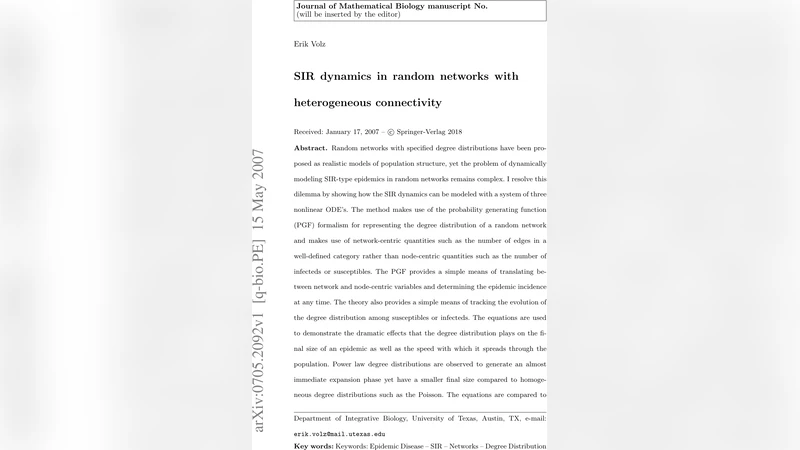
Random networks with specified degree distributions have been proposed as realistic models of population structure, yet the problem of dynamically modeling SIR-type epidemics in random networks remains complex. I resolve this dilemma by showing how the SIR dynamics can be modeled with a system of three nonlinear ODE’s. The method makes use of the probability generating function (PGF) formalism for representing the degree distribution of a random network and makes use of network-centric quantities such as the number of edges in a well-defined category rather than node-centric quantities such as the number of infecteds or susceptibles. The PGF provides a simple means of translating between network and node-centric variables and determining the epidemic incidence at any time. The theory also provides a simple means of tracking the evolution of the degree distribution among susceptibles or infecteds. The equations are used to demonstrate the dramatic effects that the degree distribution plays on the final size of an epidemic as well as the speed with which it spreads through the population. Power law degree distributions are observed to generate an almost immediate expansion phase yet have a smaller final size compared to homogeneous degree distributions such as the Poisson. The equations are compared to stochastic simulations, which show good agreement with the theory. Finally, the dynamic equations provide an alternative way of determining the epidemic threshold where large-scale epidemics are expected to occur, and below which epidemic behavior is limited to finite-sized outbreaks.
💡 Research Summary
The paper addresses a long‑standing challenge in epidemic modeling: how to describe SIR dynamics on random networks that possess heterogeneous degree distributions. Traditional compartmental models assume homogeneous mixing and rely on average contact rates, which fails to capture the influence of highly variable node degrees observed in real social and biological networks. The authors resolve this by formulating the epidemic process in terms of three coupled nonlinear ordinary differential equations (ODEs) that track edge‑centric quantities rather than node‑centric counts.
The cornerstone of the approach is the probability generating function (PGF) (G_0(x)=\sum_k p_k x^k), which compactly encodes the degree distribution (p_k). Two edge‑centric state variables are introduced: (\theta(t)), the probability that a randomly chosen edge has not yet transmitted infection to its susceptible endpoint, and (\phi(t)), the probability that an edge connects a susceptible node to an infected node. A third variable, (\rho(t)), records the cumulative fraction of infected individuals. The dynamics obey
\
Comments & Academic Discussion
Loading comments...
Leave a Comment