A Blichfeldt-type inequality for the surface area
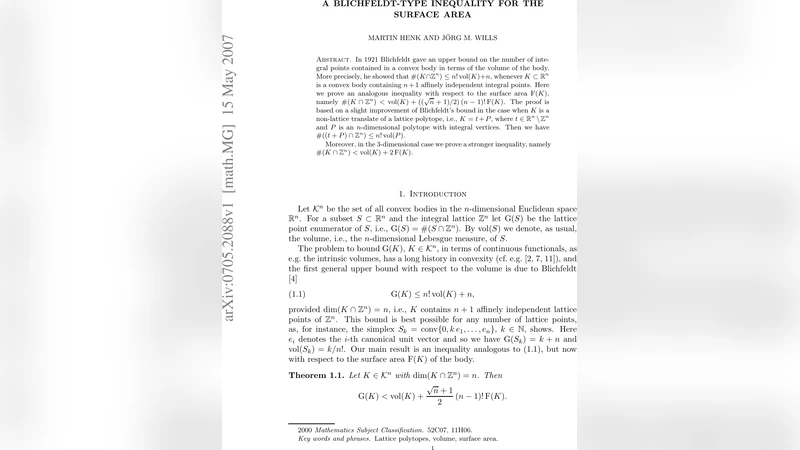
In 1921 Blichfeldt gave an upper bound on the number of integral points contained in a convex body in terms of the volume of the body. More precisely, he showed that $#(K\cap\Z^n)\leq n! \vol(K)+n$, whenever $K\subset\R^n$ is a convex body containing $n+1$ affinely independent integral points. Here we prove an analogous inequality with respect to the surface area $\F(K)$, namely $ #(K\cap\Z^n) < \vol(K) + ((\sqrt{n}+1)/2) (n-1)! \F(K)$. The proof is based on a slight improvement of Blichfeldt’s bound in the case when $K$ is a non-lattice translate of a lattice polytope, i.e., $K=t+P$, where $t\in\R^n\setminus\Z^n$ and $P$ is an $n$-dimensional polytope with integral vertices. Then we have $#((t+P)\cap\Z^n)\leq n! \vol(P)$. Moreover, in the 3-dimensional case we prove a stronger inequality, namely $#(K\cap\Z^n) < \vol(K) + 2 \F(K)$.
💡 Research Summary
The paper revisits a classical result of Blichfeldt (1921), which bounds the number of integer lattice points inside a convex body K ⊂ ℝⁿ by a function of its volume: if K contains n + 1 affinely independent integer points then
#(K∩ℤⁿ) ≤ n!·vol(K) + n.
While this inequality is sharp for many high‑volume bodies, it completely ignores the contribution of the body’s surface. The authors therefore ask whether a bound that also involves the surface area 𝔽(K) can be obtained, and they answer this in the affirmative.
The first technical contribution concerns a special class of sets: non‑lattice translates of lattice polytopes. If P is an n‑dimensional polytope whose vertices are integer points and t∈ℝⁿ\ℤⁿ, then the translate t + P contains no interior lattice points. The authors prove a refined Blichfeldt bound for such sets:
#((t + P)∩ℤⁿ) ≤ n!·vol(P).
This eliminates the additive “+ n” term present in the original inequality and shows that, for these translates, the volume alone controls the lattice‑point count.
Armed with this observation, the authors attack the general case. They cover an arbitrary convex body K with a fine grid of axis‑parallel cubes of side length ε. Cubes that lie completely inside K contribute a term proportional to vol(K)/εⁿ, while cubes intersecting the boundary contribute a term proportional to 𝔽(K)/εⁿ⁻¹. By choosing ε optimally (essentially ε≈1/√n) they balance the two contributions and obtain a surface‑area‑dependent bound: #(K∩ℤⁿ) < vol(K) +
Comments & Academic Discussion
Loading comments...
Leave a Comment