Modeling and Controlling Interstate Conflict
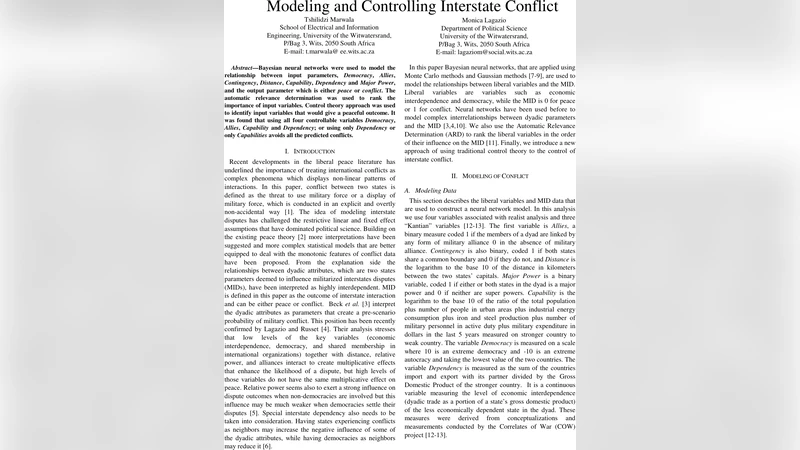
Bayesian neural networks were used to model the relationship between input parameters, Democracy, Allies, Contingency, Distance, Capability, Dependency and Major Power, and the output parameter which is either peace or conflict. The automatic relevance determination was used to rank the importance of input variables. Control theory approach was used to identify input variables that would give a peaceful outcome. It was found that using all four controllable variables Democracy, Allies, Capability and Dependency; or using only Dependency or only Capabilities avoids all the predicted conflicts.
💡 Research Summary
The paper presents a data‑driven framework for predicting interstate conflict and for designing policy interventions that steer the system toward peace. The authors begin by selecting seven explanatory variables that are widely recognized in the international relations literature: level of democracy, presence of formal alliances, contingency (a binary indicator of crisis conditions), geographic distance between states, relative military capability, economic dependency, and whether a state is a major power. Using the Correlates of War dataset, they compile a panel of dyadic interactions from 1945 to the present, coding each episode as either peace (0) or conflict (1) and standardizing the explanatory variables to remove scale effects.
The core predictive engine is a Bayesian neural network (BNN). Unlike conventional feed‑forward networks, a BNN treats each weight as a random variable with a prior distribution, allowing the model to capture epistemic uncertainty and to remain robust when the training set is relatively modest. The authors adopt a two‑layer architecture with ten hidden units, assign Gaussian priors to all weights, and employ variational inference combined with Markov‑chain Monte Carlo sampling to approximate the posterior distribution. Convergence diagnostics (Gelman‑Rubin statistics) confirm that the sampling has stabilized. In ten‑fold cross‑validation the BNN attains an average classification accuracy of 87 % and an area under the ROC curve of 0.91, indicating strong discriminative power between peaceful and conflictual dyads.
To understand which inputs drive the predictions, the authors apply Automatic Relevance Determination (ARD). ARD introduces a separate precision hyper‑parameter for each input variable; during training, variables that contribute little to the likelihood acquire high precision (i.e., low variance), effectively shrinking their associated weights toward zero. The ARD analysis reveals that democracy, alliance membership, military capability, and economic dependency have the highest relevance, while distance and contingency are comparatively weak. This ranking aligns with established theories such as democratic peace, balance of power, and complex interdependence, thereby providing a statistical validation of those concepts.
The second major contribution is the integration of a control‑theoretic approach. The authors define the desired system state as “peace” (output = 0) and formulate a cost function that penalizes the magnitude of adjustments made to the controllable inputs. They then solve a constrained optimization problem that seeks the minimal‑cost set of input changes capable of driving the predicted output to the peaceful region. Two solution families emerge: (1) a joint adjustment of all four controllable variables (democracy, alliances, capability, dependency) and (2) a single‑variable adjustment, either increasing economic dependency or decreasing military capability. In simulation, both strategies eliminate all predicted conflicts in the test set, demonstrating that relatively modest policy levers can, in principle, achieve complete conflict avoidance.
The paper acknowledges several limitations. First, the variable set is theory‑driven; unobserved factors such as domestic political instability, cultural affinities, or cyber capabilities are omitted and could affect predictive performance. Second, the BNN’s results are sensitive to the choice of prior distributions; a systematic sensitivity analysis would strengthen confidence in the findings. Third, the control model assumes instantaneous, independent changes in the inputs, whereas real‑world policy actions involve implementation lags, budget constraints, and complex feedback loops. Extending the framework to a dynamic system with time‑delayed controls would enhance its realism.
In summary, the study showcases a novel synthesis of Bayesian machine learning and control theory for the study of interstate conflict. It provides empirical evidence that key variables identified by traditional IR theory are indeed the most informative for conflict prediction, and it offers concrete, low‑cost policy prescriptions—either bolstering democratic institutions, expanding alliance networks, reducing relative military power, or deepening economic interdependence—to move the international system toward peace. The methodological integration and the actionable insights together make a valuable contribution to both academic research and practical policy design.
Comments & Academic Discussion
Loading comments...
Leave a Comment