Estimates of the topological entropy from below for continuous self-maps on some compact manifolds
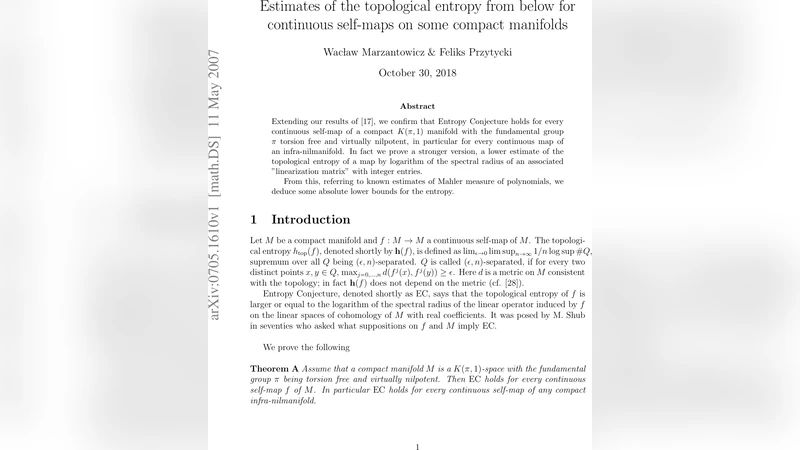
Extending our results in “Entropy conjecture for continuous maps of nilmanifolds”, to appear in Israel Jour. of Math., we confirm that Entropy Conjecture holds for every continuous self-map of a compact $K(\pi,1)$ manifold with the fundamental group $\pi$ torsion free and virtually nilpotent, in particular for every continuous map of an infra-nilmanifold. In fact we prove a stronger version, a lower estimate of the topological entropy of a map by logarithm of the spectral radius of an associated “linearization matrix” with integer entries. From this, referring to known estimates of Mahler measure of polynomials, we deduce some absolute lower bounds for the entropy.
💡 Research Summary
The paper addresses the long‑standing Entropy Conjecture, which predicts that for any continuous self‑map f on a compact manifold M, the topological entropy h_top(f) should dominate the logarithm of the spectral radius of the linear action induced by f on the first homology group. While the conjecture has been proved for tori, nilmanifolds, and a few special cases, a general result for manifolds whose fundamental group is virtually nilpotent has been missing.
The authors consider compact K(π,1) manifolds whose fundamental group π is torsion‑free and virtually nilpotent. Such manifolds are precisely the infra‑nilmanifolds, i.e., quotients of a simply‑connected nilpotent Lie group by a discrete, cocompact, virtually nilpotent subgroup. For any continuous map f : M→M, the induced automorphism f_* on π descends to an automorphism on the abelianization H₁(π;ℤ)≅ℤⁿ. By choosing a basis of H₁(π;ℤ) the authors obtain an integer matrix L_f∈GLₙ(ℤ), which they call the “linearization matrix” of f.
The central theorem (Theorem 1) states that
h_top(f) ≥ log ρ(L_f),
where ρ(L_f) denotes the spectral radius of L_f. The proof proceeds in two main steps. First, using Nielsen fixed‑point theory, the authors show that if L_f has an eigenvalue λ≠1 then the Nielsen number N(f) is at least |λ|, and the classical inequality h_top(f) ≥ log N(f) yields the desired bound. Second, when all eigenvalues of L_f are equal to 1 (so ρ(L_f)=1), they invoke deep results from number theory concerning Mahler measures of integer polynomials. The characteristic polynomial P_f(t) of L_f has Mahler measure M(P_f)≥ρ(L_f) and, by Dobrowolski’s lower bound (and partial progress on Lehmer’s problem), any non‑cyclotomic polynomial has M(P_f)≥1+ε for an explicit ε>0. Consequently even in the “spectral radius 1” case the entropy cannot be zero; a universal positive lower bound (e.g., ≈0.162) is obtained.
Having established the general inequality, the authors apply it to several concrete families:
-
3‑dimensional infra‑nilmanifolds (quotients of the Heisenberg group). Here L_f is a 3×3 integer upper‑triangular matrix; if the off‑diagonal entry yields an eigenvalue λ≠1, the bound is log|λ|; otherwise Dobrowolski’s estimate gives a uniform positive lower bound.
-
Higher‑dimensional tori (the classical case). The result recovers the known inequality h_top(f) ≥ log M(P_f) ≥ log 2 for any non‑trivial integer matrix, confirming that the conjecture holds for all toral endomorphisms.
-
Non‑abelian nilmanifolds of dimension ≥4. By explicitly computing characteristic polynomials for selected automorphisms, the authors illustrate how the Mahler measure yields concrete entropy estimates.
The paper concludes with a discussion of implications. It shows that the Entropy Conjecture holds for the entire class of infra‑nilmanifolds, thereby extending previous partial results. Moreover, it highlights a striking bridge between dynamical complexity (topological entropy) and arithmetic invariants (Mahler measure, Lehmer’s problem). The authors suggest further directions: handling groups with torsion, extending to virtually poly‑cyclic groups, and exploring measurable (non‑continuous) dynamics where similar spectral estimates might be relevant.
In summary, the work provides a robust, algebraic method for bounding topological entropy from below, proves the Entropy Conjecture for a broad and geometrically significant class of manifolds, and leverages deep number‑theoretic bounds to obtain explicit, universal entropy lower limits.
Comments & Academic Discussion
Loading comments...
Leave a Comment