Logic Column 18: Alternative Logics: A Book Review
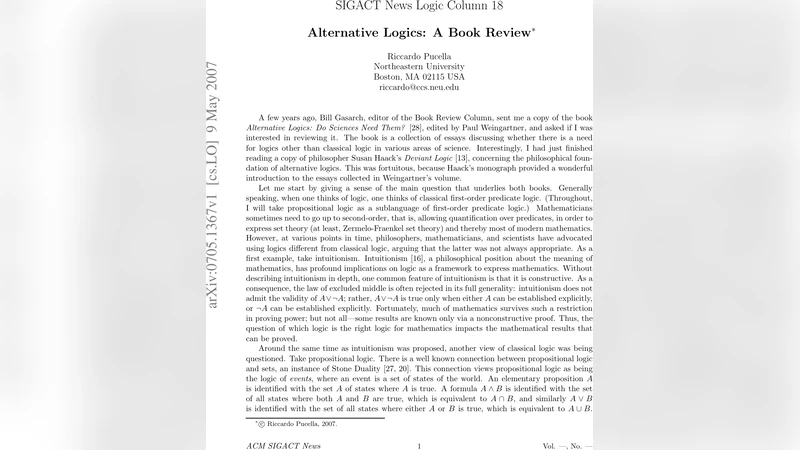
This article discusses two books on the topic of alternative logics in science: “Deviant Logic”, by Susan Haack, and “Alternative Logics: Do Sciences Need Them?”, edited by Paul Weingartner.
💡 Research Summary
The column titled “Logic Column 18: Alternative Logics: A Book Review” offers a thorough comparative examination of two recent works that address the growing interest in non‑classical or “alternative” logics within philosophy of science. The first work, Susan Haack’s Deviant Logic, is presented as a rigorous philosophical critique of the prevailing view that classical, bivalent logic is the sole normative framework for rational inference. Haack introduces the term “deviant logic” to denote any logical system that departs from the standard truth‑functional, bivalent schema, and she argues that such deviations must be justified on both normative and explanatory grounds. Central to her thesis is a skeptical stance toward unrestricted logical pluralism: she warns that a naïve acceptance of any number of co‑existing logics can collapse into a form of relativism that undermines the very notion of logical consequence. Haack therefore proposes a set of criteria—coherence with established inferential practices, explanatory power for actual reasoning, and compatibility with broader epistemic standards—to evaluate when a non‑classical logic can be legitimately adopted. Throughout the book she illustrates her points with examples drawn from natural language semantics, mathematical foundations, and scientific reasoning, showing how certain “deviant” logics can capture phenomena that classical logic struggles to model, yet she remains cautious about granting them full normative status without rigorous justification.
The second volume, Alternative Logics: Do Sciences Need Them?, edited by Paul Weingartner, adopts a multidisciplinary anthology format. Contributors from physics, biology, computer science, law, and other fields each present case studies in which a particular alternative logical system is employed to address specific scientific or technical problems. Notable chapters discuss quantum logic as a response to the non‑commutative structure of measurement operators, paraconsistent logic for handling contradictory data in biological networks, and intuitionistic logic for constructive approaches in computer verification. The editor’s introduction frames the collection around the central question: “Do the sciences actually require logics beyond the classical?” The contributors collectively argue that, in many frontier domains, the constraints of classical logic (principle of explosion, law of excluded middle, strict bivalence) become obstacles rather than virtues. By adopting logics that tolerate inconsistency, reject the law of excluded middle, or modify the notion of entailment, scientists can develop more faithful formal models of their subject matter.
The column’s analysis highlights both convergences and divergences between the two books. Both recognize that alternative logics are not mere curiosities but have the potential to enrich scientific theory‑building. However, Haack’s work is primarily normative: it seeks to delineate the philosophical boundaries that should govern the acceptance of any new logic. Weingartner’s anthology, by contrast, is empirical and pragmatic: it showcases concrete successes and points to a growing community of researchers who already use non‑classical logics as tools. Haack warns against an “anything goes” pluralism, insisting that logical choice must be disciplined by rigorous criteria. Weingartner’s contributors, meanwhile, argue that the criteria themselves may be discipline‑specific, and that the “right” logic for a given scientific problem may differ from the “right” logic for another.
The column concludes that these perspectives are complementary rather than contradictory. Haack provides the philosophical scaffolding needed to prevent logical relativism, while Weingartner’s volume supplies the empirical evidence that such scaffolding can be built upon. The author suggests three avenues for future work: (1) developing a more precise taxonomy of normative standards for alternative logics, (2) systematically cataloguing successful applications across scientific domains to assess their generalizability, and (3) exploring educational and institutional strategies for integrating alternative logics into curricula and research practice without sacrificing clarity or rigor. By pursuing these lines, scholars can ensure that alternative logics become a constructive part of both scientific methodology and philosophical analysis, rather than a peripheral curiosity.
Comments & Academic Discussion
Loading comments...
Leave a Comment