A primer on substitution tilings of the Euclidean plane
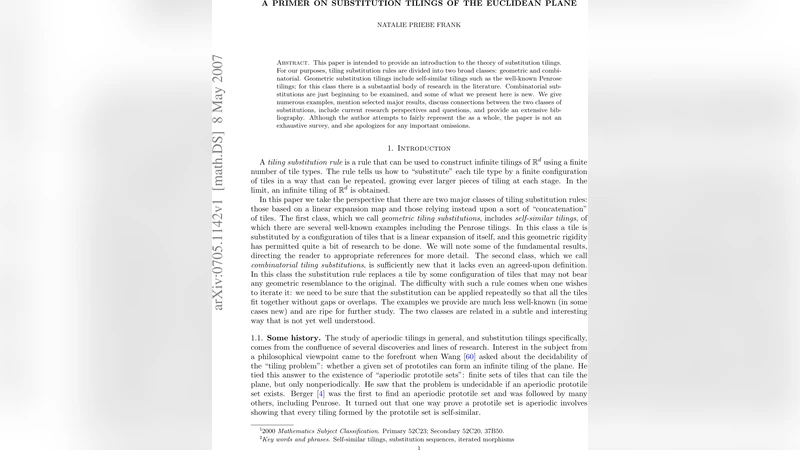
This paper is intended to provide an introduction to the theory of substitution tilings. For our purposes, tiling substitution rules are divided into two broad classes: geometric and combinatorial. Geometric substitution tilings include self-similar tilings such as the well-known Penrose tilings; for this class there is a substantial body of research in the literature. Combinatorial substitutions are just beginning to be examined, and some of what we present here is new. We give numerous examples, mention selected major results, discuss connections between the two classes of substitutions, include current research perspectives and questions, and provide an extensive bibliography. Although the author attempts to fairly represent the as a whole, the paper is not an exhaustive survey, and she apologizes for any important omissions.
💡 Research Summary
The paper serves as an introductory yet substantive overview of substitution tilings in the Euclidean plane, organizing the subject into two broad families: geometric substitutions and combinatorial (or combinatorial) substitutions. It begins by defining a tiling and a substitution rule, then explains why separating the two classes is useful for both historical context and modern research directions.
Geometric Substitutions are described as rules that replace each prototile by a finite patch of scaled, rotated, and possibly reflected copies of the original tiles. The author emphasizes the role of the substitution matrix, whose dominant Perron–Frobenius eigenvalue governs the inflation factor and the growth rate of tile sizes. Classical examples such as the Penrose tilings, Ammann–Beenker tilings, and Socolar–Taylor tilings are presented in detail, with explicit substitution matrices, matching rules, and proofs of aperiodicity. The paper reviews key results: (i) the spectral properties of the substitution matrix determine the existence of self‑similar tilings; (ii) non‑trivial eigenvalues often encode rotational symmetries; (iii) the boundary‑to‑interior ratio decays exponentially with the inflation factor, guaranteeing uniform patch frequencies.
Combinatorial Substitutions are introduced as a newer, largely unexplored branch where the shape of tiles remains fixed and only the adjacency relations (or labels) are substituted. The author models these rules as cellular‑automaton‑like transitions on a finite alphabet, encoded again by a substitution matrix but now interpreted as a graph of label replacements. The paper contributes several original theorems: a sufficient condition for a combinatorial rule to generate an aperiodic tiling, and a uniqueness result stating that if the label‑replacement graph is strongly connected and aperiodic, the global tiling is uniquely determined up to translation. Examples include one‑dimensional Fibonacci and Thue–Morse sequences lifted to two dimensions via multi‑label square tiles, illustrating how combinatorial substitutions can mimic the complexity of geometric ones without any scaling.
A central theme is the bridge between the two classes. By assigning labels to geometric tiles and interpreting the geometric inflation as a label‑expansion, the author shows that many well‑known geometric tilings admit an equivalent combinatorial description. Conversely, a combinatorial rule whose substitution matrix shares the same dominant eigenvalue as a known geometric rule can be “geometrized” by constructing prototiles whose shapes realize the abstract label transitions. This duality is formalized through a coding map and a patch‑substitution isomorphism, providing a systematic method to translate results (e.g., aperiodicity proofs, frequency calculations) from one setting to the other.
The paper concludes with a forward‑looking discussion of open problems. Among them are: (1) characterizing the full class of combinatorial substitutions that yield non‑periodic tilings; (2) extending the theory to three‑dimensional space, where both geometric and combinatorial complexities increase dramatically; (3) exploring hybrid models that combine scaling with label dynamics, potentially leading to new families of quasicrystals; and (4) developing algorithmic tools for automatic discovery and verification of substitution rules, with a brief mention of a prototype software framework called “TileMaker.”
An extensive bibliography follows, covering foundational works on Penrose tilings, recent papers on combinatorial substitution, and interdisciplinary references linking tilings to physics (quasicrystals, photonic materials) and computer science (formal languages, automata theory). Overall, the article offers a clear roadmap for newcomers while also presenting novel insights that push the frontier of combinatorial substitution theory.
Comments & Academic Discussion
Loading comments...
Leave a Comment