Equivariant Chow ring and Chern classes of wonderful symmetric varieties of minimal rank
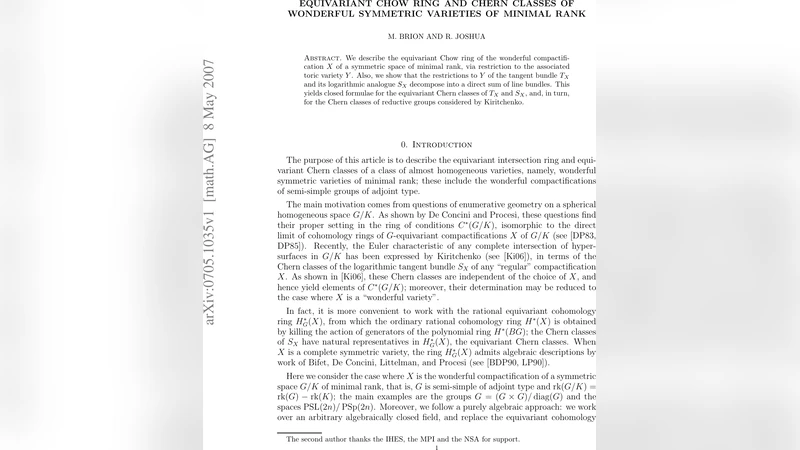
We describe the equivariant Chow ring of the wonderful compactification $X$ of a symmetric space of minimal rank, via restriction to the associated toric variety $Y$. Also, we show that the restrictions to $Y$ of the tangent bundle $T_X$ and its logarithmic analogue $S_X$ decompose into a direct sum of line bundles. This yields closed formulae for the equivariant Chern classes of $T_X$ and $S_X$, and, in turn, for the Chern classes of reductive groups considered by Kiritchenko.
💡 Research Summary
The paper investigates the equivariant Chow ring and Chern classes of the wonderful compactification X of a symmetric space G/H of minimal rank. After recalling the construction of the wonderful compactification for a symmetric space, the authors focus on the special situation where the rank of G/H is minimal. In this case the boundary divisor D has normal crossings and the fixed‑point set X^T under a maximal torus T⊂G contains a smooth toric subvariety Y, which is the normalization of X^T.
The first major result is a description of the equivariant Chow ring A_T^(X) via restriction to Y. The natural restriction map res : A_T^(X)→A_T^(Y) is shown to be surjective, and its kernel is generated by the classes of the irreducible components D_i of the boundary divisor. Consequently, A_T^(X) is isomorphic to the quotient of A_T^*(Y) by the ideal generated by the linear relations coming from the D_i. This mirrors Brion‑Kumar’s general description of equivariant Chow rings for spherical varieties, but the minimal‑rank hypothesis allows a completely explicit presentation.
Next the authors turn to the tangent bundle T_X and its logarithmic analogue S_X = T_X(–log D). By restricting these bundles to the toric variety Y, they exploit the fact that any T‑equivariant vector bundle on a smooth toric variety splits as a direct sum of line bundles. They identify characters χ_i associated to each boundary component and root‑weights α_i coming from the symmetric space structure, and obtain the equivariant isomorphisms
res(T_X) ≅ ⊕_i L(χ_i), res(S_X) ≅ ⊕_i L(χ_i − α_i).
Here L(·) denotes the T‑linearized line bundle with the indicated character.
These splittings lead to closed formulas for the equivariant Chern classes. In the equivariant Chow ring of Y one has
c_T(T_X) = ∏_i (1 + χ_i), c_T(S_X) = ∏_i (1 + χ_i − α_i).
Expanding these products yields explicit expressions for each Chern class c_T^k(T_X) and c_T^k(S_X) as symmetric polynomials in the characters. By pulling back along the restriction map, the same formulas hold in A_T^*(X).
The authors then compare these results with the Chern class formulas obtained by Kiritchenko for reductive groups. They show that, when G/H is the group G acting on itself by conjugation (which is a symmetric space of minimal rank), the above expressions coincide with Kiritchenko’s, thereby providing a geometric explanation for his combinatorial formulas.
To illustrate the theory, several concrete examples are worked out: the symmetric spaces SL_n/SO_n, Sp_{2n}/GL_n, and a few exceptional cases. For each example the toric variety Y, the characters χ_i, and the root‑weights α_i are computed explicitly, and the resulting Chow rings and Chern classes are displayed. The calculations confirm that the predicted relations among generators hold and that the Chern classes satisfy the expected topological constraints (e.g., vanishing of odd-degree classes for even‑dimensional varieties).
Finally, the paper discusses possible extensions. The restriction‑to‑toric‑variety technique relies crucially on the minimal‑rank condition, which guarantees the existence of a smooth toric fixed‑point component. The authors suggest that similar methods might apply to broader classes of spherical varieties where a toric subvariety can be identified, or to other compactifications (e.g., De Concini–Procesi compactifications) where boundary divisors have normal crossings.
In summary, the work provides a transparent, combinatorial description of the equivariant Chow ring of wonderful compactifications of minimal‑rank symmetric spaces, decomposes the tangent and logarithmic bundles into line bundles on a toric subvariety, and derives closed formulas for their equivariant Chern classes. These results not only recover known formulas for reductive groups but also open the way for explicit calculations in a wider range of spherical and symmetric varieties.
Comments & Academic Discussion
Loading comments...
Leave a Comment