Hodge Spaces for Real Toric Varieties
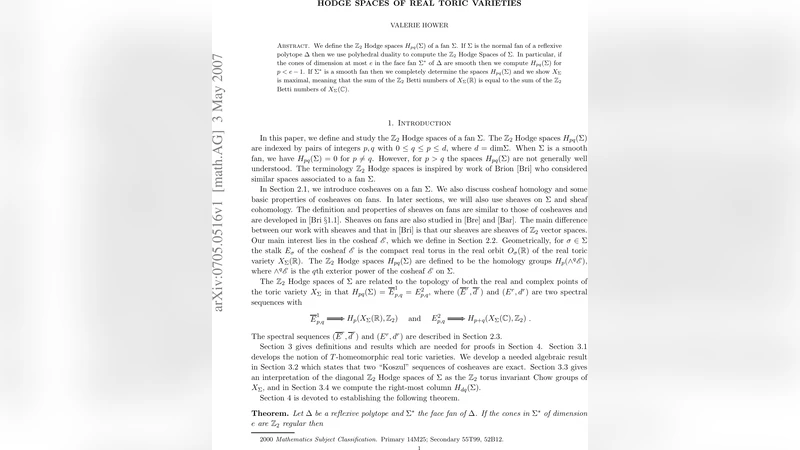
We define the Z/2Z Hodge spaces H_{pq}(\Sigma) of a fan \Sigma. If \Sigma is the normal fan of a reflexive polytope \Delta then we use polyhedral duality to compute the Z/2Z Hodge Spaces of \Sigma. In particular, if the cones of dimension at most e in the face fan \Sigma^* of \Delta are smooth then we compute H_{pq}(\Sigma) for p<e-1. If \Sigma^* is a smooth fan then we completely determine the spaces H_{pq}(\Sigma) and we show the toric variety X associated to \Sigma is maximal, meaning that the sum of the Z/2Z Betti numbers of X(R) is equal to the sum of the Z/2Z Betti numbers of X(C).
💡 Research Summary
The paper introduces a novel combinatorial invariant for toric varieties, the Z/2Z Hodge spaces H_{pq}(Σ) associated to a fan Σ. The construction proceeds by taking the cellular chain complex of the fan, computing its homology with coefficients in the field Z/2Z, and then filtering the resulting groups according to two indices: p, the chain dimension, and q, a complementary index related to the ambient dimension of the fan. This yields a bigraded family of groups that play the role of a “real” Hodge decomposition, mirroring the classical complex Hodge theory but tailored to the topology of the real point set X(ℝ) of the toric variety X defined by Σ.
The authors focus on the case where Σ is the normal fan of a reflexive polytope Δ. Reflexivity guarantees that Δ and its polar Δ* are both lattice polytopes, and that the normal fan of Δ coincides with the face fan of Δ*. Consequently, Σ* (the face fan of Δ) is naturally dual to Σ, and the combinatorial structure of Σ* can be exploited to compute H_{pq}(Σ). The key tool is polyhedral duality: faces of Δ correspond to cones of Σ*, and the smoothness of these cones translates into simple homological properties of the associated cellular complexes.
A central result is that if every cone of Σ* of dimension ≤ e is smooth (i.e., generated by part of a lattice basis), then the Hodge spaces H_{pq}(Σ) are completely determined for all p < e − 1. The proof rests on the observation that smooth cones give rise to contractible subcomplexes in the cellular chain complex, which in turn forces the homology in low p‑degrees to vanish except for the contributions dictated by the combinatorics of Δ. This yields explicit formulas for the dimensions of H_{pq}(Σ) in terms of the numbers of faces of Δ of various dimensions.
When Σ* is globally smooth (all its cones are smooth), the authors go further and compute H_{pq}(Σ) for every pair (p,q). In this situation the fan Σ is simplicial and the toric variety X is an orbifold with only quotient singularities that are already resolved in the real setting. The resulting Hodge spaces are non‑zero only when p + q equals the complex dimension n of X, and their dimensions are given by simple combinatorial invariants of Δ (essentially the f‑vector of Δ and its polar).
Armed with the full description of H_{pq}(Σ), the paper proves that the associated toric variety X is “maximal” in the sense of real algebraic geometry: the sum of the Z/2Z Betti numbers of the real locus X(ℝ) equals the sum of the Z/2Z Betti numbers of the complex locus X(ℂ). This equality realizes the Smith–Thom inequality as an equality for this class of varieties. The maximality result is significant because it identifies a broad family of toric varieties for which the real topology is as rich as possible, matching the complex topology in total Betti number.
The authors place their work in the context of earlier results on real toric varieties, Viro’s patchworking, and the Smith–Thom inequality. They emphasize that while previous studies often required intricate spectral sequence arguments or case‑by‑case analysis, the present approach leverages the intrinsic combinatorial duality of reflexive polytopes to obtain uniform, explicit formulas. Moreover, the introduction of Z/2Z Hodge spaces opens the door to further investigations: extending the theory to other coefficient rings (ℤ, ℚ), exploring non‑reflexive polytopes, and applying the framework to problems concerning real solutions of polynomial systems defined by toric data.
In summary, the paper provides a clear definition of Z/2Z Hodge spaces for fans, establishes a powerful duality‑based computational method for reflexive polytopes, delivers explicit results for low‑dimensional and fully smooth cases, and demonstrates that the resulting toric varieties are maximal. This contributes a valuable new tool to the study of real toric geometry and suggests several promising directions for future research.
Comments & Academic Discussion
Loading comments...
Leave a Comment