Formality of function spaces
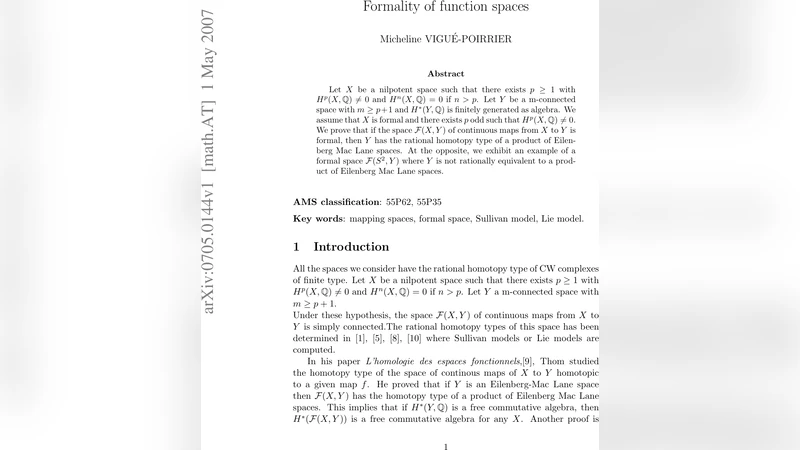
Let $X$ be a nilpotent space such that there exists $p\geq 1$ with $H^p(X,\mathbb Q) \ne 0$ and $H^n(X,\mathbb Q)=0$ if $n>p$. Let $Y$ be a m-connected space with $m\geq p+1$ and $H^*(Y,\mathbb Q)$ is finitely generated as algebra. We assume that $X$ is formal and there exists $p$ odd such that $H^p(X,\mathbb Q) \ne 0$. We prove that if the space $\mathcal F(X,Y)$ of continuous maps from $X$ to $Y$ is formal, then $Y$ has the rational homotopy type of a product of Eilenberg Mac Lane spaces. At the opposite, we exhibit an example of a formal space $\mathcal F(S^2,Y)$ where $Y$ is not rationally equivalent to a product of Eilenberg Mac Lane spaces.
💡 Research Summary
The paper investigates the interplay between formality—a property in rational homotopy theory indicating that a space’s rational homotopy type is determined solely by its rational cohomology algebra—and the structure of mapping spaces. The authors consider a nilpotent space X that possesses non‑trivial rational cohomology only up to a fixed degree p (i.e., Hⁿ(X;ℚ)=0 for n>p) and assume that p is odd with Hᵖ(X;ℚ)≠0. Moreover, X is required to be formal. The target space Y is taken to be m‑connected with m≥p+1, and its rational cohomology algebra H⁎(Y;ℚ) is assumed to be finitely generated. Under these hypotheses the authors prove a striking rigidity result: if the mapping space 𝔽(X,Y)=Map(X,Y) is itself formal, then Y must have the rational homotopy type of a product of Eilenberg–Mac Lane spaces K(ℚ,n). In other words, the only way the function space can be formal is when Y is rationally a “pure” cohomology object with trivial differential in its minimal Sullivan model.
The proof proceeds by constructing the Sullivan model of the mapping space. For a nilpotent source X with minimal model (ΛV,d_X) and a target Y with minimal model (ΛW,d_Y), the standard model for Map(X,Y) is (Λ(V⊗W),D), where D encodes both the differentials of X and Y and the interaction between them. Because X is formal, d_X can be taken to be zero, simplifying D to a derivation that essentially reflects d_Y. The degree constraints (the vanishing of cohomology of X above p and the connectivity of Y) force any non‑zero component of D to live in degrees exceeding the connectivity bound, which is impossible if the mapping space is formal. Consequently, D must vanish entirely, implying d_Y=0. Hence the minimal model of Y is a free graded commutative algebra with zero differential, which is precisely the model of a product of Eilenberg–Mac Lane spaces.
To demonstrate that the hypotheses are essential, the authors construct a counterexample when the odd‑degree condition on p or the connectivity bound is dropped. They exhibit a formal mapping space 𝔽(S²,Y) where Y is not rationally equivalent to a product of Eilenberg–Mac Lane spaces. The chosen Y has a non‑trivial differential in its minimal model (for instance, a space obtained by attaching cells to a wedge of spheres in a way that creates higher Massey products), yet the mapping space from the 2‑sphere remains formal because the source’s cohomology is concentrated in degree 2, eliminating the problematic interaction terms in the differential of the mapping space model. This example shows that the result does not extend to arbitrary source spaces or targets lacking the prescribed connectivity.
The paper concludes by discussing the broader implications of the theorem. Formality of function spaces is a strong constraint on the target’s rational homotopy type, suggesting that, in highly connected settings, the only “formal” mapping spaces arise from targets that are cohomologically trivial beyond their homotopy groups. The authors propose further investigations into more general settings, such as non‑nilpotent sources, coefficients other than ℚ, or mapping spaces of spectra, where analogous rigidity phenomena might appear. The work thus contributes a clear criterion linking the algebraic simplicity of a mapping space to the topological simplicity of its target, enriching our understanding of how rational homotopy invariants behave under function‑space constructions.
Comments & Academic Discussion
Loading comments...
Leave a Comment