Excision for K-theory of connective ring spectra
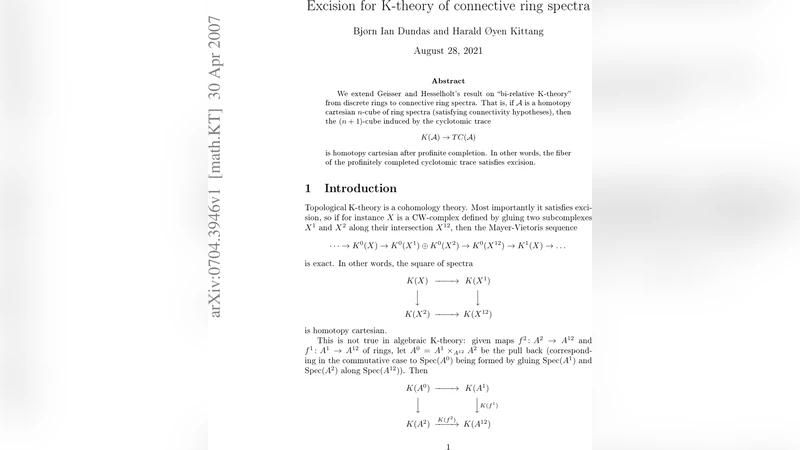
We extend Geisser and Hesselholt’s result on ``bi-relative K-theory’’ from discrete rings to connective ring spectra. That is, if $\mathcal A$ is a homotopy cartesian $n$-cube of ring spectra (satisfying connectivity hypotheses), then the $(n+1)$-cube induced by the cyclotomic trace $$K(\mathcal A)\to TC(\mathcal A)$$ is homotopy cartesian after profinite completion. In other words, the fiber of the profinitely completed cyclotomic trace satisfies excision.
💡 Research Summary
The paper extends the excision theorem for algebraic K‑theory, originally proved by Geisser and Hesselholt for discrete rings, to the setting of connective ring spectra. In the classical setting, Geisser–Hesselholt showed that for a homotopy cartesian square of rings the fiber of the cyclotomic trace map (K\to TC) becomes contractible after profinite completion, which implies that the trace satisfies excision. The author’s goal is to prove an analogous statement for higher‑dimensional cubes of connective ring spectra.
The main objects are a homotopy cartesian (n)-cube (\mathcal A) of connective ring spectra satisfying suitable connectivity hypotheses (each vertex has vanishing negative homotopy groups). From (\mathcal A) one obtains an ((n+1))-cube by applying the cyclotomic trace to each vertex: \
Comments & Academic Discussion
Loading comments...
Leave a Comment