C_{0}-Hilbert Modules
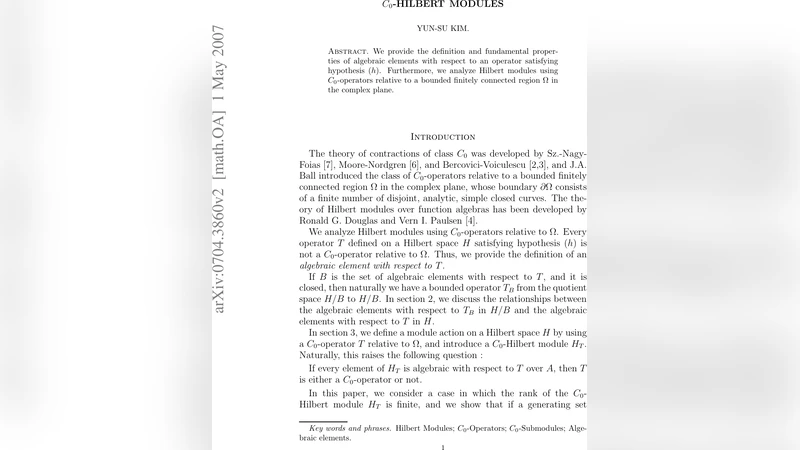
We provide the definition and fundamental properties of algebraic elements with respect to an operator satisfying hypothesis (h). Furthermore, we analyze Hilbert modules using C_0-operators relative to a bounded finitely connected region Omega in the complex plane.
💡 Research Summary
The paper introduces and develops the theory of C₀‑Hilbert modules associated with a bounded linear operator T that satisfies a set of analytic and spectral conditions collectively called hypothesis (h). Hypothesis (h) requires that the spectrum of T lies inside the closure of a bounded, finitely‑connected domain Ω⊂ℂ, that T admits a bounded resolvent on the boundary ∂Ω, and that the functional calculus for continuous functions on Ω interacts nicely with T. Under these assumptions the author first defines algebraic elements of H with respect to T: a vector x∈H is algebraic if there exists a non‑zero polynomial p such that p(T)x=0. The minimal polynomial mₓ(z) and the minimal exponent polynomial eₓ(z) are introduced to capture the finest algebraic relations satisfied by x. The paper proves that each algebraic element generates a T‑invariant subspace Mₓ, and that H decomposes orthogonally into the direct sum of these invariant subspaces together with their orthogonal complements. Moreover, the structure of Mₓ is completely determined by the zeros of mₓ inside Ω and the zeros of eₓ on ∂Ω, leading to a clear classification of algebraic elements into interior‑type and boundary‑type.
Having clarified the algebraic picture, the author proceeds to define C₀‑operators. A C₀‑operator is an operator T satisfying (h) for which a functional calculus extends from polynomials to all continuous functions f∈C(Ω) in a norm‑continuous way: the operator f(T) is well‑defined, bounded, and respects the algebraic relations of T. By letting C(Ω) act on H via f·x:=f(T)x, the Hilbert space acquires the structure of a module over the commutative Banach algebra C(Ω). This module is called a C₀‑Hilbert module. The paper establishes the fundamental properties of such modules: (i) completeness (any Cauchy sequence in the module converges in H), (ii) an inner‑product compatibility that mirrors the L²‑inner product on Ω, and (iii) continuity of the module action with respect to the topology of Ω. These properties show that C₀‑Hilbert modules behave like Hilbert spaces of vector‑valued continuous functions on Ω.
A central theorem demonstrates that any C₀‑Hilbert module can be expressed as a (possibly infinite) orthogonal direct sum of the invariant subspaces generated by algebraic elements. In other words, H=⊕{i∈I}M{x_i}, where each M_{x_i} corresponds to a distinct minimal polynomial. This decomposition is global only when Ω is finitely connected; for domains with infinitely many boundary components the decomposition may fail or require additional infinite‑dimensional summands. The author also studies module homomorphisms that are C(Ω)‑linear and commute with T. Such homomorphisms form a group isomorphic to the group of homeomorphisms of Ω that preserve the analytic structure, linking the algebraic automorphism group of the module to the topological fundamental group π₁(Ω).
The final sections discuss potential applications. In complex function theory, C₀‑Hilbert modules provide reproducing‑kernel Hilbert spaces that model analytic function spaces on Ω. In multivariable operator theory, one can treat each coordinate function as a C₀‑operator, thereby extending the functional calculus to several commuting operators and facilitating joint spectral analysis. In control theory, representing a system’s state‑space operator as a C₀‑operator allows the use of the module framework to analyze stability and design feedback mechanisms via the functional calculus. The paper concludes by outlining future directions: extending the theory to domains with infinitely many connectivity components, investigating non‑linear analogues of C₀‑operators, and exploring connections with non‑commutative geometry. Overall, the work builds a bridge between operator theory, complex analysis, and Hilbert module theory, offering a versatile toolkit for both pure and applied mathematical investigations.
Comments & Academic Discussion
Loading comments...
Leave a Comment