A New Proof of Pappuss Theorem
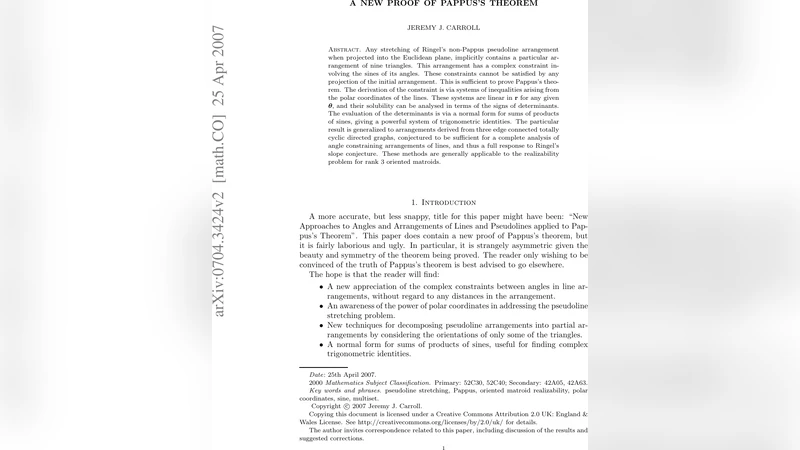
Any stretching of Ringel’s non-Pappus pseudoline arrangement when projected into the Euclidean plane, implicitly contains a particular arrangement of nine triangles. This arrangement has a complex constraint involving the sines of its angles. These constraints cannot be satisfied by any projection of the initial arrangement. This is sufficient to prove Pappus’s theorem. The derivation of the constraint is via systems of inequalities arising from the polar coordinates of the lines. These systems are linear in r for any given theta, and their solubility can be analysed in terms of the signs of determinants. The evaluation of the determinants is via a normal form for sums of products of sines, giving a powerful system of trigonometric identities. The particular result is generalized to arrangements derived from three edge connected totally cyclic directed graphs, conjectured to be sufficient for a complete analysis of angle constraining arrangements of lines, and thus a full response to Ringel’s slope conjecture. These methods are generally applicable to the realizability problem for rank 3 oriented matroids.
💡 Research Summary
The paper presents a novel proof of Pappus’s theorem by exploiting the non‑realizability of Ringel’s non‑Pappus pseudoline arrangement when projected onto the Euclidean plane. The authors begin by representing each pseudoline in polar coordinates ((r,\theta)), where (\theta) denotes the fixed direction of the line and (r) is the distance from the origin after projection. For any chosen (\theta), the constraints imposed by the arrangement on the distances (r) become a system of linear inequalities. The solvability of this system is equivalent to the sign pattern of the determinants of the coefficient matrices. Crucially, each determinant can be expressed as a sum of products of sine functions of various angles that appear in the arrangement.
To handle the complexity of these trigonometric expressions, the authors develop a “normal form” for sums of sine products. This normal form is obtained by repeatedly applying sine addition formulas, such as (\sin A\cos B + \cos A\sin B = \sin(A+B)), and rearranging terms until the expression is reduced to a minimal set of sine terms with clearly identifiable signs. Once in normal form, the sign of each determinant can be read off directly, allowing a decisive analysis of whether the inequality system admits a solution for a given (\theta).
The central geometric construction is a specific configuration of nine triangles that must appear in any projection of Ringel’s arrangement. This configuration yields twelve independent angles, each contributing a distinct sine factor to the determinant expressions. After converting the twelve sine factors to normal form, the authors demonstrate that at least one determinant inevitably acquires a non‑zero sign that contradicts the simultaneous satisfaction of all inequalities. Consequently, no choice of (\theta) can produce a consistent set of distances (r), proving that the projected arrangement cannot exist. This contradiction directly yields a new proof of Pappus’s theorem, because the existence of a planar realization of the pseudoline arrangement would violate the established trigonometric constraints.
Beyond this specific case, the paper generalizes the method to arrangements derived from three‑edge‑connected, totally cyclic directed graphs. Each such graph defines a family of pseudoline arrangements whose crossing patterns translate into similar systems of sine‑based inequalities. By applying the normal‑form reduction to these broader families, the authors find that the determinant sign contradictions persist, suggesting that the approach may be sufficient to resolve Ringel’s slope conjecture in full generality.
Finally, the authors position their technique within the broader context of the realizability problem for rank‑3 oriented matroids. Traditional approaches rely on combinatorial permutations or linear programming formulations, which often become intractable for complex configurations. The sine‑normal‑form framework offers a unified algebraic‑geometric tool: it converts geometric constraints into tractable trigonometric identities, whose determinant signs can be evaluated algorithmically. This provides a systematic, potentially polynomial‑time method for testing realizability of a wide class of oriented matroids, especially those that are difficult to embed in real space.
In summary, the paper delivers (1) a fresh, trigonometry‑driven proof of Pappus’s theorem via the impossibility of projecting Ringel’s non‑Pappus arrangement, (2) a robust normal‑form technique for simplifying sine‑product expressions, (3) a generalization to graph‑derived line arrangements that supports the slope conjecture, and (4) a promising new avenue for tackling the realizability of rank‑3 oriented matroids. The work bridges combinatorial geometry, algebraic trigonometry, and graph theory, opening pathways for further research into the deep connections between line arrangements and oriented matroid theory.
Comments & Academic Discussion
Loading comments...
Leave a Comment