A second order minimality condition for the Mumford-Shah functional
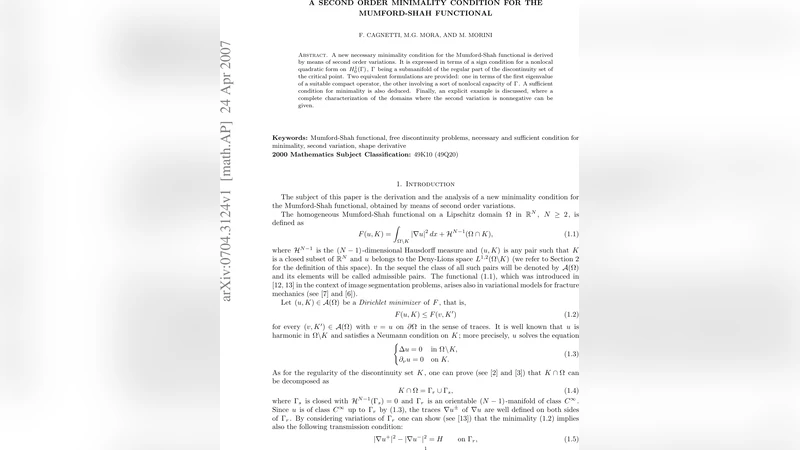
A new necessary minimality condition for the Mumford-Shah functional is derived by means of second order variations. It is expressed in terms of a sign condition for a nonlocal quadratic form on $H^1_0(\Gamma)$, $\Gamma$ being a submanifold of the regular part of the discontinuity set of the critical point. Two equivalent formulations are provided: one in terms of the first eigenvalue of a suitable compact operator, the other involving a sort of nonlocal capacity of $\Gamma$. A sufficient condition for minimality is also deduced. Finally, an explicit example is discussed, where a complete characterization of the domains where the second variation is nonnegative can be given.
💡 Research Summary
The paper addresses the longstanding problem of characterizing minimality for critical points of the Mumford‑Shah functional, a variational model that combines a bulk Dirichlet energy with a surface term measuring the (N‑1)-dimensional Hausdorff measure of a discontinuity set. While first‑order optimality conditions (Euler‑Lagrange equations and transmission conditions) are well known, they are insufficient to guarantee that a critical configuration is indeed a local minimizer. The authors fill this gap by deriving a second‑order necessary condition that is both explicit and amenable to practical verification.
The analysis begins by fixing a smooth portion Γ of the regular part of the discontinuity set K. A perturbation of K is described by a scalar normal displacement φ belonging to H¹₀(Γ). Expanding the Mumford‑Shah energy up to second order in φ yields a quadratic form
\
Comments & Academic Discussion
Loading comments...
Leave a Comment