Control of mechanical systems on Lie groups and ideal hydrodynamics
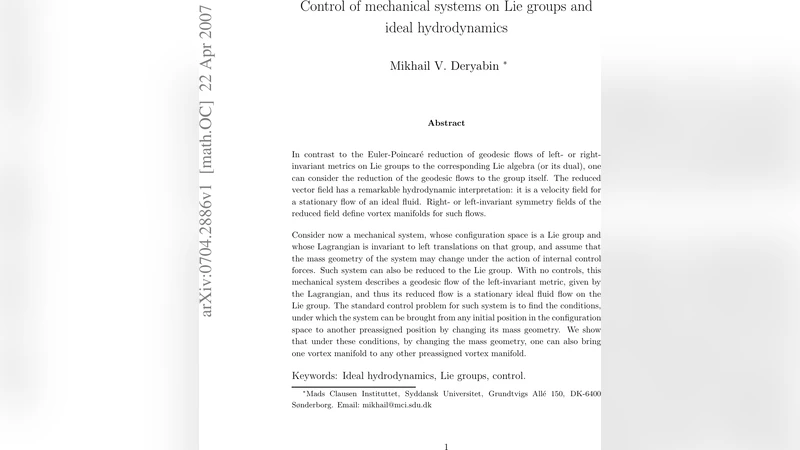
In contrast to the Euler-Poincar{'e} reduction of geodesic flows of left- or right-invariant metrics on Lie groups to the corresponding Lie algebra (or its dual), one can consider the reduction of the geodesic flows to the group itself. The reduced vector field has a remarkable hydrodynamic interpretation: it is a velocity field for a stationary flow of an ideal fluid. Right- or left-invariant symmetry fields of the reduced field define vortex manifolds for such flows. Consider now a mechanical system, whose configuration space is a Lie group and whose Lagrangian is invariant to left translations on that group, and assume that the mass geometry of the system may change under the action of internal control forces. Such system can also be reduced to the Lie group. With no controls, this mechanical system describes a geodesic flow of the left-invariant metric, given by the Lagrangian, and thus its reduced flow is a stationary ideal fluid flow on the Lie group. The standard control problem for such system is to find the conditions, under which the system can be brought from any initial position in the configuration space to another preassigned position by changing its mass geometry. We show that under these conditions, by changing the mass geometry, one can also bring one vortex manifold to any other preassigned vortex manifold.
💡 Research Summary
The paper establishes a novel bridge between the dynamics of mechanical systems whose configuration space is a Lie group and the theory of ideal fluid flows on the same group. Traditionally, left‑ or right‑invariant metrics on a Lie group lead, via Euler‑Poincaré reduction, to equations on the Lie algebra (or its dual). The authors invert this perspective: they reduce the geodesic flow not to the algebra but to the group itself. For a left‑invariant Lagrangian of the form
L(g, ẋ)=½⟨M(g)ẋ, ẋ⟩,
with M(g) a positive‑definite inertia operator, the Euler‑Lagrange equations can be rewritten as a vector field
v(g)=g⁻¹·ẋ
on the group. This vector field is divergence‑free with respect to the left‑invariant volume form and satisfies the stationary Euler equations of an incompressible ideal fluid. Consequently, the uncontrolled mechanical system is exactly a stationary fluid flow on the Lie group.
The second major contribution concerns internal controls that modify the inertia operator M. The authors model such controls by allowing M to depend on a control input u(t):
L(g, ẋ, u)=½⟨M(g, u)ẋ, ẋ⟩.
When u varies, the induced vector field on G becomes time‑dependent, which can be interpreted as a non‑stationary ideal fluid flow driven by an external “force” generated by the changing mass geometry. The central control problem is twofold: (i) determine conditions under which any initial configuration g₀ can be steered to any desired configuration g₁ by suitably varying u(t); (ii) show that the same control authority can also steer the vortex manifolds—geometric structures defined by left‑ or right‑invariant symmetry fields—between arbitrary prescribed shapes.
To answer (i), the authors assume the control set is rich enough that the family of inertia operators {M(g, u)} spans the entire space of symmetric positive‑definite operators on the Lie algebra. Under this assumption the control‑affine system satisfies the Lie‑algebra rank condition; the generated Lie brackets of the drift and control vector fields fill the whole tangent space of G. By Chow‑Rashevskii’s theorem the system is globally controllable: any two points in G can be connected by a piecewise‑smooth control trajectory.
For (ii), they analyze vortex manifolds as integral submanifolds of distributions generated by invariant symmetry fields ξ∈𝔤. Such fields give rise to left‑invariant vector fields X_ξ(g)=g·ξ whose flow preserves the fluid’s vorticity. The authors prove that if the control‑induced variations of M commute with ξ (i.e., ξ lies in the centralizer of the varying inertia operator), then the induced deformation of the velocity field respects the vortex distribution. Consequently, by appropriately shaping u(t) one can move a given vortex manifold to any other manifold of the same dimension and topology. This result extends classical controllability to the geometric level of fluid structures, not merely pointwise positions.
The paper illustrates the theory with two concrete examples. The first is the rotation group SO(3) representing a rigid body with a time‑varying inertia tensor I(t). By actuating internal rotors or moving masses, I can be steered, enabling the body’s angular momentum vector (the vortex line) to be reoriented arbitrarily. The second example concerns the special Euclidean group SE(3), modeling a spatial robot whose mass distribution can be reconfigured (e.g., by moving payloads). The analysis shows that both the robot’s pose and the associated vortex surfaces in the fluid can be prescribed through internal mass redistribution.
Overall, the work provides a unified geometric framework that merges non‑linear control theory with ideal fluid dynamics. It demonstrates that internal modifications of a system’s mass geometry not only achieve conventional position‑oriented control but also manipulate the underlying fluid‑like structures (vorticity manifolds) inherent to the reduced dynamics. This insight opens new avenues for the design of advanced control strategies in robotics, aerospace, and physics‑based simulation where Lie‑group symmetries and fluid‑like behavior coexist. Future research directions include handling control constraints, external disturbances, and extending the approach to fully time‑dependent (non‑stationary) fluid flows.
Comments & Academic Discussion
Loading comments...
Leave a Comment