The analytic index for proper, Lie groupoid actions
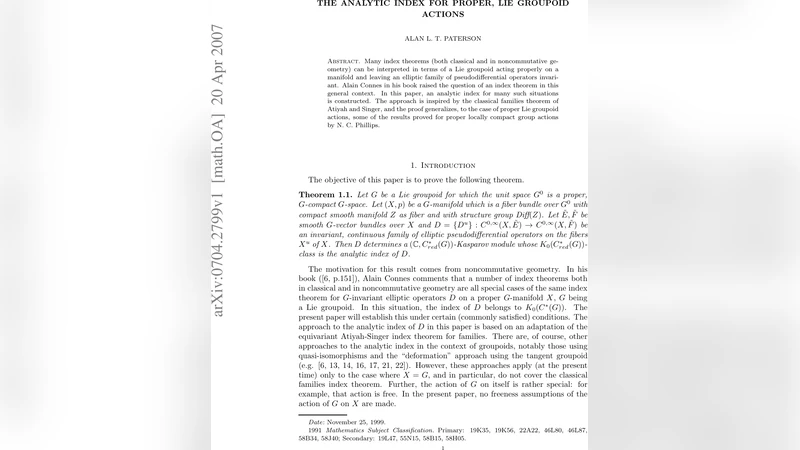
Many index theorems (both classical and in noncommutative geometry) can be interpreted in terms of a Lie groupoid acting properly on a manifold and leaving an elliptic family of pseudodifferential operators invariant. Alain Connes in his book raised the question of an index theorem in this general context. In this paper, an analytic index for many such situations is constructed. The approach is inspired by the classical families theorem of Atiyah and Singer, and the proof generalizes, to the case of proper Lie groupoid actions, some of the results proved for proper locally compact group actions by N. C. Phillips.
💡 Research Summary
The paper addresses a long‑standing question raised by Alain Connes: how to formulate an index theorem for a Lie groupoid that acts properly on a manifold while preserving an elliptic family of pseudodifferential operators. The author constructs an analytic index in this general setting, extending the classical families index theorem of Atiyah and Singer and generalizing results obtained by N. C. Phillips for proper actions of locally compact groups.
The work begins by fixing a Lie groupoid (G\rightrightarrows M) and a smooth manifold (X) on which (G) acts properly. An elliptic family ({P_x}_{x\in X}) is assumed to be (G)‑invariant, meaning that the principal symbols assemble into a continuous class in the quotient cotangent bundle (T^X/G). The central technical device is the reduced crossed‑product C(^)‑algebra (C_0(X)\rtimes_r G). The author shows that the invariant elliptic family determines a K‑theory class in (K_0(C_0(X)\rtimes_r G)) and that its principal symbol defines a class in (K^0(T^*X/G)).
Using the properness of the action, a regularizing measure on the groupoid is constructed, which allows one to define a “normalized” analytic index map
\
Comments & Academic Discussion
Loading comments...
Leave a Comment