Application of the equal dissipation rate principle to automatic generation of strut-and-tie models
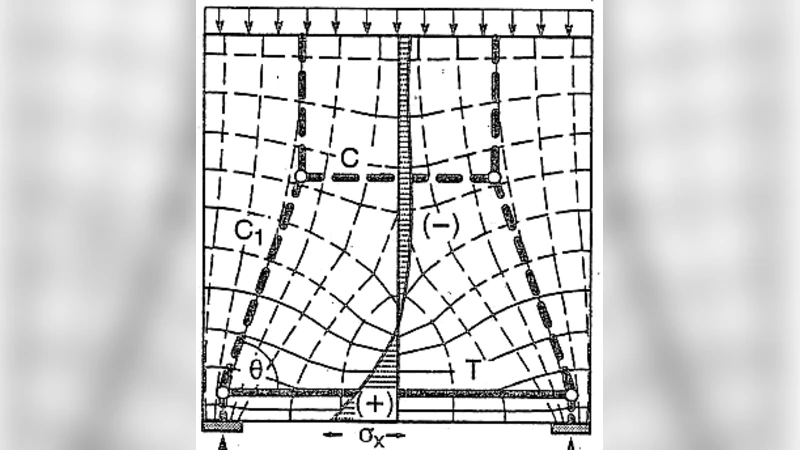
This work presents an extended formulation of maximal stiffness design, within the framework of the topology optimization. The mathematical formulation of the optimization problem is based on the postulated principle of equal dissipation rate during inelastic deformation. This principle leads to the enforcement of stress constraints in domains where inelastic deformation would occur. During the transition from the continuous structure to the truss-like one (strut-and-tie model) the dissipation rate is kept constant using the projected gradient method. The equal dissipation rate in the resulting truss and in the original continuous structure can be regarded as an equivalence statement and suggests an alternative understanding of physical motivation behind the strut-and-tie modeling. The performance of the proposed formulation is demonstrated with the help of two examples.
💡 Research Summary
The paper introduces a novel topology‑optimization framework that bridges continuous structural design and strut‑and‑tie (SAT) modeling through the principle of equal dissipation rate. Traditional topology optimization focuses on stiffness or mass objectives and typically neglects the inelastic behavior that dominates many engineering materials such as concrete. The authors argue that during plastic deformation the structure dissipates energy at a rate (\dot D = \sigma : \dot\varepsilon^p). By postulating that this dissipation rate must remain unchanged when the continuous design is transformed into a discrete truss‑like SAT model, they obtain a physically motivated constraint that directly enforces stress limits in regions where inelastic deformation would occur.
Mathematically, the continuous problem is expressed in terms of elastic strain energy (U) and dissipation rate (\dot D). The design variable (\rho(\mathbf{x})) (material density) is bounded between 0 and 1 and interpolates material stiffness via a SIMP‑type power law. The key constraint is (\dot D_{\text{cont}} = \dot D_{\text{truss}}), which is incorporated into a Lagrangian together with the usual equilibrium equations. By taking variations with respect to (\rho) and the stress field, the authors derive optimality conditions that contain both a stiffness‑maximization term and a term enforcing the dissipation‑rate equality.
To solve the resulting constrained optimization problem, a projected gradient method is employed. At each iteration the unconstrained gradient of the objective is corrected by the gradient of the dissipation‑rate constraint, scaled by a Lagrange multiplier, and then projected back onto the admissible set (
Comments & Academic Discussion
Loading comments...
Leave a Comment