The E-theoretic descent functor for groupoids
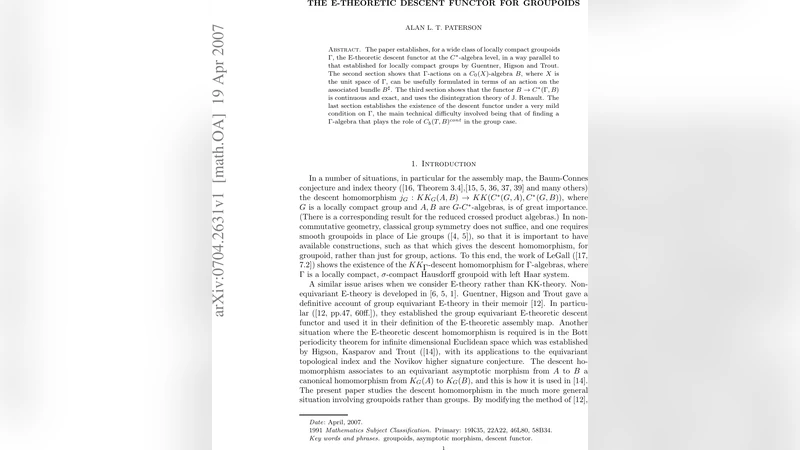
The paper establishes, for a wide class of locally compact groupoids $\Gamma$, the E-theoretic descent functor at the $C^{}$-algebra level, in a way parallel to that established for locally compact groups by Guentner, Higson and Trout. The second section shows that $\Gamma$-actions on a $C_{0}(X)$-algebra $B$, where $X$ is the unit space of $\Gamma$, can be usefully formulated in terms of an action on the associated bundle $B^{\sharp}$. The third section shows that the functor $B\to C^{}(\Gamma,B)$ is continuous and exact, and uses the disintegration theory of J. Renault. The last section establishes the existence of the descent functor under a very mild condition on $\Gamma$, the main technical difficulty involved being that of finding a $\Gamma$-algebra that plays the role of C_{b}(T,B)^{cont}$ in the group case.
💡 Research Summary
The paper extends the construction of the E‑theoretic descent functor, originally developed by Guentner, Higson and Trout for locally compact groups, to a broad class of locally compact groupoids. The author proceeds in four logically connected sections.
In the first part the author reviews the group case, where the key ingredient is the C*‑algebra C_b(T,B)^{cont} of bounded continuous functions on a parameter space T with values in a Γ‑algebra B. For a groupoid Γ, however, the presence of a unit space X and the fibrewise nature of the action prevent a direct translation of this construction. Consequently the paper introduces a new Γ‑algebra, denoted C_b^Γ(T,B), which plays the analogous role under the minimal hypotheses that Γ is locally compact, admits a Haar system, and has a second‑countable unit space.
The second section reformulates a Γ‑action on a C₀(X)‑algebra B in terms of an action on the associated bundle B♯ → X. By constructing an explicit isomorphism Φ : B → Γ₀(B♯) that respects both the C₀(X)‑module structure and the Γ‑action, the author shows that the action can be regarded as a fibrewise action on sections of B♯. This viewpoint makes it possible to apply Renault’s disintegration theorem: each Γ‑representation on B decomposes into a measurable field of *‑representations on the fibres B_x, and the groupoid action on each fibre coincides with the usual action of the isotropy group Γ_x.
The third part establishes two fundamental properties of the crossed‑product functor B ↦ C*(Γ,B). First, continuity: when B is expressed as an inductive limit of C₀(X)‑algebras, the corresponding crossed products form a compatible inductive system, and the limit of the system is naturally isomorphic to C*(Γ, lim B). Second, exactness: for any short exact sequence 0 → I → B → B/I → 0 of Γ‑algebras, the induced sequence 0 → C*(Γ,I) → C*(Γ,B) → C*(Γ,B/I) → 0 remains exact. The proof relies on the regularity of the groupoid representation and the measure‑theoretic consistency of the Haar system, together with Renault’s disintegration to reduce the problem to fibrewise exactness.
The final and most technical section constructs the replacement for C_b(T,B)^{cont}. The author chooses a standard parameter space T (for instance ℝ⁺ or
Comments & Academic Discussion
Loading comments...
Leave a Comment