Minimax State Observation in Linear One Dimensional 2-Point Boundary Value Problems
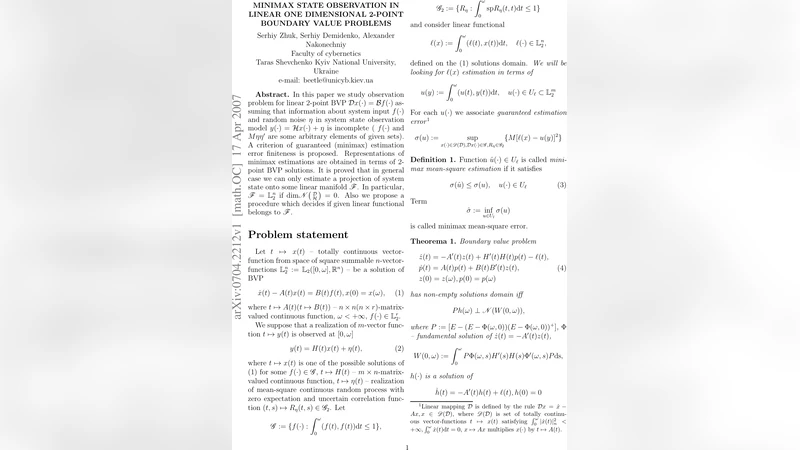
In this paper we study observation problem for linear 2-point BVP Dx=Bf assuming that information about system input f and random noise \eta in system state observation model y=Hx+\eta$ is incomplete (f and M\eta\eta’ are some arbitrary elements of given sets). A criterion of guaranteed (minimax) estimation error finiteness is proposed. Representations of minimax estimations are obtained in terms of 2-point BVP solutions. It is proved that in general case we can only estimate a projection of system state onto some linear manifold $F$. In particular, $F=L_2$ if $dim N(D H) = 0$. Also we propose a procedure which decides if given linear functional belongs to $F$.
💡 Research Summary
The paper addresses the problem of observing the state of a one‑dimensional linear two‑point boundary‑value problem (BVP) described by the differential equation (Dx = Bf) when the information about the system input (f) and the observation noise (\eta) is incomplete. The observation model is (y = Hx + \eta), where (H) is a known observation matrix. Instead of exact probability distributions, the input (f) and the covariance matrix of the noise (M_{\eta\eta}) are assumed to belong to given sets (\mathcal{F}) and (\mathcal{M}). Under this uncertainty the authors adopt a minimax (worst‑case) criterion: they seek an estimator (\hat{x}) that minimizes the maximum possible estimation error over all admissible (f) and (\eta).
The first major contribution is a necessary and sufficient condition for the finiteness of the guaranteed (minimax) estimation error. The condition is expressed in terms of the null‑space of the composite operator (DH). If the dimension of (N(DH)) is zero, i.e., (DH) is surjective, then the whole state (x) can be estimated with a finite worst‑case error. When (dim,N(DH) > 0), the components of (x) lying in this null‑space cannot be recovered; only the orthogonal projection of (x) onto a certain linear subspace (F\subset L_2) is observable. In the special case (dim,N(DH)=0) the observable subspace coincides with the whole (L_2) space.
The second contribution is an explicit representation of the minimax estimator in terms of solutions of a two‑point BVP. By introducing Lagrange multipliers for the constraints imposed by the observation model and the uncertainty sets, the minimax problem is transformed into the following system of equations:
\
Comments & Academic Discussion
Loading comments...
Leave a Comment