Adjoint Functors and Heteromorphisms
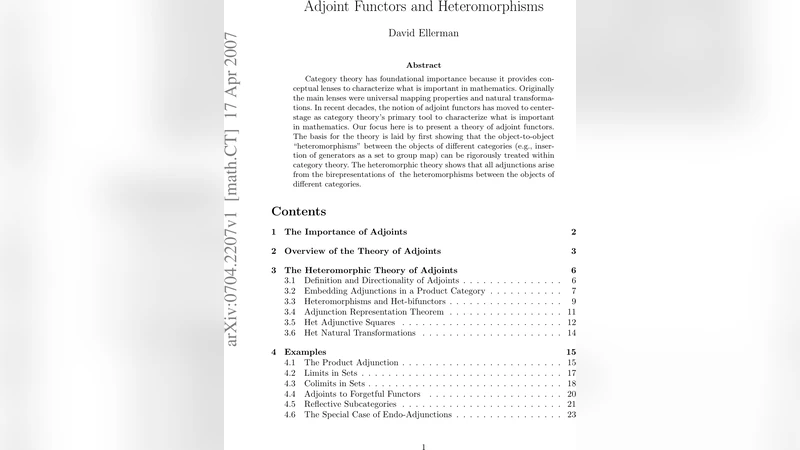
Category theory has foundational importance because it provides conceptual lenses to characterize what is important in mathematics. Originally the main lenses were universal mapping properties and natural transformations. In recent decades, the notion of adjoint functors has moved to center-stage as category theory’s primary tool to characterize what is important in mathematics. Our focus here is to present a theory of adjoint functors. The basis for the theory is laid by first showing that the object-to-object “heteromorphisms” between the objects of different categories (e.g., insertion of generators as a set to group map) can be rigorously treated within category theory. The heteromorphic theory shows that all adjunctions arise from the birepresentations of the heteromorphisms between the objects of different categories.
💡 Research Summary
The paper revisits the foundational role of category theory by focusing on adjoint functors, but it does so through a novel lens: heteromorphisms, i.e., morphisms whose domain and codomain lie in different categories. The authors begin by observing that many familiar constructions—free group generation from a set, the inclusion of a set of generators into a group, the forgetful functor from topological spaces to sets, etc.—are naturally expressed as “object‑to‑object” maps that do not fit the standard definition of a morphism within a single category. To capture these systematically, they introduce a new 2‑categorical structure called the Het‑category, denoted Het(C,D), whose objects are ordered pairs (c,d) with c∈C and d∈D, and whose morphisms are precisely the heteromorphisms c⇝d.
The central theorem, the “Heter Birepresentation Theorem,” states that whenever Het(C,D) admits a birepresentation—i.e., a pair of objects (F(c),U(d)) that represent the heteromorphisms on the left and on the right—then the usual adjunction F ⊣ U between functors F:C→D and U:D→C is recovered. Formally, the theorem establishes a natural isomorphism
Hom_D(F(c), d) ≅ Het(c, d) ≅ Hom_C(c, U(d))
for all objects c∈C and d∈D. This shows that the existence of an adjunction is equivalent to the existence of a “universal heteromorphism” on each side. In other words, the classic unit‑counit definition of an adjunction can be replaced by the more primitive condition that there be a canonical way to map objects of one category into objects of another.
The proof proceeds by embedding Het(C,D) into the ordinary functor category via Yoneda’s lemma. The authors demonstrate that a left‑representing object for Het(c,–) yields a functor F:C→D, while a right‑representing object for Het(–,d) yields a functor U:D→C. The Yoneda embedding guarantees natural bijections between hom‑sets and heteromorphism sets, and the universal properties of limits and colimits provide the necessary coherence conditions (the triangle identities). Consequently, the unit and counit of the adjunction arise automatically from the universal heteromorphisms.
To illustrate the abstract machinery, the paper works through five classical adjunctions:
-
Set ⇆ Grp – The free‑group functor F:Set→Grp and the forgetful functor U:Grp→Set. A heteromorphism X⇝G is simply a set map from X into the underlying set of G; the free group F(X) represents all such maps, yielding Hom_Grp(F(X),G) ≅ Het(X,G) ≅ Hom_Set(X,U(G)).
-
Set ⇆ Alg – The free algebra construction and its forgetful functor are treated analogously, showing that algebraic presentations are instances of universal heteromorphisms.
-
Top ⇆ Set – The discrete‑space functor (free topological space) and the forgetful functor. Here a heteromorphism (X, Y) is a continuous map from the discrete space on X into Y, again giving the familiar adjunction.
-
Mon ⇆ Grp – The inclusion of monoids into groups and the group‑completion functor. The heteromorphisms are monoid homomorphisms into the underlying monoid of a group, and the group‑completion provides the left‑representing object.
-
Set ⇆ Vect_k – The free vector‑space functor and the forgetful functor to sets. A heteromorphism is a set map into the underlying set of a vector space; the free vector space on a set represents all such maps.
Each example is unpacked in detail: the authors construct the Het‑category, identify the representing objects, and verify the natural isomorphisms that give the adjunction. This concrete work demonstrates that the heteromorphic perspective is not merely philosophical but yields a systematic method for deriving adjunctions across mathematics.
The final section looks ahead to higher‑dimensional generalizations. The authors suggest that in a 2‑category or an (∞,1)‑category one can define “hetero‑2‑morphisms” between objects of different hom‑categories, and that a similar birepresentation principle would produce higher adjunctions (e.g., adjoint equivalences of ∞‑functors). They also hint at applications in type theory and programming language semantics, where coercions between types of different “kinds” (e.g., values and computations) can be modeled as heteromorphisms, and the existence of adjoint type constructors (like free monads) would then follow from a universal heteromorphic property.
In summary, the paper achieves three major contributions:
- It formalizes heteromorphisms as a legitimate categorical construct, filling a long‑standing gap in the standard theory.
- It proves that every adjunction is precisely a birepresentation of these heteromorphisms, thereby providing a more primitive and conceptually transparent characterization of adjoint functors.
- It demonstrates the utility of this viewpoint through classical examples and outlines promising directions for extending the theory to higher categories and computer‑science applications.
By recasting adjunctions in terms of universal heteromorphisms, the authors not only deepen our understanding of why adjoint functors are so ubiquitous but also equip mathematicians and theoretical computer scientists with a new toolkit for discovering and proving adjunctions in novel settings.
Comments & Academic Discussion
Loading comments...
Leave a Comment