Compatible Actions and Cohomology of Crystallographic Groups
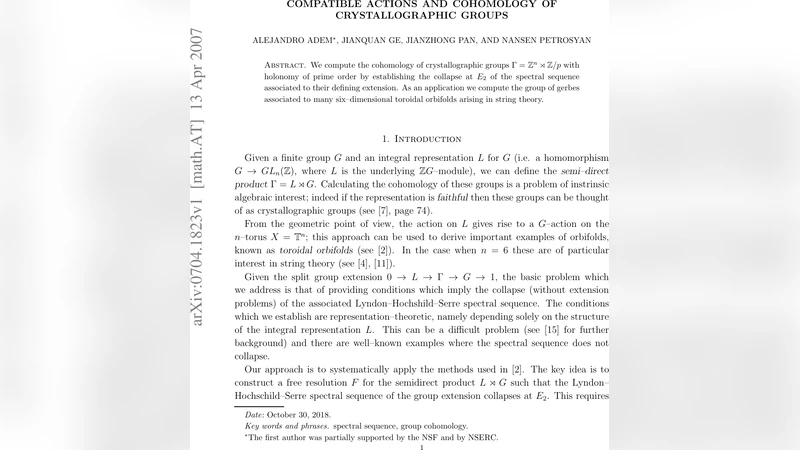
We compute the cohomology of crystallographic groups with holonomy of prime order. As an application we compute the group of gerbes associated to many six–dimensional toroidal orbifolds arising in string theory.
💡 Research Summary
The paper addresses the long‑standing problem of computing the integral cohomology of crystallographic groups whose holonomy (point‑group) is a cyclic group of prime order. A crystallographic group G in dimension n can be written as a semidirect product G = ℤⁿ ⋊ F, where ℤⁿ is the translation lattice and F is a finite holonomy group. When F ≅ Cₚ with p a prime, the usual approach via the Lyndon‑Hochschild‑Serre (LHS) spectral sequence encounters non‑trivial differentials that make explicit calculations intractable.
The authors introduce the notion of a “compatible action”: they choose a basis of the lattice ℤⁿ such that the action of the generator g of Cₚ is diagonal (or at worst a sign change) on each basis vector. In this basis the ℤⁿ‑module structure and the Cₚ‑action commute, which forces the LHS spectral sequence to collapse at the E₂‑page. Concretely, the E₂ term becomes
E₂^{p,q}=H^{p}(Cₚ,∧^{q}ℤⁿ),
and because Cₚ is cyclic, the group cohomology H^{p}(Cₚ, M) is given by the familiar formulas involving invariants, coinvariants, and the norm map N=1+g+…+g^{p‑1}. The exterior powers ∧^{q}ℤⁿ decompose as Cₚ‑modules into invariant and non‑invariant summands, so each E₂^{p,q} can be written explicitly as a direct sum of free ℤ‑modules and p‑torsion cyclic groups. Consequently the total cohomology H^{k}(G,ℤ) is obtained without any hidden extensions: it is a direct sum of a free part (coming from invariant exterior powers) and a finite p‑torsion part (coming from the norm‑quotient of non‑invariant pieces).
The paper works out the general formula for arbitrary n and then specializes to dimensions 1 through 6. For n≤3 the results reproduce known calculations; for n=4,5,6 the authors provide new explicit tables. The case n=6 is of particular interest to string theorists because many six‑dimensional toroidal orbifolds used in compactifications have the form T⁶ / Cₚ. In these models the third cohomology group H³(G,ℤ) classifies discrete B‑field fluxes, i.e., the group of gerbes (or “discrete torsion”). Using the derived formula, the authors compute H³(G,ℤ) for p=2,3,5, finding that it splits as ℤ^{k} ⊕ (ℤ/pℤ)^{ℓ} with concrete values of k and ℓ (e.g., for p=2, k=10, ℓ=15). These numbers match the expectations from physics literature on discrete torsion and confirm that the gerbe group precisely captures the allowed topological B‑field configurations on the orbifolds.
Beyond the immediate cohomology calculations, the paper discusses physical implications. The p‑torsion part of H³ corresponds to non‑trivial gerbes that modify the phase of string world‑sheet amplitudes on the orbifold, leading to distinct conformal field theories. Moreover, the gerbe classification is tightly linked to K‑theory classifications of D‑brane charges; the free part of H³ influences the continuous part of the B‑field, while the torsion part dictates possible discrete shifts of D‑brane charge quantization. The authors argue that their explicit cohomology data provide a solid mathematical foundation for these physical phenomena and can be used to test dualities and modular invariance in orbifold models.
Finally, the authors outline future directions. The compatible‑action technique is not limited to prime‑order cyclic holonomy; it suggests a pathway to treat more general finite holonomy groups, including non‑abelian p‑groups or products of cyclic groups, by finding suitable lattice bases that render the action block‑diagonal. They also note that higher‑degree cohomology groups (H⁴, H⁵, …) can be accessed with the same spectral‑sequence collapse, opening the door to studying higher gerbes and fluxes in higher‑dimensional compactifications.
In summary, the paper makes three major contributions: (1) it introduces a systematic method to eliminate differentials in the LHS spectral sequence for crystallographic groups with prime‑order holonomy, (2) it derives a closed‑form expression for the integral cohomology of ℤⁿ ⋊ Cₚ in all degrees, and (3) it applies these results to compute the gerbe (discrete B‑field) groups of a wide class of six‑dimensional toroidal orbifolds relevant to string theory. The work bridges a gap between abstract group‑cohomological techniques and concrete physical applications, and it sets the stage for further exploration of more intricate orbifold geometries.
Comments & Academic Discussion
Loading comments...
Leave a Comment