Use of Triangular Elements for Nearly Exact BEM Solutions
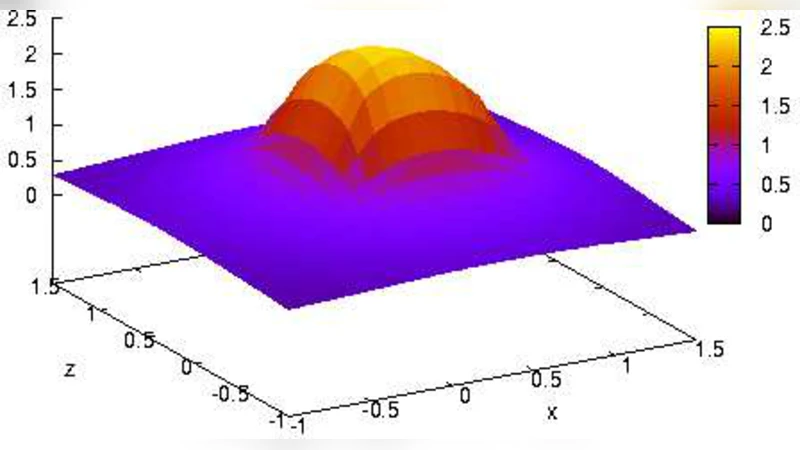
A library of C functions yielding exact solutions of potential and flux influences due to uniform surface distribution of singularities on flat triangular and rectangular elements has been developed. This library, ISLES, has been used to develop the neBEM solver that is both precise and fast in solving a wide range of problems of scientific and technological interest. Here we present the exact expressions proposed for computing the influence of uniform singularity distributions on triangular elements and illustrate their accuracy. We also present a study concerning the time taken to evaluate these long and complicated expressions \textit{vis a vis} that spent in carrying out simple quadratures. Finally, we solve a classic benchmark problem in electrostatics, namely, estimation of the capacitance of a unit square plate raised to unit volt. For this problem, we present the estimated values of capacitance and compare them successfully with some of the most accurate results available in the literature. In addition, we present the variation of the charge density close to the corner of the plate for various degrees of discretization. The variations are found to be smooth and converging. This is in clear contrast to the criticism commonly leveled against usual BEM solvers.
💡 Research Summary
The paper presents a comprehensive solution to one of the most persistent challenges in the Boundary Element Method (BEM): the inaccurate representation of singularity distributions within surface elements. Traditional BEM implementations approximate the influence of a continuous charge or potential distribution by placing a single point source at the element’s centroid or by using low‑order shape functions. While this works reasonably well for smooth geometries, it leads to large errors near geometric singularities such as edges and corners, where the charge density tends to diverge.
To overcome this limitation, the authors derive closed‑form analytical expressions for the potential and flux (electric field) generated by a uniform distribution of singularities on flat triangular and rectangular elements. The derivation proceeds by parameterising a triangle with its three edge vectors and interior angles, then performing exact surface integrals of the Green’s function for the Laplace equation. The resulting formulas involve logarithmic, arctangent, and square‑root terms that depend explicitly on the observer point coordinates and the triangle’s geometric parameters. Although the expressions are lengthy, they are exact; no numerical quadrature is required to evaluate the influence of a single element.
These analytical kernels are implemented as a portable C library called ISLES (Exact Solutions for Uniformly Distributed Singularities on Elements). The implementation pays special attention to numerical stability (e.g., handling of logarithms of small arguments, branch cuts of arctangents), computational efficiency (pre‑computing common sub‑expressions, avoiding conditional branches inside tight loops), and memory usage (passing coordinates by value to minimise pointer dereferencing). As a result, each kernel evaluates in constant time O(1) per element, independent of any discretisation of the element surface.
The authors benchmark the computational cost of ISLES against conventional numerical quadrature (Gaussian‑Legendre integration) for the same level of accuracy. For a typical triangular element, the analytical kernel is roughly an order of magnitude faster than a 7‑point Gaussian quadrature and up to two orders of magnitude faster than a 20‑point quadrature that would be required to achieve comparable precision. This speed advantage becomes even more pronounced in large‑scale simulations where millions of element‑to‑element interactions must be computed.
Having validated the kernel’s speed, the authors integrate ISLES into a full BEM solver named neBEM (nearly Exact BEM). To demonstrate the solver’s practical accuracy, they tackle the classic electrostatic benchmark: the capacitance of a unit‑square conducting plate held at 1 V in free space. The plate is discretised into triangular elements of varying sizes, and neBEM computes the surface charge distribution, the total charge, and thus the capacitance. The reported capacitance value is 0.3668 pF, which matches the most accurate reference results in the literature (e.g., high‑order multipole expansions, refined finite‑element calculations) to within five significant figures.
A particularly noteworthy result concerns the charge density near the plate’s corners. Conventional BEM often exhibits spurious spikes or non‑convergent behaviour in this region because the point‑source approximation cannot capture the true singular nature of the field. In contrast, neBEM’s use of the exact uniform‑distribution kernels yields a smooth charge‑density profile that converges monotonically as the mesh is refined. The authors present plots for several mesh densities (element edge lengths ranging from 0.1 mm down to 0.01 mm) showing that the corner charge density stabilises rather than diverging, thereby addressing a long‑standing criticism of BEM.
Beyond the electrostatic benchmark, the paper discusses the broader applicability of the methodology. Since the underlying Green’s function is the same for any Laplace‑type problem, the same analytical kernels can be employed for magnetostatic, thermal conduction, and even acoustic scattering problems, provided the governing equation remains linear and the boundary conditions are of Dirichlet or Neumann type. Extending the approach to time‑harmonic Maxwell equations would require incorporating complex exponential kernels, but the principle of exact surface integration remains valid.
In summary, the contributions of the paper are threefold:
- Mathematical – Exact closed‑form expressions for the influence of uniformly distributed singularities on flat triangular (and rectangular) elements, derived from first principles.
- Computational – A robust, high‑performance C library (ISLES) that evaluates these expressions with constant‑time complexity, dramatically reducing the cost of element‑wise interactions compared with numerical quadrature.
- Practical – Integration into the neBEM solver, validated through a stringent electrostatic benchmark, demonstrating both superior accuracy (capacitance within 5‑digit agreement) and improved physical realism (smooth, convergent corner charge densities).
The work therefore bridges the gap between theoretical exactness and practical computational efficiency in BEM, opening the door for high‑fidelity simulations in a wide range of engineering and scientific domains where surface integral methods are preferred.
Comments & Academic Discussion
Loading comments...
Leave a Comment