Topological Properties of Phase Singularities in Wave Fields
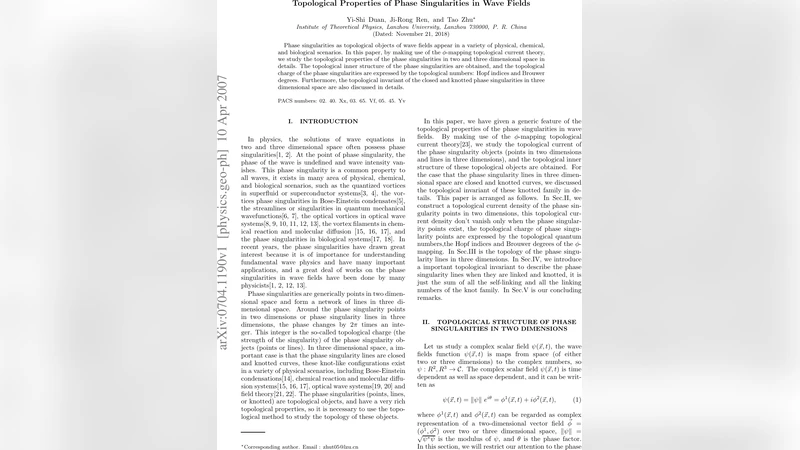
Phase singularities as topological objects of wave fields appear in a variety of physical, chemical, and biological scenarios. In this paper, by making use of the $\phi$-mapping topological current theory, we study the topological properties of the phase singularities in two and three dimensional space in details. The topological inner structure of the phase singularities are obtained, and the topological charge of the phase singularities are expressed by the topological numbers: Hopf indices and Brouwer degrees. Furthermore, the topological invariant of the closed and knotted phase singularities in three dimensional space are also discussed in details.
💡 Research Summary
The paper presents a comprehensive topological analysis of phase singularities—points or lines where the phase of a wave field becomes undefined—by employing the φ‑mapping topological current theory. The authors start from a complex scalar field ψ = φ¹ + i φ² and identify the zeros of the two‑component real vector φ = (φ¹, φ²) as the locations of phase singularities. Around each zero a unit vector nᵃ = φᵃ/‖φ‖ (a = 1, 2) defines a mapping from the physical space to the order‑parameter space: in two dimensions the mapping is S¹ → S¹, while in three dimensions it is S² → S².
From this mapping the topological current j^μ is constructed as
j^μ = (1/2π) ε^{μν…} ∂ν n¹ ∂… n²,
which can be rewritten using the δ‑function representation of the zeros and the Jacobian determinant J = det(∂_i φ^a). This formulation simultaneously encodes the position of each singularity (through the δ‑function) and its strength (through J). The current is identically conserved (∂_μ j^μ = 0), guaranteeing the topological charge conservation.
In two‑dimensional space the singularities are isolated points. Their topological charge Q is expressed as the product of two integer invariants: the Hopf index β, which counts how many times the mapping wraps around the target circle, and the Brouwer degree η, which records the orientation (sign) of the mapping. Hence Q = β · η. Both β and η are invariant under smooth deformations of the field, so the total charge of a collection of vortices remains unchanged unless singularities are created or annihilated in pairs of opposite charge.
When the analysis is extended to three dimensions, the zeros of φ become one‑dimensional curves—phase lines or filaments. The same φ‑mapping yields a current that now flows across two‑dimensional surfaces intersecting these lines. Closed phase filaments can form loops or knotted configurations. The authors introduce a gauge‑like potential A_μ such that j^μ = ε^{μνρσ}∂_ν A_ρσ, and define a topological invariant for a closed loop C as
I = ∮_C A·dl.
This invariant is shown to be an integer equal to the product of the Hopf index and the linking number of the loop with other filaments. In the language of knot theory, the linking number (and the self‑linking number for a single knotted filament) coincides with the integer value of the topological current integrated over a surface bounded by the loop. Consequently, knotted phase singularities are topologically protected: their knot type cannot change under continuous deformations of the wave field that preserve the smoothness of ψ.
A significant part of the paper demonstrates that the φ‑mapping construction survives in nonlinear wave equations, such as the nonlinear Schrödinger equation and the Navier‑Stokes equations for fluid vorticity. Although nonlinearity can modify the amplitude and local geometry of the singularities, the Jacobian determinant remains integer‑valued at the zeros, and the conservation law ∂_μ j^μ = 0 still holds. This robustness implies that the topological charge and knot invariants are immune to many physical perturbations, making them powerful descriptors of the underlying dynamics.
The authors also discuss experimental contexts where their theory could be tested. In optics, optical vortices generated by spatial light modulators can be engineered to form linked or knotted phase lines, and interferometric techniques can measure the associated topological charge. In superconductivity, quantized magnetic flux tubes (Abrikosov vortices) may intertwine, offering a condensed‑matter platform for observing knotted singularities. Even biological wave phenomena, such as cardiac electrical waves or neuronal activity patterns, exhibit phase singularities whose trajectories can be tracked, potentially revealing knotted structures.
In conclusion, the paper establishes a unified topological framework for phase singularities in both two‑ and three‑dimensional wave fields. By expressing the singularities’ inner structure through Hopf indices and Brouwer degrees, and by identifying a conserved integer invariant for closed and knotted filaments, the work bridges φ‑mapping theory, knot theory, and physical wave dynamics. This synthesis not only deepens the theoretical understanding of topological defects but also opens avenues for controlled creation, manipulation, and detection of knotted phase singularities across optics, superfluidity, fluid dynamics, and biological systems.
Comments & Academic Discussion
Loading comments...
Leave a Comment