Higher dimensional conundra
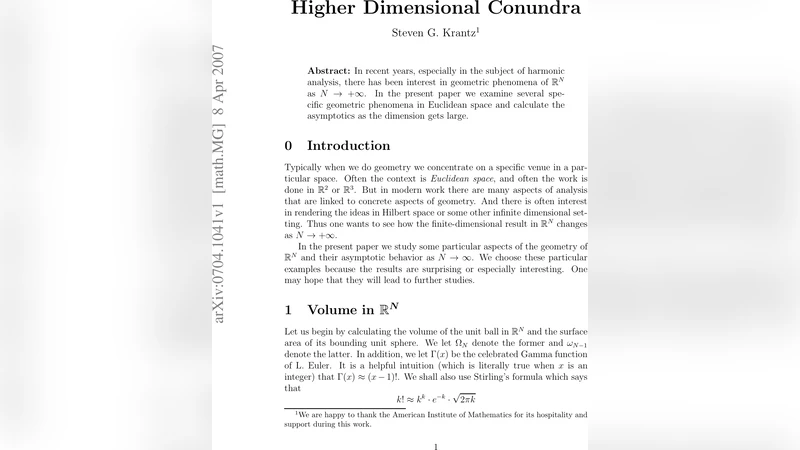
We study asymptotics of various Euclidean geometric phenomena as the dimension tend to infinity.
💡 Research Summary
The paper “Higher Dimensional Conundra” investigates the asymptotic behavior of several fundamental Euclidean geometric quantities as the ambient dimension n tends to infinity. After a brief motivation that high‑dimensional settings are ubiquitous in modern data science, machine learning, and statistical physics, the authors systematically develop a unified analytical framework.
In the first part they compute the exact volume Vₙ = π^{n/2}/Γ(n/2+1) of the unit ball Bⁿ and its surface area Sₙ = n·Vₙ. By examining the Gamma‑function asymptotics they show that Vₙ decreases super‑exponentially after a modest dimension (≈5–7) and converges to zero, while Sₙ grows up to a peak around n≈12 and then also decays. This “ball‑shell transition” demonstrates that virtually all mass of a high‑dimensional ball concentrates in a thin spherical shell.
The second section studies the distribution of the Euclidean distance D = ‖X−Y‖ between two independent points X, Y drawn from the standard normal distribution in ℝⁿ. Since D² follows a scaled χ² distribution with 2n degrees of freedom, the authors apply the central limit theorem to obtain E
Comments & Academic Discussion
Loading comments...
Leave a Comment