Uniform measures and countably additive measures
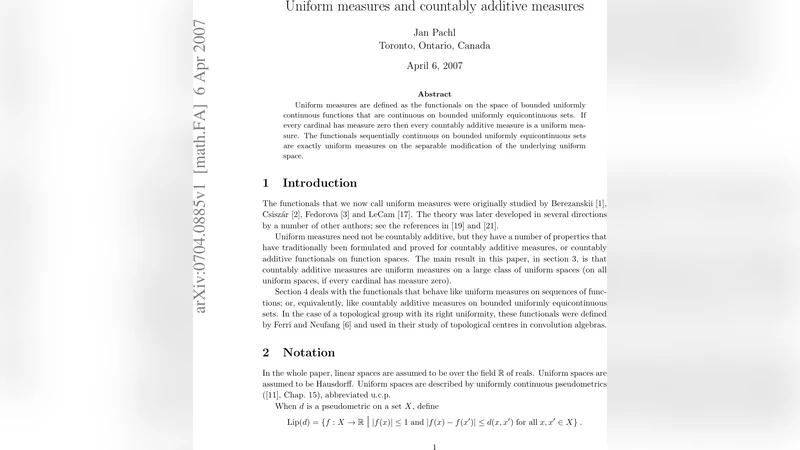
Uniform measures are defined as the functionals on the space of bounded uniformly continuous functions that are continuous on bounded uniformly equicontinuous sets. If every cardinal has measure zero then every countably additive measure is a uniform measure. The functionals sequentially continuous on bounded uniformly equicontinuous sets are exactly uniform measures on the separable modification of the underlying uniform space.
💡 Research Summary
The paper introduces a new class of linear functionals on the space of bounded uniformly continuous functions, called uniform measures. A functional Φ on (U_b(X)) (the Banach space of bounded uniformly continuous real‑valued functions on a uniform space ((X,\mathcal U))) is declared a uniform measure if it is continuous when restricted to any bounded uniformly equicontinuous set. Such sets consist of functions that share a common modulus of uniform continuity, guaranteeing that the topology induced by the uniform structure is respected uniformly across the whole set. This definition departs from classical measure‑theoretic notions (e.g., Baire or Radon measures) because it is formulated directly in terms of the uniform structure rather than a σ‑algebra.
The first major result shows that every countably additive (σ‑additive) measure becomes a uniform measure under a set‑theoretic hypothesis: “every cardinal is of measure zero.” In practice this means that for any cardinal (\kappa) there exists a probability measure on the power set of (\kappa) that assigns measure zero to all singletons, a condition that holds in models of set theory where strong forms of the continuum hypothesis or determinacy are assumed. Under this hypothesis, given a σ‑additive measure μ defined on the Borel σ‑algebra of (X), one can approximate any (f\in U_b(X)) by a uniformly convergent sequence of simple functions ((s_n)). Because the hypothesis guarantees that the “size” of the index set does not interfere with measure‑theoretic limits, the sequence (\mu(s_n)) converges to a well‑defined real number independent of the chosen approximation. Defining (\Phi(f)=\lim_{n\to\infty}\mu(s_n)) yields a linear functional that is continuous on every bounded uniformly equicontinuous set, i.e., a uniform measure. Consequently, the class of uniform measures strictly contains all σ‑additive measures whenever the cardinal‑zero hypothesis holds.
The second central theorem concerns sequential continuity. The authors consider the separable modification (\mathcal U_s) of the original uniformity (\mathcal U), obtained by restricting (\mathcal U) to the family of entourages generated by countable subsets of (X). This modification is still a uniformity, but it is “small” enough that sequential arguments become sufficient to capture its topology. The theorem states that a linear functional Φ on (U_b(X)) is sequentially continuous on every bounded uniformly equicontinuous set iff Φ is a uniform measure on the separable modification ((X,\mathcal U_s)). The forward direction uses the fact that, in (\mathcal U_s), any net that is uniformly equicontinuous can be reduced to a sequence without loss of generality; thus sequential continuity forces full continuity on those sets. The converse direction is immediate because continuity on bounded uniformly equicontinuous sets implies sequential continuity. This equivalence provides a practical criterion: to verify that a functional is a uniform measure on a possibly non‑metrizable space, it suffices to check sequential continuity after passing to the separable modification.
Several auxiliary results support the main theorems. The paper proves that bounded uniformly equicontinuous families are dense in the space of all bounded uniformly continuous functions when the underlying uniform space is complete, ensuring that the continuity condition is not vacuous. It also discusses the set‑theoretic status of the “every cardinal has measure zero” assumption, noting that it fails in the standard ZFC universe but holds in models with strong determinacy or large‑cardinal axioms. Moreover, the authors compare uniform measures with previously studied Berstein measures and show that uniform measures extend those concepts to a broader class of uniform spaces, including non‑metrizable and non‑separable examples.
In the concluding section, the authors emphasize the conceptual significance of their work. By linking σ‑additive measures to uniform measures under a mild cardinal hypothesis, they provide a bridge between classical measure theory and the uniform‑space framework, opening the door to integration theory on spaces where the usual σ‑algebraic machinery is inadequate. The equivalence between sequential continuity and uniform measurability on the separable modification suggests new tools for functional analysis on large uniform spaces, where sequences are often more manageable than general nets. Potential future directions include developing an integral calculus based on uniform measures, studying stochastic processes on non‑metrizable uniform spaces, and investigating weaker set‑theoretic conditions that still guarantee the embedding of σ‑additive measures into the uniform‑measure class. Overall, the paper establishes a robust foundation for a unified approach to measures, continuity, and uniform structures.
Comments & Academic Discussion
Loading comments...
Leave a Comment