An architecture-based dependability modeling framework using AADL
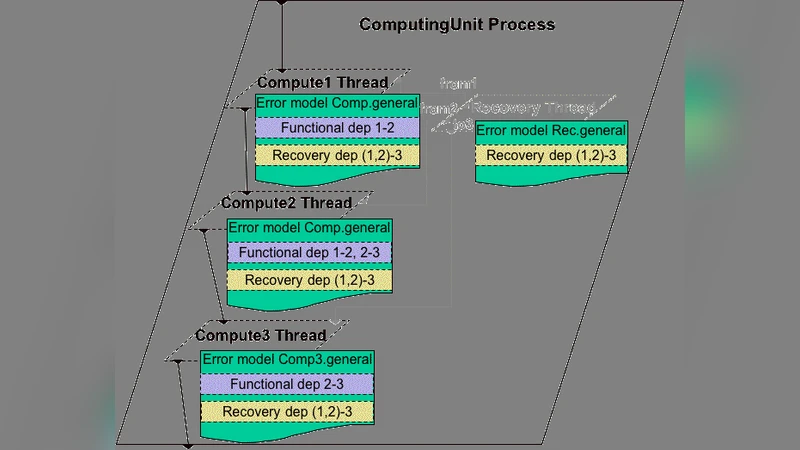
For efficiency reasons, the software system designers’ will is to use an integrated set of methods and tools to describe specifications and designs, and also to perform analyses such as dependability, schedulability and performance. AADL (Architecture Analysis and Design Language) has proved to be efficient for software architecture modeling. In addition, AADL was designed to accommodate several types of analyses. This paper presents an iterative dependency-driven approach for dependability modeling using AADL. It is illustrated on a small example. This approach is part of a complete framework that allows the generation of dependability analysis and evaluation models from AADL models to support the analysis of software and system architectures, in critical application domains.
💡 Research Summary
The paper introduces a comprehensive framework that leverages the Architecture Analysis and Design Language (AADL) for dependability modeling, focusing on an iterative, dependency‑driven methodology. The authors begin by highlighting the growing need for integrated toolchains that can simultaneously capture system specifications, architectural designs, and perform critical analyses such as reliability, schedulability, and performance. While AADL has been widely adopted for architectural description and performance evaluation, its potential for systematic dependability analysis remains underexploited.
To address this gap, the authors propose a step‑by‑step process that starts with a conventional AADL model of the system’s components and connectors. Using the Error Model Annex, each component is enriched with fault states, error transitions, and recovery actions. Crucially, the framework defines explicit dependency mappings that describe how a fault in one component propagates to others, thereby constructing a directed dependency graph that captures both direct and indirect error propagation paths.
The next phase involves automated extraction of this dependency information. A dedicated transformation engine parses the AADL XML representation, extracts the error models, and assembles a dependency matrix. Consistency checks are performed to detect cyclic dependencies, missing links, or contradictory fault specifications. Once validated, the matrix is used to generate quantitative dependability models—such as Continuous‑time Markov Chains (CTMC), Reliability Block Diagrams (RBD), or Fault Trees—tailored to the analysis tool of choice (e.g., PRISM, SHARPE, or MATLAB). The generated models preserve the hierarchical structure of the original AADL design, enabling traceability from high‑level architectural decisions down to low‑level reliability metrics.
To demonstrate feasibility, the authors apply the framework to a small but representative case study: a simplified unmanned aerial vehicle (UAV) flight‑control system. The system comprises sensors, a data‑fusion processor, a control actuator, and a communication interface. Fault rates, mean time to repair, and propagation probabilities are assigned based on typical aerospace data. The transformation engine produces a CTMC model, which is then analyzed using PRISM to compute system availability, mean time to failure, and the impact of specific component failures on overall mission success. The results reveal that certain composite failure scenarios—such as a sensor fault that triggers erroneous data processing and subsequently leads to actuator mis‑command—are captured only when the explicit dependency mappings are considered. This illustrates the added diagnostic power of the approach compared with traditional component‑wise reliability assessments.
The paper also discusses the benefits and limitations of the proposed methodology. Advantages include early‑stage dependability verification, reduction of manual modeling effort through automation, and the ability to iterate rapidly as design changes occur. The approach integrates naturally into Model‑Based Development (MBD) workflows, supporting continuous validation of reliability requirements throughout the development lifecycle. However, the authors acknowledge scalability challenges: as system size grows, the dependency graph can become dense, potentially leading to state‑space explosion in the generated Markov models. They suggest future work on graph reduction techniques, hierarchical abstraction, and the incorporation of alternative dependability formalisms such as Bayesian networks or fuzzy logic to mitigate this issue.
In the concluding section, the authors outline several research directions. First, they propose extending the framework to support dynamic reconfiguration and runtime dependability assessment for real‑time systems. Second, they aim to develop interoperability bridges between AADL and other architectural description languages like SysML, enabling cross‑domain model exchange. Third, they plan to integrate automated verification tools (e.g., model checkers) to provide formal guarantees about the correctness of the dependency specifications themselves. Finally, they envision a full end‑to‑end toolchain that starts from high‑level AADL models, proceeds through automated transformation, performs quantitative analysis, and feeds the results back into design decisions, thereby closing the loop between architecture and dependability engineering.
Overall, the paper makes a compelling case that AADL, when enriched with explicit error models and systematic dependency extraction, can serve as a unified platform for both architectural design and rigorous dependability analysis. This integration promises to streamline the development of safety‑critical systems, reduce engineering effort, and improve the fidelity of reliability predictions early in the design process.
Comments & Academic Discussion
Loading comments...
Leave a Comment