On the KK-theory of strongly self-absorbing C*-algebras
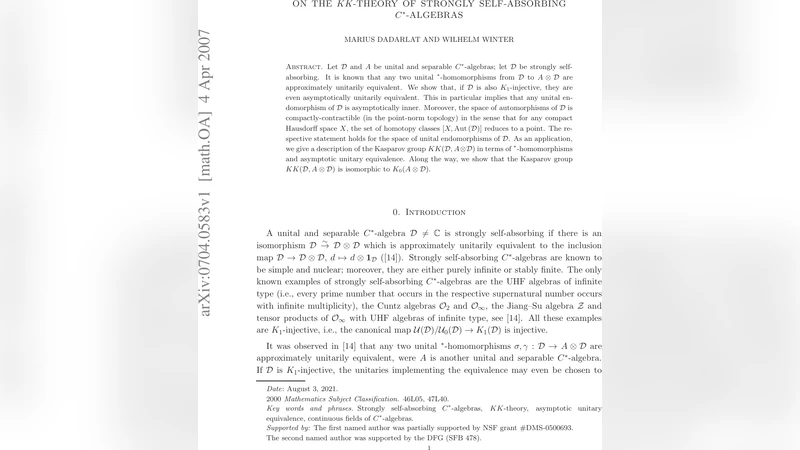
Let $\Dh$ and $A$ be unital and separable $C^{}$-algebras; let $\Dh$ be strongly self-absorbing. It is known that any two unital $^$-homomorphisms from $\Dh$ to $A \otimes \Dh$ are approximately unitarily equivalent. We show that, if $\Dh$ is also $K_{1}$-injective, they are even asymptotically unitarily equivalent. This in particular implies that any unital endomorphism of $\Dh$ is asymptotically inner. Moreover, the space of automorphisms of $\Dh$ is compactly-contractible (in the point-norm topology) in the sense that for any compact Hausdorff space $X$, the set of homotopy classes $[X,\Aut(\Dh)]$ reduces to a point. The respective statement holds for the space of unital endomorphisms of $\Dh$. As an application, we give a description of the Kasparov group $KK(\Dh, A\ot \Dh)$ in terms of $^*$-homomorphisms and asymptotic unitary equivalence. Along the way, we show that the Kasparov group $KK(\Dh, A\ot \Dh)$ is isomorphic to $K_0(A\ot \Dh)$.
💡 Research Summary
The paper investigates the interaction between strongly self‑absorbing C*-algebras and Kasparov’s bivariant K‑theory. Let 𝔇 be a unital, separable, strongly self‑absorbing C*-algebra and let A be any unital separable C*-algebra. It is already known that any two unital ‑homomorphisms φ,ψ:𝔇→A⊗𝔇 are approximately unitarily equivalent (AUE); that is, there exists a sequence of unitaries uₙ∈A⊗𝔇 with φ(d)≈uₙψ(d)uₙ for every d∈𝔇. The new contribution is to strengthen this equivalence to asymptotic unitary equivalence under the additional hypothesis that 𝔇 is K₁‑injective (the natural map K₁(𝔇)→U(𝔇)/U₀(𝔇) is injective).
The authors construct a continuous path of unitaries uₜ (t≥0) such that \
Comments & Academic Discussion
Loading comments...
Leave a Comment