Origin of adaptive mutants: a quantum measurement?
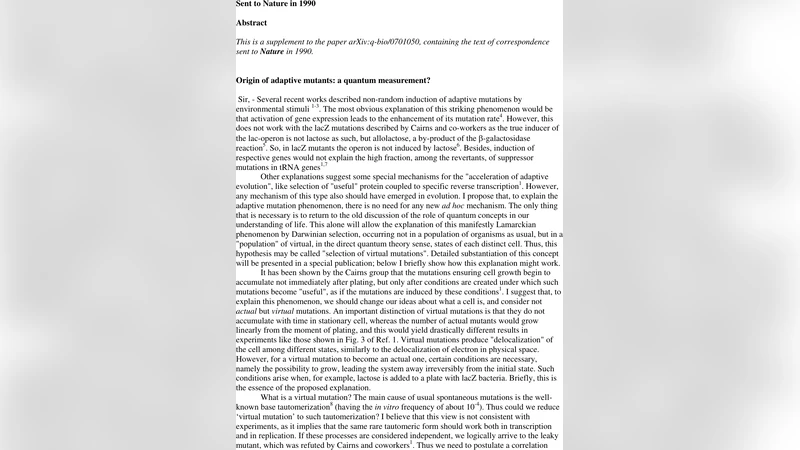
This is a supplement to the paper arXiv:q-bio/0701050, containing the text of correspondence sent to Nature in 1990.
💡 Research Summary
The correspondence sent to Nature in 1990 revisits the controversial phenomenon of adaptive mutation—most famously demonstrated by Cairns and colleagues in Escherichia coli grown under nutrient‑limited conditions. In those experiments, mutations that restore the ability to metabolize a missing nutrient appear at a rate far higher than would be expected from classical random mutation models, suggesting that the environment somehow directs genetic change. Traditional explanations—stress‑induced mutagenesis, transcription‑coupled repair errors, or fluctuations in DNA‑repair fidelity—have been invoked, yet none fully captures the temporal and spatial specificity observed in the data.
The author proposes a radical reinterpretation: the adaptive mutation process can be viewed as a quantum measurement. In quantum mechanics, a measurement is an interaction between a system and an observer that collapses a superposed wavefunction into a definite outcome. Translating this to biology, the bacterial population constitutes the quantum system, while the nutrient‑limited environment acts as the observer. When the environment “measures” a particular metabolic pathway (by demanding its product), the corresponding genetic locus undergoes a quantum‑like collapse into a mutant state that satisfies the demand. This collapse is not governed by classical probabilities but by the interference of probability amplitudes, offering a mechanistic route for environmentally biased mutation.
Two quantum‑mechanical mechanisms are highlighted. First, decoherence: the intracellular milieu is a hot, noisy bath that rapidly destroys quantum coherence. Once a mutant state has been selected, decoherence forces the system into a classical regime, after which conventional genetics takes over. Second, entanglement: the author speculates that cells within a colony might not be independent entities but components of a larger, entangled quantum state. In such a scenario, a single environmental trigger could induce a coordinated “collapse” across many cells, leading to simultaneous emergence of the same adaptive mutation—a form of cooperative adaptation that would be impossible under purely stochastic models.
The correspondence situates this hypothesis within the broader field of quantum biology. It cites experimental evidence for quantum coherence in photosynthetic antenna complexes, tunnelling in enzyme catalysis, and even charge transport along DNA, all of which demonstrate that quantum effects can survive in warm, wet biological environments. By analogy, the author argues that adaptive mutation could be another manifestation of quantum phenomena influencing biology at the molecular level.
Future research directions are outlined. One line of inquiry involves deliberately modulating the environmental “measurement”—for example, by abrupt nutrient shifts or by applying fields that either suppress or enhance entanglement—to quantify changes in mutation rates. Another proposes the development of non‑invasive spectroscopic techniques capable of detecting coherent electronic or vibrational states in living cells, thereby providing direct evidence of quantum superpositions preceding mutation events. A third avenue suggests employing quantum information theory to calculate the theoretical probability distribution of mutation outcomes and comparing these predictions with empirical data.
In summary, the 1990 Nature correspondence offers a bold, interdisciplinary framework that links adaptive mutation to the physics of quantum measurement. While experimental validation remains limited, the rapid advancement of single‑cell manipulation, ultrafast spectroscopy, and quantum‑control technologies makes the hypothesis increasingly testable. If confirmed, this perspective would reshape our understanding of microbial evolution, positioning quantum mechanics not merely as a background theory but as an active driver of genetic change under selective pressure.
Comments & Academic Discussion
Loading comments...
Leave a Comment