Realizable Paths and the NL vs L Problem
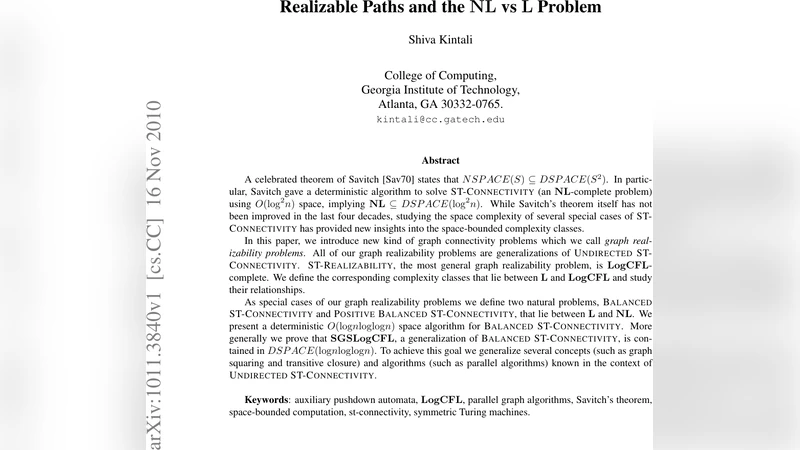
A celebrated theorem of Savitch states that NSPACE(S) is contained in DSPACE(S^2). In particular, Savitch gave a deterministic algorithm to solve ST-CONNECTIVITY (an NL-complete problem) using O(log^2{n}) space, implying NL is in DSPACE(log^2{n}). While Savitch’s theorem itself has not been improved in the last four decades, studying the space complexity of several special cases of ST-CONNECTIVITY has provided new insights into the space-bounded complexity classes. In this paper, we introduce new kind of graph connectivity problems which we call graph realizability problems. All of our graph realizability problems are generalizations of UNDIRECTED ST-CONNECTIVITY. ST-REALIZABILITY, the most general graph realizability problem, is LogCFL-complete. We define the corresponding complexity classes that lie between L and LogCFL and study their relationships. As special cases of our graph realizability problems we define two natural problems, BALANCED ST-CONNECTIVITY and POSITIVE BALANCED ST-CONNECTIVITY, that lie between L and NL. We present a deterministic O(lognloglogn) space algorithm for BALANCED ST-CONNECTIVITY. More generally we prove that SGSLogCFL, a generalization of BALANCED ST-CONNECTIVITY, is contained in DSPACE(lognloglogn). To achieve this goal we generalize several concepts (such as graph squaring and transitive closure) and algorithms (such as parallel algorithms) known in the context of UNDIRECTED ST-CONNECTIVITY.
💡 Research Summary
The paper introduces a new family of graph connectivity problems called “graph realizability problems” and uses them to explore the space‑bounded complexity landscape between L and LogCFL. In the most general form, ST‑REALIZABILITY, each vertex of a directed graph carries a label and a set of label‑conversion rules is given. A path from s to t is “realizable” if the label at s can be transformed into the label at t by repeatedly applying the conversion rules along the edges. By encoding arbitrary context‑free languages in the conversion rules, the authors show that ST‑REALIZABILITY is LogCFL‑complete. This places the problem strictly above NL (which is LogCFL‑hard) but still well below P, providing a natural problem that sits between the classic NL‑complete ST‑CONNECTIVITY and the higher class LogCFL.
From this general framework the authors extract two natural special cases that lie between L and NL. In BALANCED ST‑CONNECTIVITY each vertex is assigned either +1 or –1. A path is acceptable only if the cumulative sum of the signs never deviates from zero – i.e., the path is perfectly balanced. This extra arithmetic constraint makes the problem harder than ordinary undirected ST‑CONNECTIVITY, yet the authors prove it can be solved deterministically using only O(log n log log n) space. The key technique is an iterative graph‑squaring process that compresses two‑step paths while preserving the balance information. At each squaring step the balance of a sub‑path can be represented with O(log n) bits, and the whole algorithm proceeds through O(log log n) squaring rounds, yielding the claimed space bound.
POSITIVE BALANCED ST‑CONNECTIVITY strengthens the previous problem by demanding that the running sum never becomes negative. This “non‑negative” condition is reminiscent of a stack‑based depth‑first search, but the authors show that the stack depth can be kept logarithmic by encoding the stack’s state compactly. A careful simulation of the stack together with the balance check again fits into O(log n log log n) space.
Both special cases are subsumed by a more general class called SGSLogCFL. Here the label‑conversion rules are allowed to describe any context‑free language, but the realizable paths must still respect the global balance (and optionally the positivity) constraints. To handle SGSLogCFL the paper adapts several algorithmic ideas originally developed for undirected connectivity, such as parallel graph squaring, transitive‑closure computation, and PRAM‑style parallel reachability. The authors define a new “balanced composition” operation that merges two partial realizable paths while preserving the balance invariant. By repeatedly applying this operation in a parallel fashion, they construct a deterministic algorithm that decides SGSLogCFL in O(log n log log n) space, establishing the inclusion SGSLogCFL ⊆ DSPACE(log n log log n).
The authors also map out the resulting complexity hierarchy:
L ⊂ BALANCED ST‑CONNECTIVITY ⊂ SGSLogCFL ⊂ LogCFL ⊂ P,
showing that the newly defined problems fill previously empty “gaps” between L, NL, and LogCFL. The paper argues that these gaps are not merely theoretical curiosities; they illustrate how additional structural constraints (balance, positivity) can be exploited to break the quadratic‑space barrier of Savitch’s theorem for specific subclasses of NL‑complete problems.
In the discussion, several avenues for future work are highlighted. One direction is to broaden the label‑conversion mechanism to context‑sensitive or even arbitrary languages and study the resulting space complexity. Another is to seek tighter space bounds—perhaps O(log n) or even O(log log n)—by refining the squaring and composition techniques. Finally, the authors suggest investigating practical implementations of these algorithms in streaming or external‑memory models, where the low‑space guarantees could translate into real‑world efficiency gains.
Overall, the paper makes a significant contribution by demonstrating that, while Savitch’s O(log² n) bound remains optimal for general nondeterministic space, carefully chosen restrictions on the structure of nondeterminism can yield deterministic algorithms that operate in sub‑log‑square space. This opens a promising line of research into fine‑grained space complexity between L and LogCFL.
Comments & Academic Discussion
Loading comments...
Leave a Comment