Flat Model Structures for Nonunital Algebras and Higher K-Theory
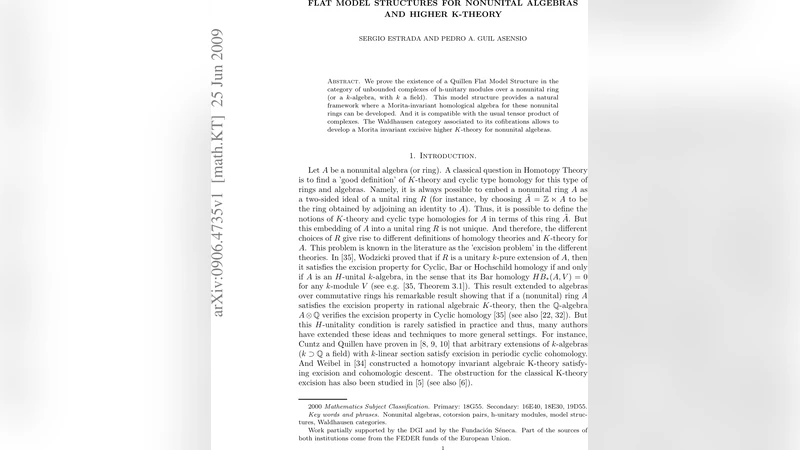
We prove the existence of a Quillen Flat Model Structure in the category of unbounded complexes of h-unitary modules over a nonunital ring (or a $k$-algebra, with $k$ a field). This model structure provides a natural framework where a Morita-invariant homological algebra for these nonunital rings can be developed. And it is compatible with the usual tensor product of complexes. The Waldhausen category associated to its cofibrations allows to develop a Morita invariant excisive higher $K$-theory for nonunital algebras.
💡 Research Summary
The paper addresses a long‑standing gap in homological algebra and higher algebraic K‑theory for non‑unital rings (or more generally, non‑unital k‑algebras). For a unital ring R, the category of chain complexes of R‑modules carries several well‑known Quillen model structures (projective, injective, flat) that are compatible with the tensor product and serve as the foundation for derived categories and Waldhausen K‑theory. When the underlying ring lacks a unit, these constructions break down because the usual notions of projectivity, flatness, and even the existence of a tensor unit are no longer available.
The authors overcome this obstacle by working with h‑unitary modules: a left A‑module M over a non‑unital ring A is called h‑unitary if the canonical action map A⊗_A M → M is an isomorphism, equivalently A·M = M. This condition ensures that M can be regarded as a module over the unitization R = A ⊕ k·1_R while retaining the essential “non‑unital” information. The paper first shows that the category of h‑unitary modules is an exact, Grothendieck abelian subcategory of R‑Mod, closed under extensions, kernels, cokernels, and filtered colimits.
With this ambient exact structure, the authors construct the flat model structure on the category Ch(A‑hU) of unbounded chain complexes of h‑unitary modules. The three distinguished classes are:
- Cofibrations – monomorphisms whose cokernel is a complex of flat h‑unitary modules (called flat complexes).
- Weak equivalences – chain homotopy equivalences (or, equivalently, quasi‑isomorphisms) between complexes.
- Fibrations – epimorphisms with the right lifting property with respect to trivial cofibrations.
The key technical work consists of proving that every complex X admits a flat cofibrant replacement Q → X, i.e., a flat complex Q together with a cofibration that is also a weak equivalence. This is achieved by a transfinite construction that uses small‑object arguments adapted to the h‑unitary setting, together with a careful analysis of how flatness behaves under the unitization functor. The authors verify all model‑category axioms, including the 2‑out‑of‑3 property, closure under pushouts and pullbacks, and the existence of functorial factorizations.
A crucial feature of the constructed model structure is its compatibility with the tensor product of complexes. The authors prove that the tensor product of two flat h‑unitary complexes is again flat, and that the tensor product of a cofibration with any complex preserves cofibrations (and similarly for trivial cofibrations). Consequently, Ch(A‑hU) becomes a monoidal model category, allowing one to speak of derived tensor products and to develop a homotopy‑theoretic version of Hochschild and cyclic homology for non‑unital algebras.
The paper then turns to Morita invariance. If A and B are Morita‑equivalent non‑unital algebras, there exist exact functors F : A‑hU → B‑hU and G : B‑hU → A‑hU forming an adjoint equivalence. The authors show that these functors lift to Quillen equivalences between the corresponding flat model categories, preserving cofibrations, fibrations, and weak equivalences. Hence the homotopy categories and all derived invariants (including K‑theory) are invariant under Morita equivalence.
Having a monoidal model structure, the authors construct a Waldhausen category (Ch(A‑hU), cof, we) where cofibrations are the flat cofibrations described above and weak equivalences are the chain homotopy equivalences. Using Waldhausen’s S•‑construction they define a higher K‑theory spectrum K(A). They verify the standard Waldhausen axioms (extension, saturation, cylinder) and prove that K(A) satisfies excision: for any two‑sided ideal I ⊂ A, there is a homotopy fibration K(I) → K(A) → K(A/I). Moreover, because the model structure is Morita invariant, the resulting K‑theory is also Morita invariant, providing a robust, excisive, and homotopy‑theoretic K‑theory for non‑unital algebras.
The final sections present illustrative examples: (1) the algebra of compact operators on a Hilbert space (a classic non‑unital C*-algebra), (2) the augmentation ideal of a group algebra, and (3) certain differential graded algebras without units. In each case the authors compute or describe the flat cofibrant replacements and indicate how the new K‑theory recovers known invariants while extending them to situations where classical K‑theory is not defined.
In summary, the paper establishes a Quillen flat model structure on complexes of h‑unitary modules over a non‑unital algebra, proves its monoidal and Morita‑invariant nature, and leverages it to build an excisive higher K‑theory via Waldhausen’s machinery. This work fills a conceptual gap, providing a unified homotopical framework for non‑unital algebras that parallels the well‑developed theory for unital rings, and opens the door to further applications in non‑commutative geometry, derived non‑unital categories, and homotopical algebraic analysis.
Comments & Academic Discussion
Loading comments...
Leave a Comment