Sequentiality vs. Concurrency in Games and Logic
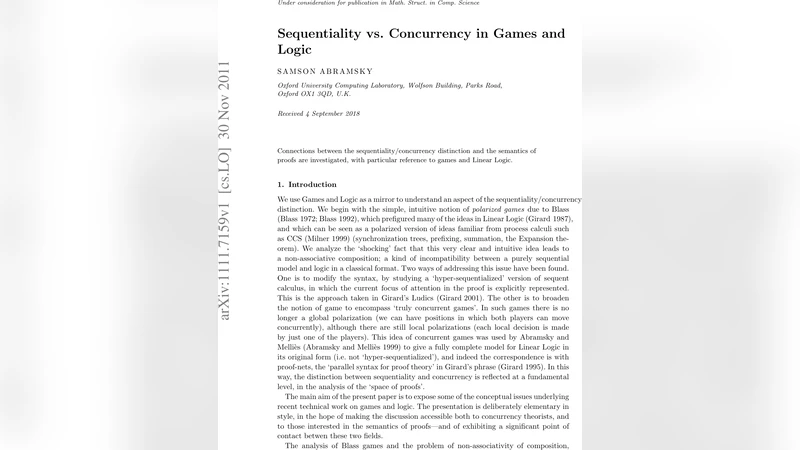
Connections between the sequentiality/concurrency distinction and the semantics of proofs are investigated, with particular reference to games and Linear Logic.
💡 Research Summary
The paper investigates the fundamental distinction between sequentiality and concurrency and its impact on the semantics of proofs, focusing especially on game semantics and Linear Logic. It begins by formally defining sequential games, where moves occur one after another, and concurrent games, where several players act simultaneously. The authors map these two execution models onto the core connectives of Linear Logic: the tensor (⊗) representing parallel composition of resources, and the par (⅋) representing a choice of usage. In sequential games, the par connective dominates, mirroring the linear order of moves; in concurrent games, the tensor becomes the natural operator, reflecting the simultaneous combination of actions.
A central contribution is the analysis of exchange and associativity laws. In traditional sequential proof systems, exchange is often treated as a trivial permutation, but in a concurrent setting the order of independent moves can affect intermediate states, making exchange a substantive semantic feature. To capture this, the authors introduce two new logical operators, “concurrent tensor” (⊗ₚ) and “concurrent par” (⅋ₚ), which extend the usual tensor and par while preserving full commutativity and associativity. These operators allow a direct correspondence between concurrent strategies in games and proof structures in Linear Logic.
The paper then develops a graph‑based representation called “concurrent proof nets.” Unlike the tree‑shaped proof trees of sequential logic, these nets are directed acyclic graphs where nodes denote logical connectives and edges encode resource flow. This graphical form makes the exchange law explicit: different interleavings of concurrent moves correspond to different graph traversals that nevertheless converge to the same net, embodying the essence of concurrency. The authors prove that cut‑elimination (normalisation) for these nets terminates and yields a unique normal form, despite the added complexity of graph rewriting.
Beyond the theoretical framework, the authors discuss practical implications. They show how the concurrent logical calculus can be embedded into process algebras and session‑type systems, providing a rigorous method for reasoning about synchronization, communication, and deadlock‑freedom in distributed programs. In interactive and multiplayer game design, the model offers a formal tool for analysing simultaneous player strategies, potentially preventing logical inconsistencies and race conditions.
In summary, the paper bridges the gap between sequential proof theory and concurrent computation by extending Linear Logic with operators that faithfully model simultaneous actions. It demonstrates that the semantics of concurrent games can be captured by enriched proof nets, preserving essential logical properties while offering a robust foundation for the formal analysis of parallel and interactive systems.
Comments & Academic Discussion
Loading comments...
Leave a Comment