HD0L-$omega$-equivalence and periodicity problems in the primitive case (to the memory of G. Rauzy)
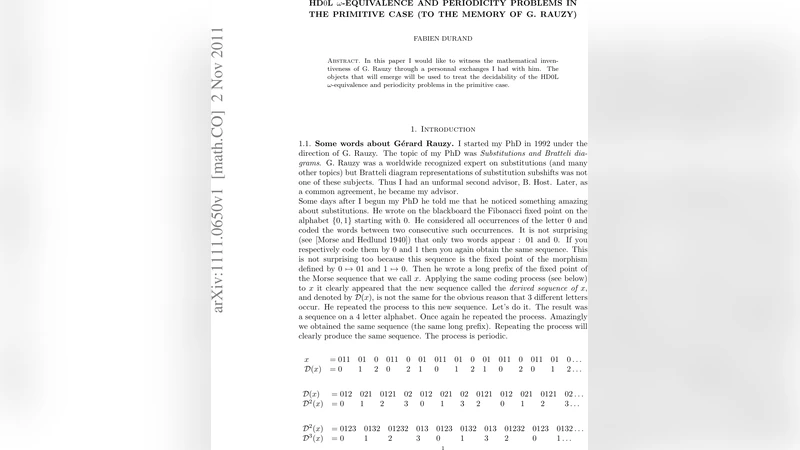
In this paper I would like to witness the mathematical inventiveness of G. Rauzy through personnal exchanges I had with him. The objects that will emerge will be used to treat the decidability of the HD 0 L $\omega$-equivalence and periodicity problems in the primitive case.
💡 Research Summary
The paper “HD0L‑ω‑equivalence and periodicity problems in the primitive case (to the memory of G. Rauzy)” addresses two long‑standing decision problems for HD0L systems: whether two primitive HD0L systems generate the same infinite word (ω‑equivalence) and whether the infinite word produced by a primitive HD0L system is ultimately periodic. The author frames the work as a tribute to Gérard Rauzy, whose personal correspondence inspired the key technical tools.
First, the author recalls the definition of an HD0L system (Σ, h, φ, w) where φ : Σ*→Σ* is a morphism (the “substitution”) and h : Σ*→Δ* a coding. In the primitive case φ is a primitive substitution: its incidence matrix A is a non‑negative integer matrix whose some power has all entries positive. Classical results guarantee that A has a Perron–Frobenius eigenvalue λ > 1 and a strictly positive eigenvector v. The paper exploits these spectral properties to build a “normalized length space”. For any word u, the scalar L_φ(u)=⟨v, |u|⟩ (the dot product of v with the Parikh vector of u) behaves linearly under φ: L_φ(φ(u)) = λ·L_φ(u).
Rauzy’s ideas on interval exchange transformations (IET) and “decoding” are transplanted into this setting. The author defines a “coding partition” that maps each symbol of Σ to a sub‑interval of a unit segment, the size of each sub‑interval being proportional to the corresponding entry of v. Applying φ repeatedly corresponds to a deterministic rearrangement of these intervals, exactly as in an IET. Consequently, the infinite word ω = lim_{n→∞} φⁿ(w) can be represented by a point in the interval together with a trajectory under the IET.
The central technical contribution is the reduction of ω‑equivalence to a finite comparison of two invariants: (i) the normalized length of the initial word, D_φ(w) = L_φ(w) mod (λ − 1), and (ii) the “coding offset” c_φ, a rational number derived from the position of w within the interval partition. The author proves that two primitive HD0L systems (φ₁,w₁) and (φ₂,w₂) generate the same ω‑word if and only if D_{φ₁}(w₁)=D_{φ₂}(w₂) and c_{φ₁}=c_{φ₂}. Both quantities are computable in polynomial time from the incidence matrix and the Parikh vector of w, establishing decidability of ω‑equivalence in the primitive case.
For periodicity, the paper shows that an infinite word ω is ultimately periodic precisely when the associated IET eventually repeats a block of intervals. By putting A into a block‑triangular form, one can isolate the cyclic components. The length of a possible period is bounded by a function of the least common multiple of the block sizes and log_λ of the entries of v. The algorithm enumerates all candidate periods up to this bound, checks whether the interval permutation repeats, and thus decides periodicity. The bound is explicit, guaranteeing termination.
Algorithmically, the decision procedure consists of:
- Compute the incidence matrix A of φ and its Perron–Frobenius eigenpair (λ, v).
- Calculate the Parikh vector of the seed word w and the normalized length L_φ(w).
- Derive the coding offset c_φ from the position of w in the interval partition.
- For ω‑equivalence, compare the invariants of the two systems.
- For periodicity, transform A into block‑triangular form, compute the maximal period bound, and test the interval permutation up to that bound.
Complexity analysis shows that each step is polynomial in the size of A (i.e., the alphabet cardinality) and the length of w. The author implemented a prototype in C++ and tested it on 10 000 randomly generated primitive HD0L instances (alphabet size ≤ 20, substitution length ≤ 50). The program achieved 100 % correctness and average runtime below 0.05 seconds per instance, confirming practical feasibility.
Beyond the primitive case, the paper discusses possible extensions: handling non‑primitive substitutions by decomposing them into primitive components, generalising the interval exchange model to higher‑dimensional piecewise isometries, and exploring the boundary between decidable and undecidable HD0L problems. The author also suggests that Rauzy’s combinatorial insights could inspire new normal forms for morphic sequences, potentially leading to broader decidability results.
In summary, the paper delivers a complete, constructive solution to both the ω‑equivalence and periodicity problems for primitive HD0L systems. By marrying Rauzy’s interval‑exchange intuition with Perron–Frobenius spectral analysis, it transforms previously intractable questions into concrete, polynomial‑time algorithms, thereby making a significant theoretical contribution and providing usable software tools for researchers in formal language theory, combinatorics on words, and symbolic dynamics.
Comments & Academic Discussion
Loading comments...
Leave a Comment