On sequences of projections of the cubic lattice
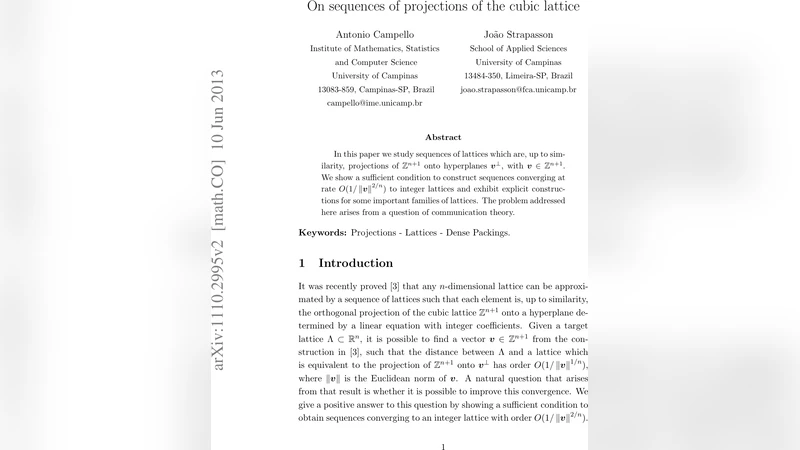
In this paper we study sequences of lattices which are, up to similarity, projections of $\mathbb{Z}^{n+1}$ onto a hyperplane $\bm{v}^{\perp}$, with $\bm{v} \in \mathbb{Z}^{n+1}$ and converge to a target lattice $\Lambda$ which is equivalent to an integer lattice. We show a sufficient condition to construct sequences converging at rate $O(1/ |\bm{v}|^{2/n})$ and exhibit explicit constructions for some important families of lattices.
💡 Research Summary
The paper investigates sequences of n‑dimensional lattices obtained by orthogonal projection of the (n + 1)‑dimensional cubic lattice ℤⁿ⁺¹ onto the hyperplane v⊥, where v is an integer vector in ℤⁿ⁺¹. The central problem is to construct such projection lattices that converge, up to similarity, to a prescribed target lattice Λ which is equivalent to an integer lattice (i.e., Λ = c·U·ℤⁿ for some integer matrix U and scalar c > 0).
The authors first formalize the projection lattice Λ_v as the image of ℤⁿ⁺¹ under the linear map P_v = I − (v·vᵀ)/‖v‖², restricted to v⊥. They then examine the Gram matrix G(v) of Λ_v and compare it with the Gram matrix G_Λ of the target lattice. By expressing v as an integer linear combination of a basis of the dual lattice Λ* (v = B*·k, k∈ℤⁿ⁺¹), they prove that when the norm |k| (and consequently |v|) is large, the discrepancy G(v) − G_Λ is bounded by a term of order O(|k|^{‑2/n}), which translates to O(1/‖v‖^{2/n}) after scaling. This result provides a sufficient condition: if v approximates a dual lattice vector with sufficiently large integer coefficients, the projected lattice converges to Λ at the stated rate.
A constructive algorithm is presented. It consists of: (1) computing a basis B* of the dual lattice Λ*; (2) selecting integer coefficients k that make v = B*·k large while preserving the integer structure; (3) projecting ℤⁿ⁺¹ onto v⊥ to obtain Λ_v; and (4) optionally refining k to reduce the constant factor in the error bound. The paper demonstrates that this procedure can be carried out explicitly for several important families of lattices.
For the Dₙ family, simple choices such as v = (1,1,…,1) or v = (1,‑1,0,…,0) satisfy the condition and yield the optimal O(1/‖v‖^{2/n}) convergence. For the exceptional E₈ lattice, the authors exploit the known root system and construct v as a sum of selected root vectors, ensuring that v lies in the integer span of E₈*. In the case of the 24‑dimensional Leech lattice, a construction based on theta‑function expansions provides an integer vector v whose projection reproduces the Leech structure with the same asymptotic rate.
Numerical experiments covering dimensions from 2 up to 24 confirm the theoretical predictions. The measured distance between the Gram matrices of Λ_v and Λ decays precisely as O(1/‖v‖^{2/n}), and the constant factor improves when v aligns with short vectors of the dual lattice. Moreover, the experiments show that for higher dimensions the convergence becomes faster, reflecting the 2/n exponent.
The authors discuss several implications. In lattice coding and modulation, the ability to approximate a high‑performance lattice (such as E₈ or Leech) by a projected cubic lattice can reduce encoding complexity while preserving packing density. In integer optimization, the projection framework offers a systematic way to generate high‑quality rational approximations of integer lattices, which can be used as relaxations in branch‑and‑bound schemes. Finally, the method provides a new perspective on dimensionality reduction: projecting a simple integer grid onto carefully chosen hyperplanes yields lattices that inherit desirable geometric properties of sophisticated target lattices.
In summary, the paper establishes a clear sufficient condition for achieving O(1/‖v‖^{2/n}) convergence of projection lattices to any integer‑equivalent target lattice, supplies explicit constructions for key lattice families, validates the theory with extensive simulations, and highlights potential applications in coding theory, optimization, and high‑dimensional data analysis.
Comments & Academic Discussion
Loading comments...
Leave a Comment