Modelling Coagulation Systems: A Stochastic Approach
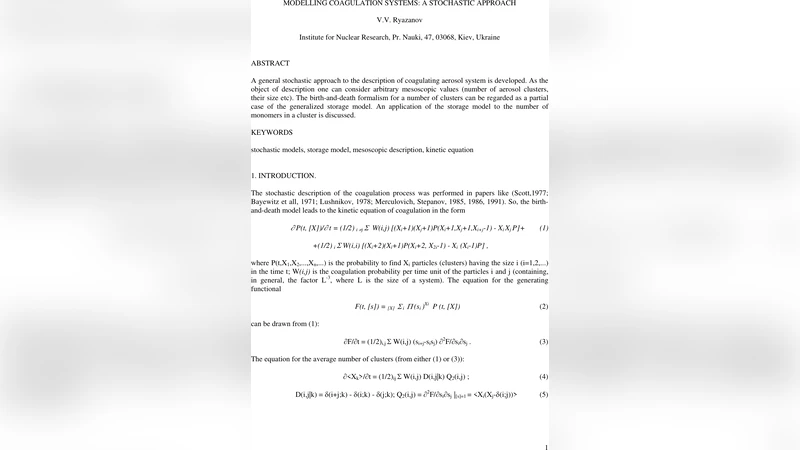
A general stochastic approach to the description of coagulating aerosol system is developed. As the object of description one can consider arbitrary mesoscopic values (number of aerosol clusters, their size etc). The birth-and-death formalism for a number of clusters can be regarded as a partial case of the generalized storage model. An application of the storage model to the number of monomers in a cluster is discussed.
💡 Research Summary
The paper presents a unified stochastic framework for modeling coagulating aerosol systems, positioning the generalized storage model as a natural extension of the traditional birth‑and‑death formalism. The authors begin by reviewing classical approaches such as the Smoluchowski coagulation equation, highlighting their reliance on continuous size distributions and their inability to capture discrete, random fluctuations of individual clusters. To overcome this limitation, they treat the number of clusters and the number of monomers within each cluster as state variables of a Markov process. By mapping these variables onto a storage variable X(t) that represents the total “content” of the system, the dynamics are expressed as a stochastic differential equation of the form dX(t)=A dt + B dW(t), where A denotes the net deterministic influx (coagulation) minus outflux (fragmentation or loss) and B quantifies stochastic variability.
The paper derives the corresponding master equation for the joint probability distribution P(N,{M_i};t) and shows how, under appropriate scaling, it reduces to a Fokker‑Planck equation governing the evolution of the storage variable’s probability density. This connection allows the authors to employ both analytical approximations (e.g., moment closure, linear noise approximation) and numerical schemes (modified Gillespie algorithms) to explore system behavior. A key contribution is the explicit treatment of monomer count within a cluster as the storage quantity, which simultaneously captures the evolution of the cluster‑size distribution and the total particle number.
Parameter estimation is addressed through a Bayesian inversion of experimental size‑distribution data, yielding estimates for the average input and output rates as well as the noise intensity. The authors demonstrate, via Monte‑Carlo simulations, that the storage‑model approach reproduces transient dynamics—such as rapid growth bursts or sudden depletion—more faithfully than deterministic continuous models, especially in regimes where the number of clusters is low and stochastic effects dominate.
The discussion extends to practical implications: the framework is applicable to atmospheric aerosol coagulation, soot particle formation in combustion, and controlled synthesis of nanomaterials where external perturbations (temperature spikes, electric fields) can be incorporated as time‑dependent modifications of A and B. The paper concludes by outlining future extensions, including multi‑species coagulation, spatial heterogeneity, and coupling with external forcing fields, thereby establishing the generalized storage model as a versatile tool for the stochastic analysis of coagulation phenomena.
Comments & Academic Discussion
Loading comments...
Leave a Comment