
Computer-Science
![Conception individuelle et collective. Approche de lergonomie cognitive [Individual and Collective Design. The Cognitive-Ergonomics Approach]](/koineu_html/2007/11/0711.1290/featured_v26.webp)
Conception individuelle et collective. Approche de lergonomie cognitive [Individual and Collective Design. The Cognitive-Ergonomics Approach]

On the defence notion

Source-to-source optimizing transformations of Prolog programs based on abstract interpretation

A Posteriori Equivalence: A New Perspective for Design of Optimal Channel Shortening Equalizers

Wireless Local Area Networks with Multiple-Packet Reception Capability

Representation of Functional Data in Neural Networks

Supervised learning on graphs of spatio-temporal similarity in satellite image sequences

Autoencoder, Principal Component Analysis and Support Vector Regression for Data Imputation
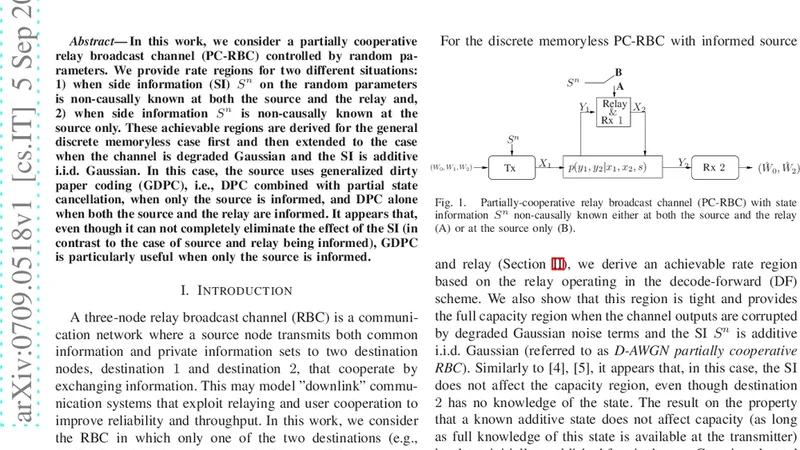
Rate Regions for the Partially-Cooperative Relay Broadcast Channel with Non-causal Side Information

An Early Warning System for Bankruptcy Prediction: lessons from the Venezuelan Bank Crisis
Gaze as a Supplementary Modality for Interacting with Ambient Intelligence Environments

Linear Time Algorithms Based on Multilevel Prefix Tree for Finding Shortest Path with Positive Weights and Minimum Spanning Tree in a Networks

Virtual screening with support vector machines and structure kernels
One-way Hash Function Based on Neural Network

The Review and Analysis of Human Computer Interaction (HCI) Principles
A Generalized Information Formula as the Bridge between Shannon and Popper

Kinematic Analysis of a Family of 3R Manipulators

Equivalence of LP Relaxation and Max-Product for Weighted Matching in General Graphs

How Many Users should be Turned On in a Multi-Antenna Broadcast Channel?

On the Information Rate of MIMO Systems with Finite Rate Channel State Feedback and Power On/Off Strategy

Subjective Information Measure and Rate Fidelity Theory
Variable-Rate Distributed Source Coding in the Presence of Byzantine Sensors