Tracking controllability on moving targets for parabolic equations
In this paper, we study the tracking controllability of a 1D parabolic type equation. Notably, with controls acting on the boundary, we seek to approximately control the solution of the equation on specific points of the domain. We prove that acting …
Authors: Jone Apraiz, Jon Asier Bárcena-Petisco, Judit Muñoz-Matute
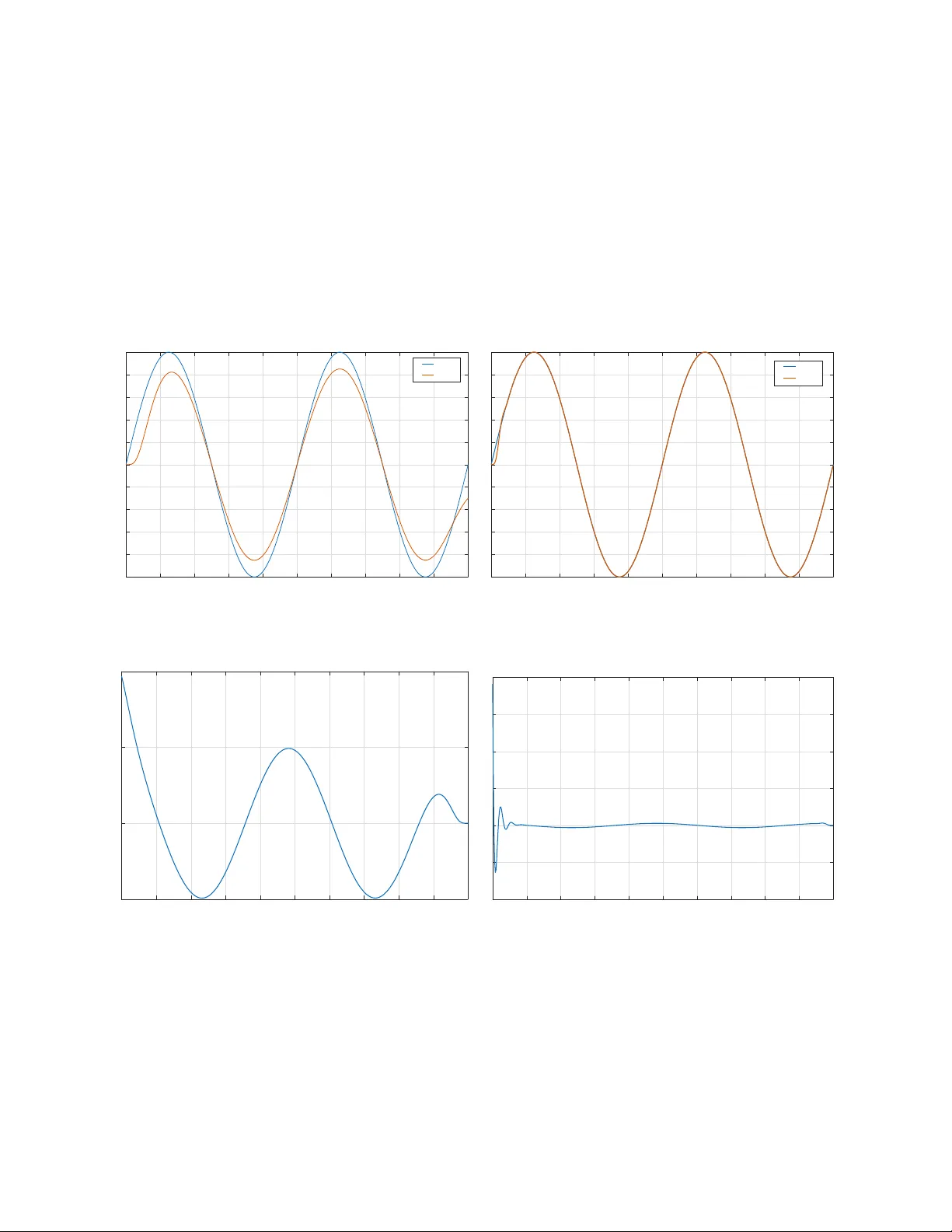
T rac king con trollabilit y on mo ving targets for parab olic equations Jone Apraiz ∗ Jon Asier Bárcena-P etisco † Judit Muñoz-Matute ‡ Marc h 31, 2026 Abstract: in this pap er, w e study the tracking controllabilit y of a 1D parab olic t yp e equation. Notably , with controls acting on the b oundary , we seek to appro ximately con trol the solution of the equation on sp ecic p oin ts of the domain. W e prov e that acting on one b oundary p oin t, we con trol the solution on one target p oint, whereas acting on t w o b oundary p oints, w e can con trol the solution on up to t w o target p oints. In order to do so, when the target is xed, we study the controllabilit y by minimizing the corresp onding problem with duality results. Afterwards, w e study the con trollability on moving p oin ts b y applying a transformation that takes the problem to a xed target. Lastly , w e also solve some of these control problems numerically and compute approximations of the solutions and the desired targets, whic h v alidates our theoretical metho dology . Key words: appro ximate con trollabiltiy , numerical sim ulation, parab olic equation, tracking control- labilit y AMS sub ject classication: 35K40, 35Q93, 65K10, 65N06, 93B05, 93B17. Abbreviated title: T racking controllabilit y of parab olic equations A ckno wledgemen ts: J.A. and J.A.B.P . were supp orted by the pro ject PID2024-158206NB-100, funded by MICIU/AEI/10.13039/501100011033 and FEDER, UE, the IMUS - María de Maeztu gran t CEX2024-001517-M - Ap oy o a Unidades de Excelencia María de Maeztu, funded b y MI- CIU/AEI/10.13039/501100011033 and the Project of Consolidación In v estigadora CNS2024-154725, also funded b y MICIU/AEI/10.13039/501100011033. J.A.B.P . w as also funded by PID2023-146764NB- I00 funded by MICIU/AEI/10.13039/501100011033 and cofunded b y the Europ ean Union. J.M.M. w as supported b y the Consolidated Researc h Group MA THMODE (IT1866-26) of the UPV/EHU giv en b y the Departmen t of Education of the Basque Go v ernment, the Research Project PID2023- 146668O A-I00 and the gran t R YC2023-045172-I funded b y MICIU/AEI/10.13039/501100011033. ∗ Departmen t of Mathematics, Universit y of the Basque Coun try UPV/EHU, Barrio Sarriena s/n, 48940, Leioa, Spain. OR CID: 0000-0001-7866-8412 E-mail: jone.apraiz@ehu.eus † Departmen t of Mathematics, Universit y of the Basque Coun try UPV/EHU, Barrio Sarriena s/n, 48940, Leioa, Spain. OR CID: 0000-0002-6583-866X E-mail: jonasier.barcena@ehu.eus . ‡ Departmen t of Mathematics, Universit y of the Basque Coun try UPV/EHU, Barrio Sarriena s/n, 48940, Leioa, Spain. OR CID: 0000-0002-1875-8982 E-mail: judit.munoz@ehu.eus . 1 1 In tro duction In this paper, we are going to study the controllabilit y of the following evolution systems in one dimensional spatial domain, [0 , L ] , and for the time in terv al [0 , T ] , for some L, T > 0 : y t − a ( t, x ) ∂ xx y + b ( t, x ) ∂ x y + c ( t, x ) y = 0 in (0 , T ) × (0 , L ) , y ( · , 0) = 0 on (0 , T ) , y ( · , L ) = v on (0 , T ) , y (0 , · ) = 0 on (0 , L ) , (1.1) and y t − a ( t, x ) ∂ xx y + b ( t, x ) ∂ x y + c ( t, x ) y = 0 in (0 , T ) × (0 , L ) , y ( · , 0) = v 0 on (0 , T ) , y ( · , L ) = v L on (0 , T ) , y (0 , · ) = 0 on (0 , L ) , (1.2) for a, b, c real analytic functions, and with: a ( t, x ) ≥ a 0 > 0 , ∀ t ∈ [0 , T ] , x ∈ [0 , L ] , (1.3) for the problem to be well-posed. In those evolution systems, the function y represents a quan tit y that c hanges along the time and space, for example: the temp erature, a concentration of a substance, or the price of a nancial asset (see [FP14]). The co ecien t a ma y mo del the diusion and the thermal conductivit y , whereas co ecients b and c are related to adv ection-conv ection and reaction-attenuation eects, resp ectively . The incorp oration of space-time dep enden t co ecients allo ws for a more accurate represen tation of non-homogeneous media in the applications that are mentioned in a few lines b elow. Observ e also, that apart from considering zero initial data in the system, w e hav e introduced some con trol functions in the b oundaries: v on the right part of the b oundary in (1.1), and v 0 and v L on the tw o ends of the domain in (1.2). The aim of this work is to study the tracking controllabilit y of these systems. Our ob jectiv e is to con trol the solution in the interior of the domain at some sp ecic p oin ts that may change smo othly with resp ect to the time. First, in Section 3, we will control on N ∈ N xed p oints ov er the whole time interv al [0 , T ] , denoting them by x i ∈ (0 , L ) and target states w i ∈ L 2 (0 , T ) . W e will seek to analyze whether there is a con trol v ∈ L 2 (0 , T ) for system (1.1), or tw o controls v 0 ∈ L 2 (0 , T ) and v L ∈ L 2 (0 , T ) on tw o spatial b oundaries for system (1.2), suc h that: y ( t, x i ) = w i ( t ) , a . e . t ∈ (0 , T ) , ∀ i = 1 , . . . , N , for y the solution to (1.1) and (1.2), resp ectively . With this purp ose in mind, a duality argument result will b e prov ed (Lemma 3.2) for the general case i = 1 , . . . , N . The results of trac king controllabilit y study will b e display ed in Theorem 3.3. Then, in Section 4, we will allow the p oin ts which we control to dep end on the time v ariable. W e are going to prov e that in (1.1), setting only one control v on the right part of the b oundary , we can 2 con trol approximately the solution in the moving target p oint given by the analytic function h to a target state w ∈ L 2 (0 , T ) ; that is, y ( t, h ( t )) = w ( t ) , a . e . t ∈ (0 , T ) . The result obtained for this problem will b e shown in Theorem 4.1. On the other hand, for system (1.2), w e will see in Theorem 4.2 that w e can control approximately (with con trols v 0 and v L ) the solution in t wo time-dep endent analytic tra jectories h 1 and h 2 sim ultaneously to targets w 1 and w 2 , resp ectiv ely; that is, y ( t, h i ( t )) = w i ( t ) , a . e . t ∈ (0 , T ) , for i = 1 , 2 . These problems hav e aroused the interest of the mathematical communit y in recen t y ears b ecause of their applications in computer sciences, the study of dynamical systems or c hemical reactors, among others. An example of this is that no wada ys they are fundamen tal in mo deling biological systems, suc h as nerv e physiology and heart rate regulation (see [OO14], for example), as w ell as in economic and nancial mo deling (notably the Black-Sc holes framework, as can b e seen in [FP14]). In the eld of robotics, these models are essential for the syn thesis of high-lev el decision strategies, sp ecically when considering the mechanics of contin uous media in exible structures or soft rob otics, where dynamics are rigorously gov erned b y parab olic partial dierential equations (see [HJ20] or [GD23]). F or this type of system, the design of stable tracking control laws has adv anced signicantly through the backstepping metho d for b oundary con trol, a metho dology formalized in [MS08]. Regarding the controllabilit y of parab olic equations to sp ecic v alues (constant targets), the rst pap er to our kno wledge is [LMR00], where the v alue on the boundary of the heat equation is con- trolled through pow er series. So on after, the pap ers [LR02] and [DPRM03] w ere published, where the controllabilit y of the b oundary in quasilinear heat equations and non-linear Stefan equation are studied, resp ectively . More recently , in [BPZ24], the trac king con trollability has b een studied for the heat equation in arbitrary dimensions, and an estimate of the cost of approximately con trolling the b oundary is given. W e w ould like to highlight that, to our knowledge, this is the rst work in which instead of con trolling the state on the b oundary , w e con trol the state in the in terior, in more than one p oint, and in target p oin ts that c hange smo othly with resp ect to the time v ariable. This scarcity of results inv olving parab olic equations contrasts with the large amoun t of results in volving hyperb olic equations. Regarding the literature, there are many related works in volving h yp erb olic equations. Let us mention here some of the main w orks: [AS02], where the authors studied the p oin twise and internal con trollability; [FP94], where the p oint wise controllabilit y w as to ok as the limit of in ternal con trollabilit y in one dimension; [HJ91], in which the p oint wise con trollabilit y w as studied for the vibrations of a plaque in t wo dimensions; [Li10] and [L W G16], where exact b oundary con trollability for h yp erb olic systems is studied; [GL11] and [GL13], where hyperb olic systems and unsteady o ws are studied on tree-like net w orks; [Cas13], where the linear wa v e equation is considered with a con trol acting on a mo ving p oin t and sucient conditions on the tra jectory of the control are obtained in order to ha ve the exact controllabilit y prop erty; [LR W21], where control on exact b eams is studied; [SZ22], where, the controllabilit y of the w av e equation is studied; and [WW23], where exact b oundary controllabilit y of no dal prole for quasi-linear hyperb olic systems and its asymptotic stabilit y is studied. 3 Another close but dierent issue is the a v eraged trac king controllabilit y (note that it’s dieren t from av eraged con trol, [BPZ21, Zua14, LZ16]), where the whole b ehavior of the state or of the output v ariable within the time in terv al of control is of interest (see [Dan25] for an sp ecic work related to that). There are other w orks in which the p oin twise con trol has b een studied for other equations, such as [R GP02b]. There, the authors prov ed the existence and uniqueness of a Nash equilibrium for the con trol of linear partial dieren tial equations of parab olic t ype (for example, the Burgers equation) and developed an algorithm to appro ximate the control solution. This work was a con tinuation of a previous one, [RGP02a]. Finally , in the pap er [ZZ24], the tracking con trollability of nite dimensional linear systems was studied. The structure of the rest of the pap er is as follows: in Section 2 we recall some basic notation w e will use along the article and presen t some basic denitions; in Section 3 w e study the con trollabilit y of the solution on xed p oints in the space; in Section 4 we study the con trollability on moving tra jectories; in Section 5 w e present some numerical sim ulations; and in Section 6 w e suggest some op en problems and p ossible extensions of this w ork. 2 Preliminaries and notation Let us start by presenting the notation that we use ov er this article: • In this pap er, for a linear space V , we denote its dual space b y V ′ . Moreo ver, h L, v i V ′ × V denotes the ev aluation of v b y the functional L ∈ V ′ . This will app ear when integrating b y parts. In the case where the function space is a Hilb ert space, w e will simplify the notation and write h v , w i V , for v , w ∈ V , as it is self-dual. • T o simplify the notation, in some parts of this article w e will use y i = y ( · , x i ) , for i = 1 , . . . , N . • In Section 3, given an interv al ( a, b ) ⊂ [0 , L ] , we will denote by 1 ( a,b ) ( x ) the indicator function that returns 1 if x ∈ ( a, b ) and 0 otherwise. • W e denote Q := (0 , T ) × (0 , L ) . T o con tinue, let us recall some of the basic denitions: Denition 2.1 . Let L > 0 and h 1 , . . . , h N analytic functions, satisfying 0 < h 1 ( t ) < · · · < h N ( t ) < L for all t ∈ [0 , T ] . Then, system (1.1) is approximately con trollable in the tra jectories ( h 1 , . . . , h N ) if for all ( w 1 , . . . , w N ) ∈ ( L 2 (0 , T )) N there is v ∈ L 2 (0 , T ) such that the solution of ( 1.1) satises y ( t, h 1 ( t )) − w 1 ( t ) , . . . , y ( t, h N ( t )) − w N ( t ) ( L 2 (0 ,T )) N < ε. A similar denition can be considered for the system (1.2), with the existence of v replaced by the existence of v 0 and v 1 . 4 R emark 2.2 . The approximate controllabilit y problem in tra jectories is a denition that makes sense. Indeed, when the b oundary data is in L 2 (0 , T ) , b oth systems (1.1) and (1.2) admit a solution by transp osition in L 2 ((0 , T ) × (0 , L )) (see [LM72], and for a more recen t control orien ted explanation, see [ F CGBdT10]). In addition, multiplying y b y a cut-o function χ that is 1 in ( ε, L − ε ) and 0 in [0 , ε/ 2) ∪ ( L − ε/ 2 , L ] , for ε > 0 small enough, we obtain, with usual regularit y estimates, that y ∈ L 2 (0 , T ; H 1 ( ε, L − ε )) . In particular, y ∈ L 2 (0 , T ; C 0 ([ ε, L − ε ])) for all ε > 0 , so t 7→ y ( t, h i ( t )) b elongs to L 2 (0 , T ) for all i = 1 , . . . , N . 3 T rac king controllabilit y on xed target p oin ts Let us rst study the control problem when the tra jectories and targets are xed, that is, h i ( t ) = x i ∈ [0 , L ] and w i ∈ L 2 (0 , L ) , for i = 1 , . . . , N . F or the sake of simplicity , we dene the dierential op erator related to the equation w e hav e p osed in (1.1) and (1.2): L y := − a ( t, x ) ∂ xx y + b ( t, x ) ∂ x y + c ( t, x ) y . Also, we consider its adjoint op erator: L ∗ p := − a ( t, x ) ∂ xx p − ( b ( t, x ) + 2 ∂ x a ( t, x )) ∂ x p − ( ∂ xx a ( t, x ) + ∂ x b ( t, x ) − c ( t, x )) p. Finally , when integrating by parts, the follo wing op erator is going to app ear naturally: M y := − a ( t, x ) ∂ x y + ( ∂ x a ( t, x ) + b ( t, x )) y . (3.1) Let us now dene the adjoin t system of b oth (1.1) and (1.2): Denition 3.1 . Let x 1 , . . . , x N ∈ (0 , L ) satisfying x 1 < · · · < x N and ( f 1 , . . . , f N ) ∈ ( L 2 (0 , T )) N . Then, p f 1 ,...,f N denotes the solution of: − p t + L ∗ p = N X i =1 f i ( t ) δ x i in (0 , T ) × (0 , L ) , p ( · , 0) = p ( · , L ) = 0 on (0 , T ) , p ( T , · ) = 0 on (0 , L ) , (3.2) where δ x i denotes the Dirac delta function supp orted at a given p oint x i ∈ (0 , L ) . In order to address the trac king problem, w e resort to Lions’ dualit y theory (see [Lio88] or [Lio92]), also known as Hilb ert Uniqueness Metho d (HUM). The approximate con trollability of the system en- sures that a dual functional, that we will dene in the next lemma, is co ercive in the corresp onding Hilb ert space, in our case ( L 2 (0 , T )) N . Consequen tly , the optimal con trol that minimizes the track- ing error is nothing more than the pro jection of the optimal adjoint state on to the control space, transforming a tra jectory search problem in to a minimizing problem. If the system is approximately con trollable, then the adjoint op erator must b e injective, which is translated into a Unique Contin ua- tion prop erty , as can b e seen in the next Lemma 3.2. On the other hand, the Lax-Milgram Theorem 5 or basic principles of con vex optimization guarantees that the minim um of the functional exists and is unique. Finally , from an intuitiv e p oint of view, the reason why the δ x i app ear on the adjoint system is that we aim at controlling on those p oints, so in the dual system we m ust b e able to observe p erturbations on those p oin ts, p erturbations that can only aect them if a Dirac mass app ears there. Also, note that since the target is contin uous on the p oints x i , we will hav e to consider the duality with contin uous functions. T o con tinue with, let us state and pro v e the following dualit y result, based on a unique contin uation prop ert y: Lemma 3.2 (Duality for interior p oint wise controllabilit y) . L et x 1 , . . . , x N ∈ (0 , L ) satisfying x 1 < · · · < x N . Then, (1.1) is appr oximately c ontr ol lable on (0 , T ) × { x 1 , . . . , x N } if and only if ( f 1 , . . . , f N ) ∈ ( L 2 (0 , T )) N and ∂ x p f 1 ,...,f N ( · , L ) = 0 = ⇒ ( f 1 , . . . , f N ) = (0 , . . . , 0) . (3.3) Mor e over, if (1.1) is appr oximately c ontr ol lable on (0 , T ) ×{ x 1 , . . . , x N } , given ε > 0 and ( w 1 , . . . , w N ) ∈ ( L 2 (0 , T )) N , we c an dene the c ontr ol v = ∂ x p f 1 ,...,f N ( · , L ) , (3.4) that al lows to obtain k ( y ( · , x 1 ) , . . . , y ( · , x N )) − ( w 1 , . . . , w N ) k ( L 2 (0 ,T )) N < ε (3.5) for ( f 1 , . . . , f N ) the minimizer of: J ( f 1 , . . . , f N ) = 1 2 Z T 0 a ( t, L ) | ∂ x p f 1 ,...,f N ( t, L ) | 2 dt + Z T 0 N X i =1 f i w i dt + ε k ( f 1 , . . . , f N ) k ( L 2 (0 ,T )) N . (3.6) Similarly, (1.2) is appr oximately c ontr ol lable on (0 , T ) × { x 1 , . . . , x N } if and only if ( f 1 , . . . , f N ) ∈ ( L 2 (0 , T )) N , ∂ x p f 1 ,...,f N ( · , 0) = 0 and ∂ x p f 1 ,...,f N ( · , L ) = 0 = ⇒ ( f 1 , . . . , f N ) = (0 , . . . , 0) , for p the solution of (3.2) . Mor e over, if (1.2) is appr oximately c ontr ol lable on (0 , T ) ×{ x 1 , . . . , x N } , given ε > 0 and ( w 1 , . . . , w N ) ∈ ( L 2 (0 , T )) N , we c an dene the c ontr ols v 0 = ∂ x p f 1 ,...,f N ( · , 0) and v L = ∂ x p f 1 ,...,f N ( · , L ) , that al low to obtain (3.5) for ( f 1 , . . . , f N ) the minimizer of: J ( f 1 , . . . , f N ) = 1 2 Z T 0 ( a ( t, 0) | ∂ x p f 1 ,...,f N ( t, 0) | 2 + a ( t, L ) | ∂ x p f 1 ,...,f N ( t, L ) | 2 ) dt + Z T 0 N X i =1 f i w i dt + ε k ( f 1 , . . . , f N ) k ( L 2 (0 ,T )) N . (3.7) 6 Lemma 3.2 can b e prov ed with duality arguments similar to those in [Lio92] and [BPZ24, Prop osition I I.4]: Pr o of of L emma 3.2 . Let us prov e the result for (1.1), b eing the case of (1.2) analogous. T o b egin with, let us supp ose that (3.3) is not satised. Then, there is ( f 1 , . . . , f N ) ∈ ( L 2 (0 , T )) N \ { (0 , . . . , 0) } such that ∂ x p f 1 ,...,f N ( · , L ) = 0 . Then, after in tegrating by parts w e obtain that (recall that M y is introduced in (3.1)): 0 = Z Z Q ( y t + L y ) p f 1 ,...,f N dx dt = − h y (0 , · ) , p f 1 ,...,f N (0 , · ) i L 2 (0 ,L ) + h y ( T , · ) , p f 1 ,...,f N ( T , · ) i L 2 (0 ,L ) − h y ( · , 0) , a ( · , 0) ∂ x p f 1 ,...,f N ( · , 0) i L 2 (0 ,T ) + h v , a ( · , L ) ∂ x p f 1 ,...,f N ( · , L ) i L 2 (0 ,T ) − h [ M y ]( · , 0) , p f 1 ,...,f N ( · , 0) i L 2 (0 ,T ) + h [ M y ]( · , L ) , p f 1 ,...,f N ( · , L ) i L 2 (0 ,T ) + Z T 0 * N X i =1 f i ( t ) δ x i , y + ( C 0 ([0 ,L ]) ′ × C 0 ([0 ,L ])) dt = − h 0 , p f 1 ,...,f N (0 , · ) i L 2 (0 ,L ) + h y ( T , · ) , 0 i L 2 (0 ,L ) − h 0 , a ( · , 0) ∂ x p f 1 ,...,f N ( · , 0) i L 2 (0 ,T ) + h v , 0 i L 2 (0 ,T ) − h [ M y ] ( · , 0) , 0 i L 2 (0 ,T ) + h [ M y ] ( · , L ) , 0 i L 2 (0 ,T ) + N X i =1 Z T 0 f i ( t ) y ( t, x i ) dt = N X i =1 Z T 0 f i ( t ) y ( t, x i ) dt. That is, the set ( y ( · , x 1 ) , . . . , y ( · , x N )) ∈ ( L 2 (0 , T )) N is orthogonal to ( f 1 , . . . , f N ) regardless of the con trol, so (1.1) is not approximately con trollable (as the closure reac hable space is orthogonal to ( f 1 , . . . , f N ) , so in particular do es not contain ( f 1 , . . . , f N ) ). Let us supp ose that (3.3) is satised. Let us show that the minimizer of (3.6) pro vides us the desired con trol with (3.4). F or that, let us start by showing that J has a minimizer. Let us dene, J 1 ( f 1 , . . . , f N ) = 1 2 Z T 0 a ( t, L ) | ∂ x p f 1 ,...,f N ( t, L ) | 2 dt, J 2 ( f 1 , . . . , f N ) = Z T 0 N X i =1 f i w i dt, J 3 ( f 1 , . . . , f N ) = ε k ( f 1 , . . . , f N ) k ( L 2 (0 ,T )) N . First, it is clear that J is conv ex, as it is the addition of three conv ex functions: J 1 is conv ex b ecause it is a p ositive-denite quadratic function (see (1.3)); J 2 is conv ex b ecause it is a linear function; and J 3 b ecause it is a multiple of a norm. Let us sho w that J is strictly con vex. Let us supp ose for some ( f 1 , . . . , f N ) ∈ ( L 2 (0 , T )) N \ { (0 , . . . , 0) } , ( g 1 , . . . , g N ) ∈ ( L 2 (0 , T )) N and θ ∈ (0 , 1) : J θ ( f 1 , . . . , f N ) + (1 − θ )( g 1 , . . . , g N ) = θ J ( f 1 , . . . , f N ) + (1 − θ ) J ( g 1 , . . . , g N ) . (3.8) 7 Then, since all the functionals are conv ex, we hav e: J i θ ( f 1 , . . . , f N ) + (1 − θ )( g 1 , . . . , g N ) = θ J i ( f 1 , . . . , f N ) + (1 − θ ) J i ( g 1 , . . . , g N ) , i = 1 , 2 , 3 . (3.9) In particular, applying (3.9) with i = 3 we get that: k θ ( f 1 , . . . , f N ) + (1 − θ )( g 1 , . . . , g N ) k ( L 2 (0 ,T )) N = θ k ( f 1 , . . . , f N ) k ( L 2 (0 ,T )) N + (1 − θ ) k ( g 1 , . . . , g N ) k ( L 2 (0 ,T )) N . Since ( L 2 (0 , T )) N is a Hilb ert space, b y squaring in b oth sides, we get that: h θ ( f 1 , . . . , f N ) , (1 − θ )( g 1 , . . . , g N ) i ( L 2 (0 ,T )) N = k θ ( f 1 , . . . , f N ) k ( L 2 (0 ,T )) N k (1 − θ )( g 1 , . . . , g N ) k ( L 2 (0 ,T )) N . Th us, using Cauch y-Sc hw arz inequality , ( f 1 , . . . , f N ) and ( g 1 , . . . , g N ) are prop ortional with a p ositive constan t, that is, there is c ≥ 0 such that: ( g 1 , . . . , g N ) = c ( f 1 , . . . , f N ) . In addition, if we hav e (3.8), then, using (3.9) with i = 1 : 1 2 Z T 0 a ( t, L ) | ∂ x p θ ( f 1 ,...,f N )+(1 − θ )( g 1 ,...,g N ) ( t, L ) | 2 dt = θ 2 Z T 0 a ( t, L ) | ∂ x p f 1 ,...,f N ( t, L ) | 2 dt + 1 − θ 2 Z T 0 a ( t, L ) | ∂ x p g 1 ,...,g N ( t, L ) | 2 dt. (3.10) Since ( f 1 , . . . , f N ) 7→ ∂ x p f 1 ,...,f N is linear: ( θ + c (1 − θ )) 2 Z T 0 a ( t, L ) | ∂ x p f 1 ,...,f N ( t, L ) | 2 dt = Z T 0 a ( t, L ) | ( θ + c (1 − θ )) ∂ x p f 1 ,...,f N ( t, L ) | 2 dt = Z T 0 a ( t, L ) | ∂ x p ( θ + c (1 − θ ))( f 1 ,...,f N ) ( t, L ) | 2 dt = Z T 0 a ( t, L ) | ∂ x p θ ( f 1 ,...,f N )+(1 − θ )( g 1 ,...,g N ) ( t, L ) | 2 dt. Consequen tly , using (3.10) w e obtain that: ( θ + c (1 − θ )) 2 Z T 0 a ( t, L ) | ∂ x p f 1 ,...,f N ( t, L ) | 2 dt = θ Z T 0 a ( t, L ) | ∂ x p f 1 ,...,f N ( t, L ) | 2 dt + (1 − θ ) Z T 0 a ( t, L ) | ∂ x p g 1 ,...,g N ( t, L ) | 2 dt = θ Z T 0 a ( t, L ) | ∂ x p f 1 ,...,f N ( t, L ) | 2 dt + (1 − θ ) Z T 0 a ( t, L ) | ∂ x p c ( f 1 ,...,f N ) ( t, L ) | 2 dt = θ Z T 0 a ( t, L ) | ∂ x p f 1 ,...,f N ( t, L ) | 2 dt + (1 − θ ) c 2 Z T 0 a ( t, L ) | ∂ x p f 1 ,...,f N ( t, L ) | 2 dt. (3.11) 8 Since ( f 1 , . . . , f N ) 6 = (0 , . . . , 0) , using (3.3), w e obtain that ∂ x p θ ( f 1 ,...,f N ) 6 = 0 . Consequen tly , from (3.11) we get that: (1 · θ + c (1 − θ )) 2 = 1 2 · θ + c 2 (1 − θ ) . Due to the squaring is a strictly con v ex function, c = 1 and therefore ( f 1 , . . . , f N ) = ( g 1 , . . . , g N ) , whic h shows that J is strictly conv ex. Moreo ver, by using again Cauc hy-Sc h warz inequality , we can see that J is co ercive. Indeed: J ( f 1 , . . . , f N ) ≥ ε 2 k ( f 1 , . . . , f N ) k ( L 2 (0 ,T )) N − 1 ε k ( w 1 , . . . , w N ) k ( L 2 (0 ,T )) N . Th us, a unique minimizer ( ˜ f 1 , . . . , ˜ f N ) exists for J . Let us consider y the solution of (1.1) with con trol v = ∂ x p ˜ f 1 ,..., ˜ f N . If ( f 1 , . . . , f N ) ∈ ( L 2 (0 , T )) N , w e hav e that: 0 = Z Z Q ( y t + L y ) p f 1 ,...,f N dt dx = − h 0 , p f 1 ,...,f N (0 , · ) i L 2 (0 ,L ) + h y ( T , · ) , 0 i L 2 (0 ,L ) − h 0 , a ( · , 0) ∂ x p f 1 ,...,f N ( · , 0) i L 2 (0 ,T ) + h ∂ x p ˜ f 1 ,..., ˜ f N , a ( · , L ) ∂ x p f 1 ,...,f N i L 2 (0 ,T ) − h [ M y ]( · , 0) , 0 i L 2 (0 ,T ) + h [ M y ]( · , L ) , 0 i L 2 (0 ,T ) + N X i =1 Z T 0 f i ( t ) y i ( t ) dt ; = D ∂ x p ˜ f 1 ,..., ˜ f N , a ( · , L ) ∂ x p f 1 ,...,f N E L 2 (0 ,T ) + N X i =1 Z T 0 f i ( t ) y i ( t ) dt. Consequen tly , we obtain that: D ∂ x p ˜ f 1 ,..., ˜ f N , a ( · , L ) ∂ x p f 1 ,...,f N E L 2 (0 ,T ) = − N X i =1 Z T 0 f i ( t ) y i ( t ) dt. Therefore, we hav e that, for h > 0 a small parameter: 0 ≤ J (( ˜ f 1 , . . . , ˜ f N ) ± h ( f 1 , . . . , f N )) − J ( ˜ f 1 , . . . , ˜ f N ) = ± h D ∂ x p ˜ f 1 ,..., ˜ f N , a ( · , L ) ∂ x p f 1 ,...,f N E L 2 (0 ,T ) ± h N X i =1 Z T 0 f i ( t ) w i ( t ) dt + ε k ( ˜ f 1 , . . . , ˜ f N ) ± h ( f 1 , . . . , f N ) k ( L 2 (0 ,T )) N − k ( ˜ f 1 , . . . , ˜ f N ) k ( L 2 (0 ,T )) N + O ( h 2 ) = ∓ h N X i =1 Z T 0 f i ( t )( y i ( t ) − w i ( t )) dt + ε k ( ˜ f 1 , . . . , ˜ f N ) ± h ( f 1 , . . . , f N )) k ( L 2 (0 ,T )) N − k ( ˜ f 1 , . . . , ˜ f N ) k ( L 2 (0 ,T )) N + O ( h 2 ) . Th us, using triangular inequalit y , we obtain from this estimate that: N X i =1 Z T 0 f i ( t )( y i ( t ) − w i ( t )) dt ≤ ε k ( f 1 , . . . , f N ) k ( L 2 (0 ,T )) N + O ( h ) , 9 whic h implies, taking the limit as h → 0 , for any ( f 1 , . . . , f N ) : N X i =1 Z T 0 f i ( t )( y i ( t ) − w i ( t )) dt ≤ ε k ( f 1 , . . . , f N ) k ( L 2 (0 ,T )) N . Consequen tly , using dualit y , we obtain that: k y i − w i k ( L 2 (0 ,T )) N ≤ ε, ∀ i = 1 , . . . , N , pro ving the desired result. Let us now prov e our main result: Theorem 3.3 (Simultaneous interior p oint wise con trol) . L et x 1 , x 2 , x 3 ∈ (0 , L ) satisfying x 1 < x 2 < x 3 . Then, 1. System (1.1) is appr oximately c ontr ol lable on (0 , T ) × { x 1 } . 2. System (1.2) is appr oximately c ontr ol lable on (0 , T ) × { x 1 , x 2 } . 3. System (1.1) is not appr oximately c ontr ol lable on (0 , T ) × { x 1 , x 2 } . 4. System (1.2) is not appr oximately c ontr ol lable on (0 , T ) × { x 1 , x 2 , x 3 } . Pr o of. The pro of of Theorem 3.3 is based on atness approach (see [FMP95] or [Lé09], for example, for the explanation and references of this metho d in Con trol Theory) and dualit y . • Implication 1 is equiv alen t by Lemma 3.2 to proving that if f 1 ∈ L 2 (0 , T ) satises ∂ x p f 1 ( · , L ) = 0 , then f 1 = 0 in L 2 (0 , T ) . Indeed, since ∂ x p f 1 ( · , L ) = p f 1 ( · , L ) = 0 , b y Holmgren’s Uniqueness Theorem (see [Hor03, Thm. 8.6.5]), as we ma y extend the solution b y 0 when x > L and get a solution of (1.1), p f 1 = 0 in ( x 1 , L ) × (0 , T ) . Similarly , from p f 1 ( · , 0) = p f 1 ( · , x 1 ) = 0 , we obtain that p f 1 = 0 in (0 , x 1 ) × (0 , T ) . Consequently , from p f 1 = 0 in (0 , x 1 ) × (0 , T ) and ( x 1 , L ) × (0 , T ) , we obtain that p f 1 = 0 in (0 , L ) × (0 , T ) , and therefore f 1 = 0 in L 2 (0 , T ) . • Implication 2 is equiv alen t b y Lemma 3.2 to proving that if f 1 , f 2 ∈ L 2 (0 , T ) satisfy ∂ x p f 1 ,f 2 ( · , 0) = 0 and ∂ x p f 1 ,f 2 ( · , L ) = 0 , then f 1 = f 2 = 0 . As in the previous item, from ∂ x p f 1 ,f 2 ( · , 0) = 0 w e obtain that p f 1 ,f 2 is n ull in (0 , T ) × (0 , x 1 ) , and from ∂ x p f 1 ,f 2 ( · , L ) = 0 that p f 1 ,f 2 is n ull in (0 , T ) × ( x 2 , L ) . Consequently , if ∂ x p f 1 ,f 2 ( · , 0) = 0 and ∂ x p f 1 ,f 2 ( · , L ) = 0 , p f 1 ,f 2 ( · , x 1 ) = p f 1 ,f 2 ( · , x 2 ) = 0 , so p f 1 ,f 2 = 0 also in (0 , T ) × ( x 1 , x 2 ) . Thus p f 1 ,f 2 = 0 in (0 , T ) × (0 , L ) , and in particular f 1 = f 2 = 0 . 10 • Implication 3 is equiv alen t by Lemma 3.2 to proving that for some ( f 1 , f 2 ) ∈ ( L 2 (0 , T )) 2 \ { 0 } the solution of (3.2) for N = 2 satises ∂ x p ( · , L ) = 0 . One of suc h solutions is giv en by: p = ˜ p in (0 , T ) × [0 , x 1 ] , ˆ p in (0 , T ) × [ x 1 , x 2 ] , 0 in (0 , T ) × [ x 2 , L ] , (3.12) for ˜ p the solution of: − ˜ p t + L ∗ ˜ p = 0 in (0 , T ) × (0 , x 1 ) , ˜ p ( · , 0) = 0 on (0 , T ) , ˜ p ( · , x 1 ) = 1 on (0 , T ) , ˜ p ( T , · ) = 0 on (0 , x 1 ) , and ˆ p the solution of: − ˆ p t − L ∗ ˆ p = 0 in (0 , T ) × ( x 1 , x 2 ) , ˆ p ( · , x 1 ) = 1 on (0 , T ) , ˆ p ( · , x 2 ) = 0 on (0 , T ) , ˆ p ( T , · ) = 0 on ( x 1 , x 2 ) . W e will see in the next lines that (3.12) satises (3.2) for: f 1 = − a ( · , x 1 ) ∂ x ˆ p ( · , x 1 ) + a ( · , x 1 ) ∂ x ˜ p ( · , x 1 ) , f 2 = a ( · , x 2 ) ∂ x ˆ p ( · , x 2 ) . Since the function p do es not hav e any irregularit y in the time v ariable, we ha ve that: p t = ˜ p t 1 (0 ,x 1 ) + ˆ p t 1 ( x 1 ,x 2 ) . Moreo ver, since p is contin uous and deriv able almost everywhere, we ha ve the following deriv ativ e as distributions: ∂ x p = ∂ x ˜ p 1 (0 ,x 1 ) + ∂ x ˆ p 1 ( x 1 ,x 2 ) . Consequen tly , we hav e the following result with resp ect to the space v ariable: ∂ xx p = ∂ xx ˜ p 1 (0 ,x 1 ) + ( ∂ x ˆ p ( · , x 1 ) − ∂ x ˜ p ( · , x 1 )) δ x 1 + ∂ xx ˆ p 1 ( x 1 ,x 2 ) − ∂ x ˆ p ( · , x 2 ) δ x 2 . Therefore, (3.12) satises (3.2) using the c hosen functions f 1 and f 2 . It can also b e shown that ∂ x p ( · , L ) = 0 for the function p dened in (3.12). • Implication 4 is equiv alen t by Lemma 3.2 to proving that for some ( f 1 , f 2 , f 3 ) ∈ ( L 2 (0 , T )) 3 \ { 0 } the solution of (3.2) for N = 3 satises ∂ x p ( · , 0) = ∂ x p ( · , L ) = 0 . One of suc h solutions is giv en by: p = 0 in (0 , T ) × [0 , x 1 ] , ˜ p in (0 , T ) × [ x 1 , x 2 ] , ˆ p in (0 , T ) × [ x 2 , x 3 ] , 0 in (0 , T ) × [ x 3 , L ] , (3.13) 11 for ˜ p the solution of: − ˜ p t + L ∗ ˜ p = 0 in (0 , T ) × ( x 1 , x 2 ) , ˜ p ( · , x 1 ) = 0 on (0 , T ) , ˜ p ( · , x 2 ) = 1 on (0 , T ) , ˜ p ( T , · ) = 0 on ( x 1 , x 2 ) , and ˆ p the solution of: − ˆ p t − L ∗ ˆ p = 0 in (0 , T ) × ( x 2 , x 3 ) , ˆ p ( · , x 2 ) = 1 on (0 , T ) , ˆ p ( · , x 3 ) = 0 on (0 , T ) , ˆ p ( T , · ) = 0 on ( x 2 , x 3 ) . In fact, using a similar argumen t to the previous implication, it can b e seen that (3.13) satises (3.2) for: f 1 = − a ( · , x 1 ) ∂ x ˜ p ( · , x 1 ) , f 2 = − a ( · , x 2 ) ∂ x ˆ p ( · , x 2 ) + a ( · , x 2 ) ∂ x ˜ p ( · , x 2 ) , f 3 = a ( · , x 3 ) ∂ x ˆ p ( · , x 3 ) . Indeed, since the function p do es not hav e any irregularity in the time v ariable, we hav e that: p t = ˜ p t 1 ( x 1 ,x 2 ) + ˆ p t 1 ( x 2 ,x 3 ) . Moreo ver, since p is contin uous and deriv able almost everywhere, we ha ve the following deriv ativ e as distributions: ∂ x p = ∂ x ˜ p 1 ( x 1 ,x 2 ) + ∂ x ˆ p 1 ( x 2 ,x 3 ) . Consequen tly , we hav e the following result with resp ect to the space v ariable: ∂ xx p = ∂ x ˜ p ( · , x 1 ) δ x 1 + ∂ xx ˜ p 1 ( x 1 ,x 2 ) + ( ∂ x ˆ p ( · , x 2 ) − ∂ x ˜ p ( · , x 2 )) δ x 2 + ∂ xx ˆ p 1 ( x 2 ,x 3 ) − ∂ x ˆ p ( · , x 3 ) δ x 3 . Finally , we can also verify that ∂ x p ( · , 0) = ∂ x p ( · , L ) = 0 for function p dened in (3.13). 4 Con trollabilit y of tra jectories on mo ving target p oints In this section, we analyze the problem of controlling on target p oints that do not remain xed. In the previous section we hav e seen that with one b oundary control, as in (1.1), we can at most control one target, whereas with tw o b oundary controls, as in (1.2), we can at most control tw o target p oints. In this section, we are going to prov e that a similar b eha vior happ ens when the target p oints are not xed. 12 4.1 Con trolling one target p oint In particular, we are going to pro ve the following result: Theorem 4.1. Consider the system (1.1) . A lso, c onsider an analytic function h such that min [0 ,T ] h ( t ) > 0 and max [0 ,T ] h ( t ) < L . Then, for al l w ∈ L 2 (0 , T ) and ε > 0 ther e is a c ontr ol v such that: k y ( t, h ( t )) − w ( t ) k L 2 (0 ,T ) < ε, for y the solution of (1.1) . T o prov e Theorem 4.1, we prop ose a dieomorphism so that the controlled trace do es not change the p osition in the time v ariable. Pr o of. First, b y a simple change of v ariable, w e can assume from now on that L = 1 . Indeed, this can b e done by dening ˜ x = x/L , as w e get a system of (1.1) with co ecient a replaced b y L 2 a , b replaced b y Lb and h ( t ) replaced b y h ( t ) /L . In particular, this do es not aect the analyticit y of the target nor of the co ecien ts. Thus, we ma y supp ose that the spatial domain is [0 , 1] . Notably , we supp ose that h is analytic and that there are m > 0 and M < 1 suc h that h ( t ) ∈ [ m, M ] for all t ∈ [0 , T ] . F rom no w on, w e consider m = min t ∈ [0 ,T ] h ( t ) and M = max t ∈ [0 ,T ] h ( t ) . W e prop ose the following change of v ariables in order to later apply Theorem 3.3: χ ( t, x ) = α ( t ) x n + β ( t ) x, (4.1) for α, β ∈ C ∞ ([0 , T ]) analytic functions, and n ∈ N to b e xed. Note that w e need the following prop erties so that χ is a well dened dieomorphism: • χ ( t, 0) = 0 , • χ ( t, h ( t )) = m , • χ ( t, 1) = 1 , • χ ( t, x ) to b e strictly increasing with resp ect to x (for all t the function x 7→ χ ( t, x ) is a dieo- morphism from [0 , 1] to [0 , 1] ). F rom (4.1) and the previous second and third conditions, w e hav e to solve the following system for all t ∈ [0 , T ] : ( α ( t ) + β ( t ) = 1 , α ( t )( h ( t )) n + β ( t ) h ( t ) = m. The solution is given by: α ( t ) = h ( t ) − m h ( t ) − ( h ( t )) n , β ( t ) = m − ( h ( t )) n h ( t ) − ( h ( t )) n . 13 Note that α ( t ) ≥ 0 . Also, for n large enough, β ( t ) > 0 . Indeed, since M < 1 , it suces to pic k n so that: m − M n > 0 . (4.2) As α ( t ) ≥ 0 , (4.2) implies that: χ x ( t, x ) ≥ β ( t ) ≥ min s ∈ [ m,M ] m − s α s − s α > 0 , ∀ t ∈ [0 , T ] , ∀ x ∈ [0 , 1] . Consequen tly , we can inv ert the c hange of v ariables in x , which considers the analytic function η ( t, x ) suc h that χ ( t, η ( t, x )) = η ( t, χ ( t, x )) = x. Note that the function η ( t, x ) is analytic. Indeed, let us dene F ( t, x, y ) = χ ( t, y ) − x. As, | ∂ y F ( t, x, y ) | = | ∂ y χ ( t, y ) | > 0 , the Implicit F unction Theorem ensures that η is analytic (see Theorem 8.6 of Chapter 1 in [KKB83]). This allo ws us to make a c hange of v ariables. If y is a solution of (1.1), then let us obtain the equation that z ( t, x ) = y ( t, χ ( t, x )) satises. As η is the spatial inv erse of χ , in particular we ha ve the follo wing: y ( t, x ) = z ( t, η ( t, x )) . Th us, we nd that z satises: z t + η t ∂ x z ( t, x ) − a ( t, x ) η 2 x ∂ xx z ( t, x ) − a ( t, x ) η xx ∂ x z ( t, x ) + b ( t, x ) η x ∂ x z ( t, x ) + c ( t, x ) z ( t, x ) = 0 . (4.3) No w, if w e dene the co ecien ts ˜ a ( t, x ) = a ( t, χ ( t, x )) η 2 x , ˜ b ( t, x ) = η t − a ( t, χ ( t, x )) η xx + b ( t, χ ( t, x )) η x and ˜ c ( t, x ) = c ( t, χ ( t, x )) , w e can observ e that they are analytic. Thus, (4.3) can b e rewritten as: z t − ˜ a ( t, x ) ∂ xx z + ˜ b ( t, x ) ∂ x z + ˜ c ( t, x ) z = 0 . (4.4) In order to prov e a similar condition to (1.3) for (4.4), recalling ˜ a ( t, x ) = a ( t, χ ( t, x )) · η 2 x ( t, χ ( t, x )) and knowing that η ( t, χ ( t, x )) = x, w e hav e η x ( t, χ ( t, x )) = 1 χ x ( t, x ) , and, using (1.3), we can ensure that there is ˜ a 0 > 0 such that: | ˜ a ( t, x ) | ≥ ˜ a 0 . Because of this, we can use Theorem 3.3 to conclude the pro of. 14 4.2 Con trolling t w o target p oin ts In this section, we prov e the following result: Theorem 4.2. Consider the system (1.2) . A lso, c onsider two analytic functions h 1 , h 2 such that h 1 ( t ) < h 2 ( t ) for al l t ∈ [0 , T ] , min [0 ,T ] h 1 ( t ) > 0 and max [0 ,T ] h 2 ( t ) < L . Then, for al l w 1 , w 2 ∈ L 2 (0 , T ) and ε > 0 ther e ar e two c ontr ols v 0 ∈ L 2 (0 , T ) and v L ∈ L 2 (0 , T ) such that: k y ( t, h 1 ( t )) − w 1 ( t ) k + k y ( t, h 2 ( t )) − w 2 ( t ) k < ε, for y the solution of (1.2) . Pr o of. Arguing as in Theorem 4.1, w e ma y assume that L = 1 , and that h 1 = k for some k > 0 . F or the sake of simplifying the notation, w e denote h 2 b y h . Also, we denote m = min t ∈ [0 ,T ] h ( t ) , whic h satises m > k . Again, we exp ect to turn it into the setting of Theorem 3.3 with an appropriate c hange of v ariables: χ ( t, x ) = α ( t ) x n + β ( t ) x r + γ ( t ) x. Here n is a suciently large constant to b e dened later on. The restrictions that χ must satisfy are the following ones: • χ ( t, 0) = 0 , • χ ( t, k ) = ˜ k , • χ ( t, h ( t )) = ˜ m , • χ ( t, 1) = 1 , • χ ( t, x ) to b e strictly increasing with resp ect to x (for all t the function x 7→ χ ( t, x ) is a dieo- morphism from [0 , 1] to [0 , 1] ). The v alues ˜ k and ˜ m are small enough constan ts that will b e determined later on. F or that, we need to solve the following linear system for all t ∈ [0 , T ] : α ( t ) + β ( t ) + γ ( t ) = 1 , α ( t ) k n + β ( t ) k r + γ ( t ) k = ˜ k , α ( t )( h ( t )) n + β ( t )( h ( t )) r + γ ( t ) h ( t ) = ˜ m. Again, the v alues r and n will be determined later on, with n considerably larger than r . The selection of the parameters will be done at the end of the pro of, to show that there is no circular fallacy . In order to solve the system, w e are going to use Cramer’s rule. First, note that: 1 1 1 k n k r k ( h ( t )) n ( h ( t )) r h ( t ) = k h ( t )( k r − 1 − ( h ( t )) r − 1 ) + O ( k n + ( h ( t )) n ) . (4.5) 15 Considering that h ( t ) > k , as k = h 1 < h 2 = h , this determinan t is negative for n large enough. Let us now obtain the co ecients in the numerators of Cramer formula: • Let us rst start obtaining the determinant corresp onding to the co ecien t of α ( t ) : 1 1 1 ˜ k k r k ˜ m ( h ( t )) r h ( t ) = k h ( t )( k r − 1 − ( h ( t )) r − 1 ) + O ( ˜ k + ˜ m ) , (4.6) whic h is negativ e as long as ˜ k and ˜ m are suciently small dep ending on r . • Let us contin ue with the co ecient corresp onding to β ( t ) : 1 1 1 k n ˜ k k ( h ( t )) n ˜ m h ( t ) = ˜ k h ( t ) − k ˜ m + O ( k n + ( h ( t )) n ) , (4.7) whic h is negativ e for n large enough if: ˜ k ˜ m < k max [0 ,T ] h ( t ) . (4.8) • Let us conclude with the co ecien t corresp onding to γ ( t ) : 1 1 1 k n k r ˜ k ( h ( t )) n ( h ( t )) r ˜ m = k r ˜ m − ˜ k ( h ( t )) r + O ( k n + ( h ( t )) n ) , (4.9) whic h is negativ e for n large enough if: k r (min [0 ,T ] h ( t )) r < ˜ k ˜ m . (4.10) So, we need to choose ˜ k and ˜ m so that we hav e, at the same time, (4.8) and (4.10). Summing up, in order to show that we are not falling in to a circular fallacy , we choose the param- eters as follows: • First, we x the ratio δ = ˜ k ˜ m so that: δ < k max [0 ,T ] h ( t ) . • Next, we x r > 0 large enough so that k r (min [0 ,T ] h ( t )) r < δ. 16 • Next, we x ˜ m small enough and x ˜ k = ˜ mδ so that the v alue in (4.6) is strictly negative. • Finally , we x n large enough so that the v alues in (4.5), (4.7) and (4.9) are strictly negative. With that choice, w e ensure that all the co ecien ts of χ are strictly p ositiv e, so, in particular, its deriv ativ e with resp ect to the spatial v ariable is strictly p ositive. Once χ is xed, we may conclude as in the pro of of Theorem 4.1. 5 Numerical results This section illustrates the constructive dualit y pro cedure of Lemma 3.2 through a series of numerical exp erimen ts. W e compute boundary con trols that approximately enforce prescrib ed time signals at in terior observ ation p oin t(s), considering b oth xed-p oin t and moving-point congurations. W e rst presen t constan t-co ecient heat equation examples with one b oundary control and one track ed p oint, and then with tw o b oundary controls and tw o track ed p oin ts. W e also include a v ariable-co ecien t parab olic example, as well as a mo ving-target exp erimen t. 5.1 Discretization and optimization strategy W e consider a uniform partition of [0 , L ] with N e subin terv als and use contin uous and piecewise ane P 1 nite elements in space [ZTNZ77]. In time, we discretize by the bac kward Euler metho d with step size ∆ t = T / N t , where N t denotes the n umber of time steps. In all the simulations of this section, we tak e a uniform mesh with N e = 200 elements and ∆ t = 10 − 3 . W e rst describ e the discretization of the state problem (1.1)-(1.2). After a standard lifting of the Diric hlet b oundary data and elimination of the b oundary degrees of freedom, the vector y n of in terior no dal v alues at time t n = n ∆ t satises a linear system of the form 1 ∆ t M + A n y n = 1 ∆ t M y n − 1 + G n , n = 1 , . . . , N t , where M is the mass matrix, A n is the matrix asso ciated with the spatial op erator L (assem bled at time t n when the co ecients dep end on time), and G n collects the contributions of the b oundary con trols. The state trace y ( t n , x i ) is then approximated by P 1 in terp olation from the no dal v alues. Since the adjoin t equation (3.2) is p osed bac kward in time, w e introduce the new v ariable s = T − t and dene q ( s, x ) := p ( T − s, x ) . In this wa y , we solv e an equiv alen t forward parab olic problem with homogeneous Dirichlet b oundary conditions. After eliminating the b oundary degrees of freedom, the vector q n of interior no dal v alues satises 1 ∆ t M + A ∗ ,n q n = 1 ∆ t M q n − 1 + N X i =1 f n i b i , n = 1 , . . . , N t , 17 where A ∗ ,n is the matrix asso ciated with the adjoint op erator L ∗ , and b i is the discrete load v ector asso ciated with the p oint source lo cated at x i . In the constan t-co ecient heat equation examples, this reduces to the usual matrix 1 ∆ t M + aK , with K the stiness matrix. T o dene b i for a target p oint x i ∈ (0 , L ) , we consider an arbitrary test function φ ∈ V h , where V h denotes the P 1 nite element space. The p oint source is introduced in weak form by h δ x i , φ i ( C 0 ([0 ,L ]) ′ × C 0 ([0 ,L ])) = φ ( x i ) . If { ϕ j } N e +1 j =1 denotes the no dal basis of V h , then ( b i ) j = h δ x i , ϕ j i ( C 0 ([0 ,L ]) ′ × C 0 ([0 ,L ])) = ϕ j ( x i ) . Hence, the vector b i is supp orted on the t w o endp oints of the element con taining x i . The same in terp olation principle is used to ev aluate the state trace at the target p oints. In addition, to recov er the boundary controls from the dual solution, the b oundary deriv ativ es ∂ x p ( t, 0) and ∂ x p ( t, L ) are approximated by one-sided nite dierences based on the rst and last in terior nite elemen t no dal v alues, in a manner consisten t with the P 1 discretization. Finally , we discretize the functional (3.6) (and its t w o-con trol analogue, (3.7)) on the time grid. The unknowns are the discrete v ectors ( f n i ) N t n =1 , that is, f i ∈ R N t for each track ed p oint, whic h enter the discrete adjoin t dynamics through the vectors b i . T o ensure dieren tiability of the regularization term, we use the smo othed norm k ( f 1 , . . . , f N ) k ( L 2 (0 ,T )) N ≈ v u u t ∆ t N t X n =1 N X i =1 | f n i | 2 + δ , with δ > 0 small. In all the examples, w e tak e δ = 10 − 14 . The minimization is carried out with a quasi-Newton metho d (BFGS, as implemented in fminunc ), using an analytically assembled gradien t computed through a discrete adjoin t sw eep. In the examples for which the bac kward Euler matrix is time-indep enden t, a sparse Cholesky factorization is p erformed once and reused at every iteration. 5.2 Example 1: One b oundary con trol and one trac ked p oin t for the heat equation W e consider system (1.1) on (0 , T ) × (0 , L ) with L = 1 , a = 1 , b = c = 0 and T = 0 . 5 : y t − y xx = 0 , ( t, x ) ∈ (0 , T ) × (0 , 1) , y ( t, 0) = 0 , y ( t, 1) = v ( t ) , t ∈ (0 , T ) , y (0 , x ) = 0 , x ∈ (0 , 1) . W e track the interior trace at x 1 = 0 . 5 tow ards a prescrib ed target w ∈ L 2 (0 , T ) : y ( t, x 1 ) ≈ w ( t ) in L 2 (0 , T ) . The target is chosen as a sin usoid, w ( t ) = A sin 2 π m T t , 18 with amplitude A = 1 and m = 2 oscillations ov er [0 , T ] . The dual functional (3.6) is minimized with regularization parameters ε = 10 − 1 and ε = 10 − 2 , pro ducing an optimizer f and therefore an adjoint state p . The control is then recov ered as v ( t ) = ∂ x p ( t, 1) and injected in to the forward solv er. Figure 1 compares the achiev ed trace y ( · , x 1 ) with the target w and Figure 2 displays the computed con trol v for each parameter. The nal tracking mismatch is measured by E 1 := k y ( · , x 1 ) − w ( · ) k L 2 (0 ,T ) . W e obtain the tracking mismatch E 1 = 1 . 000108 × 10 − 1 for ε = 10 − 1 and E 1 = 1 . 000862 × 10 − 2 for ε = 10 − 2 . t 0 0.05 0.1 0.15 0.2 0.25 0.3 0.35 0.4 0.45 0.5 -1 -0.8 -0.6 -0.4 -0.2 0 0.2 0.4 0.6 0.8 1 T racking at x 1 = 0 . 50 with ε = 10 − 1 w ( t ) y ( t, x 1 ) t 0 0.05 0.1 0.15 0.2 0.25 0.3 0.35 0.4 0.45 0.5 -1 -0.8 -0.6 -0.4 -0.2 0 0.2 0.4 0.6 0.8 1 T racking at x 1 = 0 . 50 with ε = 10 − 2 w ( t ) y ( t, x 1 ) Figure 1: T arget w ( t ) and achiev ed trace y ( t, x 1 ) at x 1 = 0 . 5 for ε = 10 − 1 (left) and ε = 10 − 2 (righ t). t 0 0.05 0.1 0.15 0.2 0.25 0.3 0.35 0.4 0.45 0.5 -5 0 5 10 Boundary control v ( t ) for ε = 10 − 1 t 0 0.05 0.1 0.15 0.2 0.25 0.3 0.35 0.4 0.45 0.5 -200 -100 0 100 200 300 400 Boundary control v ( t ) for ε = 10 − 2 Figure 2: Boundary control v ( t ) = ∂ x p ( t, 1) for ε = 10 − 1 (left) and ε = 10 − 2 (righ t). 19 5.3 Example 2: T wo b oundary con trols and tw o track ed p oin ts for the heat equa- tion W e next consider system (1.2) with t wo Dirichlet controls and T = 1 : y t − y xx = 0 , ( t, x ) ∈ (0 , T ) × (0 , 1) , y ( t, 0) = v 0 ( t ) , y ( t, 1) = v 1 ( t ) , t ∈ (0 , T ) , y (0 , x ) = 0 , x ∈ (0 , 1) . W e aim to track tw o interior traces simultaneously: y ( t, x 1 ) ≈ w 1 ( t ) , y ( t, x 2 ) ≈ w 2 ( t ) , with x 1 = 0 . 25 and x 2 = 0 . 5 . F ollowing Lemma 3.2 (tw o-con trol version), we in tro duce tw o dual forcing terms f 1 , f 2 ∈ L 2 (0 , T ) in (3.2), and minimize the corresp onding dual functional featuring b oth b oundary uxes ∂ x p ( t, 0) and ∂ x p ( t, 1) with ε = 10 − 3 . The con trols are then reco vered as v 0 ( t ) = ∂ x p ( t, 0) , v 1 ( t ) = ∂ x p ( t, 1) . The targets are chosen as smo oth ramp functions (with k = 1 ): w 1 ( t ) = t 1 − e − kt , w 2 ( t ) = 1 2 t 1 − e − kt . Figure 3 sho ws the comparison b etw een the targets and the ac hieved traces, and Figures 4 display the computed b oundary controls. W e quantify the errors b y E 1 := k y ( · , x 1 ) − w 1 ( · ) k L 2 (0 ,T ) , E 2 := k y ( · , x 2 ) − w 2 ( · ) k L 2 (0 ,T ) . W e obtain the tracking mismatches E 1 = 1 . 414322 × 10 − 3 and E 2 = 3 . 270044 × 10 − 4 . t 0 0.1 0.2 0.3 0.4 0.5 0.6 0.7 0.8 0.9 1 0 0.1 0.2 0.3 0.4 0.5 0.6 0.7 T racking at x 1 = 0 . 25 with ε = 10 − 3 w 1 (t) y ( t, x 1 ) t 0 0.1 0.2 0.3 0.4 0.5 0.6 0.7 0.8 0.9 1 0 0.05 0.1 0.15 0.2 0.25 0.3 0.35 T racking at x 2 = 0 . 50 with ε = 10 − 3 w 2 (t) y ( t, x 2 ) Figure 3: T arget w 1 ( t ) and ac hieved trace y ( t, x 1 ) at x 1 = 0 . 25 (left), and target w 2 ( t ) and ac hieved trace y ( t, x 2 ) at x 2 = 0 . 5 (right), for ε = 10 − 3 . 20 t 0 0.1 0.2 0.3 0.4 0.5 0.6 0.7 0.8 0.9 1 0 0.2 0.4 0.6 0.8 1 1.2 Left b oundary control v 0 ( t ) for ε = 10 − 3 t 0 0.1 0.2 0.3 0.4 0.5 0.6 0.7 0.8 0.9 1 -0.25 -0.2 -0.15 -0.1 -0.05 0 0.05 Right boundary control v L ( t ) for ε = 10 − 3 Figure 4: Boundary control v 0 ( t ) = ∂ x p ( t, 0) (left) and b oundary control v 1 ( t ) = ∂ x p ( t, 1) (righ t), for ε = 10 − 3 . 5.4 Example 3: One b oundary control and one track ed p oint for v ariable co e- cien ts W e now illustrate the same duality-based pro cedure for a parab olic equation with nonconstant co e- cien ts. W e consider system (1.1) on (0 , T ) × (0 , L ) with L = 1 and T = 0 . 5 : y t − a ( x ) y xx + b ( x ) y x + c ( t ) y = 0 , ( t, x ) ∈ (0 , T ) × (0 , 1) , y ( t, 0) = 0 , y ( t, 1) = v ( t ) , t ∈ (0 , T ) , y (0 , x ) = 0 , x ∈ (0 , 1) . The co ecients are chosen as a ( x ) = 1 + 0 . 15 cos( π x ) , b ( x ) = 0 . 1 sin( π x ) , c ( t ) = 0 . 3(1 + t ) . W e track the interior trace at the p oin t x 1 = 0 . 75 tow ards the target w ( t ) = sin 2 π t T . A t the discrete lev el, the second-order part is rewritten in div ergence form as − a ( x ) y xx + b ( x ) y x = − ( a ( x ) y x ) x + β ( x ) y x , β ( x ) = a x ( x ) + b ( x ) , so that the corresp onding w eak bilinear form b ecomes Z L 0 a ( x ) y x φ x dx + Z L 0 β ( x ) y x φ dx + Z L 0 c ( t ) y φ dx. The dual functional is minimized with regularization parameter ε = 10 − 3 . Unlik e in the constan t-coecient case, the reaction term c ( t ) makes the discrete parabolic op erator time-dep enden t, so the bac kward Euler matrix is assembled and factorized at eac h time step. 21 The tracking mismatch is measured by E 3 := k y ( · , x 1 ) − w ( · ) k L 2 (0 ,T ) , and we obtain E 3 = 9 . 481350 × 10 − 4 . Figure 5 displa y the computed state and adjoin t, the comparison b et ween the target w and the ac hieved trace y ( · , x 1 ) , and the b oundary con trol v . t 0 0.05 0.1 0.15 0.2 0.25 0.3 0.35 0.4 0.45 0.5 0 0.1 0.2 0.3 0.4 0.5 0.6 0.7 0.8 0.9 1 T racking at x 1 = 0 . 75 with variable coe ffi cients w ( t ) y ( t, x 1 ) t 0 0.05 0.1 0.15 0.2 0.25 0.3 0.35 0.4 0.45 0.5 -0.5 0 0.5 1 1.5 2 Boundary control v ( t ) Figure 5: T arget w ( t ) and ac hieved trace y ( t, x 1 ) at x 1 = 0 . 75 (left) and boundary con trol v ( t ) = ∂ x p ( t, L ) (right) for ε = 10 − 3 . 5.5 Example 4: One b oundary con trol and one mo ving trac k ed point As a nal test, we illustrate n umerically the moving-target setting considered in Section 4. More precisely , we consider system (1.1) on (0 , T ) × (0 , L ) with L = 1 , T = 0 . 5 , and constan t co ecients a = 1 , b = 0 , c = 0 , that is, y t − y xx = 0 , ( t, x ) ∈ (0 , T ) × (0 , 1) , y ( t, 0) = 0 , y ( t, 1) = v ( t ) , t ∈ (0 , T ) , y (0 , x ) = 0 , x ∈ (0 , 1) . In contrast with Examples 1–3, the observ ation p oint is now time-dep endent. W e choose the analytic tra jectory h ( t ) = 0 . 5 + 0 . 15 sin π t T , whic h satises 0 . 35 ≤ h ( t ) ≤ 0 . 65 for all t ∈ [0 , T ] . The target function is selected as w ( t ) = e − ( t − t 0 ) 2 2 σ 2 with t 0 = T / 2 , and σ = T / 16 . Our goal is therefore to enforce y ( t, h ( t )) ≈ w ( t ) , in L 2 (0 , T ) . 22 The dual minimization is carried out exactly as in Example 1, with regularization parameter ε = 10 − 3 . The only mo dication is that the state trace is no longer ev aluated at a xed p oint x 1 , but at the mo ving lo cation h ( t n ) at eac h time step, using the same P 1 in terp olation pro cedure as in the xed-p oin t case. The tracking error is measured b y E 4 := k y ( · , h ( · )) − w ( · ) k L 2 (0 ,T ) , and we obtain E 4 = 1 . 000641 × 10 − 3 . In the computations, we observe that the achiev ed trace y ( t, h ( t )) follo ws the prescrib ed target w ( t ) accurately , conrming at the n umerical lev el the mo ving-p oin t con trollabilit y result prov ed in Theorem 4.1. Figure 6 compares the target w ( t ) with the computed trace y ( t, h ( t )) and sho ws the corresp onding b oundary con trol v . Finally , Figure 7 shows the space-time distributions of the state y ( x, t ) and the adjoin t p ( x, t ) . The dashed white curve indicates the mo ving tra jectory x = h ( t ) . t 0 0.05 0.1 0.15 0.2 0.25 0.3 0.35 0.4 0.45 0.5 0 0.1 0.2 0.3 0.4 0.5 0.6 0.7 0.8 0.9 1 T racking along the moving point x = h ( t ) w ( t ) y ( t, h ( t )) t 0 0.05 0.1 0.15 0.2 0.25 0.3 0.35 0.4 0.45 0.5 -1.5 -1 -0.5 0 0.5 1 1.5 2 2.5 3 3.5 Boundary control v ( t ) Figure 6: T arget w ( t ) and achiev ed trace y ( t, h ( t )) (left) and b oundary control v ( t ) (righ t), for ε = 10 − 3 . Figure 7: Space-time plots of the state y ( x, t ) (left), the adjoint p ( x, t ) (right), and the moving tra jectory x = h ( t ) , for ε = 10 − 3 . 23 6 Op en problems and p ossible extensions In this section, w e w ould like to provide some additional remarks and propose some relev an t open problems: • Analytic form of con trols. Under v ery sp ecic setting, we can provide explicit formulas for the controls. Consider the following system: y t − ∂ xx y = 0 in (0 , T ) × (0 , L ) , y ( · , 0) = v 0 on (0 , T ) , y ( · , L ) = v L on (0 , T ) , y (0 , · ) = 0 on (0 , L ) . (6.1) If s ∈ (1 , 2) and w 1 , w 2 are tw o Gevrey functions of order s (for the denition and a rst application of this functions to controllabilit y of parab olic equations, see [LMR98] or [LMR00]) that annihilate at t = 0 , then there are v 0 and v L Gevrey functions of order s such that the solution of (6.1) satises: y ( · , x 1 ) = w 1 and ∂ x y ( · , x 1 ) = w 2 . (6.2) In fact, by using the atness approac h and follo wing the pro cedure used in [LMR00], if we apply the controls: v 0 ( t ) := X i ≥ 0 w ( i ) 1 ( t ) (2 i )! x 2 i 1 + X i ≥ 0 w ( i ) 2 ( t ) (2 i + 1)! ( − x 1 ) 2 i +1 , v L ( t ) := X i ≥ 0 w ( i ) 1 ( t ) (2 i )! ( L − x 1 ) 2 i + X i ≥ 0 w ( i ) 2 ( t ) (2 i + 1)! ( L − x 1 ) 2 i +1 , the solution of (6.1) is giv en by: y ( t, x ) = X i ≥ 0 w ( i ) 1 ( t ) (2 i )! ( x − x 1 ) 2 i + X i ≥ 0 w ( i ) 2 ( t ) (2 i + 1)! ( x − x 1 ) 2 i +1 . (6.3) The solution (6.3) of (6.1) is well-posed b y applying [MRR14, Prop osition 1], where they use Stirling asymptotic formula. Moreov er, we clearly hav e (6.2). In addition, we can easily prov e that y satises (6.1) (the rst three equations are straightforw ard, and the last one uses that w 1 and w 2 annihilate on t = 0 ). How ever, this technique is v ery sp ecic and cannot b e generalized to arbitrary parab olic equations in which a , b and c on equation (1.2) dep end on the the time v ariable. In addition, it is not evident how this technique can b e adapted either when there is one control or when we are con trolling the solution at t wo p oin ts, ev en if they do not change with resp ect to the time. In this setting, dev eloping new techniques for analytic controls, remains op en. • Higher dimensions. Analyzing analogue problems in higher dimensions is far from trivial. Let us consider Ω a domain in R d , for d ∈ N and d ≥ 2 . First of all, we w ould need to determine 24 the prop er form ulation: would it b e a matter of con trolling the solution in specic curv es, or w ould it b e a matter of controlling the solution in manifolds of dimension d − 1 that c hange ov er time? In addition, in order to answer those questions, one w ould need to dev elop groundbreaking tec hniques. • Con trollability with random diusion. An interesting problem that has b een kept out of the scop e of this pap er is the tracking con trollabilit y of the heat equation (or a general parab olic one, similar to those we ha ve discussed in this pap er) with random diusion. In fact, it is known that one migh t con trol the a verage of the heat equation with a random con trol whenev er the probabilit y of the diusion of being small is almost n ull (see [LZ16], [CGM19], and [BPZ21]). Th us, it seems reasonable that we can also be able to con trol the av erage of the traces under that setting. The problem, though, remains op en. • Fluid-structure problem. Controlling the trajectory of structures surrounded by uid is a problem of high relev ance. In order to tackle suc h problems, a rst approach can b e to control the tra jectory of the punctual mass in uid-structure problem with a punctual mass, as the system studied in [L TT13]. F or that, new techniques m ust b e dev elop ed. • E-trac king controllabilit y . A closely related problem is E -tracking con trollability , where instead of con trolling punctual v alues, we may seek to con trol w eigh ted a v erages on a certain domain. This notion w as in tro duced and dev elop ed in [Dan25] for abstract systems. This should not b e confused with the a v eraged tracking con trollabilit y , instead of having unknown dynamics, here we may control the av erages of the state. A further understanding of this problem remains op en. References [AS02] S. A. A vdonin and T. I. Seidman. P oint wise and in ternal ccntrollabilit y for the wa v e equation. Appl. Math. Optim. , 46:107–124, 2002. [BPZ21] J. A. Bárcena-P etisco and E. Zuazua. A v eraged dynamics and control for heat equations with random diusion. Syst. Contr ol L ett. , 158:105055, 2021. [BPZ24] J. A. Bárcena-Petisco and E. Zuazua. T racking controllabilit y for the heat equation. IEEE T r ans. A utom. Contr ol , 2024. [Cas13] C. Castro. Exact controllabilit y of the 1-d w av e equation from a moving interior p oint. ESAIM:COCV , 19(1):301–316, 2013. [CGM19] J. Coulson, B. Gharesifard, and A.-R. Mansouri. On a verage con trollability of random heat equations with arbitrarily distributed diusivit y . A utomatic a , 103:46–52, 2019. [Dan25] B. Danhane. A veraged tracking controllabilit y of parameter-dep enden t linear systems and V olterra integral equations. https://hal.scienc e/hal-04982723v1/do cument , 2025. 25 [DPRM03] W. B. Dunbar, N. P etit, P . Rouc hon, and P . Martin. Motion planning for a nonlinear Stefan problem. ESAIM: COCV , 9:275–296, 2003. [F CGBdT10] E. F ernández-Cara, M. González-Burgos, and L. de T eresa. Boundary controllabilit y of parab olic coupled equations. J. F unct. A nal. , 259(7):1720–1758, 2010. [FMP95] Martin Ph. Fliess M., LeHvine J. and Rouchon P . Flatness and defect of nonlinear sys- tems: introductory theory and examples. International Journal of Contr ol , 61(6):1327– 1361, 1995. [FP94] C. F abre and J.-P . Puel. Poin t wise controllabilit y as limit of internal controllabilit y for the wa v e equation in one space dimension. Portugal. Math. , 51:335–350, 1994. [FP14] R. F rey and U. Polte. Nonlinear black-sc holes equations in nance: asso ciated control problems and prop erties of solutions. SIAM J. Contr ol Optim. , 49(1):185–204, 2014. [GD23] Y. J. Gao and G. R. Duan. Robust mo del reference tracking control for high-order descriptor linear systems sub ject to parameter uncertain ties. IET Contr ol The ory A ppl. , 18(16):479–494, 2023. [GL11] Q. Gu and T. Li. Exact b oundary con trollability of no dal prole for quasilinear hyper- b olic systems in a tree-lik e netw ork. Math. Metho ds A ppl. Sci. , 34:911–928, 2011. [GL13] Q. Gu and T. Li. Exact b oundary controllabilit y of no dal prole for unsteady ows on a tree-like netw ork of op en canals. J. Math. Pur es Appl. , 99:86–105, 2013. [HJ91] A. Haraux and S. Jaard. P oin twise and sp ectral control of plate vibrations. R ev. Mat. Ib er o am. , 7(1):1–24, 1991. [HJ20] F. Han and Y. Jia. Boundary control and exp onential stability of a exible timoshenko b eam manipulator with measuremen t delays. IET Contr ol The ory Appl. , 14(3):499–510, 2020. [Hor03] L. Hormander. The analysis of Line ar Partial Dier ential Op er ators I: Distribution The ory and F ourier A nalysis . Springer-V erlag, 2003. [KKB83] L. Kaup, B. Kaup, and G. Barthel. Holomorphic functions of sever al variables: an intr o duction to the fundamental the ory , volume 3. W alter de Gruyter, 1983. [Li10] T. Li. Exact boundary con trollability of nodal prole for quasilinear hyperb olic systems. Math. Metho d Appl. Sci. , 33(17):2101–2106, 2010. [Lio88] J. L. Lions. Contr ôlabilité exacte, p erturb ations et stabilisation de systemes distribués, tome 1, RMA 8 . Masson, P aris, 1988. [Lio92] J.-L. Lions. Poin t wise control for distributed systems. In H.T. Banks, editor, Contr ol and estimation in distribute d p ar ameter systems , pages 1–39. SIAM, 1992. 26 [LM72] J. L. Lions and E. Magenes. Non-homo gene ous b oundary value pr oblems and applic a- tions. , volume 2. Springer Science & Business Media, 1972. [LMR98] B. Laro che, P . Martin, and P . Rouchon. Motion planning for a class of partial dieren tial equations with b oundary control. Pr o c e e dings of the 37th IEEE Confer enc e on De cision and Contr ol (CDC) , 3:3494–3499, 1998. [LMR00] B. Laro che, P . Martin, and P . Rouchon. Motion planning for the heat equation. Int. J. R obust Nonlin. , 10(8):629–643, 2000. [LR02] A.F. Lynch and J. Rudolph. Flatness-based b oundary control of a class of quasilinear parab olic distributed parameter systems. Int. J. Contr ol , 75(15):1219–1230, 2002. [LR W21] G. Leugering, C. Ro driguez, and Y. W ang. No dal prole control for netw orks of geo- metrically exact b eams. J. Math. Pur es A ppl. , 155:111–139, 2021. [L TT13] Y. Liu, T. T akahashi, and M. T ucsnak. Single input controllabilit y of a simplied uid-structure interaction mo del. ESAIM:COCV , 19(1):20–42, 2013. [L WG16] T. Li, K. W ang, and Q. Gu. Exact b oundary c ontr ol lability of no dal pr ole for quasiline ar hyp erb olic systems . Springer, 2016. [LZ16] Q. Lü and E. Zuazua. A v eraged controllabilit y for random evolution P artial Dierential Equations. J. Math. Pur e. A ppl. , 105(3):367–414, 2016. [Lé09] J. Lévine. A nalysis and Contr ol of Nonline ar Systems: A Flatness-b ase d A ppr o ach . Springer-V erlag, Berlin, Germany , 2009. [MRR14] P . Martin, L. Rosier, and P . Rouchon. Null controllabilit y of the heat equation using atness. A utomatic a , 50(12):3067–3076, 2014. [MS08] K. Miroslav and A. Smyshly aev. Boundary Contr ol of PDEs . So ciety for Industrial and Applied Mathematics, Philadelphia, P A, 2008. [OO14] Mehlsen J. Ottesen, J. T. and M. S. Olufsen. Structural correlation metho d for mo del reduction and practical estimation of patien t sp ecic parameters illustrated on heart rate regulation. Math. Biosci. , 257:50–59, 2014. [R GP02a] Á. M. Ramos, R. Glowinski, and J. Périaux. Nash Equilibria for the Multiob jective Con trol of P artial Dierential Equations. J. Optim. The ory A ppl. , 112:457–498, 2002. [R GP02b] Á. M. Ramos, R. Glo winski, and J. Périaux. Poin t wise control of the burgers equation and related nash equilibrium problems: computational approach. J. Optim. The ory A ppl. , 112(3):499–516, 2002. [SZ22] Y. Saraç and E. Zuazua. Sidewise prole control of 1-D wa ves. J. Optim. The ory A ppl. , 193(1):931–949, 2022. 27 [WW23] K. W ang and L. W ang. Exact b oundary controllabilit y of no dal prole for quasilinear h yp erb olic systems and its asymptotic stability . SIAM J. Contr ol Optim. , 61(1):1–21, 2023. [ZTNZ77] Olgierd Cecil Zienkiewicz, Rob ert Lero y T aylor, Perumal Nithiarasu, and JZ Zhu. The nite element metho d , volume 3. Elsevier, 1977. [Zua14] E. Zuazua. A veraged control. A utomatic a , 50(12):3077–3087, 2014. [ZZ24] S. Zamorano and E. Zuazua. T racking controllabilit y for nite-dimensional linear sys- tems. , 2024. 28
Original Paper
Loading high-quality paper...
Comments & Academic Discussion
Loading comments...
Leave a Comment