Optimal control with the shifted proper orthogonal decomposition via a first-reduce-then-optimize framework
Solving optimal control problems for transport-dominated partial differential equations (PDEs) can become computationally expensive, especially when dealing with high-dimensional systems. To overcome this challenge, we focus on developing and derivin…
Authors: Tobias Breiten, Shubhaditya Burela, Philipp Schulze
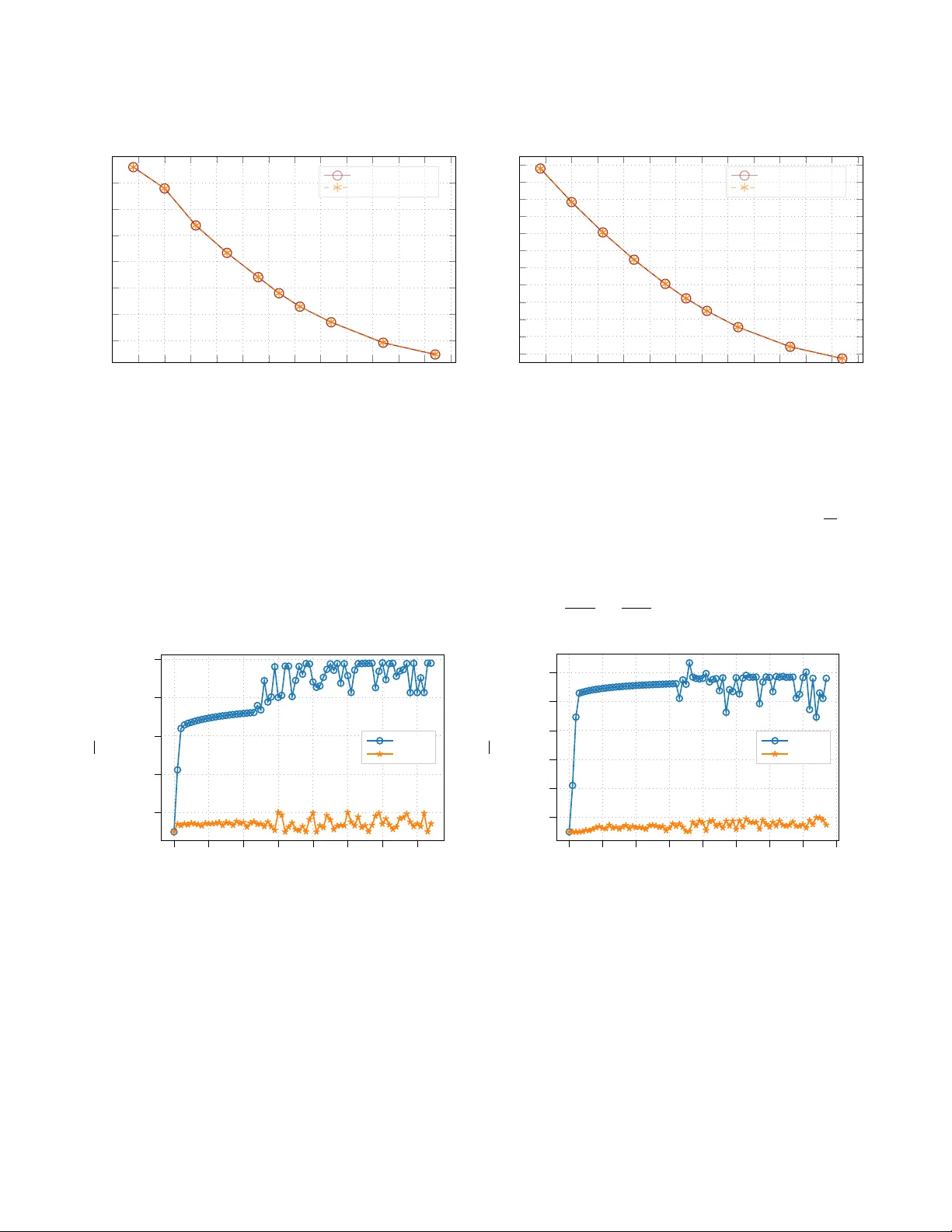
Optimal con trol with the shifted prop er orthogonal decomp osition via a first-reduce-then-optimize framew ork T obias Breiten ∗ † , Sh ubhadity a Burela ∗ † , Philipp Sc hulze ∗ † ‡ Marc h 31, 2026 Abstract Solving optimal control problems for transport-dominated partial differential equations (PDEs) can become computationally expensive, esp ecially when dealing with high-dimensional systems. T o ov ercome this c hallenge, w e fo cus on developing and deriving reduced-order mo dels that can replace the full PDE system in solving the optimal con trol problem. Sp ecifically , we explore the use of the shifted prop er orthogonal decomp osition (POD) as a reduced-order mo del, which is particularly effective for capturing low-dimensional representations of high- fidelit y transp ort-dominated phenomena. In this work, a reduced-order model is constructed first, follow ed by the optimization of the reduced system. W e consider a 1D linear adv ection equation problem and pro ve existence and uniqueness of solutions for the reduced-order mo del as well as the existence of an optimal control. Moreo ver, we compare the computational p erformance of the shifted POD method against the standard POD. Keyw ords: optimal control, model order reduction, shifted prop er orthogonal decomp osition AMS sub ject classifications: 35L02, 49M41, 49K20, 35Q35 1 In tro duction In this w ork, we discuss the use of reduced-order metho ds for an optimal control problem constrained by the li near advection equation ∂ t y ( t, x ) + v ∂ x y ( t, x ) = u ( t, x ) in (0 , T ] × (0 , l ) , y ( t, l ) = y ( t, 0) in (0 , T ) , y (0 , x ) = y 0 ( x ) in (0 , l ) , (1) where v ∈ R denotes a constant velocity and u is a control function to b e optimized. Throughout this pap er, we take a con trol theoretic p oin t of view and instead of the partial differential equation (PDE) in (1) fo cus on the abstract control system ˙ y ( t ) = A y ( t ) + B u ( t ) , t ∈ (0 , T ] , y (0) = y 0 , (2) where A : D ( A ) ⊂ L 2 (0 , l ) → L 2 (0 , l ) , A = − v d d x with D ( A ) = H 1 per (0 , l ) := { f ∈ H 1 (0 , l ) | f (0) = f ( l ) } is a densely defined and closed linear op erator generating a strongly contin uous (semi-)group, see, e.g., [ 67 , Examples 2.6.12 & 2.7.12, Thm. 3.8.6, ∗ {tobias.breiten@,burela@tnt.,pschulze@math.}tu-berlin.de † Institute of Mathematics, T ec hnische Univ ersität Berlin, Germany ‡ Institute of Mathematics, Universit y of Potsdam, Germany 1 Cor. 2.1.8, Prop. 2.3.1]. F or the control op erator B ∈ L ( U, H ) with H := L 2 (0 , l ) , U = R m , we assume that B u := m X k =1 b k u k , (3) with giv en control shape functions b k ∈ D ( A ) . Asso ciated with (2) , we consider a standard quadratic tracking-t yp e cost functional J ( y , u ) = 1 2 Z T 0 ∥ y ( t ) − y d ( t ) ∥ 2 H d t + µ 2 Z T 0 ∥ u ( t ) ∥ 2 U d t , (4) where µ > 0 and the desired state satisfies y d ∈ L 2 (0 , T ; H ) . Linear quadratic optimal control problems as in (2) - (4) are well understo od, and detailed treatises can b e found in, e.g., the monographs [ 35 , 66 ]. First-order necessary optimality conditions can b e derived straightforw ardly by means of the formal Lagrange metho d, leading to the adjoint equation, − ˙ λ ( t ) = A ∗ λ ( t ) + y ( t ) − y d ( t ) , t ∈ [0 , T ) , λ ( T ) = 0 , (5) and the optimality condition µu ( t ) + B ∗ λ ( t ) = 0 . F or the particular case considered here, w e hav e that A ∗ = −A = v d d x with D ( A ∗ ) = H 1 per (0 , l ) , see [67, Section 2.8]. Altogether, the first-order necessary optimality conditions read OC FOM := ˙ y ( t ) = A y ( t ) + B u ( t ) , t ∈ (0 , T ] , (6a) y (0) = y 0 , (6b) − ˙ λ ( t ) = A ∗ λ ( t ) + y ( t ) − y d ( t ) , t ∈ [0 , T ) , (6c) λ ( T ) = 0 , (6d) µu ( t ) + B ∗ λ ( t ) = 0 , t ∈ [0 , T ] . (6e) The optimal control problem consisting of (2) and (4) is rather standard and there exists a considerable amount of work dealing with more general control problems for hyperb olic PDEs. Let us for instance refer to [ 16 ] and [ 68 ] where nonlinear hyperb olic systems are studied. In [ 15 ], the authors discuss a bilinear optimal control problem for optical flow applications. Let us also p oin t to [ 49 ] where b oundary control problems for hyperb olic systems are considered from a classical con trol-theoretic viewp oin t. More recen t research, such as [ 20 ], inv estigates the optimal control of hyperb olic PDEs within the framework of optimal transp ort in W asserstein spaces. F or our rather simple case inv olving a 1D linear advection equation with p eriodic b oundary conditions and distributed L 2 con trol, results such as well-posedness of the state equation, existence of an optimal con trol or necessary optimalit y conditions follow straigh tforwardly with the techniques discussed in [66]. PDE-constrained optimal con trol problems are often difficult to solve numerically , as they lead to large-scale optimization c hallenges, particularly in higher spatial dimensions and/or in cases where a fine discretization is required. F or this reason, one is in terested in mathematical methods that reduce the complexity of the underlying dynamical system and speed up its sim ulation b y using reduced-order models (ROMs). Ov er the past three decades, significant progress has b een made in developing efficien t mo del order reduction (MOR) metho ds for linear quadratic (LQ) optimal control problems, with a particular fo cus on pro jection-based metho ds, see, e.g., [ 11 , 54 ]. These metho ds rely on pro jecting the dynamical system onto subspaces consisting of basis elements that con tain features of the exp ected solution. The reduced basis (RB) [ 11 ] method is one p opular approach, constructing a low-dimensional reduced basis space spanned by snapshots of the original solution. The reduced basis approximation is then efficiently obtained by Galerkin pro jection onto this space. Early research on RB metho ds for optimal control, such as [ 39 , 55 ], fo cused on flow problems, while later studies [ 51 , 48 ] extended RB metho ds to the optimal con trol of parametrized problems. Another MOR technique, balanced truncation (BT), transforms the state-space system into a balanced form, where the controllabilit y and observ ability Gramians are diagonal and equal, allowing states that are hard to observe and hard to reach to b e truncated. Applications of balanced truncation to PDE control problems hav e b een explored in works such as [10, 59]. Probably the most widely used MOR metho d for linear or nonlinear optimal control problems is prop er orthogonal decomp osi- tion (POD). Early applications of POD in optimal control can b e traced back to [ 56 , 45 ], where its use in flow control was explored. 2 POD has also b een effectively emplo yed to compute reduced-order con trollers [ 57 ] with nonlinear observers [ 7 ] and to design feedbac k as well as mo del predictive controllers [ 3 , 27 , 47 ]. Additionally , there has b een considerable research on error analysis for POD-based ROMs in optimal control. This includes analysis for nonlinear dynamical systems [ 36 ], abstract LQ systems [ 37 ], parab olic problems [ 31 , 63 ], and elliptic problems [ 40 ]. A comparison of a p osteriori error estimators for RB and POD metho ds in LQ optimal control problems was conducted in [ 64 ]. F urthermore, numerous successful applications of POD-based optimization hav e b een demonstrated in fields such as fluid dynamics and aero dynamic shap e optimization [ 38 , 21 ], chemistry [ 4 ], microfluidics [ 5 ], and finance [ 61 ]. One challenge with using the POD approach in optimal control problems is that the basis m ust b e precomputed based on a reference control, whic h may differ significantly from the final optimal control. As a result, the sub optimal control derived from the POD mo del may not provide a go od approximation of the full-order optimal control. T o address this, sev eral adaptive strategies hav e b een developed [ 1 , 57 , 2 , 30 ] that up date the POD basis during the optimization pro cess. Some of these metho ds hav e established strong mathematical foundations ov er the years, such as the optimality system POD (OSPOD) [ 46 ] and trust region POD (TRPOD) [ 6 ]. OSPOD addresses the issue of unmo deled dynamics by up dating the POD basis in the direction that minimizes the cost functional, ensuring that the POD-reduced system is computed from the tra jectory asso ciated with the optimal control. Conv ergence results and a-p osteriori error estimates for OSPOD hav e b een studied in [ 29 , 44 ]. TRPOD, on the other hand, manages mo del approximation quality within a trust-region framework by comparing the predicted reduction with the actual reduction in the mo del function v alue. The combination of trust region metho ds and mo del order reduction has also seen notable applications in recent years [12, 69]. While the use of ROMs for LQ con trol problems is no wada ys rather standard for parab olic problems, hyperb olic problems still p ose significant challenges, as they exhibit a slow er decay of the Kolmogoro v n -width [28, 53, 34], rendering many con ven tional MOR metho ds ineffective. This issue is esp ecially prev alent when dealing with transp ort-dominated fluid systems, such as propagating flame fronts or trav eling acoustic and sho c k wa ves [ 41 ]. The main goal of this work is to construct a ROM for (2) using the shifted prop er orthogonal decomp osition (sPOD) [ 58 , 42 ] and to determine an optimal control based on the resulting R OM. The sPOD alleviates the issue of the slow deca y of the Kolmogoro v n -width by utilizing a nonlinear approximation ansatz to capture the high-dimensional space, follo wed b y constructing the reduced-order appro ximation via a nonlinear Galerkin pro jection [ 14 , 13 ]. Other MOR techniques for transport-dominated systems include [ 60 ], which uses transp ort reversal and template fitting; [ 52 ], which employs transp ort maps; and [ 41 ], which approximates the field v ariable using a front shap e function and a level set function for efficien t mo del reduction. F or a detailed ov erview of MOR metho ds for transp ort-dominated problems, see [34]. Solving the original optimal control problem consistin g of (2) and (4) b y approximating the FOM using sPOD comes with some c hallenges, esp ecially since the nonlinear pro jection framework generically yields nonlinear reduced-order systems. With this context in mind, the following are the contributions of this pap er: • Under a smallness condition on the control u , in Theorem 3.1 we pro ve existence and uniqueness of solutions to the sPOD-Galerkin (sPOD-G) reduced-order mo del asso ciated with (2). • F or a sufficiently large regularization parameter µ , Theorem 3.2 shows the existence of an optimal control for the underlying reduced-order optimal control problem. • Theorem 3.3 provides necessary optimality conditions for the sPOD-G metho d applied to the linear advection equation. • A dditionally , in Proposition 2.2, we prop ose and later numerically prov e that the dimension of y ( t ) when shifted in a stationary frame of reference is b ounded from ab ov e for a sp ecific choice of control shap e functions b k . • W e examine the 1D linear adv ection test case with tw o different v ariations, a single tilt problem and a double tilt problem. W e then compare the results i n terms of reduced-order dimension, conv ergence b eha vior, and computational time for b oth the sPOD-G and POD-G metho ds. The structure of the pap er is as follows. In Section 2, we recall the basic ideas of POD and sPOD. W e briefly review the essential optimalit y conditions for the POD-G metho d in Section 3.1 and then, in Section 3.2, we thoroughly derive the sPOD-G metho d sp ecifically for the 1D linear advection equation. In Section 4, we presen t algorithmic details as well as the numerical results for the 1D linear advection equation, offering a detailed comparison and analysis of timings. Lastly , w e conclude with a summary of our findings in Section 5. 3 Notation W e use the notation R m × n for the space of m × n matrices with real entries and the transp ose of a matrix A is denoted with A ⊤ . Moreo ver, we often write vectors and matrices in terms of their comp onen ts, e.g., v = [ v i ] n i =1 ∈ R n , A = [ a ij ] n i,j =1 ∈ R n × n , or A = [ a ij ] m,n i,j =1 ∈ R m × n . The expressions ∥ v ∥ and ∥ A ∥ denote the Euclidean norm of the vector v and the sp ectral norm of the matrix A , resp ectiv ely . F or the partial deriv ative of a function f w.r.t. the v ariable x i , we write ∂ x i f . Throughout the pap er, we denote the Bo chner spaces of L p functions with p ≥ 1 in the interv al [ a, b ] with v alues in a Hilb ert space X b y L p ( a, b ; X ) and we set L p ( a, b ) : = L p ( a, b ; R ) . Similarly , for k ≥ 1 w e use the notation H k ( a, b ; X ) and H k ( a, b ) for the Bo c hner spaces with weak deriv atives up to order k in L 2 . Moreov er, we use H 1 per ( a, b ) for the Sob olev space of weakly differentiable functions with p eriodic b oundary conditions. The spaces of contin uous and contin uously differentiable functions from an interv al I ⊆ R to a Hilb ert space X are denoted with C ( I , X ) and C 1 ( I , X ) , resp ectiv ely , and we set C ( I ) : = C ( I , X ) and C 1 ( I ) : = C 1 ( I , X ) . The space of b ounded linear op erators betw een tw o Hilb ert spaces X and Y is denoted by L ( X, Y ) and we set L ( X ) : = L ( X, X ) . W e also often drop the explicit time dep endency from some terms for simplicity throughout the pap er. 2 Mo del order reduction metho ds In this section, we recall the most imp ortant steps for constructing ROMs by POD and sPOD. F or POD, the results are all w ell-known and can b e found in, e.g., [ 31 ]. F or the presentation of Galerkin reduced-order mo dels associated with sPOD, we closely follow the exp osition in [13]. 2.1 POD-Galerkin metho d Giv en tra jectories y ∈ C ([0 , T ]; D ( A )) obtained by solving (2) , consider snapshots y j = y ( t j ) ∈ D ( A ) for j = 1 , . . . , n t and define a snapshot set by Y := span n y ( t j ) | t j ∈ [0 , T ] for 1 ≤ j ≤ n t o ⊂ D ( A ) . Our aim is to iden tify a suitable -dimensional subspace Y ℓ ⊂ Y describ ed by the basis { φ 1 , . . . , φ ℓ } that minimizes the appro ximation error in y ( t ) ≈ ℓ X i =1 α i ( t ) φ i , (7) via the optimization problem min 1 2 Z T 0 y ( t ) − ℓ X i =1 D y ( t ) , φ i E H φ i 2 H d t, (8a) s.t. { φ i } ℓ i =1 ⊂ D ( A ) and ⟨ φ i , φ j ⟩ H = δ ij , i, j = 1 , . . . , . (8b) The spatial basis functions { φ i } ℓ i =1 are often referred to as POD basis or POD mo des, and α i ( t ) = ⟨ y ( t ) , φ i ⟩ H are the reduced states. F or a detailed analysis and solution pro cedure of this optimization problem, see, e.g., [32, 54]. After computing the POD basis, we are interested in deriving a low-dimensional approximation of (2) . F or this, we use the Galerkin ansatz (7) in (2) and subsequently use the Galerkin orthogonality condition to obtain D φ j , ℓ X i =1 ˙ α i ( t ) φ i E H − D φ j , ℓ X i =1 α i ( t ) A φ i E H − D φ j , B u ( t ) E H = 0 D φ j , ℓ X i =1 α (0) φ i E H = D φ j , y 0 E H 4 for j = 1 , . . . , . As a consequence, the low-dimensional reduced-order mo del is given as ˙ α ( t ) = A ℓ α ( t ) + B ℓ u ( t ) α (0) = α 0 (9) where A ℓ := ⟨ φ 1 , A φ 1 ⟩ H . . . ⟨ φ 1 , A φ ℓ ⟩ H . . . ⟨ φ ℓ , A φ 1 ⟩ H . . . ⟨ φ ℓ , A φ ℓ ⟩ H ∈ R ℓ × ℓ , B ℓ := ⟨ φ 1 , B e 1 ⟩ H . . . ⟨ φ 1 , B e m ⟩ H . . . ⟨ φ ℓ , B e 1 ⟩ H . . . ⟨ φ ℓ , B e m ⟩ H ∈ R ℓ × m , α 0 = [ ⟨ φ j , y 0 ⟩ H ] ℓ j =1 ∈ R ℓ . 2.2 sPOD-Galerkin metho d The discussion ab out to follow is inspired by the exposition describ ed in [ 13 ]. In contrast to standard POD, the sPOD metho d decomp oses y ( t ) using a nonlinear decomp osition ansatz y ( t ) ≈ r X i =1 α i ( t ) T i ( z i ( t )) φ i , (10) where z i ( t ) ∈ Z i , i = 1 , . . . , r are time-dep enden t shifts and T i : Z i → L ( H ) , i = 1 , . . . , r , are appropriately chosen transformation op erators. Throughout this manuscript, we will consider the case Z i = R . F or the transformation op erators, we assume that the space H is T i -in v ariant in the sense that T i ( z ) H ⊆ H for all z ∈ Z i and i = 1 , . . . , r . While a general choice of the transformation op erators is a challenge on its own, see [ 18 ], for sp ecific scenarios T i can b e designed by analyzing the underlying dynamics of the problem at hand. F or example, in the case of (1) , it makes sense to consider a shift semigroup as w e will discuss in more detail in Prop osition 2.2. Given T i , we aim to minimize the approximation error in (10) and consider the following minimization problem min 1 2 Z T 0 y ( t ) − r X i =1 α i ( t ) T i ( z i ( t )) φ i 2 H d t, (11a) s.t. { φ i } r i =1 ⊂ D ( A ) and ∥ φ i ∥ H = 1 , α i ∈ L 2 (0 , T ) , z i ∈ L 2 (0 , T ; Z i ) for i = 1 , . . . , r. (11b) A p oin t to note is that unlike the POD minimization problem where the mo des are required to form an orthonormal set, in sPOD, the shifted mo des {T i ( z i ( t )) φ i } r i =1 are chosen to b e just normalized and not necessarily orthonormal, see [13, Example 4.4]. As noted in [ 13 , Remark 1.1], the sPOD ansatz can b e simplified by considering the same transformation op erator with the same shifts for different mo des φ i , i.e., y ( t ) ≈ K X k =1 ℓ k X i =1 α k,i ( t ) T k ( z k ( t )) φ k,i . (12) In particular, if we consider only a single time-dep enden t shift z ( t ) ∈ R and a corresp onding transformation op erator T : R → L ( H ) , this expression further simplifies according to y ( t ) = ˜ ℓ X i =1 α i ( t ) T ( z ( t )) φ i . (13) In the context of the linear advection equation considered here, this choice is motiv ated b y the dynamics b eing characterized by a single trav eling w av e with constant velocity v . Subsequently , the minimization problem (11a) is simplified to min 1 2 Z T 0 y ( t ) − T ( z ( t )) ˜ ℓ X i =1 α i ( t ) φ i 2 H d t, (14a) s.t. { φ i } ˜ ℓ i =1 ⊂ D ( A ) and ∥ φ i ∥ H = 1 , ⟨ φ i , φ j ⟩ H = δ ij , α i ∈ L 2 (0 , T ) for i, j = 1 , . . . , ˜ . (14b) 5 Under the assumption that T is isometric and the shift function z ∈ L 2 (0 , T ) is given, problem (14a) is solv able and its solution can b e obtained equiv alently via a POD minimization of the transformed data T ∗ ( z ( t )) y ( t ) , t ∈ [0 , T ] , see [ 13 , Theorem 4.8]. With regard to the assumptions on T and in view of the dynamics in (1) , from no w on we fo cus on the p erio dic shift op erator T : R → L ( L 2 (0 , l )) defined via T ( z ) φ ( x ) = ( φ ( x − η ) for η ≤ x ≤ l, φ ( x − η + l ) for 0 ≤ x < η (15) with η : = z mod l , see e.g. [ 62 , Def. 1.2.2]. Esp ecially , this choice ensures that T is isometric and that H = H 1 per (0 , l ) is a T ( z ) -in v ariant subspace for any z ∈ R . Remark 2.1. Note that if φ is sufficiently r e gular, we have that T ′ ( z ) φ := d d z ( T ( z ) φ ) = −T ( z ) φ ′ and T ′′ ( z ) φ = T ( z ) φ ′′ . In p articular, it holds that T ∗ ( z ) = T ( − z ) = T − 1 ( z ) . W e pro ceed by constructing a ROM for (2) via a nonlinear Galerkin pro jection, also known as the Dirac–F renkel v ariational principle, cf. [24, 26, 50], and obtain M 1 ( z ( t )) N ( z ( t )) α ( t ) α ( t ) ⊤ N ( z ( t )) ⊤ α ( t ) ⊤ M 2 ( z ( t )) α ( t ) ˙ α ( t ) ˙ z ( t ) = A 1 ( z ( t )) 0 α ( t ) ⊤ A 2 ( z ( t )) 0 α ( t ) z ( t ) + B 1 ( z ( t )) α ( t ) ⊤ B 2 ( z ( t )) u ( t ) where M 1 , N , M 2 : R → R ˜ ℓ × ˜ ℓ are defined via M 1 ( z ) := ⟨T ( z ) φ i , T ( z ) φ j ⟩ H ˜ ℓ i,j =1 , N ( z ) := ⟨T ( z ) φ i , T ′ ( z ) φ j ⟩ H ˜ ℓ i,j =1 , M 2 ( z ) := ⟨T ′ ( z ) φ i , T ′ ( z ) φ j ⟩ H ˜ ℓ i,j =1 On the right-hand side, we hav e A 1 , A 2 : R → R ˜ ℓ × ˜ ℓ and B 1 , B 2 : R → R ˜ ℓ × m whic h are defined via A 1 ( z ) := ⟨T ( z ) φ i , A T ( z ) φ j ⟩ H ˜ ℓ i,j =1 , A 2 ( z ) := ⟨T ′ ( z ) φ i , A T ( z ) φ j ⟩ H ˜ ℓ i,j =1 , (16a) B 1 ( z ) := ⟨T ( z ) φ i , B e j ⟩ H ˜ ℓ,m i,j =1 , B 2 ( z ) := ⟨T ′ ( z ) φ i , B e j ⟩ H ˜ ℓ,m i,j =1 . (16b) F ollowing the assumptions mentioned in [ 13 , Section 6], with our sp ecific choice of T , w e can further simplify the ROM by eliminating the explicit dep endency on the shift z in M 1 , N , M 2 , A 1 , and A 2 . Subsequently , these matrices can b e written as M 1 = I ˜ ℓ , N = − ⟨ φ i , φ ′ j ⟩ H ˜ ℓ i,j =1 , M 2 = ⟨ φ ′ i , φ ′ j ⟩ H ˜ ℓ i,j =1 , A 1 = ⟨ φ i , A φ j ⟩ H ˜ ℓ i,j =1 , A 2 = − ⟨ φ ′ i , A φ j ⟩ H ˜ ℓ i,j =1 , (17) where we exploited that the mo des { φ i } ˜ ℓ i =1 are orthonormal. Moreo ver, w e find that A 1 = v N , A 2 = v M 2 . This further simplifies the ROM as follows I ˜ ℓ N α ( t ) α ( t ) ⊤ N ⊤ α ( t ) ⊤ M 2 α ( t ) ˙ α ( t ) ˙ z ( t ) = v N 0 α ( t ) ⊤ M 2 0 α ( t ) z ( t ) + B 1 ( z ( t )) α ( t ) ⊤ B 2 ( z ( t )) u ( t ) . (18) As for the initial condition of the reduced system, for given z (0) we choose α (0) such that the approximation error in y 0 ≈ ˜ ℓ X i =1 α i (0) T ( z (0)) φ i is minimized. Performing an orthogonal pro jection onto the span of the shifted mo des {T ( z (0)) φ j } ˜ ℓ j =1 , this leads to ⟨T ( z (0)) φ j , y 0 ⟩ H = D T ( z (0)) φ j , ˜ ℓ X i =1 α i (0) T ( z (0)) φ i E H = D φ j , ˜ ℓ X i =1 α i (0) φ i E H = α j (0) for j = 1 , . . . , ˜ . Assuming z (0) = z 0 = 0 and, hence, T ( z 0 ) = I n , it follows that α (0) = [ ⟨ φ j , y 0 ⟩ H ] ˜ ℓ j =1 ∈ R ˜ ℓ is the orthogonal pro jection of the initial v alue y 0 on to the span of the mo des { φ j } ˜ ℓ j =1 . 6 The choice of the shift op erator T significan tly influences the p erformance of the sPOD method which will only b e practicable if the singular v alues asso ciated with the transformed snapshot set decay rapidly . If the shap e functions b k in the control term can be chosen freely , for op erators A generating a strongly contin uous group S ( t ) the following proposition demonstrates how certain choices of the shap e functions may possibly lead to a low rank of the transformed snapshot matrix. Prop osition 2.2. Consider an abstr act c ontr ol system of the form (2) with A : D ( A ) ⊂ H → H b eing the infinitesimal gener ator of a strongly c ontinuous group S ( t ) ∈ L ( H ) , H a Hilbert sp ac e, y 0 ∈ H , u ∈ L 2 (0 , T ; U ) with U = R m , and B ∈ L ( U, H ) defined via (3) with b 1 , . . . , b m ∈ D ( A ) . Mor e over, let span { b 1 , . . . , b m } b e an A -invariant subsp ac e. Then, ther e exists a family of line ar op er ators T : R → L ( H ) such that for any given set of discr ete time points t 1 , . . . , t n t ∈ [0 , T ] we have dim(span {T ( t 1 ) y ( t 1 ) , . . . , T ( t n t ) y ( t n t ) } ) ≤ min( m + 1 , n t ) , wher e y denotes the mild solution of (2) . Pr o of. The mild solution is giv en by y ( t ) = S ( t ) y 0 + Z t 0 S ( t − s ) B u ( s ) d s = S ( t ) y 0 + Z t 0 S ( t − s ) m X k =1 b k u k ( s ) d s = S ( t ) y 0 + Z t 0 S ( − s ) m X k =1 b k u k ( s ) d s ! , see e.g. [ 23 , Def. 3.1.4]. Since span { b 1 , . . . , b m } is an A -in v ariant subspace, it is also an S ( − s ) -in v ariant subspace [ 23 , Lemma 2.5.4]. Hence, there exist β 1 ,k , . . . , β m,k : [0 , T ] → R for k = 1 , . . . , m such that y ( t ) = S ( t ) y 0 + m X i =1 b i m X k =1 Z t 0 β i,k ( s ) u k ( s ) d s ! . Consequen tly , choosing T ( t ) = S ( − t ) , for any j ∈ { 1 , . . . , n t } we obtain T ( t j ) y ( t j ) = y 0 + m X i =1 b i m X k =1 Z t 0 β i,k ( s ) u k ( s ) d s ∈ span { y 0 , b 1 , . . . , b m } . In the numerical examples, we will use this strategy and consider b k as real-v alued functions representing pairs of complex conjugate eigenfunctions of the op erator A = − v d d x . 3 Optimal con trol with reduced-order mo dels In this section, we briefly recall standard first-order necessary optimality conditions for the POD-G metho d. Subsequently , we establish theoretical results regarding the existence of solutions to the reduced optimal control problem associated with the sPOD-G metho d. In particular, we show the existence of a solution to the reduced state equation provided u is small enough and, as a consequence, obtain the existence of an optimal con trol if the regularization parameter µ is c hosen large enough. W e also deriv e the necessary optimality conditions for the underlying optimal control problem. 7 3.1 POD-based optimal con trol As the POD reduced state equation (9) is linear, deriving the asso ciated optimality system is straightforw ard and yields OC POD − G := ˙ α ( t ) = A ℓ α ( t ) + B ℓ u ( t ) , (19a) α (0) = α 0 , (19b) − ˙ λ ℓ ( t ) = A ⊤ ℓ λ ℓ ( t ) + α ( t ) − ˆ y d ( t ) , (19c) λ ℓ ( T ) = 0 , (19d) µu ( t ) + B ⊤ ℓ λ ℓ ( t ) = 0 . (19e) The first t wo equations are the reduced-order state equations already given in (9) . Equations (19c) - (19d) are the reduced- order adjoint equations derived from the reduced-order state equation. Here, λ ℓ ( t ) ∈ R ℓ is the reduced adjoint and ˆ y d ( t ) = [ ⟨ φ j , y d ( t ) ⟩ H ] ℓ j =1 ∈ R ℓ . Equation (19e) is the optimality condition for the control. Let us emphasize that (19a) - (19e) corresp ond to the (constrained) minimization of the cost functional (4) given as J POD − G ( α, u ) = 1 2 Z T 0 ℓ X i =1 α i ( t ) φ i − y d ( t ) 2 H d t + µ 2 Z T 0 ∥ u ( t ) ∥ 2 U d t. (20) 3.2 sPOD-based optimal con trol F or the sPOD-G metho d, we consider the optimization problem min u ∈ L 2 (0 ,T ; U ) J sPOD − G ( α, z , u ) := 1 2 Z T 0 ˜ ℓ X i =1 α i ( t ) T ( z ( t )) φ i − y d ( t ) 2 H d t + µ 2 Z T 0 ∥ u ( t ) ∥ 2 U d t s.t. (18) , α (0) = α 0 , z (0) = z 0 . (21) Note that, in contrast to the previous subsection, w e are faced with an optimal control problem that is constrained b y the nonlinear reduced state equation (21) for which we understand solutions in the sense of Carathéo dory , see, e.g., [ 33 , Chapter I.5.1]. W e obtain the following well-p osedness result for the nonlinear reduced-order equation. Theorem 3.1. F or given l, T > 0 , φ 1 , . . . , φ ˜ ℓ ∈ C 1 per ([0 , l ]) : = { φ ∈ C 1 ([0 , l ]) | φ (0) = φ ( l ) , φ ′ (0) = φ ′ ( l ) } orthonormal w.r.t. ⟨· , ·⟩ H , u ∈ L 2 (0 , T ; U ) , b 1 , . . . , b m ∈ H 1 per (0 , l ) \ { 0 } we c onsider the ROM (18) with c o efficient matric es sp e cifie d in (16b) , (17) , p erio dic shift op er ator T and c ontr ol op er ator B as define d in (15) and (3) , r esp e ctively, and H = L 2 (0 , l ) , U = R m . Mor e over, let φ 1 , . . . , φ ˜ ℓ , φ ′ 1 , . . . , φ ′ ˜ ℓ b e line arly indep endent, α 0 ∈ R ˜ ℓ \ { 0 } and z 0 ∈ R b e given initial values, and u satisfy ∥ u ∥ 2 L 2 (0 ,T ; U ) < ∥ α 0 ∥ 2 ∥B ∥ 2 L ( U,H ) exp(1) T ˜ . (22) Then, the initial value pr oblem c onsisting of (18) and α (0) = α 0 , z (0) = z 0 has a unique solution ( α, z ) ∈ H 1 (0 , T ; R ˜ ℓ ) × H 1 (0 , T ) . In addition, there exists a c onstant C > 0 with max( ∥ α ∥ H 1 (0 ,T ; R ˜ ℓ ) , ∥ z ∥ H 1 (0 ,T ) ) ≤ C . (23) Pr o of. By assumption { φ i , φ ′ i } , i = 1 , . . . , ˜ are linearly indep enden t and α (0) = 0 . As a consequence, we obtain the inv ertibility of the matrix I ˜ ℓ N α (0) α (0) ⊤ N ⊤ α (0) ⊤ M 2 α (0) = I ˜ ℓ 0 0 α (0) ⊤ I ˜ ℓ N N ⊤ M 2 | {z } M c I ˜ ℓ 0 0 α (0) 8 since M c is the (positive defin ite) Gramian matrix asso ciated with { φ i , φ ′ i } , i = 1 , . . . , ˜ . Since the set of p ositiv e definite matrices is op en, we can thus find a neighborho od around (0 , α (0) , z (0)) on which (18) can b e expressed as an explicit ODE of the form ˙ α ˙ z = I ˜ ℓ N α α ⊤ N ⊤ α ⊤ M 2 α − 1 v N 0 α ⊤ M 2 0 α z + B 1 ( z ) α ⊤ B 2 ( z ) u . (24) Due to the con tinuous differentiabilit y of the mo des, the prop erties of the shift op erator, cf. Remark 2.1, and the fact that u is in L 2 (0 , T ; U ) , the right-hand side satisfies the assumptions of Theorems 5.2 and 5.3 in [ 33 ], which yields that there exists a maximal interv al of existence [0 , ˜ t ) with ˜ t > 0 or [0 , ∞ ) for which we hav e a unique solution ( α, z ) in the sense of Carathéo dory . Moreo ver, for the case of a finite maximal interv al of existence, ( α ( t ) , z ( t )) tends to the b oundary of the domain of definition of the right-hand side in (24) as t tends to ˜ t , i.e., we hav e ∥ ( α ( t ) , z ( t )) ∥ → ∞ or α ( t ) → 0 as t → ˜ t . W e pro ceed by showing that ( α, z ) remain b ounded from ab ov e and that α remains b ounded from b elow on [0 , T ] . W e b egin by multiplying the first equation in (18) with α ⊤ whic h, since we ha ve N = − N ⊤ leads to 1 2 d d s ∥ α ( s ) ∥ 2 = α ( s ) ⊤ ˙ α ( s ) = α ( s ) ⊤ B 1 ( z ( s )) u ( s ) . (25) In tegration ov er [0 , t ] with t < ˜ t thus yields ∥ α ( t ) ∥ 2 = ∥ α (0) ∥ 2 + 2 Z t 0 α ( s ) ⊤ B 1 ( z ( s )) u ( s ) d s. Using the Cauch y-Sc hw arz and Y oung’s inequality for > 0 , we subsequently obtain ∥ α ( t ) ∥ 2 ≤ ∥ α (0) ∥ 2 + 2 Z t 0 ∥ α ( s ) ∥ 2 d s + 1 2 Z t 0 ∥ B 1 ( z ( s )) u ( s ) ∥ 2 d s. (26) Recalling the definition of B 1 ( z ( s )) = [ ⟨T ( z ( s )) φ i , B e j ⟩ H ] ˜ ℓ,m i,j =1 , using that T ( z ( s )) is an isometry on H and orthonormality of φ i , w e find that ∥ B 1 ( z ( s )) u ( s ) ∥ 2 = ˜ ℓ X i =1 |⟨T ( z ( s )) φ i , B u ( s ) ⟩ H | 2 ≤ ˜ ∥B ∥ 2 L ( U,H ) ∥ u ( s ) ∥ 2 U . (27) Returning to (26), the previous estimate implies ∥ α ( t ) ∥ 2 ≤ ∥ α (0) ∥ 2 + 2 Z t 0 ∥ α ( s ) ∥ 2 d s + ˜ ∥B ∥ 2 L ( U,H ) 2 ∥ u ∥ 2 L 2 (0 ,t ; U ) whic h, using Grönw all’s inequality , also yields ∥ α ( t ) ∥ 2 ≤ ∥ α (0) ∥ 2 + ∥B ∥ 2 L ( U,H ) ˜ 2 ∥ u ∥ 2 L 2 (0 ,t ; U ) ! e R t 0 ϵ 2 d s . If u is small as announced in the theorem, we can contin ue with ∥ α ( t ) ∥ 2 < ∥ α (0) ∥ 2 (1 + 1 exp(1) ϵ 2 T ) e ϵ 2 T ≤ ∥ α (0) ∥ 2 ( e + 1) . (28) where in the last inequality we set 2 = 1 T > 0 to mini mize the upp er b ound. F or a low er b ound on ∥ α ( s ) ∥ , we conclude from (25) that d d s ∥ α ( s ) ∥ 2 = 2 α ( s ) ⊤ B 1 ( z ( s )) u ( s ) ≥ − 2 ˜ ℓ X i =1 | α i ( s ) |∥T ( z ( s )) φ i ∥ H ∥B ∥ L ( U,H ) ∥ u ( s ) ∥ U . 9 Similarly as b efore, we can utilize the p roperties of T ( z ( s )) and φ i as well as Y oung’s inequality (with 2 = 1 T ) to arrive at d d s ∥ α ( s ) ∥ 2 ≥ − 1 T ∥ α ( s ) ∥ 2 − T ˜ ∥B ∥ 2 L ( U,H ) ∥ u ( s ) ∥ 2 U . As a consequence, it holds that d d s (e s T ∥ α ( s ) ∥ 2 ) = 1 T e s T ∥ α ( s ) ∥ 2 + e s T d d s ∥ α ( s ) ∥ 2 ≥ 1 T e s T ∥ α ( s ) ∥ 2 + e s T − 1 T ∥ α ( s ) ∥ 2 − T ˜ ∥B ∥ 2 L ( U,H ) ∥ u ( s ) ∥ 2 U = − e s T T ˜ ∥B ∥ 2 L ( U,H ) ∥ u ( s ) ∥ 2 U . In tegration ov er [0 , t ] with t < ˜ t shows that e t T ∥ α ( t ) ∥ 2 ≥ ∥ α (0) ∥ 2 − T ˜ ∥B ∥ 2 L ( U,H ) Z t 0 e s T ∥ u ( s ) ∥ 2 U d s as well as ∥ α ( t ) ∥ 2 ≥ e − t T ∥ α (0) ∥ 2 − T ˜ ∥B ∥ 2 L ( U,H ) Z t 0 e s − t T ∥ u ( s ) ∥ 2 U d s ≥ e − 1 ∥ α (0) ∥ 2 − T ˜ ∥B ∥ 2 L ( U,H ) ∥ u ∥ 2 L 2 (0 ,t ; U ) . F rom here, we conclude that ∥ α ( t ) ∥ remains b ounded aw ay from zero if ∥ u ∥ 2 L 2 (0 ,t ; U ) ≤ ∥ u ∥ 2 L 2 (0 ,T ; U ) < ∥ α (0) ∥ 2 ∥B ∥ 2 L ( U,H ) exp(1) T ˜ . Defining ζ := ∥ α (0) ∥ 2 ∥B∥ 2 L ( U,H ) exp(1) T ˜ ℓ − ∥ u ∥ 2 L 2 (0 ,T ; U ) , we in particular hav e shown that T ˜ ∥B ∥ 2 L ( U,H ) ζ < ∥ α ( t ) ∥ 2 < ( e + 1) ∥ α (0) ∥ 2 (29) for all t ∈ [0 , ˜ t ) . F or b ounds on z , w e define g ( t ) := α ( t ) ⊤ ( M 2 − N ⊤ N ) α ( t ) and first note that this term is uniformly b ounded a wa y from 0 since ∥ α ( t ) ∥ > ∥B ∥ L ( U,H ) q T ˜ ζ and M 2 − N ⊤ N is the p ositiv e definite Sch ur complement of the I ˜ ℓ -blo c k of the p ositiv e definite matrix M c . Using the representation ˙ α = − N α ˙ z + v N α + B 1 ( z ) u in the second equation of (18) w e obtain ˙ z ( t ) = v + g ( t ) − 1 α ( t ) ⊤ ( B 2 ( z ( t )) u ( t ) − N ⊤ B 1 ( z ( t )) u ( t )) (30) as well as z ( t ) = z (0) + vt + Z t 0 g ( s ) − 1 α ( s ) ⊤ ( B 2 ( z ( s )) u ( s ) − N ⊤ B 1 ( z ( s )) u ( s )) d s. Utilizing (27) and (29), it follows that | z ( t ) | ≤ | z (0) | + | v | T + √ e + 1 ∥ α (0) ∥ Z t 0 | g ( s ) | − 1 ( ∥ B 2 ( z ( s )) u ( s ) ∥ + p ˜ ∥ N ∥∥B ∥ L ( U,H ) ∥ u ( s ) ∥ U ) d s. (31) With arguments similar to those provided for (27) and using Remark 2.1, we can show that ∥ B 2 ( z ( s )) u ( s ) ∥ = ˜ ℓ X i =1 |⟨T ′ ( z ( s )) φ i , B u ( s ) ⟩ H | = ˜ ℓ X i =1 |⟨T ( z ( s )) φ ′ i , B u ( s ) ⟩ H | ≤ C ϕ ′ ∥B ∥ L ( U,H ) ∥ u ( s ) ∥ U (32) 10 where C ϕ ′ = P ˜ ℓ i =1 ∥ φ ′ i ∥ H . F rom the low er b ound in (29) w e find | g ( t ) | > T ˜ ∥B ∥ 2 L ( U,H ) ζ λ min where λ min denotes the smallest eigen v alue of the p ositiv e definite matrix M 2 − N ⊤ N . Combining this estimate with (32), we can return to (31) to conclude | z ( t ) | ≤ | z (0) | + | v | T + √ e + 1( T ˜ ∥B ∥ 2 L ( U,H ) ζ λ min ) − 1 ∥ α (0) ∥∥B ∥ L ( U,H ) p ˜ ∥ N ∥ + C ϕ ′ Z t 0 ∥ u ( s ) ∥ U d s and, in particular, that ∥ z ∥ L ∞ (0 , ˜ t ) ≤ C 1 (1 + | z (0) | + ∥ α (0) ∥∥ u ∥ L 2 (0 ,T ; U ) ) (33) for some constant C 1 , indep endent of ˜ t. T ogether with (29) this shows that the solution ( α ( t ) , z ( t )) remains b ounded on [0 , ˜ t ) , implying it exists globally on [0 , T ] . F or the a priori b ounds (23), we first revisit (30) to obtain a constant C 2 suc h that | ˙ z ( t ) | ≤ C 2 (1 + ∥ u ( t ) ∥ U ) for almost every t in [0 , T ] . Squaring and integrating b oth sides, together with (33) readily yields the b ound for ∥ z ∥ H 1 (0 ,T ) . Finally , from the first equation in (18) it follows that there exists a constant C 3 > 0 with ∥ ˙ α ∥ L 2 (0 ,T ; R ˜ ℓ ) ≤ ∥ N ∥∥ α ˙ z ∥ L 2 (0 ,T ; R ˜ ℓ ) + | v |∥ N ∥∥ α ∥ L 2 (0 ,T ; R ˜ ℓ ) + ∥ B 1 ( z ) u ∥ L 2 (0 ,T ; R ˜ ℓ ) ≤ C 3 ( ∥ α ∥ L ∞ (0 ,T ; R ˜ ℓ ) ∥ ˙ z ∥ L 2 (0 ,T ) + ∥ α ∥ L 2 (0 ,T ; R ˜ ℓ ) + ∥ u ∥ L 2 (0 ,T ; U ) ) whic h finishes the pro of. As we can exploit that by increasing the regularization parameter µ > 0 , the previous smallness condition on the control can b e enforced, we also obtain the existence of a minimizer. Theorem 3.2. L et the assumptions of The or em 3.1 b e satisfie d. Then, for given y d ∈ L 2 (0 , T ; H ) and sufficiently lar ge µ > 0 , ther e exists an optimal c ontr ol ¯ u to (21) . Pr o of. F rom Theorem 3.1 we know that for u = 0 there exists a unique solution ( α, z ) to (18) . F rom the a priori b ounds (23) w e conclude that u = 0 is feasible for (21) . Moreov er, for sufficiently large µ > 0 , we can restrict the set of admissible inputs U ad ⊂ L 2 (0 , T ; U ) to those satisfying the b ound (22) since other inputs will lead to v alues of the cost function which are larger than for u = 0 . Thus, by Theorem 3.1 there exists a unique solution ( α, z ) to the initial v alue problem consisting of (18) and α (0) = α 0 , z (0) = z 0 for an y admissible input. By abuse of notation, we use ( α ( u ) , z ( u )) in the follo wing to denote the unique solution for a given admissible input u . Let { u n } ⊂ U ad denote a minimizing sequence for (21), i.e., lim n →∞ J sPOD − G ( α n , z n , u n ) = inf u ∈U ad J sPOD − G ( α ( u ) , z ( u ) , u ) | {z } = : J ( u ) with ( α n , z n ) : = ( α ( u n ) , z ( u n )) b ounded in H 1 (0 , T ; R ˜ ℓ ) × H 1 (0 , T ) . Subsequently , we get u n ¯ u in L 2 (0 , T ; U ) , α n ¯ α in H 1 (0 , T ; R ˜ ℓ ) , z n ¯ z in H 1 (0 , T ) (34) for subsequences denoted in the same manner, see e.g. Theorem 3 in [ 25 , App. D.4]. In addition, since the mappings x 7→ x and x 7→ ˙ x from H 1 (0 , T ) to L 2 (0 , T ) are con tinuous, we also get α n ¯ α , ˙ α n ˙ ¯ α in L 2 (0 , T ; R ˜ ℓ ) as w ell as z n ¯ z , ˙ z n ˙ ¯ z in L 2 (0 , T ) , cf. [ 17 , Thm. 3.10]. F rom classical Sob olev embeddings, cf. [ 17 , Thm. 8.8], we obtain H 1 (0 , T ; R d ) → L ∞ (0 , T ; R d ) as w ell as H 1 (0 , T ; R d ) compact → C ([0 , T ]; R d ) , which implies α n → ¯ α in C ([0 , T ]; R ˜ ℓ ) , z n → ¯ z in C ([0 , T ]) , (35) see e.g. [43, Thm. 8.1-7]. Let us show that ( ¯ α, ¯ z ) = ( α ( ¯ u ) , z ( ¯ u )) . 11 F or arbitrary but fixed q ∈ L 2 (0 , T ; R ˜ ℓ ) , the first equation in (18) implies ⟨ ˙ α n , q ⟩ L 2 (0 ,T ; R ˜ ℓ ) + ⟨ N α n ˙ z n , q ⟩ L 2 (0 ,T ; R ˜ ℓ ) = ⟨ v N α n , q ⟩ L 2 (0 ,T ; R ˜ ℓ ) + ⟨ [ ⟨T ( z n ) φ i , B u n ⟩ H ] ˜ ℓ i =1 , q ⟩ L 2 (0 ,T ; R ˜ ℓ ) . F rom (34) , w e obtain ⟨ ˙ α n , q ⟩ L 2 (0 ,T ; R ˜ ℓ ) → ⟨ ˙ ¯ α, q ⟩ L 2 (0 ,T ; R ˜ ℓ ) as well as ⟨ v N α n , q ⟩ L 2 (0 ,T ; R ˜ ℓ ) → ⟨ v N ¯ α, q ⟩ L 2 (0 ,T ; R ˜ ℓ ) . F or the second term on the left hand side, we first obtain |⟨ N α n ˙ z n , q ⟩ L 2 (0 ,T ; R ˜ ℓ ) − ⟨ N ¯ α ˙ ¯ z , q ⟩ L 2 (0 ,T ; R ˜ ℓ ) | ≤ |⟨ N ( α n − ¯ α ) ˙ z n , q ⟩ L 2 (0 ,T ; R ˜ ℓ ) | + |⟨ N ¯ α ( ˙ z n − ˙ ¯ z ) , q ⟩ L 2 (0 ,T ; R ˜ ℓ ) | . F rom the Cauch y-Sch warz and generalized Hölder’s inequality , cf. [22, Thm. I I.1.5], it follows that |⟨ N ( α n − ¯ α ) ˙ z n , q ⟩ L 2 (0 ,T ; R ˜ ℓ ) | ≤ ∥ q ⊤ N ( α n − ¯ α ) ∥ L 2 (0 ,T ; R ˜ ℓ ) ∥ ˙ z n ∥ L 2 (0 ,T ) ≤ ∥ N ⊤ q ∥ L 2 (0 ,T ; R ˜ ℓ ) ∥ α n − ¯ α ∥ L ∞ (0 ,T ; R ˜ ℓ ) ∥ ˙ z n ∥ L 2 (0 ,T ) whic h conv erges to 0 as α n → ¯ α in C ([0 , T ]; R ˜ ℓ ) and z n is b ounded in H 1 (0 , T ) . Since ¯ α ∈ H 1 (0 , T ; R ˜ ℓ ) → C ([0 , T ]; R ˜ ℓ ) we conclude that ¯ α ⊤ N ⊤ q ∈ L 2 (0 , T ) and hence ⟨ N ¯ α ˙ z n , q ⟩ L 2 (0 ,T ; R ˜ ℓ ) = ⟨ ˙ z n , ¯ α ⊤ N ⊤ q ⟩ L 2 (0 ,T ) → ⟨ ˙ ¯ z , ¯ α ⊤ N ⊤ q ⟩ L 2 (0 ,T ) = ⟨ N ¯ α ˙ ¯ z , q ⟩ L 2 (0 ,T ; R ˜ ℓ ) . F or the controlled term in the first equation of (18), let us first note that it holds ⟨ [ ⟨T ( z n ) φ i , B u n ⟩ H ] ˜ ℓ i =1 , q ⟩ L 2 (0 ,T ; R ˜ ℓ ) − ⟨ [ ⟨T ( ¯ z ) φ i , B ¯ u ⟩ H ] ˜ ℓ i =1 , q ⟩ L 2 (0 ,T ; R ˜ ℓ ) = ˜ ℓ X i =1 ⟨ ( T ( z n ) − T ( ¯ z )) φ i q i , B u n ⟩ L 2 (0 ,T ; H ) + ⟨T ( ¯ z ) φ i q i , B ( u n − ¯ u ) ⟩ L 2 (0 ,T ; H ) . Using the b oundedness of B u n in L 2 (0 , T ; H ) , the fact that q i ∈ L 2 (0 , T ) as w ell as T ( · ) φ i ∈ C 1 ( R ; H ) and z n → ¯ z in C ([0 , T ]) , the first term con verges to 0 . F or the second term, con vergence to 0 follows from the fact that T ( ¯ z ) φ i q i ∈ L 2 (0 , T ; H ) and the w eak conv ergence of u n ¯ u in L 2 (0 , T ; U ) . Thus, ¯ α and ¯ z indeed satisfy the first equation in L 2 (0 , T ; R ˜ ℓ ) . Recall that for arbitrary but fixed p ∈ L 2 (0 , T ) , the triplet ( α n , z n , u n ) satisfies ⟨ α ⊤ n N ⊤ ˙ α n , p ⟩ L 2 (0 ,T ) + ⟨ α ⊤ n M 2 α n ˙ z n , p ⟩ L 2 (0 ,T ) = ⟨ v α ⊤ n M 2 α n , p ⟩ L 2 (0 ,T ) + ⟨ α ⊤ n [ ⟨T ′ ( z n ) φ i , B u n ⟩ H ] ˜ ℓ i =1 , p ⟩ L 2 (0 ,T ) . W e will show conv ergence only for the second and the fourth term in this equation as the other tw o follow with almost identical argumen ts. Starting from ⟨ α ⊤ n M 2 α n ˙ z n , p ⟩ L 2 (0 ,T ) − ⟨ ¯ α ⊤ M 2 ¯ α ˙ ¯ z , p ⟩ L 2 (0 ,T ) = ⟨ ˙ z n , p ( α ⊤ n M 2 α n − ¯ α ⊤ M 2 ¯ α ) ⟩ L 2 (0 ,T ) + ⟨ ˙ z n − ˙ ¯ z , p ¯ α ⊤ M 2 ¯ α ⟩ L 2 (0 ,T ) with the Cauch y-Sc hw arz and generalized Hölder’s inequalities we obtain ⟨ ˙ z n , p ( α ⊤ n M 2 α n − ¯ α ⊤ M 2 ¯ α ) ⟩ L 2 (0 ,T ) ≤ ∥ ˙ z n ∥ L 2 (0 ,T ) ∥ p ( α ⊤ n M 2 α n − ¯ α ⊤ M 2 ¯ α ) ∥ L 2 (0 ,T ) ≤ ∥ ˙ z n ∥ L 2 (0 ,T ) ∥ p ∥ L 2 (0 ,T ) ∥ α ⊤ n M 2 α n − ¯ α ⊤ M 2 ¯ α ∥ L ∞ (0 ,T ) . Next, we can use bound edness of z n in H 1 (0 , T ) and α n → ¯ α in C ([0 , T ]; R ˜ ℓ ) to conclude conv ergence to 0 . F or the term ⟨ ˙ z n − ˙ ¯ z , p ¯ α ⊤ M 2 ¯ α ⟩ L 2 (0 ,T ) , w e note that p ¯ α ⊤ M 2 ¯ α ∈ L 2 (0 , T ) b y the generalized Hölder’s inequality which implies conv ergence to 0 since z n ¯ z in H 1 (0 , T ) . F or the con vergence of the controlled term, we utilize similar arguments as for the first equation. Let us start with the decomp osition ⟨ α ⊤ n [ ⟨T ′ ( z n ) φ i , B u n ⟩ H ] ˜ ℓ i =1 , p ⟩ L 2 (0 ,T ) − ⟨ ¯ α ⊤ [ ⟨T ′ ( ¯ z ) φ i , B ¯ u ⟩ H ] ˜ ℓ i =1 , p ⟩ L 2 (0 ,T ) = ˜ ℓ X i =1 ⟨ p ( α n,i T ′ ( z n ) − ¯ α i T ′ ( ¯ z )) φ i , B u n ⟩ L 2 (0 ,T ; H ) + ˜ ℓ X i =1 ⟨ p ¯ α i T ′ ( ¯ z ) φ i , B ( u n − ¯ u ) ⟩ L 2 (0 ,T ; H ) . 12 Similar as b efore, conv ergence of the first sum follows from the b oundedness of B u n in L 2 (0 , T ; H ) , the fact that p ∈ L 2 (0 , T ) as well as T ′ ( · ) φ i ∈ C ( R ; H ) , z n → ¯ z in C ([0 , T ]) and α n → ¯ α in C ([0 , T ]; R ˜ ℓ ) . F or the second sum, we employ the fact that u n ¯ u in L 2 (0 , T ; U ) and p ¯ α i T ′ ( ¯ z ) φ i ∈ L 2 (0 , T ; H ) which is a consequence of p ∈ L 2 (0 , T ) , ¯ α ∈ C ([0 , T ]; R ˜ ℓ ) , ¯ z ∈ C ([0 , T ]) as w ell as T ′ ( · ) φ i ∈ C ( R ; H ) . Altogether, we conclude that ( ¯ α, ¯ z ) = ( α ( ¯ u ) , z ( ¯ u )) . Finally , due to the con tinuit y of the first term in the cost function, the strong conv ergence of α n and z n in C ([0 , T ]; R ˜ ℓ ) and C ([0 , T ]) , resp ectiv ely , and the sequential w eak low er semicon tinuit y of norms, cf. [70, Prop. 21.23(c)], w e arrive at J sPOD − G ( ¯ α, ¯ z , ¯ u ) ≤ lim inf n →∞ J sPOD − G ( α n , z n , u n ) whic h concludes the pro of. Com bining Theorem 3.1 and Theorem 3.2, we can rely on standard optimality results from, e.g., [ 35 ] to finally derive th e optimalit y system for the sPOD-G metho d. Theorem 3.3. L et the assumptions of The or em 3.2 b e satisfie d, ( ¯ α, ¯ z , ¯ u ) b e a lo c al minimizer of the optimal c ontr ol pr oblem (21) , and the mo des φ 1 , . . . , φ ˜ ℓ b e in H 2 (0 , l ) . Then, ther e exists a unique adjoint ( λ ℓ a , z ℓ a ) ∈ H 1 (0 , T , R ˜ ℓ ) × H 1 (0 , T ; R ) , such that the fol lowing first or der optimality c onditions hold OC sPOD − G := I ˜ ℓ N ¯ α ¯ α ⊤ N ⊤ ¯ α ⊤ M 2 ¯ α ˙ ¯ α ˙ ¯ z = v N 0 ¯ α ⊤ M 2 0 ¯ α ¯ z + B 1 ( ¯ z ) ¯ α ⊤ B 2 ( ¯ z ) ¯ u, (36a) ¯ α (0) = α 0 , ¯ z (0) = 0 , (36b) I ˜ ℓ N ¯ α ¯ α ⊤ N ⊤ ¯ α ⊤ M 2 ¯ α ˙ λ ℓ a ˙ z ℓ a = E 11 ( ˙ ¯ z ) E 12 ( ¯ α, ¯ z , ˙ ¯ z , ¯ u ) E 21 ( ¯ z , ˙ ¯ α, ¯ u ) E 22 ( ¯ α, ¯ z , ˙ ¯ α, ¯ u ) λ ℓ a z ℓ a + ⟨T ( ¯ z ) φ j , y d ⟩ H ˜ ℓ j =1 − ¯ α ⟨ P ˜ ℓ j =1 ¯ α j T ′ ( ¯ z ) φ j , y d ⟩ H , (36c) I ˜ ℓ N ¯ α ( T ) ¯ α ( T ) ⊤ N ⊤ ¯ α ( T ) ⊤ M 2 ¯ α ( T ) λ ℓ a z ℓ a = 0 0 , (36d) µ ¯ u ( t ) + B 1 ( ¯ z ( t )) ⊤ λ ℓ a ( t ) + B 2 ( ¯ z ( t )) ⊤ ¯ α ( t ) z ℓ a ( t ) = 0 , (36e) wher e α 0 ∈ R ˜ ℓ , E 11 : R → R ˜ ℓ × ˜ ℓ , E 12 : R ˜ ℓ × R × R × R m → R ˜ ℓ , E 21 : R × R ˜ ℓ × R m → R 1 × ˜ ℓ , and E 22 : R ˜ ℓ × R × R ˜ ℓ × R m → R ar e define d via α 0 : = [ ⟨ φ j , y 0 ⟩ H ] ˜ ℓ j =1 , E 11 ( ˙ ¯ z ) : = ( ˙ ¯ z − v ) N ⊤ , E 12 ( ¯ α, ¯ z , ˙ ¯ z , ¯ u ) : = 2( ˙ ¯ z − v ) M ⊤ 2 ¯ α − B 2 ( ¯ z ) ¯ u, E 21 ( ¯ z , ˙ ¯ α, ¯ u ) : = − ˙ ¯ αN ⊤ − ¯ u ⊤ B 2 ( ¯ z ) ⊤ , E 22 ( ¯ α, ¯ z , ˙ ¯ α, ¯ u ) : = − 2 ¯ α ⊤ M 2 ˙ ¯ α − ([ ⟨T ′′ ( ¯ z ) φ i , B ¯ u ⟩ H ] ˜ ℓ i =1 ) ⊤ ¯ α. (37) Pr o of. In view of the results in Theorem 3.1 and Theorem 3.2, the statement follows with standard arguments as given in, e.g., [35, Section 1.7.2] and we only summarize the most imp ortan t steps. Denoting w := ( α, z ) , let us consider (21) in the form min ( w,u ) ∈W ×U J sPOD − G ( w, u ) sub ject to e ( w, u ) = 0 , u ∈ U ad , where e : W × U → Z and e ( w , u ) = 0 represents (36a)-(36b). In particular, let us consider W = H 1 (0 , T ; R ˜ ℓ ) × H 1 (0 , T ) , U = L 2 (0 , T ; U ) , Z = L 2 (0 , T ; R ˜ ℓ ) × L 2 (0 , T ) × R ˜ ℓ × R . Since with Theorem 3.2, it follows that for µ sufficiently large, there exists an optimal pair ( ¯ w, ¯ u ) ∈ W × U , we can define U ad = u ∈ L 2 (0 , T ; U ) | ∥ u ∥ L 2 (0 ,T ; U ) ≤ ∥ ¯ u ∥ L 2 (0 ,T ; U ) + ε 13 for some fixed ε > 0 . If µ is sufficiently large and ε is sufficiently small, with Theorem 3.1 it follows that for all u ∈ U ad there exists a unique solution w ( u ) ∈ W . Straightforw ard calculations yield that ∂ w e ( ¯ w, ¯ u ) ˜ w is given as ∂ w e ( ¯ w, ¯ u ) ˜ w = ( v − ˙ ¯ z ) N B 2 ( ¯ z ) ¯ u ¯ u ⊤ B 2 ( ¯ z ) ⊤ − ˙ ¯ α ⊤ N − 2( ˙ ¯ z − v ) ¯ α ⊤ M 2 ¯ α ⊤ [ ⟨T ′′ ( ¯ z ) φ i , B ¯ u ⟩ H ] ˜ ℓ i =1 ˜ α ˜ z − I ˜ ℓ N ¯ α ¯ α ⊤ N ⊤ ¯ α ⊤ M 2 ¯ α ˙ ˜ α ˙ ˜ z ˜ α (0) ˜ z (0) for ˜ w = ( ˜ α, ˜ z ) . As shown in the pro of of Theorem 3.1, the mass matrix h I ˜ ℓ N ¯ α ¯ α ⊤ N ⊤ ¯ α ⊤ M 2 ¯ α i is inv ertible for all t ∈ [0 , T ] with uniformly b ounded inv erse so that ∂ w e ( ¯ w , ¯ u ) ∈ L ( W , Z ) has a b ounded inv erse, see e.g. [ 71 , Thm. 4.20]. Hence, there exists an adjoin t state ¯ p = ( λ ℓ a , z ℓ a , η , ζ ) ∈ Z ∗ = L 2 (0 , T ; R ˜ ℓ ) × L 2 (0 , T ) × R ˜ ℓ × R such that ∂ w e ( ¯ w, ¯ u ) ∗ ¯ p = − ∂ w J sPOD − G ( ¯ w, ¯ u ) . Using the expression for ∂ w e ( ¯ w, ¯ u ) ˜ w and the cost functional in (21), we can obtain the adjoin t equations as I ˜ ℓ N ¯ α ¯ α ⊤ N ⊤ ¯ α ⊤ M 2 ¯ α ˙ λ ℓ a ˙ z ℓ a = E 11 ( ˙ ¯ z ) E 12 ( ¯ α, ¯ z , ˙ ¯ z , ¯ u ) E 21 ( ¯ z , ˙ ¯ α, ¯ u ) E 22 ( ¯ α, ¯ z , ˙ ¯ α, ¯ u ) λ ℓ a z ℓ a + ⟨T ( ¯ z ) φ j , y d ⟩ H ˜ ℓ j =1 − ¯ α ⟨ P ˜ ℓ j =1 ¯ α j T ′ ( ¯ z ) φ j , y d ⟩ H with E 11 , E 12 , E 21 , E 22 as defined in (37). Moreo ver, we ha ve the final time condition I ˜ ℓ N ¯ α ( T ) ¯ α ( T ) ⊤ N ⊤ ¯ α ( T ) ⊤ M 2 ¯ α ( T ) λ ℓ a ( T ) z ℓ a ( T ) = 0 0 whic h, due to the inv ertibility of the mass matrix, implies λ ℓ a ( T ) = 0 and z ℓ a ( T ) = 0 . In view of Remark 2.1 and th e assumption φ i ∈ H 2 (0 , l ) , using similar arguments as in the proof of Theorem 3.1, one can sho w that ( λ ℓ a , z ℓ a ) is indeed in H 1 (0 , T , R ˜ ℓ ) × H 1 (0 , T ; R ) . Finally , since ¯ u lies in the in terior of U ad , we also hav e that ∂ u J sPOD − G ( ¯ w, ¯ u ) + ∂ u e ( ¯ w, ¯ u ) ∗ ¯ p = 0 whic h translates into µ ¯ u + B 1 ( ¯ z ) ⊤ λ ℓ a + B 2 ( ¯ z ) ⊤ ¯ αz ℓ a = 0 . 4 Numerical results All numerical tests were run using Python 3.12 on a Macb o ok Air M1(2020) with an 8-core CPU and 16 GB of RAM. 4.1 Problem setup F or problem (2) , we consider a one-dimensional strip of length l = 100 with x ∈ (0 , l ] discretized into n = 3201 grid p oin ts with ∆ x = 0 . 03124 and p eriodic b oundary conditions. The discretized system is then simulated with the initial control u = 0 on [0 , T ] with T = 136 . 2642 , considering the n t = 2400 time steps, ∆ t = 0 . 0568 , and v = 0 . 55 . The solution obtained is shown in Figure 1 along with the desired target profile for tw o different setups, where Q and Q d are snapshot matrices constructed by stacking the discrete state and the target state column-wise, resp ectiv ely . The initial condition is given as: y 0 ( x ) := exp − x − l 12 2 ! . (38) 14 In our tests, we consider the control shap e functions (first few shap es shown in Figure 2) given as b 1 ( x ) = 1 , b 2 k ( x ) = sin 2 π kx l , b 2 k +1 ( x ) = − cos 2 π kx l (39) for k = 1 , . . . , ξ , where ξ = 20 and m = 2 ξ + 1 = 41 . Q 0 . 0 0 . 2 0 . 4 0 . 6 0 . 8 1 . 0 Q d 0 . 0 0 . 2 0 . 4 0 . 6 0 . 8 1 . 0 time t space x (a) Single tilt: T rav eling wa ve with kink at t = 3 4 T . Q 0 . 0 0 . 2 0 . 4 0 . 6 0 . 8 1 . 0 Q d 0 . 0 0 . 2 0 . 4 0 . 6 0 . 8 1 . 0 time t space x (b) Double tilt: T rav eling wa ve with kinks at t = 1 4 T and t = 3 4 T . Figure 1: Plots for the state and the target for the t wo example problems The optimization parameters used for the example problems are given in T able 1, cf. the up coming Algorithm 1. µ β ω 0 n iter n samples Single tilt problem 10 − 3 1 × 10 − 5 1 20000 800 Double tilt problem 10 − 3 1 × 10 − 5 1 20000 800 T able 1: Constant parameters 4.2 Algorithmic details The algorithmic details for b oth the sPOD-G metho d and the POD-G metho d are shown in Algorithm 1 and Algorithm 2, resp ectiv ely . T o solve b oth the state and adjoint FOM equations, we employ a first-order upwind scheme. F or time integration in the reduced-order setting, we use the first-order explicit Euler scheme for b oth the POD-G and sPOD-G reduced-state equations as well as for the corresp onding linear reduced-adjoin t equations. Upon solving the reduced state equation (36a) , we observe that some terms dep end on α and z . Since these v alues change at each time step, rep eatedly constructing these terms could b e time-consuming unless they are scaled with the reduced dimension. T o address this, we pre-construct the terms dep enden t on the shift (sp ecifically B 1 ( z ( t )) , B 2 ( z ( t )) , whic h scale with the FOM dimension) by sampling n samples v alues of the shift from a 15 20 40 60 80 100 space x − 1 . 00 − 0 . 75 − 0 . 50 − 0 . 25 0 . 00 0 . 25 0 . 50 0 . 75 1 . 00 b k ( x ) Control shap e functions b 1 ( x ) = 1 b 2 ( x ) = sin 2 πx l b 3 ( x ) = − cos 2 πx l b 4 ( x ) = sin 4 πx l b 5 ( x ) = − cos 4 πx l Figure 2: Control shap e functions Algorithm 1 Optimal control with sPOD-G Input: y 0 , y d , ˜ ℓ , µ , ω 0 , n iter , β , n samples 1: Initialize: u = u 0 2: for i = 1 , . . . , n iter do 3: if refine then 4: y = St a te ( u i , y 0 ) ▷ Solv e (6a) and (6b) 5: {T ( z ) ϕ k } ˜ ℓ k =1 = Basis ([ y ( t 1 ) . . . y ( t n t )] , ˜ ℓ, n samples ) 6: end if 7: α i , z i = ReducedSt a te ( {T ( z ) ϕ k } ˜ ℓ k =1 , u i , y 0 ) ▷ Solv e (36a) and (36b) 8: λ ℓ a ,i , z ℓ a ,i = ReducedAdjoint ( {T ( z ) ϕ k } ˜ ℓ k =1 , u i , y d ) ▷ Solv e (36c) and (36d) 9: d L d u i = Gradient ( λ ℓ a ,i , z ℓ a ,i , {T ( z ) ϕ k } ˜ ℓ k =1 , α i , u i ) ▷ Solv e (36e) 10: ω i = StepSize ( ω i − 1 , d L d u i , {T ( z ) ϕ k } ˜ ℓ k =1 , α i , u i ) 11: u i +1 = u i − ω i d L d u i 12: if i = n iter then 13: break 14: else if d L d u i / d L d u 1 < β then 15: set u = u i +1 and return 16: end if 17: end for Output: u 16 sufficien tly large sample space and then interpolating linearly to obtain their v alues during the time evolution. How ever, α is dynamically included during time evolution. This approach is similar to the one used in [14]. Algorithm 2 Optimal control with POD-G Input: y 0 , y d , ℓ , µ , ω 0 , n iter , β 1: Initialize: u = u 0 2: for i = 1 , . . . , n iter do 3: if refine then 4: y = St a te ( u i , y 0 ) ▷ Solv e (6a) and (6b) 5: { ϕ k } ℓ k =1 = Basis ([ y ( t 1 ) . . . y ( t n t )] , ℓ ) 6: end if 7: α i = ReducedSt a te ( { ϕ k } ℓ k =1 , u i , y 0 ) ▷ Solv e (19a) and (19b) 8: λ ℓ,i = ReducedAdjoint ( { ϕ k } ℓ k =1 , u i , α i , y d ) ▷ Solv e (19c) and (19d) 9: d L d u i = Gradient ( λ ℓ,i , u i ) ▷ Solv e (19e) 10: ω i = StepSize ( ω i − 1 , d L d u i , { ϕ k } ℓ k =1 , α i , u i ) 11: u i +1 = u i − ω i d L d u i 12: if i = n iter then 13: break 14: else if d L d u i / d L d u 1 < β then 15: set u = u i +1 and return 16: end if 17: end for Output: u The selection of the specific v alue for n iter dep ends on the conv ergence criteria met for the FOM with the giv en β . Consequently , w e terminate the optimal control lo op for the techniques discussed either after reaching the prescrib ed n iter or when the relative norm of the gradient d L d u i falls b elo w the sp ecified β . Remark 4.1. F or step size sele ction, we use a c ombination of the two-way b acktr acking metho d [ 65 ] and the Barzilai-Borwein metho d [ 9 ]. Whenever the r elative norm of the L agr angian gr adient fal ls b elow 5 × 10 − 3 , we switch to the Barzilai-Borwein metho d to acc eler ate conver genc e. As describ ed in the algorithms, when using reduced-order mo dels, one needs to input the num b er of truncated mo des. One could v ery well prescrib e exactly the num b er of modes; how ever, it is not necessary to maintain the same num b er of mo des at eac h step to accurately represent the dynamics. T o address this, we also implemented a tolerance-based strategy , dynamically selecting the num ber of truncated mo des at each optimization step based on the criterion d = min( n,n t ) X i =1 1 σ i σ 1 > tol . (40) Here, { σ i } are the singular v alues for the POD-G metho d and the sPOD-G metho d, tol is a tolerance selected in adv ance, n is the dimension of the spatially semi-discretized FOM, and 1 is a function mapping true statements to 1 and wrong statements to 0 . 4.3 Using R OMs in optimal con trol W e b egin by numerically verifying Prop osition 2.2 for the sPOD-G metho d for which we immediately refer to Figure 3. The F OM optimal control problem is solved for different num b er of control basis functions b k and consequen tly , for v arying num ber of con trols. The conv erged cost functional v alues are rep orted in the plots. F or the sPOD-G metho d we use the same num b er of 17 5 10 15 20 25 30 35 40 45 50 55 60 65 5 10 15 20 25 30 35 40 m + 1 J FOM sPOD-G ( ˜ = m + 1 ) (a) Single tilt problem 5 10 15 20 25 30 35 40 45 50 55 60 65 10 20 30 40 50 60 70 80 90 100 110 120 m + 1 J FOM sPOD-G ( ˜ = m + 1 ) (b) Double tilt problem Figure 3: Number of controls vs. J con trols. The stationary basis { φ i } ˜ ℓ i =1 is built from pairs of complex conjugate eigenfunctions of the op erator A = − v d d x . In practice, we collect these eigenfunctions along with the initial condition y 0 and extract an orthogonal basis of size ˜ = m + 1 using an SVD. This basis is then used as the stationary basis for the sPOD-G metho d. Since span { φ i } ˜ ℓ i =1 = span { y 0 , b 1 , . . . , b m } , no basis up dates are required during the intermediate optimization steps. F rom Figure 3, we see that the costs obtained by the sPOD-G method match the cost functional v alues of the FOM. Moreov er, Figure 4 demonstrates that m + 1 stationary mo des suffice to approximate the advection snapshots in the stationary frame where σ m +2 σ 0 ≪ σ m +1 σ 0 for all optimization steps, which n umerically confirms Prop osition 2.2. 0 100 200 300 400 500 600 700 10 − 15 10 − 13 10 − 11 10 − 9 10 − 7 n iter σ σ 0 σ m +1 σ m +2 (a) Single tilt problem 0 100 200 300 400 500 600 700 800 10 − 15 10 − 13 10 − 11 10 − 9 10 − 7 10 − 5 n iter σ σ 0 σ m +1 σ m +2 (b) Double tilt problem Figure 4: Plots sho wing singular v alue trend ov er optimization steps for m = 9 W e next consider a standard configuration in which the basis is formed directly from the state snapshots. F or comparison, we fix m = 41 controls. F ollo wing Algorithm 1, the sPOD ansatz is applied to the snapshot matrix to pro duce the basis {T ( z ) φ k } ˜ ℓ k =1 during the refinement steps. These refinements require computing the shifts z and the asso ciated transformation op erators T ( z ) , 18 whic h although sparse are costly to assemble. T o reduce this exp ense, we compute the shift and its corresp onding transformation op erator once from the uncontrolled profile and keep them fixed throughout the optimization. Ho wev er, the mo des φ k need to b e up dated and are obtained solely by p erforming an SVD on the shifted state snapshot matrix. Nevertheless, it is also feasible to determine a common basis b y integrating snapshots from b oth the state and adjoint, which we do not touch on in this work. The basis refinement is p erformed at every fifth optimization step, as well as whenever the step-size selection criterion fails. The implemen tation of the POD-G metho d follows in a similar fashion and is shown in Algorithm 2. Subsequently , the results for the single tilt problem are shown in Figure 5. The plot on the left shows the mo de study , and the plot on the right shows the 10 30 50 100 150 200 250 300 10 20 30 40 50 60 70 80 90 modes J POD-G sPOD-G FOM (a) Mo de study 10 − 9 10 − 8 10 − 7 10 − 6 10 − 5 10 − 4 10 − 3 10 − 2 8 10 12 14 16 18 20 22 24 tol J POD-G sPOD-G FOM (b) T olerance study Figure 5: Plots for J b eha vior for the single tilt problem tolerance study . The plot on the left shows that the sPOD-G metho d requires close to 20 mo des to reac h near the FOM cost functional, whereas the POD-G metho d requires close to 300 mo des. F rom the right plot in Figure 5, we observe that as the tolerance decreases, b oth curves approach the FOM cost functional. The av erage num b er of mo des n avg required by the metho ds p er optimization step for the tolerance study is shown in T able 2. T able 2: n avg v alues for tolerance study Single tilt problem Double tilt problem tol POD-G sPOD-G POD-G sPOD-G 10 − 2 103 7 101 6 10 − 3 127 10 125 18 10 − 4 148 12 146 24 10 − 5 166 15 166 30 10 − 6 184 17 184 34 10 − 7 200 20 200 39 10 − 8 214 25 215 41 10 − 9 228 27 230 41 F or the double tilt problem, the results are shown in Figure 6. W e observe that for the mo de study , the sPOD-G metho d requires close to 45 mo des to reach the FOM cost functional, whereas the POD-G metho d requires close to 300 mo des to reach 19 10 30 50 100 150 200 250 300 20 30 40 50 60 70 80 90 100 110 120 130 140 modes J POD-G sPOD-G FOM (a) Mo de study 10 − 9 10 − 8 10 − 7 10 − 6 10 − 5 10 − 4 10 − 3 10 − 2 30 40 50 60 70 80 90 100 110 120 tol J POD-G sPOD-G FOM (b) T olerance study Figure 6: Plots for J b eha vior for the double tilt problem the F OM cost functional. The right plot shows the tolerance study along similar lines as in the previous example. The av erage mo de num b ers throughout the iterations are listed in T able 2. In the following we summarize the crucial observ ations from b oth test cases. • W e observe that the sPOD-G uses roughly 6 − 15 times few er mo des than the POD-G. While further reduction could b e achiev ed by up dating the shifts p eriodically , intermediate snapshots develop smeared (diffused) features that make the resulting shift estimates ambiguous. This problem thus b ecomes non-trivial and for this reason, we do not pursue shift-up dating in the present study . • The minimum num b er of mo des required for sPOD-G and POD-G to reach the FOM cost in the mo de study roughly matc hes the n avg obtained in the tolerance study at the strictest tolerance. Moreov er, sp ecifically for the sPOD-G metho d, these v alues n avg also indicate that there is indeed an upp er b ound for the num b er of mo des, which is m + 1 = 42 , and in b oth examples if we let the algorithm choose the appropriate n umber of mo des based on a prescrib ed tolerance, it picks n avg ≤ m + 1 . • The difference b et ween n avg (listed in T able 2) and th e mo des in the mo de study is exp ected. The mo de num b ers given in the mo de study are exact and prescrib ed b y the user upfront, while n avg are av erage mo de num b ers p er iteration that are automatically selected b y the tolerance criterion and are rough estimates. Th us, they should not b e confused with each other. 4.4 Timing analysis So far, we ha ve examined the p erformance differences b et ween the POD-G and sPOD-G metho ds in terms of reduced-order dimensions and tolerance v alues. Let us also fo cus on a comparison b etw een the tw o techniques based on their computational times. Figure 7 illustrates a study of the time it takes for computations when using reduced-order mo dels for b oth example problems. W e note right aw ay that the sPOD-G metho d provides no sp eedup when compared with either POD-G or the FOM. Although it seems coun terintuitiv e, the FOM is in general faster than b oth the reduced order mo dels. F or a more detailed comparison of the computational time for the main steps, we refer to T able 3 and T able 4. The tables rep ort timings for selected mo de n umbers and suffice to illustrate the discrepancies shown in Figure 7. The FOM is the fastest for t wo main reasons, it exploits sparse-matrix algebra to solve the state and adjoint equations (which the ROMs cannot use) and it do es not incur the ov erhead of constructing a reduced basis. Comparing the tw o ROMs, the most significan t 20 10 1 10 2 10 3 10 4 10 15 20 25 30 35 run time (s) J J vs run time FOM POD-G sPOD-G (a) Single tilt problem 10 1 10 2 10 3 10 4 40 60 80 100 120 run time (s) J J vs run time FOM POD-G sPOD-G (b) Double tilt problem Figure 7: Plots for J vs. run time for b oth examples T able 3: Computational time ( s ) for crucial steps (Single tilt problem) Computational Steps POD-G ( mo des = 300 ) sPOD-G ( mo des = 35 ) F OM n iter 2601 1501 2015 Basis construction 1199 . 06 1112 . 77 0 . 00 R OM/FOM state solve 123 . 24 106 . 85 466 . 15 Compute J 403 . 33 334 . 49 132 . 20 R OM/FOM adjoint solve 296 . 56 1060 . 25 597 . 09 Compute gradien t 8 . 33 14 . 44 70 . 66 Up date control 897 . 46 1309 . 96 1235 . 69 T otal 3436 . 33 4217 . 15 3098 . 29 T able 4: Computational time ( s ) for crucial steps (Double tilt problem) Computational Steps POD-G ( mo des = 300 ) sPOD-G ( mo des = 45 ) F OM n iter 2601 2601 1601 Basis construction 1332 . 88 2088 . 27 0 . 00 R OM/FOM state solve 120 . 40 308 . 85 267 . 90 Compute J 433 . 17 784 . 34 85 . 65 R OM/FOM adjoint solve 308 . 56 2485 . 28 344 . 15 Compute gradien t 9 . 67 25 . 75 44 . 63 Up date control 1195 . 09 2393 . 90 1146 . 35 T otal 4007 . 47 8787 . 66 2240 . 54 21 timing difference app ears during solving the ROM adjoint equation b ecause, unlike the POD-G metho d, the sPOD-G adjoint equation scales with the FOM dimension while computing the target term. A crucial p oin t which should b e noted additionally is that the basis-construction step for sPOD-G is, in principle, more exp ensiv e than for POD-G b ecause the sPOD-G must build shift-dep enden t terms for each sampled shift v alue and assemble the corresp onding op erators at every basis-refinemen t step. Despite this, the measured timings do not show a large gap. The reason is that the POD-G m ust compute an SVD of the snapshot matrix with 300 mo des, which is an exp ensiv e op eration. This cost largely offsets the extra exp ense of assembling shift-dep enden t terms for sPOD-G, so the ov erall basis-construction times are often comparable. 5 Conclusion and outlo ok In this pap er, we inv estigated an op en-lo op optimal control problem using ROMs, with a particular fo cus on the sPOD-Galerkin approac h. Theoretical analysis and numerical exp erimen ts indicate that, despite its complexity , the sPOD-G metho d provides a v aluable initial step tow ard applying this framew ork to more challenging problems. Nonetheless, several difficulties p ersist, as highlighted by the computational timing results. A promising direction for future work is to accelerate the solution of the sPOD-G adjoin t equation, which currently still scales with the full-order model dimension. Addressing this is non-trivial, as it lik ely requires the incorp oration of hyperreduction techniques, such as EIM/DEIM [ 8 , 19 ], to obtain an efficient yet accurate appro ximation of the full-order op erations inv olved. In principle, one could also aim to rigorously formalize the adaptive basis refinemen t pro cedure in the spirit of OSPOD and TRPOD. F urthermore, applying the sPOD-G metho d to optimal control problems for more complex PDE systems, for instance a wildland fire mo del [ 18 ], could yield additional insights into the practical relev ance and applicabilit y of this approach. Data A v ailabilit y Statemen t T o enhance the repro ducibilit y and transparency of the research in this pap er, the source co de for the exp erimen ts and analyzes has b een made publicly av ailable via the following Zeno do rep ository: https://doi.org/10.5281/zenodo.19185335 W e encourage researchers to utilize and build up on the co de for their own research purp oses. A c kno wledgemen t T.B. and S.B. gratefully ackno wledge the supp ort of the Deutsche F orsch ungsgemeinschaft (DFG) as part of GRK2433 DAED ALUS (DF G Pro ject num b er: 384950143) as well as the financial support from the SFB TRR154 (DFG pro ject num b er: 239904186) under the sub-pro ject B03. P .S. thanks the Deutsche F orsch ungsgemeinschaft for their support within the SFB 1294 “Data Assimilation – The Seamless Integration of Data and Mo dels” (Pro ject 318763901). W e also thank Philipp Krah for his insightful commen ts and feedback and for providing access to the sPOD co debase. Conflict Of In terest (COI) All authors declare that they hav e no conflicts of interest. References [1] K. Afanasiev and M. Hinze. Adaptiv e con trol of a wak e flo w using prop er orthogonal decomp osition. L e ct. Notes Pur e and App. Mathematics , 216:317–332, Jan 2001. 22 [2] A. Alla and M. F alcone. An Adaptiv e POD Approximation Metho d for the Control of Adv ection-Diffusion Equations. In Contr ol and Optimization with PDE Constr aints , pages 1–17. Springer Basel, 2013. [3] A. Alla and S. V olkwein. Asymptotic stability of POD based mo del predictive con trol for a semilinear parab olic PDE. A dv. Comput. Math. , 41(5):1073–1102, Octob er 2015. [4] D. Amsallem, M. Zahr, Y. Choi, and C. F arhat. Design optimization using hyper-reduced-order mo dels. Struct. Multidisc. Optim. , 51(4):919–940, April 2015. [5] H. An til, M. Heinkensc hloss, R.H.W. Hop e, C. Linsenmann, and A. Wixforth. Reduced order mo deling based shap e optimization of surface acoustic wa ve driven microfluidic bio c hips. Math. Comput. Simul. , 82(10):1986–2003, June 2012. [6] E. Arian, M. F ahl, and E.W. Sachs. T rust-region Prop er Orthogonal Decomp osition for Flow Control. ICASE r ep. , 2000. [7] J. At w ell, J. Borggaard, and B. King. Reduced order controllers for Burgers’ equation with a nonlinear observer. Int. J. of App. Math. and Comp. Sci. , 11(6):1311–1330, 2001. [8] M. Barrault, Y. Mada y , N. C. Nguyen, and A.T. Patera. An ‘empirical interpolation’ metho d: application to efficient reduced-basis discretization of partial differential equations. C. R. Math. , 339(9):667–672, Nov ember 2004. [9] J. Barzilai and J. M. Borwein. T wo-P oint Step Size Gradient Metho ds. IMA J. Numer. Anal. , 8(1):141–148, 1988. [10] P . Benner. Balancing-Related Mo del Reduction for Parabolic Control Systems. IF AC Pr o c. V ol. , 46(26):257–262, 2013. [11] P . Benner, M. Ohlberger, A. Cohen, and K. Willco x. Mo del r eduction and appr oximation: The ory and algorithms . Computational Science & Engineering. So ciet y for Industrial and Applied Mathematics, July 2017. [12] M. Bergmann and L. Cordier. Optimal control of the cylinder wak e in the laminar regime by trust-region metho ds and POD reduced-order mo dels. J. Comput. Phys. , 227(16):7813–7840, August 2008. [13] F. Black, P . Sch ulze, and B. Unger. Pro jection-based mo del reduction with dynamically transformed mo des. ESAIM Math. Mo del. Numer. Anal. , 54(6):2011–2043, 2020. [14] F. Black, P . Sch ulze, and B. Unger. Efficient Wildland Fire Simulation vi a Nonlinear Mo del Order Reduction. MDPI Fluids , 6(8):280, 2021. [15] A. Borzì, K. Ito, and K. Kunisch. Optimal Control F ormulation for Determining Optical Flow. SIAM J. Sci. Comput. , 24(3):818–847, January 2003. [16] A. Bressan and W. Shen. Optimalit y conditions for solutions to hyperb olic balance laws. In F. Ancona, I. Lasieck a, W. Littman, and R. T riggiani, editors, Contemp or ary Mathematics , volume 426, pages 129–152. American Mathematical So ciet y , Providence, Rhode Island, 2007. [17] H. Brezis. F unctional Analysis, Sob olev Sp ac es and Partial Differ ential Equations . Springer New Y ork, NY, USA, 2011. [18] S. Burela, P . Krah, and J. Reiss. Parametric mo del order reduction for a wildland fire mo del via the shifted POD based deep learning metho d. A dv. Comput. Math. , 51(1):9, F ebruary 2025. [19] S. Chaturantabut and D.C. Sorensen. Nonlinear Mo del Reduction via Discrete Empirical Interpolation. SIAM J. Sci. Comput. , 32(5):2737–2764, January 2010. [20] Y. Chen, T.T. Georgiou, and M. Pa von. Optimal T ransp ort in Systems and Control. Annu. R ev. Cont. R ob. & Auto. Sys. , 4(1):89–113, May 2021. [21] Y. Choi, G. Boncoraglio, S. Anderson, D. Amsallem, and C. F arhat. Gradien t-based constrained optimization using a database of linear reduced-order mo dels. J. Comput. Phys. , 423:109787, December 2020. [22] J. B. Conw ay . A Course in F unctional Analysis . Springer New Y ork, NY, USA, second edition, 2007. [23] R.F. Curtain and H.J. Zwart. A n Intr o duction to Infinite-Dimensional Linear Systems Theory . Springer-V erlag, Berlin/Heidelb erg, Germany , 1995. [24] P . A. M. Dirac. Note on exchange phenomena in the Thomas atom. Math. Pr o c. Camb. Philos. Soc. , 26(3):376–385, 1930. [25] L.C. Ev ans. Partial Differ ential Equations . American Mathematical So ciet y , 1997. 23 [26] J. F renkel. W ave Me chanics: A dvanc e d Gener al The ory . Oxford Universit y Press, UK, 1934. [27] J. Ghiglieri and S. Ulbric h. Optimal flo w control based on POD and MPC and an application to the cancellation of T ollmien–Schlic hting wa ves. Optim. Metho ds Softw. , 29(5):1042–1074, September 2014. [28] C. Greif and K. Urban. Decay of the Kolmogoro v n-width for wa ve problems. Appl. Math. L ett. , 96:216–222, 2019. [29] E. Grimm. Optimality system POD and a-p osteriori error analysis for linear-quadratic problems. Master’s thesis, Universität K onstanz, Konstanz, German y , May 2014. [30] C. Gräßle, M. Gubisch, S. Metzdorf, S. Rogg, and S. V olkwein. POD basis updates for nonlinear PDE control. at - Automatisierungste chnik , 65(5):298–307, May 2017. [31] M. Gubisch and S. V olkwein. POD a-p osteriori error analysis for optimal control problems with mixed control-state constrain ts. Comput. Optim. Appl. , 58(3):619–644, July 2014. [32] M. Gubisch and S. V olkwein. Prop er orthogonal decomposition for linear-quadratic optimal control. In P . Benner, M. Ohlb erger, A. Cohen, and K. Willcox, editors, Mo del R e duction and Appr oximation , pages 3–63. So ciet y for Industrial and Applied Mathematics, Philadelphia, P A, USA, 2017. [33] J. Hale. Or dinary Differential Equations . Dov er Publications, 2009. [34] J. S. Hesthav en, B. Peherstorfer, and B. Unger. Nonlinear mo del reduction for transp ort-dominated problems. ArXiv preprin t 2602.01397v1, 2026. [35] M. Hinze, R. Pinnau, M. Ulbric h, and S. Ulbrich. Optimization with PDE c onstr aints . Number 23 in Mathematical modelling: theory and applications. Springer, New Y ork, 2009. [36] M. Hinze and S. V olkwein. Proper Orthogonal Decomp osition Surrogate Mo dels for Nonlinear Dynamical Systems: Error Estimates and Sub optimal Control. In Dimension R e duction of Lar ge-Sc ale Systems , volume 45, pages 261–306. Springer- V erlag, Berlin/Heidelb erg, 2005. [37] M. Hinze and S. V olkwein. Error estimates for abstract linear–quadratic optimal control problems using prop er orthogonal decomp osition. Comput. Optim. Appl. , 39(3):319–345, April 2008. [38] L. V. Hung and H. T. T ran. Mo deling and control of physical pro cesses using prop er orthogonal decomp osition. Math. Comp. Model. , 33(1):223–236, 2001. [39] K. Ito and S.S. Ravindran. Reduced Basis Metho d for Optimal Control of Unsteady Viscous Flo ws. Int. J. Comp. Fluid Dyn. , 15(2):97–113, Octob er 2001. [40] M. Kahlbacher and S. V olkwein. POD a-posteriori error based inexact SQP metho d for bilinear elliptic optimal control problems. ESAIM Math. Mo del. Numer. Anal. , 46(2):491–511, March 2012. [41] P . Krah, S. Büchholz, M. Häringer, and J. Reiss. F ront T ransp ort Reduction for Complex Moving F ronts. J. Sci. Comput. , 96(1):28, June 2023. [42] P . Krah, A. Marmin, B. Zorawski, J. Reiss, and K. Schneider. A robust shifted prop er orthogonal decomp osition: proximal metho ds for decomp osing flows with multiple transp orts. SIAM J. Sci. Comput. , 47(2):A633–A656, 2025. [43] E. Kreyszig. Intr o ductory F unctional Analysis with Applications . John Wiley & Sons, Hob ok en, NJ, USA, 1978. [44] K. Kunisch and M. Müller. Uniform conv ergence of the POD metho d and applications to optimal control. Disc. Cont. Dyn. Syst. , 35(9):4477–4501, 2015. [45] K. Kunisch and S. V olkwein. Control of the Burgers Equation by a Reduced-Order Approach Using Prop er Orthogonal Decomp osition. J. Optim. The ory Appl. , 102(2):345–371, August 1999. [46] K. Kunisch and S. V olkwein. Prop er orthogonal decomp osition for optimality systems. ESAIM Math. Mo del. Numer. Anal. , 42(1):1–23, January 2008. [47] K. Kunisc h, S. V olkwein, and L. Xie. HJB-POD-Based F eedback Design for the Optimal Control of Evolution Problems. SIAM J. Appl. Dyn. Syst. , 3(4):701–722, January 2004. 24 [48] M. Kärcher, Z. T okoutsi, M. Grepl, and K. V eroy . Certified Reduced Basis Metho ds for Parametrized Elliptic Optimal Con trol Problems with Distributed Controls. J. Sci. Comput. , 75(1):276–307, April 2018. [49] I. Lasiec k a and R. T riggiani. Contr ol The ory for Partial Differ ential Equations: Continuous and Appr oximation The ories . Encyclop edia of Mathematics and its Applications. Cambridge Univ ersity Press, Cambridge, 2000. [50] C. Lubich. F r om Quantum to Classic al Mole cular Dynamics: R e duc e d Mo dels and Numeric al A nalysis . Europ ean Mathematical So ciet y , Zurich, Switzerland, 2008. [51] F. Negri, G. Rozza, A. Manzoni, and A. Quarteroni. Reduced Basis Metho d for Parametrized Elliptic Optimal Control Problems. SIAM J. Sci. Comput. , 35(5):A2316–A2340, January 2013. [52] M. Nonino, F. Ballarin, G. Rozza, and Y. Maday . A reduced basis metho d by means of transp ort maps for a fluid–structure in teraction problem with slowly decaying Kolmogoro v n -width. A dv. Comput. Sci. Eng. , 1(1):36–58, March 2023. [53] B. P eherstorfer. Breaking the Kolmogorov barrier with nonlinear mo del reduction. Not. Am. Math. So c. , 69(5):725–733, 2022. [54] A. Quarteroni, A. Manzoni, and F. Negri. R educ e d Basis Metho ds for Partial Differ ential Equations . Springer International Publishing, Cham, 2016. [55] A. Quarteroni, G. Rozza, and A. Quaini. Reduced Basis Metho ds for Optimal Control of Adv ection- Diffusion Problems. In Pr oc. of A dvanc es in Numeric al Mathematics , pages 193–216, Moscow, Russia and Houston, USA, 2007. RAS and Universit y of Houston. [56] S. S. Ravindran. A reduced-order approach for optimal control of fluids using prop er orthogonal decomp osition. Int. J. Numer. Meth. Fluids , 34(5):425–448, 2000. [57] S.S. Ravindran. Adaptiv e Reduced-Order Controllers for a Thermal Flow System Using Prop er Orthogonal Decomp osition. SIAM J. Sci. Comput. , 23(6):1924–1942, January 2002. [58] J. Reiss, P . Sch ulze, J. Sesterhenn, and V. Mehrmann. The Shifted Prop er Orthogonal Decomp osition: A Mo de Decomp osition for Multiple T ransp ort Phenomena. SIAM J. Sci. Comput. , 40(3):A1322–A1344, 2018. [59] J.C. De Los Reyes and T. Styk el. A balanced truncation-based strategy for optimal control of evolution problems. Optim. Metho ds Softw. , 26(4-5):671–692, Octob er 2011. [60] D. Rim, S. Mo e, and R. J. Le V eque. T ransp ort Reversal for Mo del Reduction of Hyp erb olic Partial Differential Equations. SIAM/ASA J. Uncert. Quant. , 6(1):118–150, 2018. [61] E.W. Sachs and M. Sch u. A priori error estimates for reduced order mo dels in finance. ESAIM Math. Mo del. Numer. Anal. , 47(2):449–469, March 2013. [62] P . Sch ulze. Ener gy-Base d Mo del R e duction of T r ansp ort-Dominate d Phenomena . PhD thesis, TU Berlin, Berlin, Germany , 2023. [63] A. Studinger and S. V olkwein. Numerical Analysis of POD A-p osteriori Err or Estimation for Optimal Contr ol , pages 137–158. Springer Basel, Basel, 2013. [64] T. T onn, K. Urban, and S. V olkwein. Comparison of the reduced-basis and POD a p osteriori error estimators for an elliptic linear-quadratic optimal control problem. Math. Comp. Mo del. Dyn. Syst. , 17(4):355–369, August 2011. [65] T.T. T ruong and H.T. Nguyen. Backtrac king Gradient Descent Method and Some Applications in Large Scale Optimisation. P art 2: Algorithms and Exp erimen ts. Appl. Math. Opt. , 84(3):2557–2586, December 2021. [66] F. T röltzsc h. Optimal Contr ol of Partial Differ ential Equations . American Mathematical So ciet y , Providence, Rho de Island, 2010. [67] M. T ucsnak and G. W eiss. Observation and Control for Oper ator Semigr oups . Birkhäuser Basel, Basel, 2009. [68] S. Ulbrich. Adjoin t-based deriv ative computations for the optimal control of discontin uous solutions of h yp erbolic conserv ation la ws. Syst. & Contr ol L ett. , 48(3-4):313–328, March 2003. [69] Y. Y ue and K. Meerb ergen. Accelerating Optimization of Parametric Linear Systems by Mo del Order Reduction. SIAM J. Optim. , 23(2):1344–1370, January 2013. 25 [70] E. Zeidler. Nonline ar F unctional Analysis and its Applications II/A: Linear Monotone Oper ators . Springer Science+Business Media, New Y ork, NY, USA, 1990. [71] C. Zimmer. T emp or al Discretization of Constr aine d Partial Differ ential Equations . PhD thesis, T echnisc he Univ ersität Berlin, Germany , 2021. 26
Original Paper
Loading high-quality paper...
Comments & Academic Discussion
Loading comments...
Leave a Comment