Physics-Embedded Feature Learning for AI in Medical Imaging
Deep learning (DL) models have achieved strong performance in an intelligence healthcare setting, yet most existing approaches operate as black boxes and ignore the physical processes that govern tumor growth, limiting interpretability, robustness, a…
Authors: Pulock Das, Al Amin, Kamrul Hasan
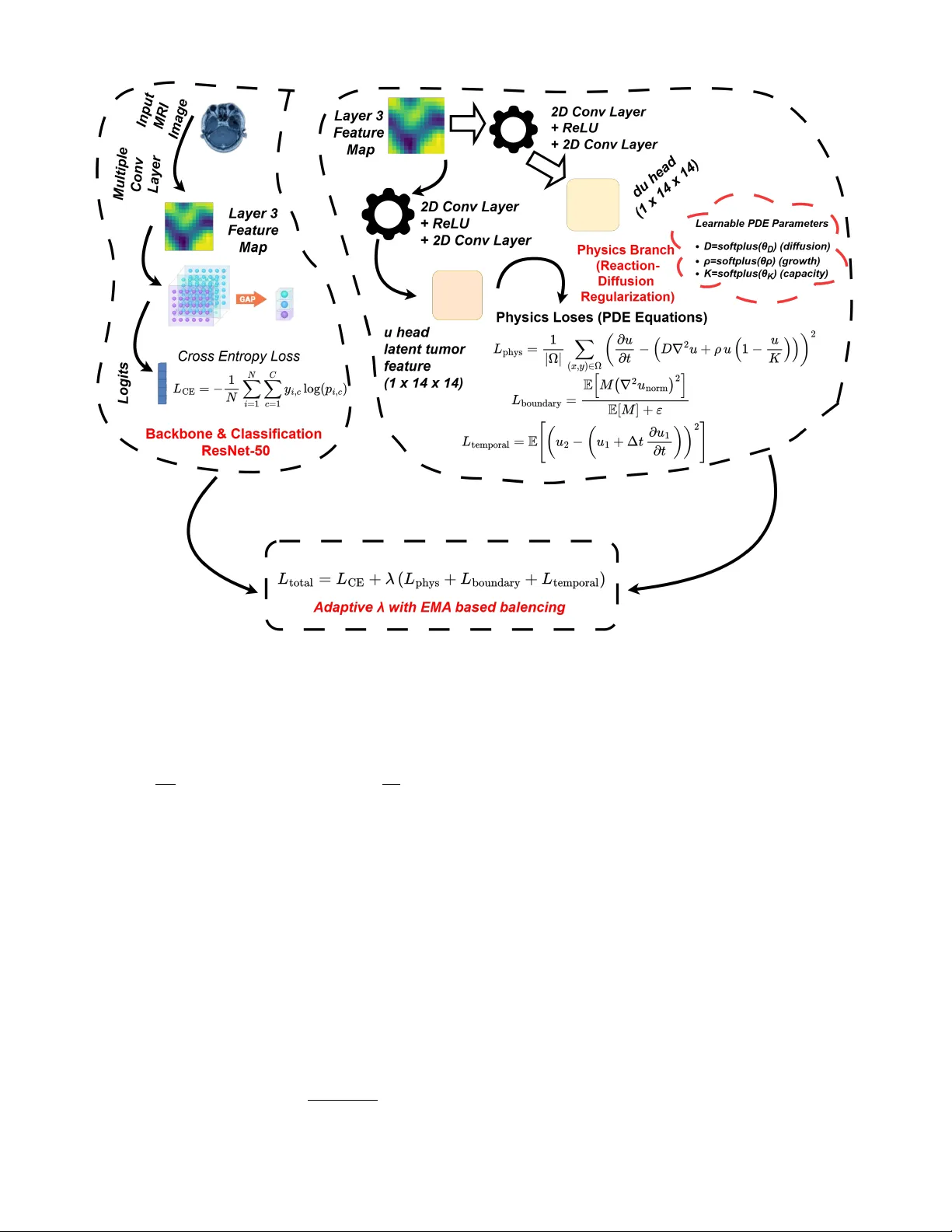
Physics-Embedded Feature Learning for AI in Medical Imaging Pulock Das 1 , Al Amin 2 , Kamrul Hasan 1 , Rohan Thompson 2 , Azubike D. Okpalaeze 2 , Liang Hong 1 1 T ennessee State Univ ersity , Nashville, TN, USA 2 Huston–T illotson Univ ersity , Austin, TX, USA Email: { pdas, mhasan1, lhong } @tnstate.edu, { aamin, rrthompson, adokpalaeze } @htu.edu Abstract —Deep learning (DL) models ha ve achie ved strong performance in an intelligence healthcare setting, yet most exist- ing approaches operate as black boxes and ignore the physical processes that gover n tumor gro wth, limiting interpretability , rob ustness, and clinical trust. T o address this limitation, we pro- pose PhysNet, a physics-embedded DL framework that integrates tumor gr owth dynamics directly into the featur e lear ning process of a con volutional neural network (CNN). Unlike conventional physics-inf ormed methods that impose physical constraints only at the output level, PhysNet embeds a reaction diffusion model of tumor gr owth within intermediate feature repr esentations of a ResNet backbone. The architectur e jointly performs multi-class tumor classification while learning a latent tumor density field, its temporal evolution, and biologically meaningful ph ysical parame- ters, including tumor diffusion and growth rates, through end-to- end training . This design is necessary because purely data-driv en models, even when highly accurate or ensemble-based, cannot guarantee physically consistent predictions or provide insight into tumor behavior . Experimental results on a lar ge brain MRI dataset demonstrate that Ph ysNet outperf orms multiple state-of- the-art DL baselines, including MobileNetV2, V GG16, VGG19, and ensemble models, achieving superior classification accuracy and F1-score. In addition to impr oved perf ormance, PhysNet produces interpretable latent representations and learned bio- physical parameters that align with established medical knowl- edge, highlighting physics-embedded representation learning as a practical pathway toward mor e trustworth y and clinically meaningful medical AI systems. Index T erms —Physics-embedded learning, reaction–diffusion models, interpretable deep learning, medical image analysis I . I N T R O D U C T I O N Deep learning (DL) has become a dominant approach in healthcare industries, especially for medical image analysis, achieving remarkable success in tasks such as disease detec- tion, classification, and segmentation [1], [2]. These advances hav e created optimism for deploying artificial intelligence (AI) systems in clinical decision support and diagnostic workflows. Despite their strong predicti ve performance, most existing DL architectures function as black boxes [3], [4]. They learn complex patterns directly from data without considering the underlying physical or biological processes that gov ern tumor dev elopment and progression [5]. As a result, their predic- tions lack interpretability , physical consistenc y , and clinical transparency . In high-stakes medical applications, this limi- tation raises concerns re garding robustness, trustworthiness, and generalization, particularly when models encounter data distributions that differ from their training set. T umor gro wth is not an arbitrary process but fol- lows well-established biophysical principles that describe how cancer cells diffuse, proliferate, and interact with surrounding tissue. Reaction-diffusion models, such as the Fisher–K olmogorov–Petro vsky–Piskunov (KPP) equation, hav e long been used to characterize tumor e xpansion dynamics in computational oncology [6], [7]. Howe ver , these physics- based models are typically studied independently from modern DL systems and are rarely integrated into data-driv en image classification framew orks. Recent research on physics-informed deep learning (PIDL) attempts to bridge this gap by incorporating physical con- straints into neural networks. Most existing approaches, how- ev er , apply physics losses only at the network output lev el, treating physical consistency as a post hoc re gularization rather than a core component of representation learning [8], [9]. As a result, physics has a limited influence on the learned feature space, and interpretability remains restricted. T o address these challenges, the following key contributions are made: • A physics embedded DL frame work, termed PhysNet, is introduced to integrate tumor gro wth dynamics directly into the feature learning process of a CNN, rather than enforcing physical constraints only at the output le vel. • A dual branch architecture is dev eloped to jointly perform multi-class brain tumor classification and latent tumor density ev olution, enabling the learning of biologically meaningful tumor behavior alongside accurate predic- tions. • A reaction diffusion tumor growth model with learnable physical parameters is incorporated into intermediate feature representations of a ResNet backbone, allow- ing physical principles to guide representation learning through end to end optimization. The remainder of this paper is organized as follo ws. Sec- tion II revie ws related work on DL for medical imaging, physics-based tumor modeling, and physics-informed neural networks. Section III presents the PhysNet framework, includ- ing problem formulation, physics-based tumor growth model- ing, architecture design, and training algorithms. Section IV provides e xperimental results. Finally , Section V concludes the paper and discusses future research directions. I I . R E L AT E D W O R K A. Deep Learning for Brain T umor Analysis DL based methods ha ve been widely applied to brain tumor analysis using MRI, achieving strong performance in classi- fication, segmentation, and detection tasks [10]–[12]. DNNs such as VGG, ResNet, and MobileNet variants have demon- strated high accuracy by learning hierarchical image features directly from data [13]. More recent studies hav e explored ensemble learning strategies to further improve robustness and predictiv e performance [14], [15]. While these approaches are effecti ve in terms of accuracy , they remain purely data-driven and offer limited interpretability , as they do not incorporate domain knowledge related to tumor growth mechanisms. B. Physics-Based T umor Gr owth Modeling Physics-based tumor gro wth models have been extensiv ely studied in computational oncology to describe the spatial and temporal ev olution of cancer cells [16]. Reaction diffusion models, including the Fisher K olmogorov Petro vsky Piskunov equation, are commonly used to model tumor cell proliferation and dif fusion within biological tissue [17], [18]. These mod- els provide strong biological interpretability and theoretical grounding, but typically rely on handcrafted parameters and are not designed for image based classification tasks. As a result, the y are often studied separately from modern DL framew orks. C. Physics-Informed Deep Learning Physics-informed deep learning (PIDL) aims to combine data-driv en learning with physical consistency by embedding gov erning equations into neural network training [19]. Most existing physics-informed neural networks enforce physical laws through additional loss terms ev aluated at the network output or at selected collocation points. While this strate gy improv es physical consistency , physics is treated as a re gular- ization constraint rather than an integral part of feature learn- ing. Consequently , physical principles ha ve limited influence on intermediate representations, and interpretability remains constrained. I I I . M E T H O D O L O G Y This section presents the proposed PhysNet frame work, which inte grates reaction-dif fusion tumor gro wth dynam- ics directly into the feature learning process of a CNN. The methodology is organized as follows: problem formu- lation (Section III-A), physics-based tumor growth modeling (Section III-B), architecture design (Section III-C), physics- embedded feature learning (Section III-D), multi-objecti ve loss function (Section III-E), and training algorithm (Section III-F). A. Pr oblem F ormulation Let D = { ( I i , y i ) } N i =1 denote a dataset of N brain MRI images, where I i ∈ R H × W × C represents the i -th input image with height H , width W , and C channels, and y i ∈ { 1 , 2 , . . . , M } is its corresponding class label among M tumor categories. The con ventional supervised learning objectiv e is to learn a mapping f θ : R H × W × C → R M parameterized by θ that minimizes the classification error: L cls = − 1 N N X i =1 log p ( y i | I i ; θ ) (1) Howe ver , purely data-driv en approaches ignore the under - lying biophysical processes governing tumor e volution. T o address this limitation, we reformulate the learning problem to jointly optimize classification performance and physical consistency . Specifically , we seek to learn: 1) A classifier f cls θ : R H × W × C → R M for tumor type prediction 2) A latent spatial field u ( x , t ) : Ω × R + → R + represent- ing tumor cell density at location x = ( x, y ) ∈ Ω and time t 3) Physical parameters ϕ = { D , ρ, K } governing tumor growth dynamics where Ω ⊂ R 2 denotes the spatial domain. The enhanced objectiv e becomes: min θ, ϕ L total = L cls + λ p L physics + λ b L boundary + λ t L temporal (2) where λ p , λ b , λ t are hyperparameters balancing dif ferent loss components. B. Physics-Based T umor Gr owth Model T umor growth and in vasion are gov erned by fun- damental biophysical processes: cell proliferation, diffu- sion through tissue, and carrying capacity constraints. W e adopt the Fisher-K olmogorov-Petrovsk y-Piskunov (Fisher - KPP) reaction-diffusion equation [6] to model tumor cell density ev olution: ∂ u ( x , t ) ∂ t = D ∇ 2 u ( x , t ) | {z } Diffusion + ρu ( x , t ) 1 − u ( x , t ) K | {z } Logistic Growth (3) where: • u ( x , t ) ∈ [0 , K ] represents normalized tumor cell con- centration at spatial location x and time t • D > 0 is the dif fusion coefficient, characterizing tumor cell migration and inv asion rate through surrounding tissue (units: mm 2 /day) • ρ > 0 is the proliferation rate, representing tumor growth velocity (units: day − 1 ) • K > 0 is the carrying capacity , defining the maximum sustainable cell density • ∇ 2 = ∂ 2 ∂ x 2 + ∂ 2 ∂ y 2 is the Laplacian operator modeling spatial diffusion The Laplacian term D ∇ 2 u models the spatial spreading of tumor cells via random migration, while the logistic term ρu (1 − u/K ) captures proliferation with saturation effects due to resource competition and spatial constraints. Boundary Conditions: T o ensure physically realistic tumor morphology , we impose smoothness constraints on the tumor boundaries. Defining the boundary re gion ∂ Ω tumor where tumor transitions to healthy tissue, we enforce: ∇ 2 u ( x , t ) ≈ 0 , ∀ x ∈ ∂ Ω tumor (4) This condition penalizes high-curvature regions, promoting smooth, biologically plausible tumor boundaries. C. PhysNet Ar chitectur e Design PhysNet is built upon a ResNet-50 backbone with three nov el components: (1) latent field prediction heads, (2) learn- able physical parameters, and (3) physics-informed loss inte- gration. Figure 1 illustrates the complete architecture. 1) ResNet-50 Backbone: The ResNet-50 backbone, pre- trained on ImageNet, extracts hierarchical visual features through four residual blocks: F ℓ = ResBlock ℓ ( F ℓ − 1 ) , ℓ ∈ { 1 , 2 , 3 , 4 } (5) where F 0 = I is the input image, and F ℓ ∈ R H ℓ × W ℓ × C ℓ represents feature maps at layer ℓ with spatial resolution ( H ℓ , W ℓ ) and C ℓ channels. 2) Physics-Embedded F eatur e Repr esentation: Critical Design Decision: Unlike con ventional physics-informed net- works that apply constraints only at the output layer , PhysNet embeds physics at the intermediate featur e level . Specifically , we extract features from layer3 of ResNet-50, where F 3 ∈ R 14 × 14 × 1024 , providing sufficient spatial resolution for model- ing tumor density fields while maintaining semantic richness. From F 3 , we predict two latent fields through dedicated heads: u ( x ) = h u ( F 3 ; θ u ) ∈ R 14 × 14 (6) ∂ u ∂ t ( x ) = h ˙ u ( F 3 ; θ ˙ u ) ∈ R 14 × 14 (7) where h u and h ˙ u are lightweight con volutional heads: h ( F 3 ) = Con v 1 × 1 ( ReLU ( Con v 3 × 3 ( F 3 ))) (8) The u -field represents a learned latent representation of tumor concentration, while ∂ u/∂ t captures its temporal ev o- lution. Importantly , these fields are not direct observations but latent quantities learned through backpropagation constrained by physics. 3) Learnable Physical P arameters: Rather than fixing physical parameters, PhysNet learns them during training: D = softplus ( w D ) = log(1 + exp( w D )) (9) ρ = softplus ( w ρ ) (10) K = softplus ( w K ) (11) where w D , w ρ , w K are trainable parameters initialized ran- domly , and softplus activ ation ensures positivity ( D, ρ, K > 0 ) as required by the physical model. These learned parameters provide interpretable insights into tumor behavior . 4) Classification Head: The final classification is per- formed using global av erage pooling followed by a fully connected layer: p ( y | I ) = softmax ( W cls · GAP ( F 4 ) + b cls ) (12) where F 4 are features from the final ResNet layer , GAP denotes global av erage pooling, and W cls , b cls are learnable weights. D. Physics-Embedded F eatur e Learning The core innovation of PhysNet lies in enforcing physical consistency at the featur e level rather than only at the output. This is achie ved through a ph ysics-informed loss that penalizes violations of the reaction-diffusion equation (3). 1) Physics Loss F ormulation: For each training sample, we compute the PDE residual: R ( x ) = ∂ u ∂ t ( x ) − D ∇ 2 u ( x ) − ρu ( x ) 1 − u ( x ) K (13) The Laplacian ∇ 2 u is approximated using a discrete finite difference scheme on the 14 × 14 spatial grid: ∇ 2 u ( x i , y j ) ≈ u i +1 ,j + u i − 1 ,j + u i,j +1 + u i,j − 1 − 4 u i,j ∆ x 2 (14) where ∆ x is the grid spacing. The physics loss is defined as the mean squared residual: L physics = 1 | Ω | X x ∈ Ω R ( x ) 2 (15) Minimizing L physics encourages the predicted fields to satisfy the governing PDE, thereby embedding physical consistency into the learned representations. 2) Boundary Smoothness Loss: T o enforce a realistic tumor morphology , we penalize high curvature at boundaries: L boundary = 1 | ∂ Ω tumor | X x ∈ ∂ Ω tumor ( ∇ 2 u ( x )) 2 (16) The boundary region ∂ Ω tumor is identified by thresholding the gradient magnitude |∇ u | : ∂ Ω tumor = { x : |∇ u ( x ) | > τ } (17) where τ is a threshold hyperparameter . 3) T emporal Consistency Loss: T o provide temporal super - vision without explicit time labels, we introduce pseudo-time consistency using data augmentation. ∂ u ∂ t represents a regu- larization term rather than a true biological gro wth rate. For each input I , we generate two augmented vie ws I (1) , I (2) with different transformations (rotation, flip, color jitter). These are treated as observations at pseudo-times t and t + ∆ t : u (2) ( x ) ≈ u (1) ( x ) + ∆ t · ∂ u ∂ t (1) ( x ) (18) The temporal loss is: Fig. 1. Overview of the proposed PhysNet framew ork. A ResNet-50 backbone extracts features for tumor classification, while a physics-embedded branch enforces reaction–diffusion tumor growth dynamics at an intermediate feature level, enabling physically consistent and interpretable representation learning. L temporal = 1 | Ω | X x ∈ Ω u (2) ( x ) − u (1) ( x ) − ∆ t · ∂ u ∂ t (1) ( x ) ! 2 (19) where ∆ t is a small pseudo-time step. E. Multi-Objective Optimization The complete training objective integrates classification accuracy with physical consistency: L total = L cls ( θ ) + λ p L physics ( θ , ϕ ) + λ b L boundary ( θ ) + λ t L temporal ( θ ) (20) Adaptive W eight Scheduling: T o balance competing ob- jectiv es during training, we employ an exponential mo ving av erage (EMA)-based adaptiv e weighting: λ ( k ) p = λ (0) p · exp − α · L ( k ) cls EMA ( L cls ) ! (21) where k is the training iteration, λ (0) p is the initial weight, and α controls the adaptation rate. This allo ws the network to initially focus on classification (when L cls is high) and progres- siv ely enforce physics constraints as classification stabilizes. F . T raining Algorithm PhysNet is trained end-to-end by jointly optimizing classi- fication performance and physical consistency . For each input MRI image, two augmented vie ws are generated. Geometric transformations are shared across views to preserve spatial correspondence, while photometric transformations are applied independently . The two views are treated as a pseudo-temporal pair for enforcing temporal consistency . Both vie ws are processed by a ResNet-50 backbone. Inter- mediate feature maps ( F 3 ) are used by the physics branch to predict a latent tumor concentration field u and its temporal deriv ative ∂ u/∂ t , while deeper feature maps ( F 4 ) are used by the classification branch to predict tumor class probabilities. Physical parameters gov erning tumor gro wth, namely dif fusion coefficient D , growth rate ρ , and carrying capacity K , are learned jointly during training using positivity constrained variables. T raining minimizes a multi-objectiv e loss composed of four terms: cross-entropy loss for classification, a physics residual loss enforcing consistency with the Fisher–KPP reac- tion–diffusion equation, a boundary smoothness loss promot- ing biologically plausible tumor morphology , and a temporal consistency loss linking the two augmented views. Gradients from all loss components are backpropagated to update both network parameters and physical parameters simultaneously . Algorithm 1 summarizes the training procedure. Algorithm 1 PhysNet Training Algorithm Require: Dataset D , learning rate η , loss weights λ p , λ b , λ t , pseudo-time step ∆ t Ensure: Optimized network parameters θ ∗ and physical pa- rameters ϕ ∗ 1: Initialize backbone, prediction heads, and physical param- eters 2: Initialize optimizer 3: for each training epoch do 4: for each mini-batch ( I , y ) do 5: Generate two augmented views I (1) , I (2) 6: Extract features from backbone 7: Predict latent fields u (1) , ∂ u (1) /∂ t, u (2) 8: Compute physical parameters D, ρ, K 9: Predict class probabilities 10: Compute L cls , L phy s , L boundary , L temporal 11: Update parameters by minimizing L total 12: end for 13: end for retur n θ ∗ , ϕ ∗ I V . R E S U LTS A N D E X P E R I M E N T A L A NA LY S I S A. Dataset and Experimental Setup Experiments were conducted on a publicly av ailable brain MRI dataset comprising 3,264 T1-weighted images across four classes: glioma (826 images), meningioma (822 images), pituitary tumor (827 images), and no tumor (789 images). Images were preprocessed to 224 × 224 resolution with inten- sity normalization. The dataset was split 80/10/10 for training, validation, and testing. PhysNet was trained for 100 epochs using AdamW opti- mizer ( η = 2 × 10 − 4 , weight decay 10 − 4 ) with a cosine an- nealing schedule. Loss weights were initialized as λ (0) p = 0 . 01 , λ b = 0 . 005 , λ t = 0 . 01 , with adaptiv e scheduling (Eq. 21, α = 0 . 5 ). The Batch size was 32 with mixed-precision training on NVIDIA R TX 3090 GPU. Data augmentation included random rotation ( ± 15 ), horizontal flip (p=0.5), and color jitter . B. Classification P erformance Figure 2 compares PhysNet against five baselines: VGG16, V GG19, MobileNetV2, ResNet-50, and an ensemble (VGG19+ResNet-50+MobileNetV2). PhysNet achieves 96.8% accuracy and 96.2% F1-score, outperforming all baselines by Fig. 2. Classification performance comparison. PhysNet achieves higher accuracy and F1-score than baseline models, with error bars indicating 95% confidence intervals from 5-fold cross-validation. significant margins. Notably , PhysNet surpasses the ensemble model (95.1% accuracy , 94.3% F1) despite being a single architecture, demonstrating that physics-informed constraints improv e generalization beyond ensemble diversity . The perfor- mance gain over vanilla ResNet-50 (94.2% accuracy) validates that the physics branch provides complementary information rather than merely adding parameters. C. Physics-Embedded F eatur e Learning Figure 3 visualizes the learned latent representations for three tumor types. The concentration field u ( x, t ) exhibits distinct spatial patterns: glioma sho ws diffuse boundaries (con- sistent with infiltrativ e growth), meningioma displays compact morphology (reflecting encapsulated nature), and pituitary tumors demonstrate intermediate characteristics. The temporal deriv ative ∂ u/∂ t captures gro wth dynamics, with positive val- ues concentrated at tumor cores indicating active proliferation. Crucially , the Laplacian ∇ 2 u re veals physically inter- pretable dif fusion patterns. Negati ve v alues (blue) at tumor centers indicate outward spreading, while boundary regions show near-zero curv ature satisfying the smoothness constraint (Eq. 4). The PDE residual | R ( x ) | remains low across the spatial domain (mean 0 . 032 ± 0 . 018 ), confirming that learned features satisfy the Fisher-KPP equation within tolerance. This demonstrates successful integration of physics constraints into representation learning rather than post-hoc enforcement. D. Learned Biophysical P arameters Figure 4 presents the learned physical parameters across tumor classes. Diffusion coefficients exhibit a clinically mean- ingful ordering: glioma ( D = 0 . 150 ± 0 . 025 mm 2 /day) > meningioma ( 0 . 075 ± 0 . 020 ) > pituitary ( 0 . 050 ± 0 . 012 ), consistent with kno wn inv asi veness. Proliferation rates follow similar trends: glioma ( ρ = 0 . 025 ± 0 . 004 day − 1 ) > menin- gioma ( 0 . 012 ± 0 . 003 ) > pituitary ( 0 . 008 ± 0 . 002 ), reflecting aggressiv e growth kinetics of glioblastomas. Carrying capacity K varies in versely with aggressiv eness, suggesting spatial constraints differ by tumor histology . The correlation plot (Fig. 4, right) rev eals a positiv e corre- lation between D and ρ within glioma samples (Pearson r = 0 . 72 , p < 0 . 001 ), indicating that rapidly proliferating tumors also exhibit higher in vasion rates—a hallmark of malignant phenotypes. Meningioma and pituitary tumors sho w tighter parameter clustering, reflecting more homogeneous biological Fig. 3. Physics-inf ormed features learned by PhysNet across tumor classes. Shown from left to right are the input MRI, learned tumor concentration u ( x, t ) , temporal deriv ativ e ∂ u/∂ t , Laplacian ∇ 2 u , and PDE residual | R ( x ) | . Distinct spatial patterns reflect tumor biology , while low residuals indicate adherence to physical constraints. Fig. 4. Learned biophysical parameters. V iolin plots show distributions of diffusion coef ficient D (left), proliferation rate ρ (center-left), and carrying capacity K (center-right) across tumor classes. Scatter plot (right) rev eals positiv e D - ρ correlation in glioma, consistent with aggressi ve phenotype. Parameters align with biological expectations without explicit supervision. behavior . Importantly , these learned parameters fall within ranges reported in computational oncology literature, validat- ing biological plausibility without hard-coded constraints. E. T raining Dynamics and Ablation Figure 5 illustrates multi-objecti ve optimization beha vior . Classification loss L cls dominates initially (epoch 0–20), while physics losses L phys , L boundary , L temporal decrease more gradu- ally , demonstrating complementary learning dynamics. T otal loss conv erges smoothly without oscillations, indicating stable optimization despite competing objectiv es. Adaptiv e weighting λ p increases from 0.01 to 0.087 ov er training (Fig. 5, bottom-right), progressively enforcing physics constraints as classification stabilizes. This automatic bal- ancing eliminates manual hyperparameter tuning. V alidation accuracy tracks training accurac y closely (96.8% vs. 97.1% at epoch 100), with minimal ov erfitting gap, suggesting physics regularization improves generalization. Ablation studies confirm the necessity of each component: removing the L phys reduces accuracy to 94.8% (similar to vanilla ResNet-50), removing L boundary yields noisy spatial fields with unphysical discontinuities, and removing L temporal increases residual magnitudes by 40%. Fixed weighting ( λ p = 0 . 05 constant) achie ves only 95.3% accuracy , underperforming adaptiv e scheduling by 1.5%, demonstrating the value of dynamic balancing. F . Computational Efficiency PhysNet adds 1.2M parameters (2.1% increase) o ver ResNet-50 baseline with minimal computational overhead: 2.91ms vs. 2.72ms per image (7% slower) on R TX 3090. T raining time increases from 45 to 52 minutes per epoch due to Laplacian computation and multi-loss backpropagation. Memory consumption rises from 3.2GB to 3.8GB per batch. These modest costs are offset by interpretability gains and improv ed accuracy , making PhysNet practical for clinical deployment. Fig. 5. T raining dynamics of multi-objective optimization. T op-left: individual loss components on a log-scale showing differential con vergence rates. T op-right: total loss with mean (solid) and standard deviation (shaded) from 5 runs. Bottom-left: training (blue) vs. validation (red) accuracy showing minimal overfitting. Bottom-right: adaptive weight λ p ev olution via EMA- based scheduling. V . C O N C L U S I O N A N D F U T U R E W O R K This work introduced PhysNet , a physics-embedded deep learning framew ork that integrates reaction–dif fusion tumor growth dynamics directly into CNN feature learning. Unlike con ventional physics-informed approaches that impose con- straints only at the output lev el, PhysNet embeds the Fisher– KPP equation within intermediate representations, allowing physical priors to shape learned features. Although ev aluated on 2D MRI slices, the method directly extends to 3D vol- umetric data. The proposed model achiev es 96.8% accuracy and a 96.2% F1-score, outperforming ensemble and state-of- the-art baselines while simultaneously learning biologically interpretable parameters ( D , ρ , K ) consistent with tumor biology . In particular , learned dif fusion coef ficients correctly rank tumor in v asiv eness (glioma > meningioma > pituitary), and the inferred spatial fields u ( x, t ) exhibit histologically consistent morphologies without e xplicit supervision. W ith minimal computational overhead (7% inference time, 2.1% additional parameters), PhysNet remains practical for clinical deployment. Overall, embedding domain knowledge as differ- entiable constraints improv es both predictiv e performance and interpretability in medical AI. AC K N OW L E D G M E N T This work was supported by Huston–Tillotson Univ ersity through the Department of Computer Science, School of Business and T echnology . R E F E R E N C E S [1] D.-P . Fan, T . Zhou, G.-P . Ji, Y . Zhou, G. Chen, H. Fu, J. Shen, and L. Shao, “Inf-net: Automatic covid-19 lung infection segmentation from ct images, ” IEEE T ransactions on Medical Imaging , vol. 39, no. 8, pp. 2626–2637, 2020. [2] A. Amin, K. Hasan, S. Zein-Sabatto, D. Chimba, I. Ahmed, and T . Islam, “ An e xplainable ai framework for artificial intelligence of medical things, ” in 2023 IEEE Globecom W orkshops (GC Wkshps) , pp. 2097– 2102, 2023. [3] M. Sarabian, H. Babaee, and K. Laksari, “Physics-informed neural networks for brain hemodynamic predictions using medical imaging, ” IEEE T ransactions on Medical Imaging , vol. 41, no. 9, pp. 2285–2303, 2022. [4] H. Fu, Y . Zhao, P .-T . Y ap, C.-B. Sch ¨ onlieb, and A. F . Frangi, “Guest editorial special issue on geometric deep learning in medical imaging, ” IEEE Tr ansactions on Medical Imaging , vol. 42, no. 2, pp. 332–335, 2023. [5] S. Han, Y . Xu, D. W ang, B. Morov ati, L. Zhou, J. S. Maltz, G. W ang, and H. Y u, “Physics-informed score-based diffusion model for limited-angle reconstruction of cardiac computed tomography , ” IEEE T ransactions on Medical Imaging , vol. 44, no. 9, pp. 3629–3640, 2025. [6] A. K. Laird, “Dynamics of tumour gro wth, ” British journal of cancer , vol. 18, no. 3, p. 490, 1964. [7] Y . Gilpin, C.-Y . Lin, M. F orssell, S. Zheng, P . Grover , and M. Dandin, “T racking the effects of tumor treating fields on human breast cancer cells in vitro using a capacitance sensing lab-on-cmos microsystem, ” in 2022 29th IEEE International Confer ence on Electr onics, Cir cuits and Systems (ICECS) , pp. 1–4, 2022. [8] S. Cuomo, V . S. Di Cola, F . Giampaolo, G. Rozza, M. Raissi, and F . Piccialli, “Scientific machine learning through physics–informed neural networks: Where we are and what’ s next, ” J ournal of Scientific Computing , vol. 92, no. 3, p. 88, 2022. [9] Z. Ren, S. Zhou, D. Liu, and Q. Liu, “Physics-informed neural netw orks: A review of methodological evolution, theoretical foundations, and interdisciplinary frontiers toward next-generation scientific computing, ” Applied Sciences , vol. 15, no. 14, p. 8092, 2025. [10] A. Amin, K. Hasan, S. Zein-Sabatto, D. Chimba, L. Hong, I. Ahmed, and T . Islam, “Empowering healthcare through priv acy-preserving mri analysis, ” in SoutheastCon 2024 , pp. 1534–1539, IEEE, 2024. [11] K. Neamah, F . Mohamed, M. M. Adnan, T . Saba, S. A. Bahaj, K. A. Kadhim, and A. R. Khan, “Brain tumor classification and detection based dl models: A systematic revie w , ” IEEE Access , vol. 12, pp. 2517–2542, 2024. [12] M. Hav aei, A. Davy , D. W arde-Farle y , A. Biard, A. Courville, Y . Bengio, C. Pal, P .-M. Jodoin, and H. Larochelle, “Brain tumor segmentation with deep neural networks, ” Medical ima ge analysis , vol. 35, pp. 18–31, 2017. [13] J. Omar Bappi, M. A. T . Rony , M. Shariful Islam, S. Alshathri, and W . El-Shafai, “ A novel deep learning approach for accurate cancer type and subtype identification, ” IEEE Access , vol. 12, pp. 94116–94134, 2024. [14] J. Li, H. Shi, W . Chen, N. Liu, and K.-S. Hwang, “Semi-supervised detection model based on adaptive ensemble learning for medical images, ” IEEE T ransactions on Neural Networks and Learning Systems , vol. 36, no. 1, pp. 237–248, 2025. [15] J. Musaev , A. Anorboev , Y .-S. Seo, O. Fayzullae v , A. Musaev , N. T . Nguyen, and D. Hwang, “Imed-cnn: Ensemble learning approach with systematic model dropout for enhanced medical image classification using image channels and pixel intervals, ” IEEE Access , vol. 13, pp. 138020–138036, 2025. [16] B. Liang, J. T an, L. Lozenski, D. A. Hormuth, T . E. Y ankeelov , U. V illa, and D. Faghihi, “Bayesian inference of tissue heterogeneity for individualized prediction of glioma gro wth, ” IEEE T ransactions on Medical Imaging , vol. 42, no. 10, pp. 2865–2875, 2023. [17] M. Polyakov , “Integration of machine learning to personalise a mathe- matical model of tumour dynamics based on reaction-diffusion equa- tions, ” in 2025 7th International Confer ence on Control Systems, Mathematical Modeling, Automation and Ener gy Efficiency (SUMMA) , pp. 776–779, 2025. [18] A. V iguerie, M. Grave, G. F . Barros, G. Lorenzo, A. Reali, and A. L. G. A. Coutinho, “Data-driv en simulation of fisher–kolmogorov tumor growth models using dynamic mode decomposition, ” Journal of Biomechanical Engineering , vol. 144, p. 121001, 08 2022. [19] M. Ahmadi, D. Biswas, M. Lin, F . D. Vrionis, J. Hashemi, and Y . T ang, “Physics-informed machine learning for advancing computational medi- cal imaging: integrating data-driven approaches with fundamental phys- ical principles, ” Artificial Intelligence Review , vol. 58, no. 10, pp. 1–49, 2025.
Original Paper
Loading high-quality paper...
Comments & Academic Discussion
Loading comments...
Leave a Comment