G2DR: A Genotype-First Framework for Genetics-Informed Target Prioritization and Drug Repurposing
Human genetics offers a promising route to therapeutic discovery, yet practical frameworks translating genotype-derived signal into ranked target and drug hypotheses remain limited, particularly when matched disease transcriptomics are unavailable. H…
Authors: Muhammad Muneeb, David B. Ascher
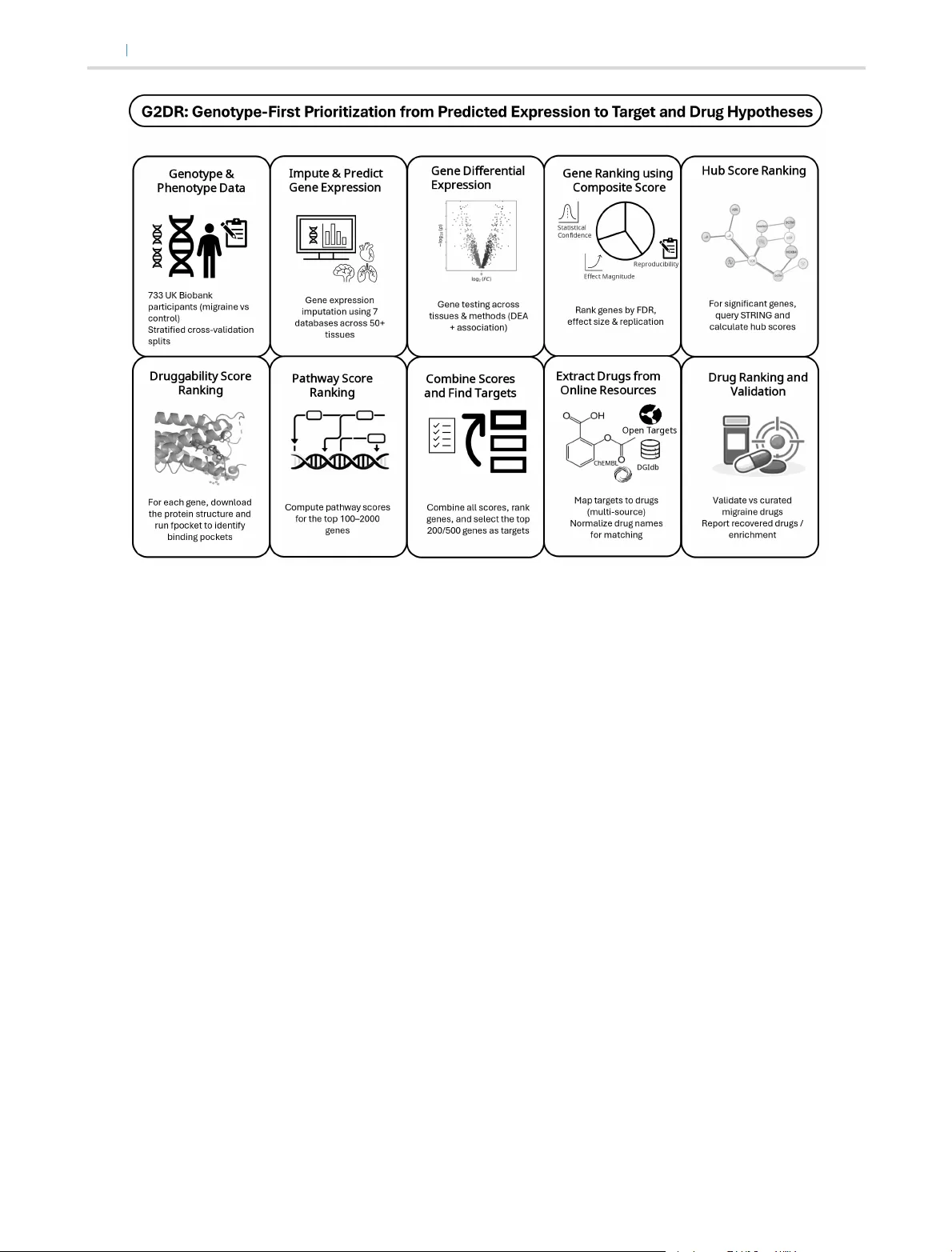
Briefings in Bioinformatics, 2026, pp. 1–17 doi: Paper P APER G2DR: A Genot yp e-First F ramew ork for Genetics-Informed T arget Prioritization and Drug Repurp osing Muhammad Muneeb 1,2 and Da vid B. Ascher 1,2, ∗ 1 School of Chemistry and Molecular Biology , The Univ ersity of Queensland, Queen Street, 4067, Queensland, Australia and 2 Computational Biology and Clinical Informatics, Baker Heart and Diab etes Institute, Commercial Road, 3004, Victoria, Australia ∗ Corresponding author: David B. Asc her, Email: d.ascher@uq.edu.au Abstract Human genetics offers a promising route to therap eutic disco v ery , y et practical framew orks that translate genot yp e-deriv ed signal in to rank ed target and drug h yp otheses remain limited, particularly when matched disease transcriptomics are una v ailable. Here, w e present G2DR, a genotype-first computational prioritization framework that propagates inherited genetic v ariation through genetically predicted gene expression, multi-method gene-level testing, pathw a y enric hment, net w ork con text, druggabilit y , and multi-source drug–target evidence integration to generate rank ed hypotheses for do wnstream follo w-up. In a migraine case study using 733 UK Biobank participants (53 cases and 680 controls) under stratified fiv e-fold cross-v alidation, we imputed genetically regulated expression across sev en transcriptome-weigh t resources and ranked genes using a reproducibility-a ware discov ery score derived exclusively from training and v alidation data, follow ed b y a balanced integrated score for do wnstream target selection. In held-out ev aluation, discov ery-based prioritization generalized to unseen data, achieving a gene-lev el R OC-A UC of 0.775 and PR-AUC of 0.475 for recov ery of test-significant genes, while retaining enric hmen t for curated migraine-asso ciated biology . Mapping prioritized genes to comp ounds through Op en T argets, DGIdb, and ChEMBL yielded candidate drug sets enriched for migraine-linked and literature-associated comp ounds relative to a global drug background, although recov ery was strongest for broader mec hanism-link ed and off-lab el therapeutic space rather than migraine-sp ecific appro ved therapies. Directionalit y filtering further separated broadly recov ered comp ounds from those with stronger mechanistic compatibilit y . G2DR should therefore be interpreted as a modular computational prioritization framew ork for genetics-informed hypothesis generation and follow-up in genot ype-first settings, not as a clinically actionable target-iden tification or drug-recommendation system. All prioritized genes and comp ounds require independent exp erimental, pharmacological, and clinical v alidation. Supplemen tary data are av ailable at Briefings in Bioinformatics online. Key words: drug repurp osing, h uman genetics, TW AS, genetically predicted expression, target prioritization, translational bioinformatics In tro duction Drug repurposing remains an attractive strategy for accelerating therapeutic dev elopment b ecause existing comp ounds b enefit from prior pharmacological, toxicological, and manufacturing knowledge ([1, 2, 3]). Ov er the past t wo decades, computational repurposing has expanded from expression-signature matching ([4]) and netw ork medicine ([5, 6, 7]) to machine-learning and knowledge-graph approac hes that integrate heterogeneous biomedical evidence at scale ([8, 9]). Y et many current pipelines dep end on disease-sp ecific transcriptomic profiles ([10, 11]), curated disease mo dules ([6, 12]), or historical drug–disease lab els ([2, 8]), whic h can b e limiting for newly studied phenotypes or for biobank settings where genotype and phenotype lab els are av ailable but disease-relev ant molecular profiling is sparse or absent ([13, 14, 2, 15]). Human genetics provides a particularly attractive starting point for therap eutic prioritization because inherited v ariation is stable, scalable, and increasingly well characterized across large cohorts ([13, 14]). When measured expression is unav ailable, genotype can be propagated through transcriptome imputation mo dels to estimate genetically regulated expression ([16, 17]), offering an in terpretable intermediate la yer betw een v ariant-lev el signal and candidate genes ([15]). This strategy is appealing, but it also comes with imp ortant cav eats: TW AS- style approaches prioritize genes asso ciated with trait-linked regulatory signal, not necessarily causal effector genes ([15]), and inference remains sensitive to link age disequilibrium, co- regulation, tissue context, ancestry , and mo del architecture ([15, 18]). These limitations argue for integrativ e frameworks that improve robustness and interpretabilit y rather than relying © The Author 2026. Published by Oxford Universit y Press. All righ ts reserv ed. F or p ermissions, please e-mail: journals.permissions@oup.com 1 2 Muneeb et al . Fig. 1. Overview of the G2DR framew ork. Genotype and phenotype data from the migraine cohort w ere partitioned by stratified cross-validation and propagated through genotype-based transcriptome imputation across multiple expression-weight resources. Cov ariate-adjusted predicted expression v alues were tested using m ultiple differential-expression and association methods, and significant results from the training and v alidation splits were aggregated into a discov ery set. Genes were then ranked using a comp osite score that integrated repro ducibility , effect magnitude, and statistical confidence, follow ed by path wa y , network, and druggability annotation to generate an integrated target-prioritization score. T op-ranked genes were mapped to candidate compounds through Open T argets, DGIdb, and ChEMBL, and the resulting drug lists were ev aluated against curated migraine- associated drug references. on any single transcriptome-prediction resource or analytical test ([15]). A further motiv ation comes from therap eutic translation. Multiple studies ha ve sho wn that targets supported by h uman genetics are more likely to succeed in clinical development ([19, 20]), making genetics-informed target selection an increasingly important comp onent of drug discov ery . How ever, the key translational challenge is not simply to detect associated genes, but to prioritize those with the strongest conv ergent supp ort and then connect them to tractable pharmacological h ypotheses in a transparent and reproducible manner. Here, we present G2DR (Figure 1), a genotype- first computational framework for genetics-informed target prioritization and drug repurp osing h ypothesis generation. G2DR integrates genetically predicted expression (T able 1) from multiple transcriptome-weigh t resources ([16, 17, 15]), multi-method gene-lev el testing, pathw ay enric hment, net work context, structure- and knowledge-based druggability , and multi-source drug–target evidence ([21, 22, 23, 24, 25]) to generate ranked computational hypotheses for candidate targets and asso ciated comp ounds, without requiring measured disease transcriptomics or sup ervised training on curated indication labels ([2]). W e demonstrate the framework in migraine using UK Biobank data and ev aluate p erformance at m ultiple lev els, including held-out gene replication, enrichmen t for curated migraine biology , and recov ery of migraine-linked drugs from prioritized targets. F ramed explicitly as a computational prioritization engine for downstream experimental follow-up rather than a clinically actionable target-identification system, G2DR is b est viewed as a modular pro of-of-concept framework with clear ro om for further maturation. Metho ds Study Design and Cohort Assem bly A total of 733 participants (53 cases and 680 con trols) who rep orted migraine and recorded comorbid conditions, including hypertension, asthma, depression, osteoarthritis, hypercholesterolemia, irritable b ow el syndrome, h yp othyroidism, hay fev er, and gastro esophageal reflux disease, were extracted from the UK Biobank ([13, 14]). These comorbidities are commonly reported to co-o ccur with migraine ([31, 32, 33, 34]). Genotype–phenotype data w ere partitioned using stratified five-fold cross-v alidation, with eac h fold split into training (80%), v alidation (10%), and test (10%) subsets to preserve the case–control ratio. Genotype quality control was applied within each training fold and propagated to validation and test subsets, including per-varian t filters for minor allele frequency (MAF) ≥ 0 . 01, Hardy–W einberg equilibrium (HWE) p ≥ 1 × 10 − 6 , and v ariant missingness ≤ 0 . 1, along with p er-individual G2DR: A Genot yp e-First F ramework for Genetics-Informed T arget Prioritization and Drug Repurposing 3 T able 1. Expression w eight mo dels used for genot yp e-based gene expression prediction. Model Source Description Gene–Tissue Pairs MASHR https://zenodo.org/records/7551845 Multiv ariate adaptiv e shrinkage mo dels for cross-population transcriptome prediction, designed to improv e TW AS p erformance in underrepresented populations [26] 686,241 (49 tissues) JTI https://zenodo.org/records/3842289 Joint-tissue imputation models that b orrow information across tissues via shared genetic regulation, enabling b oth expression prediction and do wnstream causal inference [27] 533,141 (49 tissues) CTIMP https://github.com/yiminghu/CTIMP Cross-tissue gene-expression imputation models trained with sparse group- LASSO to borrow information across GTEx tissues [28] 404,450 (49 tissues) UTMOST https://zenodo.org/records/3842289 Cross-tissue transcriptome prediction mo dels from the UTMOST framework, hosted alongside JTI models; treated as a separate mo del set in this study [28] 340,104 (49 tissues) EpiXcan h t t p s : / / w w w . s y n a p s e . o r g / S y n a p s e : syn52745052 T ranscriptome imputation incorporating epigenomic annotations to w eight SNP priors, impro ving prediction accuracy over standard elastic net [29] 143,609 (14 tissues) FUSION http://gusevlab .org/projects/ fusion / Bay esian sparse linear mixed model and p enalized regression framew ork for transcriptome-wide asso ciation studies [17] 265,052 (48 tissues) TIGAR htt ps : // git hu b.c om /ya ng lab - em o ry /T IGAR Nonparametric Bayesian gene expression imputation to ol supporting individual- and summary-lev el GW AS data for transcriptome-wide asso ciation studies [30] 181,605 (49 tissues) missingness ≤ 0 . 1 and remov al of related individuals using PLINK ( --rel-cutoff 0.125 ) ([35, 36]). Genetically Predicted Gene Expression Genetically predicted gene expression was computed for eac h individual within eac h fold using PrediXcan-style genotype- based transcriptome imputation ([16, 18]), in whic h expression for gene g in tissue t is estimated as a weighted sum of SNP dosages using pre-trained expression-w eight models. T o maximize gene co verage and capture div erse regulatory architectures, w e incorp orated seven publicly av ailable expression-weigh t databases trained under different statistical and biological assumptions: MASHR, JTI, CTIMP , UTMOST, EpiXcan, FUSION, and TIGAR (T able 1; full mathematical details are provided in Supplementary Metho ds S1). Predicted expression v alues w ere adjusted for sex and the top 10 genetic principal comp onents using ordinary least squares regression applied to the training split only , with fitted parameters applied to v alidation and test splits. Differen tial Expression Analysis Differential expression analysis (DEA) was p erformed on cov ariate-adjusted imputed expression v alues for each gene, tissue, database, fold, and dataset split using eigh t statistical methods: LIMMA empirical Ba yes mo derated t -test ([37]), W elch’s unequal-v ariance t -test, OLS regression, Wilcoxon rank-sum test, phenotype-lab el p ermutation te st ( B = 1 , 000 permutations), w eighted logistic regression, bias-reduced Firth logistic regression, and Bayesian logistic approximation. F or differential-expression metho ds, significance required FDR < 0 . 1 and | log 2 FC | ≥ 0 . 5; for asso ciation-style metho ds, significance required FDR < 0 . 1 and | Effect | ≥ 0 . 5. Complete model sp ecifications are provided in Supplementary Metho ds S1. Gene Prioritization Significant genes w ere aggregated across all databases, tissues, folds, and metho ds. The discov ery set was defined as G discov ery = G train ∪ G v al , reserving G test exclusively for out-of-sample ev aluation. Each gene in G discov ery was scored using a comp osite imp ortance score S g that integrates three components: reproducibility (40%), effect magnitude (30%), and statistical confidence (30%). Repro ducibility captures both the total n umber of significant hits and the breadth of supp ort across database–tissue–method com binations. Effect magnitude is derived from metho d-standardized absolute effect sizes. Statistical confidence is derived from BH-adjusted FDR v alues. F ull scoring formulas are pro vided in Supplementary Metho ds S2. Rankings were robust to alternative weigh ts (Spearman ρ = 0 . 992; T op-100 ov erlap ≥ 75%; full stability results in Supplementary T able S1). Generalizability was assessed using the held-out test split as the replication target. F or each gene g in the tested universe U , a binary label y g = I ( g ∈ G test ) w as defined, and S g was used as the ranking predictor. Performance was quantified using ROC-A UC, PR-AUC, and hypergeometric enric hmen t tests at multiple top- K cutoffs. Enric hment for a curated set of 3,190 migraine-associated genes ([15]) assembled via PhenotypeToGeneDownloaderR ( h t t p s : / / g i t h u b . c o m / M u h a m m a d M u n e e b 0 0 7 / P h e n o t y p e T o G e n e D o w n l o a d e r R ) was assessed using the same hypergeometric framework. F ull test deriv ations are provided in Supplementary Metho ds S3. T o obtain an in tegrated target-prioritization ranking, S g was com bined with three additional evidence lay ers: path wa y support ( PathwaySc or e ) derived from GO, KEGG, Reactome, and Disease Ontology enrichmen t analyses ( clusterProfiler , ReactomePA , DOSE ); netw ork hub score from STRING protein– protein interaction analysis; and structure- or knowledge- based druggability from DGIdb, ChEMBL, and fp o ck et. The integrated score w as computed as CoreScore g = 0 . 45 · DE norm g + 0 . 25 · Path norm g + 0 . 25 · Drug norm g + 0 . 05 · Hub norm g , with DE weigh ted highest b ecause it provides the primary TW AS-deriv ed genetic link betw een genot yp e and disease. F ull pathw ay score propagation formulas and weigh t justification are provided in Supplementary Metho ds S2. Drug Repurposing A curated migraine drug reference set of 4,824 normalized drug entries was assembled using DownloadDrugsRelatedToDiseases ( h t t p s : / / g i t h u b . c o m / M u h a m m a d M u n e e b 0 0 7 / D o w n l o a d D r u g s R e la t e dT o Di s e as e s ), which aggregates drug–disease associations from Op en T argets, DrugBank, CTD, and literature-mining sources. All enrichmen t claims are framed relative to a global background of 139,597 drugs. Candidate comp ounds were mapped from the top N ranked genes using drug–target 4 Muneeb et al . evidence from Open T argets, DGIdb, and ChEMBL, with drug names harmonized using conserv ative text normalization. Each gene–drug evidence row was assigned an evidence weigh t based on clinical dev elopmen t stage, and a DrugSc or e was computed by aggregating GeneW eight × EvidenceW eight contributions across all supp orting genes. The curated migraine drug reference set was partitioned into four dev elopment-stage tiers: Tier 1 (migraine-sp ecific approv ed therapies), Tier 2 (guideline-supported acute or preven tive therapies), Tier 3 (established off-lab el therapies), and Tier 4 (broader literature-link ed compounds). Performance was assessed using multi- K ov erlap ev aluation under tw o complementary universes: an ALL-drugs global background (hypergeometric test v alid) and a PREDICTED candidates- only universe (AUR OC and AUPR C are the appropriate metrics; full results in Supplementary T able S5). Directionalit y Assessment T o assess mechanistic compatibility of prioritized gene–drug pairs, drug action annotations were extracted from lo cally aggregated evidence fields and supplemen ted via ChEMBL and DGIdb, harmonized in to a reduced action vocabulary (inhibitor, an tagonist, agonist, activ ator, modulator, unkno wn). Each pair was classified as directionally consisten t when the drug action w as compatible with the inferred disease-associated gene direction, inconsisten t when opp osed, or unclear when insufficient annotation was av ailable. F ull annotation and classification criteria are provided in Supplementary Methods S4. Results Cross-database concordance of predicted gene expression A total of 733 participants (53 cases, 680 controls) were stratified into five cross-v alidation folds, preserving case– control balance across training (80%), v alidation (10%), and test (10%) splits. Within each fold and split, we imputed genetically regulated expression from genotype dosages using PrediXcan-style mo dels ([16, 18]). T o compare expression-weigh t databases, we quantified tissue-matched concordance b y computing gene-wise Pearson correlations of predicted expression across individuals for genes shared by each database pair, then av eraging within tissue and across folds to yield one concordance estimate p er database pair and split. The highest concordance was observed for the CTIMP–UTMOST pair ( r ≈ 0 . 55; train = 0 . 547, v alidation = 0 . 546, test = 0 . 546), follow ed by JTI–CTIMP ( r ≈ 0 . 53; train = 0 . 526, v alidation = 0 . 525, test = 0 . 525), MASHR–UTMOST ( r ≈ 0 . 54; train = 0 . 536, v alidation = 0 . 538, test = 0 . 537), and MASHR–CTIMP ( r ≈ 0 . 49; train = 0 . 491, v alidation = 0 . 492, test = 0 . 492). Concordance with FUSION was mo derate for UTMOST ( r ≈ 0 . 50; train = 0 . 498, v alidation = 0 . 497, test = 0 . 499) and lo wer for MASHR ( r ≈ 0 . 38; train = 0 . 380, v alidation = 0 . 380, test = 0 . 378) and JTI ( r ≈ 0 . 31; train = 0 . 311, v alidation = 0 . 310, test = 0 . 311). TIGAR show ed near-zero concordance with all other databases ( r ≈ 0 . 03), indicating substantially differen t predicted-expression patterns (Figure 2). Adjusting expression for sex and the top ten genetic principal comp onents had negligible impact on cross-database correlations (ov erall mean ∆ r = r fixed − r raw ≈ − 1 × 10 − 4 ). How ever, the adjustment altered expression v alues modestly ov erall (corr(raw , fixed) = 0 . 9696, mean | ∆ | = 0 . 00797, RMSE = 0 . 0353), with the largest shifts observed in FUSION (mean | ∆ | ≈ 0 . 023, RMSE ≈ 0 . 124) and in EpiXcan (mean | ∆ | ≈ 0 . 011, RMSE ≈ 0 . 078), while TIGAR show ed minimal absolute change (mean | ∆ | ≈ 6 . 3 × 10 − 5 ). These results suggest that cross-database differences primarily reflect methodological and architectural v ariation among expression- weigh t resources, rather than confounding by sex or ancestry principal components. Gene differen tial expression analysis W e p erformed 1 72,868,680 gene-level differential-expression and asso ciation tests across expression-weigh t databases, tissues, folds, dataset splits, and eigh t statistical metho ds. Applying the predefined significance and effect-size thresholds yielded 96,502 significan t test records, corresponding to 11 ,451 unique significant genes within a tested univ erse of U = 34 , 355 genes. Giv en the modest cohort size and the highly lay ered testing design, these coun ts should b e interpreted primarily as a broad discov ery space rather than as a set of individually robust causal signals. Imp ortantly , the main ranking conclusions w ere preserved under stricter thresholds in sensitivity analyses, indicating that the held-out prioritization signal do es not dep end solely on the most p ermissive op erating point. Discov ery candidates were defined without test leakage using training and v alidation only , producing G discov ery = G train ∪ G v al ( n = 9 , 305), of whic h 1,189 overlapped a curated migraine-linked reference set and 8,116 remained outside that reference space. Out-of-sample replication w as assessed by treating test- significant genes ( T = 7 , 141) as p ositives within U , where G discov ery recov ered 4,995 te st p ositives (recall = 0 . 699) with precision = 0 . 537, while smaller top- K lists achiev ed higher precision at the cost of recall (e.g., top-100 precision = 0 . 790; T able 2). W e next ev aluated the contin uous disco very score as a genome-wide ranking mo del ov er the full tested universe U , using test-significant genes ( T = 7 , 141) as the replication target. Under this ranking framew ork, the score ach ieved R OC- AUC = 0 . 7753 and PR-AUC = 0 . 4754, indicating meaningful separation of test-replicating genes from non-replicating genes. Given the baseline prev alence of positives in the tested univ erse ( T /U = 0 . 2079), the observ ed PR-A UC corresponds to a substantial lift ov er random ranking. W e therefore interpret the primary signal of G2DR at this stage not as binary hit identification, but as the ability to order genes suc h that held-out p ositives are preferentially concentrated tow ard the top of the ranked list. This distinction is imp ortant in small, class-imbalanced settings, where prioritization quality is more informative than exact gene-list identit y (T able 3, left panel). As an orthogonal v alidation, we tested enrichment for curated migraine genes ( M = 3 , 190) within U . G discov ery contained 1,189 kno wn genes (expected 864.01), corresp onding to 1.38-fold enrichmen t ( p = 5 . 47 × 10 − 40 ), indicating that the discov ery set preferentially captures established migraine biology while retaining a large no vel comp onent (T able 3, righ t panel). T ogether, these results sho w that in tegrating gene-level evidence across tissues, metho ds, and databases yields a reproducible prioritization that generalizes to held-out test data, p erforms substantially b etter than random ranking, and G2DR: A Genot yp e-First F ramework for Genetics-Informed T arget Prioritization and Drug Repurposing 5 Fig. 2. Cross-database concordance of predicted gene expression across expression-w eight databases. (A) Hierarchical clustering of databases using distance (1 − r ) deriv ed from the pairwise correlation matrix. (B) Pairwise correlation matrix (Pearson r ). T able 2. Held-out test replication for the disco very set and top- K lists. Positiv es are test-significant genes ( T = 7 , 141). TP/FP/FN are computed relative to T . Predicted set TP FP FN Precision Recall G discov ery (train ∪ v al) 4,995 4,310 2,146 0.537 0.699 T op 50 39 11 7,102 0.780 0.005 T op 100 79 21 7,062 0.790 0.011 T op 200 156 44 6,985 0.780 0.022 T op 500 347 153 6,794 0.694 0.049 T op 1000 664 336 6,477 0.664 0.093 T able 3. Hyp ergeometric enric hment of predicted sets for held-out test positives and curated migraine genes. F or test positives: k exp = N pred · ( T /U ), T = 7 , 141, U = 34 , 355. F or migraine genes: k exp = N pred · ( | M | /U ), | M ∩ U | = 3 , 190. FE = k obs /k exp . T est p ositives ( T = 7 , 141 ) Curated migraine genes ( | M | = 3 , 190 ) Set N pred k obs k exp FE p -v alue N pred k obs k exp FE p -v alue G discov ery (train ∪ v al) 9,305 4,995 1,934.13 2.58 < 10 − 300 9,305 1,189 864.01 1.38 5 . 47 × 10 − 40 T op 50 50 39 10.39 3.75 7 . 14 × 10 − 18 50 12 4.64 2.58 1 . 71 × 10 − 3 T op 100 100 79 20.79 3.80 1 . 55 × 10 − 35 100 21 9.29 2.26 2 . 97 × 10 − 4 T op 200 200 156 41.57 3.75 1 . 77 × 10 − 67 200 36 18.57 1.94 8 . 72 × 10 − 5 T op 500 500 347 103.93 3.34 6 . 94 × 10 − 123 500 74 46.43 1.59 4 . 26 × 10 − 5 T op 1000 1,000 664 207.86 3.19 2 . 30 × 10 − 220 1,000 132 92.85 1.42 2 . 39 × 10 − 5 can b e further refined into compact candidate gene sets for downstream network and drug-mapping analyses. Gene prioritization was robust to stricter significance thresholds T o assess whether the discov ery-based prioritization was sensitive to the choice of significance threshold, we rep eated the same workflow under stricter FDR and effect-size criteria. Relative to the primary analysis (FDR < 0 . 10, | log 2 FC | ≥ 0 . 50), tightening the FDR threshold to < 0 . 05 reduced the num b er of significant genes in training, v alidation, and test from 1,046, 9,107, and 7,141 to 958, 7,861, and 5,313, respectively , and reduced G discov ery from 9,305 to 8,135 genes. Increasing the effect-size threshold to | log 2 FC | ≥ 0 . 75 at FDR < 0 . 10 reduced these counts further to 263, 6,241, and 4,599 genes, yielding G discov ery = 6 , 303, while the strictest setting (FDR < 0 . 05, | log 2 FC | ≥ 0 . 75) pro duced 248 training genes, 5,709 v alidation genes, and 3 ,772 test genes, with G discov ery = 5 , 794. Despite the exp ected reduction in G discov ery size under stricter filtering, held-out replication remained substantial across all threshold settings. The primary analysis ac hieved ROC-A UC = 0 . 7753 and PR-AUC = 0 . 4754. Under FDR < 0 . 05 and | log 2 FC | ≥ 0 . 50, p erformance remained above random with ROC-A UC = 0 . 7314 and PR-AUC = 0 . 3412. Under the stricter effect-size threshold of | log 2 FC | ≥ 0 . 75, performance was similarly retained, with ROC-A UC = 0 . 7339 and PR-AUC = 0 . 3289 for FDR < 0 . 10, and R OC-AUC 6 Muneeb et al . = 0 . 7025 and PR-AUC = 0 . 2497 for FDR < 0 . 05. G discov ery also remained strongly enriched for held-out test positives across all settings, with fold enrichmen t ranging from 2.58- fold to 3.20-fold. Enrichmen t for curated migraine genes was likewise preserved, ranging from 1.38-fold under the primary rule to 1.41-fold under the strictest setting. F ull sensitivity results are pro vided in Supplemen tary T able S2; together, these results indicate that the main gene-prioritization findings are not driv en b y permissive significance filtering. Comp onen t-based reco very T o identify which comp onents contributed the most disease- relev ant signal in G discov ery , we tested whether each component-specific disco v ery set (defined using training and v alidation only) was enriched for curated migraine-asso ciated genes. F or each database, tissue, and metho d, we defined a discov ery set as the unique genes that were significan t at least once within that component across folds and the remaining dimensions, and quantified ov er-representation of database- annotated migraine-linked genes using a fold-enrichmen t statistic (FE = k obs /k exp ) with empirical p -v alues from size- matched random gene-set sampling. F ull results across all databases, tissues, and metho ds are pro vided in Supplemen tary T able S3. Across expression-w eight databases, MASHR show ed the strongest disco very enric hment (FE = 2 . 30, p emp = 1 × 10 − 4 ), follow ed by JTI (FE = 1 . 86, p emp = 6 . 799 × 10 − 3 ) and FUSION (FE = 1 . 36, p emp = 1 × 10 − 4 ), whereas EpiXcan, CTIMP , UTMOST, and TIGAR show ed weaker and non- significant enric hment. Across tissues, disco very enrichment highlighted a reproducible set of migraine-informativ e contexts, led by Brain Amygdala (FE = 1 . 96, p emp = 1 × 10 − 4 ), Minor Saliv ary Gland (FE = 1 . 94, p emp = 1 × 10 − 4 ), and Whole Blo o d (FE = 1 . 83, p emp = 1 × 10 − 4 ), with multiple additional tissues showing significant ov er-represen tation of database-annotated migraine-link ed genes. Across metho ds, the disco v ery signal was dominated by the asso ciation-style models: W eighted Logistic and Bayesian Logistic both showed consistent enrichment (FE ≈ 1 . 37, p emp = 1 × 10 − 4 ), while W elch t -test identified a smaller, disease-dense set (FE = 1 . 35, p emp = 6 × 10 − 4 ); low-co verage metho ds did not show significant discovery enrichment. Unified gene prioritization framework W e next evaluated a unified gene-prioritization framework by comparing individual evidence comp onents against b oth the primary comp osite score and the multi-source integrated score. Two complemen tary ev aluation universes w ere used throughout. The full universe comprised all U = 34 , 355 tested genes; genes not in the discov ery set received a score of zero, so this universe measures ho w well a ranking separates disco very- relev ant genes from the en tire tested space — the same univ erse used to compute the headline R OC-AUC and PR-A UC reported above. The disco very univ erse comprised only the n = 9 , 305 genes in G discov ery (train ∪ v al); here non-discov ery genes are absent, so this universe measures ranking quality within the already-selected candidates — a strictly harder question. Two composite scores were ev aluated. The primary comp osite score ( S g , Imp ortance Sc or e ) in tegrates reproducibility , effect magnitude, and statistical confidence with weigh ts 40/30/30. The integrated score additionally combines S g with pathw ay support, druggabilit y evidence, and netw ork hub score (w eights DE = 0 . 45, P athwa y = 0 . 25, Drug = 0 . 25, Hub = 0 . 05), and is designed for downstream target selection. Ev aluated ov er all 34,355 tested genes, effect-only ranking achiev ed the strongest test-replication performance (ROC-A UC = 0 . 790, PR-AUC = 0 . 526), marginally exceeding the primary composite (R OC-AUC = 0 . 775, PR-AUC = 0 . 475) and the integrated score (ROC-A UC = 0 . 776, PR-A UC = 0 . 472). The elev ated AUC v alues across most rankings in this universe reflect the large separation b etw een disco very genes (score > 0) and the ma jority of non-discov ery genes (score = 0), rather than solely fine-grained within-set discrimination. F or curated migraine-gene enrichmen t at T op-200, pathw ay ranking recov ered 66 kno wn genes (FE = 3 . 55, precision = 0 . 330) and hub ranking reco vered 64 (FE = 3 . 45, precision = 0 . 320), both substantially exceeding the primary comp osite (36 genes; FE = 1 . 94) and significance-only (25 genes; FE = 1 . 35) rankings. Within G discov ery alone, effect-only ranking remained the strongest for test replication (ROC-A UC = 0 . 675, PR-AUC = 0 . 663), recov ering 145 held-out test-p ositive genes at T op- 200. The primary composite and significance-only rankings show ed similar within-set replication (ROC-AUC ≈ 0 . 54–0 . 55), indicating that the headline 0.775 figure is driv en in substantial part b y disco v ery–versus–non-disco very separation rather than by within-set ranking quality alone. Path wa y and hub rankings show ed substan tially stronger enrichmen t for curated migraine biology: at T op-200, pathw ay ranking recov ered 66 database- annotated migraine-link ed genes (FE = 2 . 58, precision = 0 . 330) and hub ranking reco vered 64 (FE = 2 . 50, precision = 0 . 320). Direct target evidence reco vered 58 known genes (FE = 2 . 27, precision = 0 . 290), whereas drug-link count and druggability alone pro vided w eaker standalone biological enric hment. Component-level benchmarking sho wed that no single evidence la yer w as uniformly optimal across all ev aluation criteria. Effect-only ranking performed best for held-out replication, whereas pathw ay- and hub-based rankings were stronger for enrichmen t of curated migraine biology . The integrated score therefore should not b e in terpreted as maximizing an y single benchmark metric; rather, it represen ts a balanced op erating p oint designed for downstream target selection, where replication supp ort, biological coherence, and translational tractability all matter simultaneously . In this sense, the v alue of in tegration lies in controlled trade-off rather than empirical dominance on one axis alone. F ull component-wise metrics across b oth univ erses are provided in Supplementary T able S4. T o assess whether the in tegrated score w eigh ts were arbitrary , we ev aluated 17 alternative weigh ting schemes spanning nine reasonable alternativ es (e.g. DE-hea vy , pathw ay- heavy , drug-heavy , equal, and no-hub v ariants) and eigh t extreme stress tests (single-comp onent schemes). Across reasonable alternatives, the mean Sp earman ρ against the default ranking w as 0 . 963 (minim um 0 . 866), with a mean T op-100 gene o verlap of 81 . 6%; crucially , p erformance metrics were virtually unchanged, with DISC-universe test ROC- AUC ranging only from 0 . 544 to 0 . 547 and FULL-universe test ROC-A UC from 0 . 775 to 0 . 776 across all nine sc hemes (Supplementary T able S1). Extreme single-component schemes diverged substantially (mean ρ = 0 . 682, minimum 0 . 292 for hub-only), suggesting that the integrated score draws on genuine multi-source signal rather than being dominated by any single lay er. These results suggest that the default weights (DE = 0 . 45, Path wa y = 0 . 25, Drug = 0 . 25, Hub = 0 . 05) lie within a stable region of parameter space, with divergence o ccurring G2DR: A Genot yp e-First F ramework for Genetics-Informed T arget Prioritization and Drug Repurposing 7 only under extreme parameterizations that lack biological justification in a TW AS-first pip eline. Significan t gene comparison against Op en T argets W e compared G2DR with the Open T argets migraine disease– target resource using the same curated migraine reference set ( M = 3 , 190 genes). In the full analysis, G2DR rank ed 9,305 genes across the broader genot yp e-first search space, whereas Op en T argets returned 2,376 migraine-asso ciated targets. The full G2DR ranking recovered 1,189 curated migraine genes (37.27%), while Op en T argets recov ered 1,228 (38.50%), and G2DR additionally recov ered 725 curated migraine reference genes absent from Op en T argets entirely . When G2DR w as restricted to genes represen ted in the Open T argets target space ( n = 823), T op-50 precision increased from 22.00% to 46.00% and T op-200 precision increased from 23.00% to 55.50%, approaching but not matc hing the standalone Op en T argets precision (T op-50: 92.00%), which reflects its disease-curated, pre-filtered design rather than a direct p erformance comparison. F ull comparison metrics are provided in Supplementary T able S6. These comparisons are complementary rather than directly comp etitive: Op en T argets offers higher precision within a curated space, while G2DR extends target hypothesis generation b eyond existing disease annotations, recov ering a substantial set of curated migraine reference genes that are absent from Op en T argets en tirely . Drug mapping and candidate enric hmen t Using the rank ed migraine gene lists (top N = 200 and N = 500), we aggregated gene–drug evidence from Op en T argets, DGIdb, and ChEMBL to generate ranked candidate compounds. F or N = 200, the pip eline compiled 5,348 gene– drug evidence rows and yielded 3,963 unique predicted drugs. F or N = 500, evidence increased to 11,234 ro ws and the predicted set expanded to 7,981 unique drugs. W e ev aluated ov erlap with a curated reference set of 4,824 normalized migraine-asso ciated drugs under tw o complementary ev aluation frames. First, an ALL-drugs univ erse (139,597 background drugs) tests capture and enrichmen t: whether the returned candidates include migraine- linked drugs ab ov e chance relative to the global pharmacop eia. Second, a PREDICTED universe (3,963 or 7,981 returned drugs) ev aluates ranking within the returned candidate set: whether reference migraine-associated drugs are preferentially placed tow ard the top among returned comp ounds. Note that FE v alues b elow 1.0 in the PREDICTED universe reflect the fact that the reference migraine drug set exceeds the returned candidate po ol in size, making standard hypergeometric enrichmen t interpretation inapplicable in that frame; AUR OC and AUPR C are the appropriate metrics for within-set ranking performance. Under the ALL-drugs background, both gene sets show ed strong enrichmen t of known migraine drugs. F or N = 200, recov ery increased from 5 / 20 (Precision@20 = 0 . 25, FE = 7 . 23, p = 4 . 93 × 10 − 4 ) to 51 / 100 (Precision@100 = 0 . 51, FE = 14 . 76, p = 4 . 20 × 10 − 47 ) and 205 / 500 (Precision@500 = 0 . 41, FE = 11 . 86, p = 6 . 19 × 10 − 161 ). F or N = 500, early enrichmen t improv ed further (8 / 20, Precision@20 = 0 . 40, FE = 11 . 58, p = 1 . 75 × 10 − 7 ; 53 / 100, Precision@100 = 0 . 53, FE = 15 . 34, p = 4 . 48 × 10 − 50 ; 213 / 500, Precision@500 = 0 . 426, FE = 12 . 33, p = 1 . 67 × 10 − 171 ). These results indicate that both gene inputs yield drug sets highly enric hed for established migraine-relev ant compounds relative to a global drug bac kground. Within the returned candidates, for N = 200, 3 53 curated migraine drugs were presen t among 3,963 predicted drugs and the ranking ac hieved AUROC = 0 . 8004 and AUPR C = 0 . 3528. F or N = 500, 527 curated migraine drugs were presen t among 7,981 predicted drugs with AUR OC = 0 . 8152 and AUPRC = 0 . 3311. Expanding the input from 200 to 500 genes increased the n um ber of reco vered reference drugs and modestly impro ved AUR OC, while AUPR C decreased slightly due to the larger candidate universe. T ogether, the tw o-universe evaluation separates capture from ranking: the strong fold-enric hment and hypergeometric significance under the ALL universe supp orts disease-relev ant signal in the upstream gene prioritization, while AUR OC and AUPR C suggest that reference migraine- associated drugs tend to app ear earlier than non-reference drugs within the returned set. F ull m ulti- K ov erlap results for both N = 200 and N = 500 under both univ erses are pro vided in Supplemen tary T able S5. When we mapped the predicted drug set back to disease indications in the aggregated drug–disease database, migraine was not alwa ys the top reco vered indication. Instead, cardiometabolic, inflammatory , neuropsychiatric, and seizure- related categories frequen tly rank ed highly . This is biologically plausible because migraine has a well-established comorbidity landscape and shares mechanisms, risk factors, and therapeutic ov erlap with m ultiple neurological and systemic disorders ([31, 32, 33, 34]). Disease-label recov ery should therefore b e interpreted as reflecting shared pharmacology and o verlapping biology across comorbid conditions rather than as a migraine- exclusive signal. W e partitioned the curated migraine drug reference set ( n = 4 , 824 normalized drugs) in to four evidence-oriented tiers: migraine-sp ecific approv ed therapies (Tier 1; triptans, ditans, gepants, CGRP mono clonals, ergot deriv atives), guideline-supported acute or preven tive therapies (Tier 2), established off-lab el therapies (Tier 3), and broader literature-linked compounds (Tier 4). Recov ery of eac h tier was ev aluated within the rank ed candidate drug list against a global background of 139,597 drugs. Across the p o oled migraine-drug reference set, the ranked list recov ered migraine-link ed compounds at rates ab ov e random exp ectation, but tiered ev aluation show ed that this recov ery was uneven across evidence classes. No Tier 1 migraine-specific appro ved therapies w ere reco vered within the T op-200 ranked drugs, whereas ov erlap was more evident for guideline-supp orted, off-lab el, and broader literature- linked compounds. These results indicate that the curren t framework is b etter at surfacing broader mec hanism-linked and repurp osing-relev ant pharmacology than at rediscov ering the most migraine-sp ecific mo dern therapeutic classes. W e therefore interpret the drug-level signal as evidence of biologically meaningful translational expansion rather than indication-specific clinical precision (T able 4). Directionalit y of prioritized gene–drug pairs T o assess mec hanistic plausibility beyond drug enrichmen t alone, we ev aluated the directionality of all gene–drug pairs derived from the top 200 genes of the final in tegrated migraine ranking. Across 4 , 861 unique gene–drug pairs, 549 (11.3%) w ere classified as directionally consistent, 618 (12.7%) as inconsistent, and 3 , 694 (76.0%) as unclear (T able 5). When restricted to the 614 pairs inv olving drugs from the curated migraine reference set, 50 (8.1%) were consistent, 83 (13.5%) inconsisten t, and 481 (78.3%) unclear. The proportions were broadly stable across both univ erses, indicating that 8 Muneeb et al . T able 4. Tiered migraine-evidence b enchmark of the ranked drug list. Tier 1: migraine-sp ecific approv ed therapies ( n ref = 135); Tier 2: guideline-supp orted therapies ( n ref = 92); Tier 3: established off-lab el therapies ( n ref = 29); Tier 4: broader literature-linked compounds ( n ref = 4 , 568). F old enrichmen t (FE) and hypergeometric p -v alues are computed relative to a global background of 139,597 drugs. High FE v alues for Tiers 2–3 reflect low absolute counts and should b e in terpreted accordingly . Tier T op-20 T op-50 T op-100 Prec@100 Rec@100 FE@100 p @100 T op-200 Tier 1: Migraine-sp ecific approved 0 0 0 0.00 0.000 0.00 1.00 0 Tier 2: Guideline-supp orted 0 1 2 0.02 0.022 30.35 2 . 04 × 10 − 3 2 Tier 3: Established off-label 1 1 1 0.01 0.034 48.14 2 . 06 × 10 − 2 1 Tier 4: Broad literature-link ed 4 18 48 0.48 0.011 14.67 7 . 08 × 10 − 44 86 the directionalit y signal do es not selectively concentrate in migraine-annotated compounds. Among the 50 directionally consistent migraine-drug pairs, several biologically interpretable clusters emerged. First, aspirin– GSTP1 (drug rank 26; GSTP1 higher in cases) was classified as consistent based on a ChEMBL inhibitor annotation; this pair should be interpreted with caution because aspirin’s primary mec hanism is CO X-1/COX-2 inhibition, and the GSTP1 annotation likely reflects indirect or in vitro effects rather than direct pharmacological inhibition. Second, the cardiac glycosides digoxin and digitoxin (drug ranks 126 and 133) were consistent against A TP1A4 (higher in cases; gene rank 2), which enco des a Na + /K + -A TPase α 4 subunit; cardiac glycosides are established Na + /K + - A TPase inhibitors, making the directionality pharmacologically coherent, though A TP1A4 itself is supp orted b y only a single- family case report in migraine and should be considered a low- evidence candidate gene rather than an established migraine locus. Third, several GLP-1 receptor agonists (exenatide, liraglutide, semaglutide, lixisenatide; drug ranks 142–146) were mapp ed against ALPL (low er in cases; gene rank 6) via DGIdb annotations; this mapping should b e interpreted cautiously b ecause GLP-1 agonists act canonically through GLP1R rather than ALPL directly , and the annotation likely reflects indirect effects on alk aline phosphatase activity rather than direct pharmacological agonism. F ourth, α 1 - adrenergic receptor antagonists including phenoxybenzamine, phentolamine, prazosin, and carvedilol (drug ranks 377–551) were consistent against ADRA1A (higher in cases; gene rank 150), where inhibition of elev ated adrenergic signalling is mechanistically plausible. Fifth, amitriptyline (drug rank 438; a guideline-supported migraine prophylactic) sho wed consisten t directionality against AADA C (higher in cases; gene rank 119) via DGIdb inhibitor annotations. Directionality filtering materially refined the candidate space by separating broadly recov ered comp ounds from those with stronger mechanistic compatibility . Among migraine-linked or biologically plausible candidates, only a subset remained directionall y consistent, while others w ere directionally inconsistent or unresolved b ecause the mapped action did not align clearly with the inferred disease-asso ciated gene direction. This distinction matters because enric hmen t alone can recov er compounds that are pharmacologically adjacent to migraine biology without necessarily supp orting a coherent repurp osing hypothesis. Accordingly , we treat directionally consisten t pairs as higher-priorit y computational hypotheses, whereas inconsisten t or unresolved pairs should b e viewed as context signals rather than actionable leads. T op gene and drug v alidation panel T o provide a concise summary of the final integrated prioritization, w e assembled top-gene and top-drug evidence panels from the Combine d Sc or e -ranked gene list and the downstream drug-mapping and directionality outputs. The top-gene panel (T able 7) rep orts the 10 highest-ranked genes together with their evidence support, inferred disease direction, migraine relev ance, and linked druggability information. The top-drug panel (T able 8) rep orts the 10 highest-ranked drugs with merged target gene information, appro v al status, and directionality classification. T op gene highligh ts. Among the top 10 integrated-score genes, A TP1A4 (rank 2; higher in cases; known migraine gene; 24 linked drugs; Consistent directionalit y) was the most directly disease- relev ant, encoding the Na + /K + -A TPase α 4 subunit and linking to cardiac glycoside inhibitors including digoxin and digitoxin. ALPL (rank 6; lo w er in cases; Tier 1 confidence; 96 linked drugs; Consistent) w as the most druggable top gene, linked to GLP-1 agonists through DGIdb annotations. HLA-DQB1 (rank 3; lower in cases; kno wn migraine gene; 55 linked drugs) had the broadest drug connectivity but showed inconsistent directionality . MRPL36 (rank 18; higher in cases; 67 linked drugs; Consistent) was linked to a cluster of antibiotic and antimicrobial drugs through mito chondrial ribosomal inhibition annotations. Among the 49 database-annotated migraine-link ed genes presen t in the top 200, additional highly rank ed examples included GSTP1 (rank 31; Consistent; aspirin-GSTP1 was the most evidenced approv ed consistent pair), GRIN2B (rank 44; 110 linked drugs; known migraine gene), and OSGEP (rank 58; highest comp osite Imp ortanc e Sc or e of 0.682; kno wn migraine gene). Sev eral top-rank ed genes — including GRHPR , MRPL21 , DHX15 , and GCDH — had few or no linked drugs. T op drug highligh ts. Among the top 10 ranked drugs, lifitegrast (rank 6; appro ved; targets ITGB2 and ICAM1 , b oth higher in cases; Consisten t) was the only approv ed drug in the top 10 with directional consistency , acting as an in tegrin inhibitor compatible with elev ated integrin subunit expression. Oleclumab (rank 12; Phase 3; targets NT5E ; Consistent) and ezatiostat (rank 13; Phase 2; targets GSTP1 ; Consisten t) provided the clearest non-approv ed consistent candidates. Neramexane (rank 17; Phase 3; targets GRIN2B and CHRNA10 ; Consistent) w as the highest-ranking inv estigational drug with a migraine- biology rationale through NMDA receptor modulation. Sev eral top-ranked approv ed drugs show ed directionally inconsistent mappings, including metformin (rank 2; Inconsistent against NDUFV1 and NDUFS6 ), amantadine (rank 5; Inconsistent against GRIN2B ), dibotermin alfa (rank 4; Inconsisten t against BMPR1B ), and apremilast (rank 10; Inconsisten t against PDE4C ). Among the top 20 migraine-reference drugs, aspirin (rank 26; Consisten t against GSTP1 ) was the highest-ranking approv ed drug with directional support, while metformin, esketamine, and memantine app eared at ra nks 2, 7, and 8 G2DR: A Genot yp e-First F ramework for Genetics-Informed T arget Prioritization and Drug Repurposing 9 T able 5. Summary of directionality classification for unique prioritized gene–drug pairs from the final integrated migraine ranking. Results are shown for all pairs derived from the top 200 rank ed genes and separately for pairs inv olving drugs from the curated migraine reference set ( n mig = 614). Directionalit y class All pairs ( n = 4 , 861 ) Migraine drugs only ( n = 614 ) Coun t % Coun t % Consistent 549 11.3% 50 8.1% Inconsistent 618 12.7% 83 13.5% Unclear 3 , 694 76.0% 481 78.3% T otal 4 , 861 100.0% 614 100.0% T able 6. Representativ e directionally consistent gene–drug pairs from the migraine reference set. P airs were classified as consistent when the known drug action w as mec hanistically compatible with the inferred disease-associated direction of the target gene. Drug rank is from the integrated gene-to-drug scoring pipeline; gene rank is from the Combined Sc ore integrated gene prioritization. Evidence source indicates the database providing mec hanism-of-action annotation. The MRPL36 antibiotic cluster (rows 3–9) reflects DGIdb-derived mitochondrial rib osomal inhibitor annotations and should be in terpreted with caution. Drug rank Drug Gene Gene rank Disease direction Drug action Evidence source Approv ed Known migraine gene 26 Aspirin GSTP1 31 Higher in cases Inhibitor ChEMBL Y es Y es 126 Digo xin A TP1A4 2 Higher in cases Inhibitor DGIdb Y es Y es 133 Digito xin A TP1A4 2 Higher in cases Inhibitor DGIdb Y es Y es 142 Exenatide ALPL 6 Low er in cases Agonist DGIdb Y es No 144 Liraglutide ALPL 6 Low er in cases Agonist DGIdb Y es No 146 Semaglutide ALPL 6 Low er in cases Agonist DGIdb Y es No 54 Chloramphenicol MRPL36 18 Higher in cases Inhibitor DGIdb Y es No 86 Minocycline MRPL36 18 Higher in cases Inhibitor DGIdb Y es No 162 Clarithrom ycin MRPL36 18 Higher in cases Inhibitor DGIdb Y es No 379 Prazosin ADRA1A 150 Higher in cases Inhibitor DGIdb Y es Y es 512 Carv edilol ADRA1A 150 Higher in cases Inhibitor DGIdb Y es Y es 438 Amitript yline AADA C 119 Higher in cases Inhibitor DGIdb Y es No 257 Empagliflozin SLC5A2 45 Higher in cases Inhibitor DGIdb Y es No 222 Glycine GRIN2B 44 Lo wer in cases Agonist DGIdb Y es Y es 497 Lo xapine KCNT1 133 Lo wer in cases Activator DGIdb Y es Y es T able 7. T op 10 prioritized genes from the final integrated migraine ranking. Genes are rank ed by Combined Scor e (integrated: DE + path wa y + druggability + h ub). KnMig = kno wn migraine gene; Tier = confidence tier from primary composite ranking; NDrugs = num b er of unique linked drugs; ApprDrug = has at least one approv ed linked drug; DirBest = best directionality supp ort across linked drug pairs. Rank Sym bol CombScore ImpScore Disease direction KnMig Confidence tier Hits Tissues DBs NDrugs ApprDrug DirBest 1 APOBEC3G 0.936 0.435 Higher in cases No Tier3 Exploratory 100 29 1 98 Y es Unclear 2 A TP1A4 0.934 0.531 Higher in cases Y es Tier3 Exploratory 18 3 3 24 Y es Consistent 3 HLA-DQB1 0.933 0.410 Lower in cases Y es Tier2 Moderate 32 15 2 55 Y es Inconsisten t 4 PSMB5 0.932 0.413 Low er in cases No Tier2 Moderate 40 13 2 33 Y es Inconsisten t 5 SLC1A1 0.932 0.491 Lower in cases No Tier2 Mo derate 103 15 2 54 Y es Inconsisten t 6 ALPL 0.931 0.412 Low er in cases No Tier1 High 35 5 1 96 Y es Consistent 7 AQP5 0.930 0.419 Low er in cases No Tier2 Mo derate 42 10 2 29 Y es Consistent 8 CBL 0.930 0.385 Unclear No Tier3 Exploratory 4 2 1 29 Y es Unclear 9 GRHPR 0.929 0.485 Higher in cases No Tier3 Exploratory 206 16 1 2 No Unclear 10 MRPL21 0.929 0.447 Higher in cases Y es Tier2 Moderate 93 31 1 1 No Unclear respectively , consistent with their presence in the migraine drug compendium. Biological interpretation of prioritised genes and drug repurp osing candidates The 200 genes prioritised by the integrated G2DR pipeline conv erged on several biological themes with established or plausible relev ance to migraine pathoph ysiology . Of these, 49 (24.5%) had prior evidence linking them to migraine or closely related headac he phenotypes based on database annotation from OMIM, DisGeNET, and HPO, whereas the remainder represent computationally prioritized candidates without established migraine asso ciation. These novel signals should b e treated as hypothesis-generating outputs of the prioritization pip eline rather than v alidated migraine targets, and their biological interpretation b elow is offered to motiv ate experimental follo w-up rather than to make mec hanistic claims. Overall, the prioritised genes mapp ed to pathw ays related to glutamatergic and ion-channel excitabilit y , mito chondrial and metab olic function, immune and inflammatory signalling, cerebrov ascular and extracellular-matrix integrit y , and broader neuronal and synaptic main tenance, consisten t with the multifactorial biology highlighted by large migraine genetic studies [38, 39]. Among the most in terpretable signals, GRIN2B and SLC1A1 supported glutamatergic hyperexcitability and cortical- spreading-depression-related biology [40, 41], while SCN1B , KCNT1 , K CNS2 , and A TP1A4 pointed to broader disturbance of ion-c hannel homeostasis and neuronal firing. A second ma jor component comprised mito chondrial and metab olic genes, 10 Muneeb et al . T able 8. T op 10 prioritized drug candidates from the final integrated migraine repurp osing analysis. Drugs are ranked by DrugSc or e ; target genes are merged per drug. KnMig = drug presen t in curated migraine reference set; NT arg = number of unique target genes among top 200; Dir = best directionality classification across gene–drug pairs. Rank Drug Phase KnMig Approved NT arg T arget genes Disease directions Directionality Evidence sources 1 Ataluren APPR OVED No Y es 4 RPL28, RPS14, RPL12, RPS16 Unclear, low er Unclear DGIdb, OpenT argets 2 Metformin APPRO VED Y es Y es 2 NDUFV1, NDUFS6 Lower in cases Inconsistent OpenT argets, DGIdb 3 V oxelotor APPRO VED No Y es 1 HBB Low er in cases Unclear OpenT argets 4 Dibotermin alfa APPRO VED No Y es 1 BMPR1B Higher in cases Inconsistent Op enT argets 5 Amantadine APPROVED No Y es 1 GRIN2B Lower in cases Inconsistent OpenT argets 6 Lifitegrast APPR OVED No Y es 2 ITGB2, ICAM1 Higher in cases Consistent OpenT argets 7 Esketamine APPRO VED Y es Y es 1 GRIN2B Low er in cases Unclear Op enT argets, DGIdb 8 Memantine APPROVED Y es Y es 1 GRIN2B Lower in cases Unclear OpenT argets, DGIdb 9 Midostaurin APPRO VED No Y es 7 CBL, BMPR1B, CDK3, LA TS2, PRKD3, SEPTIN9, PEG3 Mixed Inconsisten t Op enT argets, DGIdb 10 Apremilast APPRO VED No Y es 1 PDE4C Low er in cases Inconsistent Op enT argets including NDUFV1 , NDUFS6 , MRPL21 , MRPL36 , TUFM , V ARS2 , FXN , ETFB , COASY , and HAAO , consistent with longstanding hypotheses that impaired cerebral bio energetics contributes to migraine susceptibilit y [42, 43]. Immune and inflammatory signals were also prominent, including multiple HLA-region genes together with RELA , ICAM1 , CLEC7A , L Y96 , UNC93B1 , and SERPINE1 , in keeping with evidence that neuroinflammatory and immune-traffic king mec hanisms contribute to trigemino vascular sensitisation [44, 45, 46]. In parallel, neurov ascular and extracellular-matrix genes such as HTRA1 , HSPG2 , GNAQ , TIE1 , EGFL7 , LAMB1 , F12 , and multiple collagen-related genes supp orted a v ascular- integrit y component, consistent with the broader ov erlap between migraine and cerebral small-vessel or neurov ascular disorders [47, 48, 49]. T ogether, these results suggest that the prioritised set reflects conv ergence a cross excitability , metabolism, inflammation, and neurov ascular maintenance rather than a single dominant molecular pathw ay . The do wnstream drug-mapping analysis likewise reco vered a broad migraine-relev ant pharmacological landscape rather than only migraine-specific therapies. Using the top 200 genes, the pipeline iden tified 3,963 unique candidate drugs from 5,348 gene–drug evidence rows, and 353 curated migraine-associated drugs were present within the predicted set. Enrichmen t against the global drug background w as strong, indicating that the upstream gene prioritisation captures disease-relev ant pharmacology even though the output did not capture classical migraine medications. At the top of the ranked list, several recov ered migraine-link ed drugs were already notable, including metformin (rank 2), esketamine (rank 7), meman tine (rank 8), aspirin (rank 26), dexamethasone (rank 48), lido caine (rank 66), zonisamide (rank 79), indomethacin (rank 85), and acetaminophen (rank 98). Additional reco v ered migraine- associated or migraine-relev ant drugs were present low er in the ranked set, including v erapamil (rank 213), v alproic acid (rank 253), celecoxib (rank 340), diclofenac (rank 343), amitript yline (rank 438), topiramate (rank 491), and ergotamine tartrate (rank 521), showing that the pip eline recov ered b oth acute- care and preven tive classes as w ell as broader off-lab el and mechanism-link ed therapies [50, 51, 52, 53, 54, 55, 56, 57]. Directionality filtering w as particularly useful for separating broadly recov ered drugs from those with clearer mechanistic compatibility . Among migraine-linked drugs, aspirin sho wed consistent directionalit y at GSTP1 ; amitript yline was directionally consistent at AAD AC ; and a cluster of antibiotic- derived mappings including c hloramphenicol, mino cycline, clarithromycin, erythrom ycin, tigecycline, and tobram ycin were directionally consisten t through MRPL36 , although these latter signals should b e interpreted cautiously b ecause they arise from mito chondrial ribosomal annotations rather than direct migraine therap eutic use. Several non-reference but biologically interesting candidates were also directionally consistent as computational hypotheses, including lifitegrast at the ITGB2 – ICAM1 axis, neramexane at GRIN2B / CHRNA10 , digoxin and digito xin at A TP1A4 , and GLP-1 receptor agonists such as exenatide, liraglutide, and semaglutide, mapp ed to ALPL via an indirect DGIdb annotation (GLP-1 agonists act canonically through GLP1R rather than ALPL directly); notably , GLP-1 agonists have shown promising signals in emerging clinical reports of chronic migraine managemen t [58, 59, 60, 61], although all such pairs require direct experimental and clinical v alidation b efore any repurp osing conclusions can be drawn. By contrast, sev eral high-ranking reco vered migraine drugs were directionally inconsistent, including metformin at NDUFV1 / NDUFS6 , dipyridamole at PDE4C , carbamazepine, zonisamide, eslicarbazepine, oxcarbazepine, phenytoin, and lidocaine at SCN5A , as w ell as v erapamil in its mapped targets. Other prominent recov ere d drugs, including esketamine, memantine, dexamethasone, indomethacin, acetaminophen, and v alproic acid, were retained but remained directionally unresolved. Overall, these results indicate that the G2DR framework recov ers a substantial set of migraine-relev ant compounds, but that directional filtering is necessary to distinguish broadly asso ciated drugs from those with stronger mechanistic coherence for repurp osing. T aken together, the drug-mapping results suggest that G2DR is currently strongest as a framework for broad genetics-anc hored translational hypothesis generation. It expands b eyond curated disease- target space, recov ers migraine-linked pharmacology ab ov e background, and b enefits from directionality-a w are refinement, but it does not yet reco ver migraine-specific approv ed therapies with high fi delity . This op erating profile is consistent with a framework designed for prioritization and follo w-up rather than definitive repurp osing recommendation. G2DR: A Genot yp e-First F ramework for Genetics-Informed T arget Prioritization and Drug Repurposing 11 Discussion W e presen t G2DR as a genot ype-first computational prioritization framework for settings in which genotype and phenotype lab els are av ailable but matched disease transcriptomics are limited or absent. The principal contribution is not a new TW AS algorithm or a clinically actionable target-identification system, but a modular w orkflow that conv erts inherited genetic signal into ranked target and comp ound hypotheses through multiple complementary evidence la yers. In a migraine proof-of-concept, the framew ork generalized to held-out data at the gene- prioritization stage, recov ered established migraine biology , and produced drug candidate sets enric hed for migraine-linked pharmacology relative to a global background. F ramed in this wa y , G2DR is b est understo o d as a structured computational engine for narrowing the candidate space for downstream experimental and translational follo w-up. Several features of the results are especially informativ e. First, transcriptome-prediction resources were only mo derately concordant, reinforcing that genetically predicted expression is itself model-dep endent and that no single reference architecture should be assumed sufficien t. Second, component- level benchmarking show ed that differen t evidence lay ers optimize differen t ob jectives: effect-based ranking w as strongest for held-out replication, whereas path wa y and hub scores more strongly concentrated curated migraine biology . The integrated score should therefore be in terpreted as a balanced downstream- selection score rather than as a universally dominan t ranking. Third, contextual comparison with Op en T argets suggests that G2DR is complementary to established evidence-integration platforms: it broadens the exploratory target space and recov ers additional migraine-reference genes outside the Op en T argets migraine list, while remaining less concen trated within established disease-target space. The drug-level results are most informative when interpreted through the tiered b enchmark rather than the global- background enrichmen t alone. While the framework recov ered migraine-linked comp ounds abov e random exp ectation, reco very was strongest for broader literature-linked, off-lab el, and shared-mechanism therapeutic space, whereas migraine-specific approv ed therapies were under-represented in the top-ranked set. This suggests that the current implementation is b etter at expanding genetics-anchored translational h yp othesis space than at reproducing the most indication-specific modern pharmacology . Directionality filtering further strengthened this interpretation by sho wing that only a subset of reco vered compounds retained clear mechanistic compatibility with the inferred disease-asso ciated gene direction. T ogether, these findings argue that the strongest present use case for G2DR is structured target and drug-hypothesis prioritization rather than direct inference of therap eutic efficacy . The causal-support analyses are important precisely because they limit o verin terpretation. Single-instrument Mendelian randomization yielded nominal asso ciations only in broader ranked sets, no gene survived multiple-testing correction, and colocalization identified no gene-locus pairs with strong shared- signal support. These findings do not negate the prioritization signal, but they do indicate that the current framew ork is operating at the level of genetics-anchored candidate ranking rather than causal effector-gene identification. In practical terms, G2DR should therefore b e view ed as a h ypothesis- prioritization framework whose outputs require orthogonal v alidation, not as a causal target-discov ery engine. Across cross-v alidation folds, exact o v erlap among top- ranked genes was limited, which is expected in a modest, class-imbalanced cohort in whic h eac h fold contains only a small num b er of cases. More importantly , prioritization performance was stable at the signal level, and drug-level rankings were substantially more stable than gene-level identities. This distinction is central to interpreting the framework correctly: for a prioritization metho d, repro ducibility of ranking b ehavior is more informative than p erfect recurrence of specific gene lists. The results therefore supp ort stabilit y of the prioritization signal even when individual top-ranked genes v ary across folds. The study has sev eral imp ortant limitations. The migraine cohort is mo dest and class-imbalanced, which constrains p ow er and likely contributes to b oth instabilit y in individual gene identities and diffuse significance across highly lay ered testing structures. The framew ork relies on genetically predicted rather than measured context-specific transcription, and TW AS- style signal remains vulnerable to linkage disequilibrium and co-regulation. Drug mapping is further constrained by database cov erage, evidence heterogeneity , and imp erfect action-direction annotation. These limitations mean that prioritized genes should be interpreted as genetically supported candidates rather than confirmed causal effectors, and prioritized compounds should b e interpreted as computational hypotheses rather than translational recommendations. Equally informative is what the framework does not yet recov er well. The under-representation of serotonergic and CGRP-axis therapies suggests that current public drug- target resources and genetically prioritized gene programs more readily capture shared neurobiological and comorbidity- linked pharmacology than highly indication-specific migraine therapeutics. This op erating profile helps explain why broader mechanism-link ed candidates are enriched even when migraine- specific approv ed therapies are sparse in the top-ranked set. F uture extensions should therefore fo cus on stronger causal filters, more explicit perturbational and mechanism-of-action resources, and disease-sp ecific pharmacological annotations that may impro ve b oth target specificity and directionality- aw are drug ranking. Overall, G2DR provides a useful foundation for genetics- informed prioritization in genotype-first settings. Its mo dular design allows indep endent refinement of transcriptome imputation, gene-level ranking, biological contextualization, and drug mapping, and its present v alue lies in providing a transparent framework for moving from diffuse inherited signal to a more tractable set of exp erimentally testable hypotheses. The next critical step is not simply to scale the pip eline, but to strengthen causal attribution, benchmark it more directly against alternative genetics-to-drug workflo ws, and improv e translational specificity through external v alidation and richer pharmacological annotation. F ramed in this wa y , G2DR is a proof-of-concept prioritization framework with clear ro om for maturation rather than a finished repurp osing engine. Key P oints • G2DR is a genot yp e-first computational prioritization framework for h yp othesis generation in settings where matched disease transcriptomics are una vailable; it is intended to narrow the space for downstream experimental and translational follow-up rather than to provide clinically actionable target recommendations directly . 12 Muneeb et al . • The framework integrates genetically predicted gene expression across seven transcriptome-w eight resources, m ulti-method gene-level testing, pathwa y enrichmen t, netw ork con text, druggability , and multi-source drug–target evidence into a mo dular and reproducible prioritization pip eline. • In held-out internal ev aluation, discov ery-based gene prioritization generalized to test data (ROC-A UC = 0 . 775; PR-AUC = 0 . 475), while the in tegrated score provided a balanced op erating point for downstream target selection rather than maximizing any single benchmark criterion. • Drug mapping recov ered migraine-linked compounds relative to a global background, but the strongest signal lay in broader mechanism-link ed and off- label therap eutic space rather than migraine-sp ecific approv ed therapies; directionality filtering helped distinguish mec hanistically coheren t h ypotheses from broadly associated candidates. • All prioritized genes and comp ounds remain computational hypotheses requiring independent pharmacological, mec hanistic, and clinical v alidation; in its current form, G2DR is best viewed as a proof-of-concept framew ork for genetics-anc hored prioritization with clear directions for improv ement in causal attribution and translational sp ecificity . G2DR: A Genot yp e-First F ramework for Genetics-Informed T arget Prioritization and Drug Repurposing 13 Comp eting in terests The authors declare no comp eting interests. Author con tributions statement M.M. conceived the study , designed and implemen ted the G2DR framew ork, p erformed all analyses, and drafted the manuscript. D.B.A. sup ervised the pro ject, contributed to study design and interpretation, and reviewed and edited the manuscript. All authors appro ved t he final manuscript. F unding This w ork w as supported by the Universit y of Queensland and the Bak er Heart and Diab etes Institute. The UK Biobank data were accessed under application ID 50000. The funding sources had no role in study design, data collection, analysis, interpretation, or the decision to submit for publication. Data and Softw are Av ailability The genotype and phenotype data used in this study w ere accessed through the UK Biobank under application ID 50000 ( https://www.ukbiobank.ac.uk/ ) and are sub ject to UK Biobank access restrictions; researchers may apply for access through the UK Biobank Access Management System. The G2DR framework source co de is freely av ailable for non-commercial use at ht tps :// git hub .co m/M uha mm a dMu ne e b00 7/G 2D R- A- Gen oty p e- Fi r st - F ra me w or k- fo r- Ge n e ti cs- In fo rm e d- T a r ge t- P ri o r i ti z ation- an d - Drug- Rep urposi ng . Supporting utilities are av ailable at the following repositories: gene phenotype downloader, PhenotypeToGeneDownloaderR ( htt p s: // g it hu b .c om / Mu ha m ma dM u n eeb007/ Phenoty peToGe n eDownl o aderR ); gene identifier con verter, GeneMapKit ( ht tp s:/ /g ith ub .co m/ Muh am mad Mu nee b0 07/ Ge neM ap Ki t ); drug–disease downloader, DownloadDrugsRelatedToDiseases ( ht tp s: // gi t hu b. co m/ M u h am ma dM un e e b 00 7/ Do wn l oa dD ru gs Re l at e dToDiseases ). All repositories will b e main tained for a minimum of tw o y ears follo wing publication. Public annotation resources used b y the pipeline include STRING ( https://string- db.org ), Open T argets ( https://www.opentargets.org ), DGIdb ( https:// www.dgidb.org ), and ChEMBL ( https://www.ebi.ac.uk/chembl ). Ac knowledgmen ts Not applicable Author Biographies Muhammad Muneeb is a PhD candidate at the Universit y of Queensland and Bak er Heart and Diabetes Institute, specializing in computational biology . Da vid B. Ascher is a Professor at the Univ ersity of Queensland and Bak er Heart and Diabetes Institute, leading research in computational structural biology , molecular pharmacology , and translational bioinformatics for drug discov ery and precision medicine. References 1. T ed T. Ashburn and Karl B. Thor. Drug rep ositioning: identifying and dev eloping new uses for existing drugs. Natur e R eviews Drug Disc overy , 3(8):673–683, August 2004. 2. Sudeep Pushpak o m, F rancesco Iorio, Patric k A. Eyers, Kieron J. Escott, Shirley Hopp er, Andrew W ells, Andrew Doig, Tim Guilliams, Joanna Latimer, Catherine McNamee, Alison Norris, Philipp e Sanseau, Daniela Cav alla, and Munir Pirmohamed. Drug repurp osing: progress, challenges and recommendations. Nature R e views Drug Disc overy , 18(1):41–58, 2019. 3. Nicola Nosengo. Can you teac h old drugs new tric ks? Natur e , 534:314–316, 2016. 4. Justin Lamb, Emily D. Crawford, Da vid Peck, Josh ua W. Modell, Irene C. Blat, Matthew J. W rob el, Jim Lerner, Jean-Philippe Brunet, Aravind Subramanian, Kenneth N. Ross, Michael Reic h, Haley Hieronym us, Guo W ei, Scott A. Armstrong, Stephen J. Haggarty , Paul A. Clemons, Ru W ei, Steven A. Carr, Eric S. Lander, and T o dd R. Golub. The connectivity map: using gene-expression signatures to connect small molecules, genes, and disease. Scienc e , 313(5795):1929–1935, 2006. 5. Andrew L Hopkins. Netw ork pharmacology: the next paradigm in drug discov ery . Natur e Chemic al Biolo gy , 4(11):682–690, 2008. 6. Alb ert-L´ aszl´ o Barab´ asi, Natali Gulbahce, and Joseph Loscalzo. Network medicine: a netw ork-based approach to human disease. Natur e R eviews Genetics , 12(1):56–68, 2011. 7. V ´ ıctor Mart ´ ınez and et al. Drugnet: netw ork-based drug–disease prioritization. Bioinformatics , 2015. 8. Daniel S. Himmelstein, Antoine Lizee, Christine Hessler, Leo Brueggeman, Sabrina L. Chen, Dexter Hadley , Ari Green, P ouya Khankhanian, and Sergio E. Baranzini. Systematic integration of biomedical knowledge prioritizes drugs for repurp osing. eLife , 6:e26726, 2017. 9. Marink a Zitnik, Monica Agraw al, and Jure Lesko vec. Modeling polypharmacy side effects with graph conv olutional net works. Bioinformatics , 34(13):i457–i466, 2018. 10. Ara vind Subramanian, Rohith Naray an, Steven M. Corsello, David D. Pec k, Theodore E. Natoli, Xiaodong Lu, Joshua Gould, John F. Da vis, Alb erto A. T ub elli, Joseph K. Asiedu, David L. Lahr, Joseph E. Hirsc hman, Zihan Liu, Michael Donahue, Brian Julian, Mehrtash Khan, David W adden, Ian C. Smith, Daniel Lam, Arthur Liberzon, Craig T oder, Megan Bagul, Marcin Orzecho wski, Oana M. Enache, F rancesco Piccioni, Scott A. Johnson, Nicholas J. Lyons, Adam H. Berger, Alykhan F. Shamji, Aaron N. Brooks, Anita V rcic, Colleen Flynn, Jenna Rosains, Daisuke Y. T akeda, Rong Hu, Daniel Davison, Justin Lamb, Kristin Ardlie, Larson Hogstrom, Peyton Greenside, Nathanael S. Gray , Paul A. Clemons, Seth Silver, Xiaoyun W u, W. Nicholas Zhao, William Read- Button, Xiao W u, Stephen J. Haggarty , Luigi V. Ronco, Jesse S. Boehm, Stuart L. Schreiber, John G. Do ench, Joshua A. Bittk er, Da vid E. Ro ot, Bang W ong, and T o dd R. Golub. A next generation connectivity map: L1000 platform and the first 1,000,000 profiles. Cel l , 171(6):1437–1452.e17, 2017. 11. Amar Koleti, R T erryn, V Stathias, et al. Data portal for the library of integrated net w ork-based cellular signatures (lincs) program. Nucleic Acids R ese ar ch , 46(D1):D558– D566, 2018. 12. J¨ org Menc he, Amitabh Sharma, Maksim Kitsak, Susan D. Ghiassian, Marc Vidal, Joseph Loscalzo, and Alb ert-L´ aszl´ o 14 Muneeb et al . Barab´ asi. Uncov ering disease–disease relationships through the incomplete interactome. Scienc e , 347(6224):1257601, 2015. 13. Cathie Sudlo w, John Gallac her, Naomi Allen, V alerie Beral, Paul Burton, John Danesh, P aul Do wney , P aul Elliott, Jane Green, Martin Landra y , Bette Liu, Paul Matthews, Gideon Ong, Jill Pell, Alan Silman, Alan Y oung, Tim Sprosen, Tim Peakman, and Rory Collins. UK Biobank: an op en access resource for identifying the causes of a wide range of complex diseases of middle and old age. PLOS Me dicine , 12(3):e1001779, 2015. 14. Clare Bycroft, Colin F reeman, Desislav a Petko v a, Gavin Band, Llo yd T. Elliott, Kevin Sharp, Allan Moty er, Damjan V ukcevic, Olivier Delaneau, Jared O’Connell, Adrian Cortes, Samantha W elsh, Gil McV ean, Stephen Leslie, Peter Donnelly , and Jonathan Marchini. The UK Biobank resource with deep phenotyping and genomic data. Natur e , 562(7726):203–209, 2018. 15. Mic hael W ainberg, Nasa Sinnott-Armstrong, Nicolo Mancuso, Alv aro N. Barb eira, David A. Knowles, David Golan, Rachel Ermel, Arno Ruusalepp, Thomas Quertermous, Ke Hao, Johan L.M. Bj¨ ork egren, Hong-Hee Im, Bogdan Pasaniuc, and Manuel A. Rivas. Opp ortunities and challenges for transcriptome-wide association studies. Natur e Genetics , 51(4):592–599, 2019. 16. Eric R. Gamazon, Heather E. Wheeler, Kaan P . Shah, Somay eh V. Mozaffari, Karolina Aquino-Michaels, Rory J. Carroll, Anne E. Eyler, Joshua C. Denn y , Dan L. Nicolae, Nancy J. Cox, and Hong-Hee Im. A gene-based asso ciation method for mapping traits using reference transcriptome data. Natur e Genetics , 47(9):1091–1098, 2015. 17. Alexander Gusev, Arthur Ko, Hu wenbo Shi, Gaura v Bhatia, W endy Chung, Brenda WJH P enninx, Rick Jansen, Eco JC De Geus, Dorret I Boomsma, F red A W right, et al. Integrativ e approac hes for large-scale transcriptome-wide association studies. Natur e genetics , 48(3):245–252, 2016. 18. Alv aro N. Barbeira, Scott P . Dic kinson, Ro drigo Bonazzola, Jiamao Zheng, Heather E. Wheeler, Jason M. T orres, Eric S. T orstenson, Kaanan P . Shah, Tzintzuni Garcia, T o dd L. Edwards, Eli A. Stahl, Laura M. Huckins, F ran¸ cois Aguet, Kristin G. Ardlie, Beryl B. Cummings, Ellen T. Gelfand, Gad Getz, Kane Hadley , Rob ert E. Handsaker, Katherine H. Huang, Sev a Kashin, Konrad J. Karczewski, Monkol Lek, Xiao Li, Daniel G. MacArth ur, Jared L. Nedzel, Duyen T. Nguyen, Michael S. Noble, Ayellet V. Segr` e, Casandra A. T rowbridge, T aru T ukiainen, Nathan S. Abell, Brunilda Balliu, Ruth Barshir, Omer Basha, Alexis Battle, Gireesh K. Bogu, Andrew Brown, Christopher D. Brown, Stephane E. Castel, Lin S. Chen, Colby Chiang, Donald F. Conrad, F arhan N. Damani, Jo e R. Davis, Olivier Delaneau, Emmanouil T. Dermitzakis, Barbara E. Engelhardt, Eleazar Eskin, P edro G. F erreira, Laure F r´ esard, Eric R. Gamazon, Diego Garrido-Mart ´ ın, Ariel D. H. Gewirtz, Genna Gliner, Mic hael J. Gloudemans, Roderic Guigo, Ira M. Hall, Buhm Han, Y uan He, F arhad Hormozdiari, Cedric Howald, Brian Jo, Eun Y ong Kang, Y ungil Kim, Sarah Kim-Hellmuth, T uuli Lappalainen, Gen Li, Xin Li, Boxiang Liu, Serghei Mangul, Mark I. McCarthy , Ian C. McDow ell, Pejman Mohammadi, Jean Monlong, Stephen B. Montgomery , Manuel Mu˜ noz-Aguirre, Anne W. Ndungu, Andrew B. Nobel, Meritxell Oliv a, Halit Ongen, John J. Palo witch, Nikolaos P anousis, Panagiotis P apasaik as, Y oSon Park, Princy Parsana, Anthon y J. Payne, Christine B. Peterson, Jie Quan, F erran Reverter, Chiara Sabatti, Ashis Saha, Michael Sammeth, Alexandra J. Scott, Andrey A. Shabalin, Reza Sodaei, Matthew Stephens, Barbara E. Stranger, Benjamin J. Strober, Jae Ho on Sul, Emily K. Tsang, Sarah Urbut, Martijn v an de Bunt, Gao W ang, Xiao quan W en, F red A. W right, Hualin S. Xi, Esti Y eger- Lotem, Zac hary Zappala, Judith B. Zaugg, Yi-Hui Zhou, Joshua M. Akey , Daniel Bates, Joanne Chan, Lin S. Chen, Melina Claussnitzer, Kathryn Demanelis, Morgan Diegel, Jennifer A. Dohert y , Andrew P . F einberg, Marian S. F ernando, Jessica Halow, Kasper D. Hansen, Eric Haugen, Peter F. Hick ey , Lei Hou, F arzana Jasmine, Ruiqi Jian, Lihua Jiang, Audra Johnson, Ra jinder Kaul, Manoli s Kellis, Muhammad G. Kibriya, Kristen Lee, Jin Billy Li, Qin Li, Xiao Li, Jessica Lin, Shin Lin, Sandra Linder, Caroline Link e, Y aping Liu, Matthew T. Maurano, Benoit Molinie, Stephen B. Montgomery , Jemma Nelson, Fidencio J. Neri, Meritxell Oliv a, Y ong jin Park, Brandon L. Pierce, Nicola J. Rinaldi, Lindsay F. Rizzardi, Richard Sandstrom, Andrew Skol, Kevin S. Smith, Michael P . Snyder, John Stamatoy annop oulos, Barbara E. Stranger, Hua T ang, Emily K. Tsang, Li W ang, Meng W ang, Nicholas V an Witten b erghe, F an W u, Rui Zhang, Concep cion R. Nierras, Philip A. Branton, Latarsha J. Carithers, Ping Guan, Helen M. Moore, Abhi Rao, Jimmie B. V aught, Sarah E. Gould, Nicole C. Lock art, Casey Martin, Jeffery P . Struewing, Simona V olpi, Anjene M. Addington, Susan E. Koester, A. Roger Little, Lori E. Brigham, Richard Hasz, Marcus Hunter, Christopher Johns, Mark Johnson, Gene Kopen, William F. Leinw eb er, John T. Lonsdale, Alisa McDonald, Bernadette Mestichelli, Kevin Myer, Brian Roe, Michael Salv atore, Sab o or Shad, Jeffrey A. Thomas, Gary W alters, Michael W ashington, Joseph Wheeler, Jason Bridge, Barbara A. F oster, Bry an M. Gillard, Ellen Karasik, Rachna Kumar, Mark Miklos, Michael T. Moser, Scott D. Jewell, Robert G. Montro y , Daniel C. Rohrer, Dana R. V alley , David A. Davis, Deborah C. Mash, Anita H. Undale, Anna M. Smith, David E. T abor, Nancy V. Ro che, Jeffrey A. McLean, Negin V atanian, Karna L. Robinson, Leslie Sobin, Mary E. Barcus, Kimberly M. V alen tino, Liqun Qi, Steven Hunter, Pushpa Hariharan, Shilpi Singh, Ki Sung Um, T akunda Matose, Maria M. T omaszewski, Laura K. Bark er, Magh bo eba Mosav el, Laura A. Siminoff, Heather M. T raino, Paul Flicek, Thomas Juettemann, Magali Ruffier, Dan Sheppard, Kieron T aylor, Stephen J. T rev anion, Daniel R. Zerbino, Brian Craft, Mary Goldman, Maximilian Haeussler, W. James Kent, Christopher M. Lee, Benedict Paten, Kate R. Rosenbloom, John Vivian, Jingch un Zhu, Dan L. Nicolae, Nancy J. Cox, and Hae Kyung Im. Exploring the phenotypic consequences of tissue specific gene expression v ariation inferred from gwas summary statistics. Natur e Communic ations , 9(1), May 2018. 19. Matthew R. Nelson, Harriet Tipney , Jeffrey L. Pain ter, Jessica Shen, Paolo Nicoletti, Y ufeng Shen, Aris Floratos, Pak C. Sham, Michael J. Li, Jing W ang, et al. The supp ort of human genetic evidence for approv ed drug indications. Natur e Genetics , 47(8):856–860, 2015. 20. Emily A. King, Jimmy W. Davis, and Jacob F. Degner. Are drug targets with genetic supp ort twice as likely to be appro ved? revised estimates of the impact of genetic support for drug mec hanisms on the probability of drug approv al. PLOS Genetics , 15(12):e1008489, 2019. G2DR: A Genot yp e-First F ramework for Genetics-Informed T arget Prioritization and Drug Repurposing 15 21. Da vid Ochoa, Andrew Hercules, Miguel Carmona, et al. The op en targets platform: supporting systematic drug– target identification and prioritisation. Nucleic A cids R ese arch , 49(D1):D1302–D1310, 2021. 22. Summer L F reshour, Sa v annah Kiw ala, Kelsy C Cotto, et al. Integration of the drug–gene interaction database (dgidb 4.0). Nucleic A cids R ese ar ch , 49(D1):D1144–D1151, 2021. 23. A. Gaulton, L. J. Bellis, A. P . Bento, J. Chambers, M. Davies, A. Hersey , Y. Light, S. McGlinchey , D. Michalovic h, B. Al-Lazik ani, and J. P . Ov erington. Chembl: a large-scale bioactivity database for drug discov ery . Nucleic A cids R esear ch , 40(D1):D1100–D1107, September 2011. 24. Anna Gaulton, Anne Hersey , Micha l Now otka, A. P atr ´ ıcia Bento, Jon Chambers, David Mendez, Prudence Mutow o, F rancis Atkinson, Louisa J. Bellis, Elena Cibri´ an- Uhalte, Mark Davies, Nathan Dedman, Anneli Karlsson, Mar ´ ıa Paula Magari˜ nos, John P . Overington, George Papadatos, Ines Smit, and Andrew R. Leach. The chem bl database in 2017. Nucleic A cids R ese ar ch , 45(D1):D945–D954, No vem b er 2016. 25. Da vid S Wishart, Y annick D F eunang, An C Guo, et al. Drugbank 5.0: a ma jor update to the drugbank database. Nucleic A cids R ese ar ch , 46(D1):D1074–D1082, 2018. 26. Daniel S Araujo, Chris Nguyen, Xiaow ei Hu, Anna V Mikhaylo v a, Christopher Gignoux, Kristin Ardlie, Kent D T aylor, Peter Durda, Y ongmei Liu, George Papanicolaou, et al. Multivariate adaptive shrink age impro ves cross- population transcriptome prediction and asso ciation studies in underrepresented p opulations. HGG advanc es , 4(4):100250, 2023. 27. Dan Zhou, Yi Jiang, Xiaohong Zhong, Nancy J Cox, Chun yu Liu, and Eric R Gamazon. A unified framework for joint-tissue transcriptome-wide asso ciation and mendelian randomization analysis. Nature genetics , 52(11):1234– 1242, 2020. 28. Yiming Hu, Mo Li, Qiongshi Lu, Haoyi W eng, Jiaw ei W ang, Sey edeh M. Zek av at, Zhaolong Y u, Boyang Li, Jianlei Gu, Sydney Muchnik, Y u Shi, Brian W. Kunkle, Shubhabrata Mukherjee, Pradeep Natara jan, Adam Na j, Amanda Kuzma, Yi Zhao, Paul K. Crane, Hui Lu, and Hongyu Zhao. A statistical framew ork for cross-tissue transcriptome-wide association analysis. Natur e Genetics , 51(3):568–576, F ebruary 2019. 29. W en Zhang, Georgios V oloudakis, V eera M Ra jagopal, Ben Readhead, Jo el T Dudley , Eric E Schadt, Johan L M Bj¨ orkegren, Y ungil Kim, John F F ullard, Gabriel E Hoffman, et al. Integrativ e transcriptome imputation reveals tissue-sp ecific and shared biological mec hanisms mediating susceptibilit y to complex traits. Natur e c ommunic ations , 10(1):3834, 2019. 30. Sini Nagpal, Xing Meng, Michael P Epstein, Lam C Tsoi, Matthew P atrick, Greg Gibson, Philip L De Jager, Da vid A Bennett, Thomas S Wingo, Aliza P Wingo, et al. Tigar: an improv ed ba yesian tool for transcriptomic data imputation enhances gene mapping of complex traits. The Americ an Journal of Human Genetics , 105(2):258–266, 2019. 31. Da wn C Buse, Adam Manack, Daniel Serrano, Connie T urkel, and Richard B Lipton. Migraine-related disability , impact, and health-related qualit y of life. Neurolo gy , 80(24):2194–2203, 2013. 32. Marcelo E. Bigal and Richard B. Lipton. Migraine and cardio v ascular disease: a population-based study . Neur olo gy , 72(21):1864–1871, 2009. 33. P arisa Gazerani. Migraine and gastrointestinal disorders: a systematic review. The Journal of Headache and Pain , 16:39, 2015. 34. Zaza Katsara v a, Dawn C. Buse, Adam N. Manack, and Richard B. Lipton. Migraine and comorbidities. The Journal of He adache and Pain , 19(1):126, 2018. 35. Shaun Purcell, Benjamin Neale, Kathryn T odd-Brown, Lori Thomas, Manuel AR F erreira, David Bender, Julian Maller, Pamela Sklar, Paul IW de Bakker, Mark J Daly , and P ak C Sham. Plink: a to ol set for whole-genome asso ciation and population-based link age analyses. Americ an Journal of Human Genetics , 81(3):559–575, 2007. 36. Carl A Anderson, F redrik H Pettersson, Gerald M Clarke, Lon R Cardon, Andrew P Morris, and Krina T Zonderv an. Data qualit y control in genetic case-control asso ciation studies. Natur e Pr otoc ols , 5(9):1564–1573, 2010. 37. Matthew E Ritchie, Belinda Phipson, Di W u, et al. limma powers differential expression analyses for rna-sequencing and microarray studies. Nucleic A cids R esear ch , 43(7):e47– e47, 2015. 38. Heidi Hautak angas, Bendik S. Winsv old, Sanni E. Ruotsalainen, Gyda Bjornsdottir, Aster V. E. Harder, Lisette J. A. Kogelman, Laurent F. Thomas, Raymond Noordam, Christian Benner, Padhraig Gormley , Ville Artto, Karina Banasik, Anna Bjornsdottir, Dorret I. Boomsma, Ben M. Brumpton, Kristoffer Sølvsten Burgdorf, Julie E. Buring, Mona Ameri Chalmer, Irene de Boer, Martin Dichgans, Christian Erikstrup, Markus F¨ arkkil¨ a, Maiken Elvestad Garbrielsen, Mohsen Ghanbari, Knut Hagen, Paa vo H¨ app¨ ol¨ a, Jouke-Jan Hottenga, Maria G. Hrafnsdottir, Kristian Hveem, Marianne Bakke Johnsen, Mik a K¨ ah¨ onen, Espen S. Kristoffersen, T obias Kurth, T erho Lehtim¨ aki, Lannie Lighart, Sigurdur H. Magnusson, Rainer Malik, Ole Birger Pedersen, Nadine Pelzer, Brenda W. J. H. P enninx, Caroline Ran, P aul M. Ridk er, F rits R. Rosendaal, Gudrun R. Sigurdardottir, Anne Heidi Skogholt, Olafur A. Sveinsson, Thorgeir E. Thorgeirsson, Henrik Ullum, Lisanne S. Vijfh uizen, Elisabeth Wid´ en, Ko Willems v an Dijk, Irene de Boer, Arn M. J. M. v an den Maagdenberg, Arp o Aromaa, Andrea Carmine Belin, T obias F reilinger, M. Arfan Ikram, Marjo-Riitta J¨ arvelin, Olli T. Raitak ari, Gisela M. T erwindt, Mikko Kallela, Maija W essman, Jes Olesen, Daniel I. Chasman, Dale R. Nyholt, Hreinn Stef´ ansson, Kari Stefansson, Arn M. J. M. v an den Maagden b erg, Thomas F olkmann Hansen, Samuli Ripatti, John-Anker Zwart, Aarno Palotie, and Matti Pirinen. Genome-wide analysis of 102, 084 migraine cases iden tifies 123 risk loci and subt yp e-sp ecific risk alleles. Natur e Genetics , 54(2):152–160, F ebruary 2022. 39. P adhraig Gormley , V erneri An ttila, Bendik S Winsvold, Priit P alta, T onu Esk o, T une H P ers, Kai-How F arh, Ester Cuenca-Leon, Mikko Muona, Nic holas A F urlotte, T obias Kurth, Andres Ingason, George McMahon, Lannie Ligthart, Gisela M T erwindt, Mikko Kallela, T obias M F reilinger, Caroline Ran, Scott G Gordon, Anine H Stam, Stacy Stein b erg, Gun tram Borck, Markku Koiranen, Lydia Quay e, Hieab H H Adams, T erho Lehtim¨ aki, Antti- Pekk a Sarin, Juho W edeno ja, Da vid A Hinds, Julie E Buring, Markus Sch¨ urks, Paul M Ridker, Maria Gudlaug Hrafnsdottir, Hreinn Stefansson, Susan M Ring, Jouke- Jan Hottenga, Brenda W J H Penninx, Markus F¨ arkkil¨ a, Ville Artto, Mari Kaunisto, Salli V eps¨ al¨ ainen, Rainer Malik, Andrew C Heath, Pamela A F Madden, Nicholas G Martin, Grant W Montgomery , Mitja I Kurki, Mart 16 Muneeb et al . Kals, Reedik M¨ agi, Kalle P¨ arn, Eija H¨ am¨ al¨ ainen, Hailiang Huang, Andrea E Byrnes, Lude F ranke, Jie Huang, Evie Stergiakouli, Phil H Lee, Cynthia Sandor, Caleb W ebb er, Zameel Cader, Bertram Muller-Myhsok, Stefan Schreiber, Thomas Meitinger, Johan G Eriksson, V eikko Salomaa, Kauko Heikkil¨ a, Elizab eth Lo ehrer, Andre G Uitterlinden, Albert Hofman, Cornelia M van Duijn, Lynn Cherk as, Linda M Pedersen, Audun Stubhaug, Christopher S Nielsen, Minna M¨ annikk¨ o, Evelin Mihailov, Lili Milani, Hartmut G¨ ob el, Ann-Louise Esserlind, Anne F ranck e Christensen, Thoma s F olkmann Hansen, Thomas W erge, Jaakko Kaprio, Arp o J Aromaa, Olli Raitak ari, M Arfan Ikram, Tim Sp ector, Marjo-Riitta J¨ arvelin, Andres Metspalu, Christian Kubisch, Da vid P Strac han, Michel D F errari, Andrea C Belin, Martin Dichgans, Maija W essman, Arn M J M v an den Maagdenberg, John-Anker Zwart, Dorret I Boomsma, George Da vey Smith, Kari Stefansson, Nicholas Eriksson, Mark J Daly , Benjamin M Neale, Jes Olesen, Daniel I Chasman, Dale R Nyholt, and Aarno Palotie. Meta-analysis of 375, 000 individuals identifies 38 susceptibility lo ci for migraine. Natur e Genetics , 48(8):856–866, June 2016. 40. Claudia F. Gasparini, Robert A. Smith, and Lyn R. Griffiths. Genetic insights into migraine and glutamate: a protagonist driving the headache. Journal of the Neur olo gical Scienc es , 367:258–268, August 2016. 41. Gio vanna Criv ellaro et al. Specific activation of glun1-n2b nmda receptors underlies facilitation of cortical spreading depression in a genetic mouse mo del of migraine with reduced astro cytic glutamate clearance. Neur obiolo gy of Dise ase , 156:105419, 2021. 42. Elena C. Gross, Marco Lisic ki, Dirk Fischer, Peter S. S´ andor, and Jean Sc ho enen. The metabolic face of migraine — from pathophysiology to treatmen t. Nature R eviews Neur olo gy , 15(11):627–643, October 2019. 43. Martina Curto, Luana Lionetto, Andrea Negro, Matilde Capi, F rancesco F azio, Maria Adele Giamberardino, Maurizio Simmaco, F erdinando Nicoletti, and Paolo Martelletti. Altered kyn urenine pathwa y metabolites in serum of c hronic migraine patients. The Journal of He adache and Pain , 17(1), April 2016. 44. Huly a Karatas, Sefik Evren Erdener, Y asemin Gurso y- Ozdemir, Sevda Lule, Emine Eren-Ko¸ cak, Z ¨ umr ¨ ut Duygu Sen, and T urgay Dalk ara. Spreading depression triggers headache b y activ ating neuronal panx1 c hannels. Scienc e , 339(6123):1092–1095, Marc h 2013. 45. Qiu He, Xiang Lin, F engzhi W ang, Jialiang Xu, Zhanxiu Ren, W ei Chen, and Xuesha Xing. Asso ciations of a polymorphism in the intercellular adhesion molecule-1 (icam1) gene and icam1 serum levels with migraine in a c hinese han population. Journal of the Neur olo gic al Scienc es , 345(1–2):148–153, Octob er 2014. 46. Aelita Plinta, Peteris T retjako vs, Simons Svirskis, Inara Logina, Gita Gersone, Antra Jurk a, Indra Mikelsone, Leons Blumfelds, Vitolds Mack evics, and Guntis Bahs. Association of b o dy mass index, blo o d pressure, and interictal serum levels of cytokines in migraine with and without aura. Journal of Clinical Me dicine , 11(19):5696, September 2022. 47. Kenju Hara, Atsushi Shiga, T oshio F ukutake, Hiroaki Nozaki, Akinori Miyashita, Akio Y okoseki, Hirotoshi Kaw ata, Akihide Koyama, Kunimasa Arima, T oshiaki T ak ahashi, Mari Ikeda, Hiroshi Shiota, Masato T amura, Y utak a Shimoe, Mikio Hiray ama, T ak ay o Arisato, Sohei Y anagaw a, Akira T anak a, Imaharu Nak ano, Sh u-ichi Ikeda, Y utak a Y oshida, T adashi Y amamoto, T akeshi Ikeuchi, Ryozo Kuw ano, Masatoyo Nishizaw a, Sho ji Tsuji, and Osamu Ono dera. Association of htra1 mutations and familial isc hemic cerebral small-v essel disease. New England Journal of Me dicine , 360(17):1729–1739, April 2009. 48. Matthew D. Shirley , Hao T ang, Carol J. Gallione, Joseph D. Baugher, Laurence P . F relin, Bernard Cohen, Paula E. North, Douglas A. March uk, Anne M. Comi, and Jonathan Pevsner. Sturge–weber syndrome and p ort-wine stains caused b y somatic m utation in gnaq. New England Journal of Me dicine , 368(21):1971–1979, Ma y 2013. 49. Coen Maas and Thomas Renn ´ e. Coagulation factor xii in thrombosis and inflammation. Blo o d , 131(17):1903–1909, April 2018. 50. V. Kirthi, S. Derry , and R. A. Mo ore. Aspirin with or without an antiemetic for acute migraine headaches in adults. Co chr ane Database of Systematic R eviews , 2013. 51. Sheena Derry , Roy Rabbie, and R Andrew Moore. Diclofenac with or without an antiemetic for acute migraine headaches in adults. Co chrane Datab ase of Systematic R eviews , 2019(5), April 2013. 52. M. J. Marmura and S. W. Goldb erg. Celecoxib for acute migraine: a systematic review. He adache , 55(3):387–393, 2015. 53. A. Singh, H. J. Alter, and B. Zaia. Do es the addition of dexamethasone to standard therapy for acute migraine headache decrease the incidence of recurrent headache for patients treated in the emergency department? a meta- analysis and systematic review of the literature. A c ademic Emer gency Medicine , 15(12):1223–1233, 2008. 54. I. Colman, B. W. F riedman, M. D. Brown, G. D. Innes, E. Grafstein, T. E. Rob erts, and B. H. Row e. Paren teral dexamethasone for acute severe migraine headac he: meta- analysis of randomised controlled trials for preven ting recurrence. BMJ , 336(7657):1359–1361, 2008. 55. Eric S Sch wenk, Aaron W alter, Marc C T orjman, Sarah Mukhtar, Harsh T Patel, Bryan Nardone, George Sun, Bhav ana Thota, Clinton G Lauritsen, and Stephen D Silberstein. Lido caine infusions for refractory chronic migraine: a retrosp ective analysis. R e gional A nesthesia and; Pain Me dicine , 47(7):408–413, May 2022. 56. J. L. Pomero y , M. J. Marmura, S. J. Nahas, and E. R. Viscusi. Ketamine infusions for treatment refractory headache. He adache , 57(2):276–282, 2017. 57. Christian Lampl, Jan V ersijpt, F aisal Mohammad Amin, Christina I. Deligianni, Raquel Gil-Gouv eia, T anvir Jassal, Antoinette MaassenV anDenBrink, Raffaele Ornello, Jakob Paungarttner, Margarita Sanchez-del Rio, Uwe Reuter, Derya Uluduz, T essa de V ries, Dena Zeraatk ar, and Simona Sacco. Europ ean headache federation (ehf ) critical re-appraisal and meta-analysis of oral drugs in migraine preven tion—part 1: amitriptyline. The Journal of He adache and Pain , 24(1), April 2023. 58. Charles Sem ba and Thomas Gadek. Developmen t of lifitegrast: a nov el t-cell inhibitor for the treatment of dry eye disease. Clinic al Ophthalmology , page 1083, June 2016. 59. Gerhard Rammes. Neramexane: a mo derate-affinity nmda receptor channel blo ck er: new prosp ects and indications. Exp ert Review of Clinic al Pharmac ology , 2(3):231–238, May 2009. 60. Karolina P odkow a, Kamil Czarnac ki, Agnieszka Boro ´ nczyk, Micha l Boro ´ nczyk, and Just yna P aprock a. The nmda G2DR: A Genot yp e-First F ramework for Genetics-Informed T arget Prioritization and Drug Repurposing 17 receptor antagonists memantine and ketamine as an ti- migraine agents. Naunyn-Schmie deb er g’s Ar chives of Pharmac olo gy , 396(7):1371–1398, Marc h 2023. 61. Simone Braca, Cinzia V aleria Russo, An tonio Stornaiuolo, Gennaro Cretella, Angelo Miele, Caterina Giannini, and Roberto De Simone. Effectiveness and tolerability of liraglutide as add-on treatment in patien ts with ob esity and high-frequency or c hronic migraine: A prosp ective pilot study . He adache: The Journal of Head and F ac e Pain , 65(10):1831–1838, June 2025. Supplemen tary Material G2DR: A Genot yp e-First F ramework for Genetics-Informed T arget Prioritization and Drug Repurp osing Muhammad Muneeb 1 , 2 and David B. Ascher 1 , 2 , ∗ 1 Sc ho ol of Chemistry and Molecular Biology , The Univ ersity of Queensland, Queen Street, 4067, Queensland, Australia 2 Computational Biology and Clinical Informatics, Bak er Heart and Diab etes Institute, Commercial Road, 3004, Victoria, Australia ∗ Corresp onding author: David B. Ascher, d.asc her@uq.edu.au Con tents of this Supplementary Material This document con tains four supplemen tary metho ds sections and six supplemen tary tables. The supplementary metho ds pro vide complete mathematical details for the genetically predicted gene expression computation, differential expression analysis, gene prioritization scoring, statistical ev aluation framework, and directionality annotation criteria that are summarized in the main manuscript. The supplementary tables provide full results for analyses that are referenced by summary statistics in the main text. • Supplemen tary Metho ds S1. F ull mathematical specification of genetically predicted gene expression computation (Equations 1–2) and all eight differen tial expression and asso ciation metho ds (Equations 3–4). Referenced in the main text Metho ds section under Genetically Predicted Gene Expression and Differential Expression Analysis. • Supplemen tary Metho ds S2. F ull scoring formulas for the comp osite imp ortance score ( S g ), including repro ducibility ( R g ), effect magnitude ( E g ), statistical confidence ( C g ), P ath wa yScore propagation, and integrated CoreScore computation. Referenced in the main text Metho ds section under Gene Prioritization. 1 • Supplemen tary Metho ds S3. F ull deriv ation of the hypergeometric enric hmen t test, p ermutation-based ranking significance test, and fold-enric hmen t formula used throughout the Results section. Referenced in the main text Metho ds section under Gene Prioritization. • Supplemen tary Metho ds S4. F ull directionalit y annotation criteria, action v o cabulary , and classification rules for gene–drug pair directionality assessment. Referenced in the main text Metho ds section under Directionalit y Assessment. • Supplemen tary T able S1. W eigh t stability analysis of the in tegrated scoring framew ork across 17 alternative w eigh ting schemes. Referenced in the main text at the Unified Gene Prioritization F ramew ork section. • Supplemen tary T able S2. Sensitivit y analysis of gene prioritization under stricter FDR and effect-size significance thresholds. Referenced in the main text at the Gene Prioritization Robustness section. • Supplemen tary T able S3. Discov ery disease-enric hmen t for curated migraine genes across all expression-weigh t databases, tissues, and analytical metho ds. Referenced in the main text at the Comp onent-Based Reco v ery section. • Supplemen tary T able S4. F ull comparison of individual evidence comp onen ts and comp osite scores across t w o ev aluation univ erses. Referenced in the main text at the Unified Gene Prioritization F ramew ork section. • Supplemen tary T able S5. Multi- K o verlap ev aluation of predicted drugs against the curated migraine reference drug set for top- N input genes ( N = 200 and N = 500) under tw o ev aluation universes. Referenced in the main text at the Drug Mapping and Candidate Enrichmen t section. • Supplemen tary T able S6. External contextual comparison of G2DR with the Op en T argets migraine disease-target resource for migraine gene reco v ery . Referenced in the main text at the Significan t Gene Comparison Against Op en T argets section. 2 Supplemen tary Metho ds S1. Genetically Predicted Gene Expression and Differen tial Expression Analysis Expression prediction. F or individual i , gene g , and tissue t , genetically predicted expression was computed as a w eigh ted linear combination of SNP dosages: b E i,g ,t = α g ,t + X j ∈ S g G ij w j,g ,t , (1) where G ij ∈ [0 , 2] is the allelic dosage of SNP j for individual i , w j,g ,t is the pre-trained SNP w eight for gene g in tissue t , S g is the set of SNPs used b y the mo del, and α g ,t is an in tercept term. Co v ariate-adjusted predicted expression w as obtained by regressing out sex and the top 10 genetic principal comp onents estimated from the training split: b E adj i,g ,t = b E i,g ,t − b γ g ,t + b δ g ,t Sex i + 10 X k =1 b β k,g ,t PC ik + b E g ,t , (2) where b γ g ,t , b δ g ,t , and b β k,g ,t w ere estimated by ordinary least squares on the training split and applied to v alidation and test splits without refitting. b E g ,t denotes the training-split mean of b E i,g ,t . Differen tial expression metho ds. F or eac h gene g and tissue t , the case–con trol mean difference was computed as: µ (1) g ,t = 1 n 1 X i : y i =1 b E adj i,g ,t , µ (0) g ,t = 1 n 0 X i : y i =0 b E adj i,g ,t , ∆ g ,t = µ (1) g ,t − µ (0) g ,t . (3) Fiv e differen tial-expression metho ds w ere applied: (i) LIMMA empirical Bay es mo derated t -test with effect estimate tak en as the fitted phenotype co efficient; (ii) W elc h’s unequal- v ariance t -test with effect estimate equal to the mean difference; (iii) OLS regression of expression on phenot yp e y i with effect estimate taken as the regression co efficient; (iv) Wilco xon rank-sum test with effect estimate defined as the median difference; and (v) phenot yp e-lab el p erm utation test using B = 1 , 000 random p ermutations of y i with an empirical tw o-sided p -v alue computed from the p ermutation distribution of lab el-sh uffled mean differences. Three asso ciation-style mo dels treated disease status as the outcome and expression as the predictor. Adjusted expression was standardized to z i,g ,t and a logistic mo del w as fitted: Pr( y i = 1 | z i,g ,t ) = 1 1 + exp[ − ( θ 0 ,g ,t + θ 1 ,g ,t z i,g ,t )] , (4) using weigh ted logistic regression, bias-reduced Firth logistic regression, and a Bay esian 3 logistic approximation. Gene-wise nominal p -v alues were adjusted using the Benjamini– Ho c h b erg pro cedure, yielding FDR ( m ) g ,t . Genes were considered significant if FDR ( m ) g ,t < 0 . 1 and | log 2 F C | ≥ 0 . 5 for differen tial-expression metho ds, or | Effect | ≥ 0 . 5 for asso ciation- st yle metho ds. 4 Supplemen tary Metho ds S2. Gene Prioritization Scor- ing Comp osite importance score. F or each candidate gene g ∈ G discov ery , the comp osite imp ortance score is S g = 0 . 4 R g + 0 . 3 E g + 0 . 3 C g . Repro ducibilit y w as quan tified as R g = 0 . 6 norm hits g + 0 . 4 norm breadth g , where norm hits g is the total n um b er of significan t o ccurrences of g across all databases, tissues, metho ds, and folds normalized to [0 , 1] b y dividing b y the empirical maxim um, and norm breadth g is the n um b er of unique database–tissue–metho d com binations in whic h g w as significant, similarly normalized. Effect magnitude w as computed by standardizing | b ψ ( m ) g ,t | within each method m , then aggregating to the gene lev el as E g = 0 . 7 f ( e g ) + 0 . 3 f ( e max g ), where f ( · ) is a smo oth monotonic mapping to [0 , 1], e g is the mean standardized absolute effect, and e max g is the maxim um; if all non-zero effect directions for g w ere consistent in sign, E g w as m ultiplied b y 1.1 to rew ard directional stabilit y . Statistical confidence was computed as C g = 0 . 6 (1 − FDR min g ) + 0 . 4 (1 − FDR g ), where FDR min g is the minimum FDR across all significant results and FDR g is the mean FDR. Repro ducibilit y was w eigh ted highest (40%) b ecause cross-mo del replication reduces metho d-sp ecific artefacts, consisten t with TW AS prioritization guidance and the winner’s curse literature; effect magnitude and statistical confidence were w eigh ted equally (30% eac h) to balance biological relev ance with statistical supp ort. P athw a yScore propagation. Enric hmen t w as p erformed using clusterProfiler::enrichGO , clusterProfiler::enrichKEGG , ReactomePA::enrichPathway , and DOSE::enrichDO on top- K foreground sets ( K ∈ { 50 , 100 , 200 , 500 , 1000 , 2000 } ) with the full tested uni- v erse U as bac kground. F or each significant enriched term t , a w eigh t w as assigned as w eight ( t ) = strength ( t ) × robustness ( t ), where strength ( t ) = − log 10 ( FDR t ) and robustness ( t ) = n hits ( t ) coun ts recurrence of term t as significan t across m ultiple K thresh- olds and enric hmen t databases. The Path w ayScore for gene g w as then P athw ayScore ( g ) = P t : g ∈ Genes( t ) w eight ( t ), with genes absen t from all enric hed-term o v erlap lists assigned P athw ayScore( g ) = 0. In tegrated CoreScore. The final in tegrated score combines four evidence la y ers as a weigh ted sum: CoreScore g = 0 . 45 · DE norm g + 0 . 25 · P ath norm g + 0 . 25 · Drug norm g + 0 . 05 · Hub norm g , where all comp onents w ere p ercentile-normalized before com bination. Differential expression receiv ed the highest w eigh t (0.45) b ecause it provides the primary TW AS-deriv ed genetic link b etw een genot yp e and disease. Path wa y and druggability scores received equal moderate w eigh ts (0.25 eac h) to balance biological coherence with therap eutic tractabilit y . Hub score was down-w eigh ted (0.05) b ecause net work centralit y often reflects pleiotrop y , risking prioritization of non-sp ecific, highly connected genes o ver disease-sp ecific targets. Hub score w as derived from STRING-based degree, b et w eenness, closeness, and 5 eigen vector centralit y metrics combined into a single net work-priorit y score. Druggabilit y w as assessed by querying DGIdb and ChEMBL for known drug interactions (kno wledge- based druggability) and applying fpocket to PDB or AlphaF old structures for genes without known drug interactions (structure-based druggability). 6 Supplemen tary Metho ds S3. Statistical Ev aluation F ramew ork R OC-AUC and PR-A UC. Generalizabilit y of the comp osite score was assessed ov er the full tested universe U = 34 , 355 genes by assigning binary replication lab els y g = I ( g ∈ G test ), where G test comprises genes significant in the held-out test split, and using S g (or CoreScore g ) as the ranking predictor. ROC-A UC and PR-AUC w ere computed o v er all genes in U , with genes outside the disco very set assigned a score of zero. The baseline PR-A UC under random ranking equals T /U = 0 . 2079, so the observed PR-AUC of 0.4754 corresp onds to a 2 . 29 × lift ov er random. Hyp ergeometric enric hment test. F or a top- K list P K ⊆ U and a p ositiv e set of size K + (either test-p ositive genes or curated migraine genes), the h yp ergeometric p - v alue is p hyper = Pr ( X ≥ x ) for X ∼ Hyp ergeometric ( N = | U | , K + , n = | P K | ), where x = | P K ∩ p ositives | is the observ ed o verlap. Exp ected o v erlap under random sampling is k exp = | P K | × ( K + / | U | ), and fold-enrichmen t is FE = k obs /k exp . P ermutation test. Statistical significance of the observed ROC-A UC and PR-A UC w as ev aluated using 1,000 random p erm utations of gene scores { S g } while holding lab els { y g } fixed, yielding empirical p -v alues of 9 . 99 × 10 − 4 for b oth metrics (minim um attainable p = 1 / 1001), confirming that the observed ranking lift is not attributable to c hance. 7 Supplemen tary Metho ds S4. Directionalit y Annotation Criteria Gene direction w as assigned from the differential-expression ranking as higher in c ases (p ositiv e mean difference ∆ g ,t > 0), lower in c ases (negativ e mean difference ∆ g ,t < 0), or uncle ar (conflicting directions across tissues or metho ds, or no consistent directional signal). Drug action annotations were first extracted from lo cally aggregated drug– target evidence fields including mechanism-of-action, in teraction-type, and directionality fields compiled from Open T argets, DGIdb, and ChEMBL during the drug-mapping step. F or pairs lac king explicit lo cal mechanism information, additional annotations w ere retriev ed from ChEMBL by comp ound iden tifier and from DGIdb by gene symbol, and w ere harmonized into a reduced action vocabulary comprising six categories: inhibitor , antagonist , agonist , activator , mo dulator , and unknown . Eac h unique gene–drug pair was then classified using the following rules: (i) dir e ctional ly c onsistent if the drug action w as mechanistically compatible with the inferred gene direction — sp ecifically , if the drug is an inhibitor or antagonist against a gene inferred to b e higher in cases, or if the drug is an agonist or activ ator for a gene inferred to b e lo w er in cases; (ii) dir e ctional ly inc onsistent if the drug action was opposite to this exp ectation; and (iii) uncle ar if the gene direction w as unresolved, if the drug action was classified as mo dulator or unknown, or if a v ailable annotations were insufficient to supp ort a confiden t directional in terpretation. Directionalit y was summarized at the level of unique drug–gene pairs to a v oid inflation from rep eated evidence records for the same pair across multiple databases. 8 T able S1: Supplementary T able S1. W eigh t stabilit y analysis of the in tegrated scoring framew ork across 17 alternativ e w eighting sc hemes. Nine reasonable alternativ e sc hemes (panel A) and eight extreme single-comp onen t stress tests (panel B) w ere ev aluated against the default in tegrated w eights (DE = 0.45, P athw a y = 0.25, Drug = 0.25, Hub = 0.05). F or each scheme, Sp earman ρ against the default ranking, mean T op-100 gene ov erlap (%), DISC-universe test ROC-A UC (discov ery set only , n = 9 , 305 genes), and FULL-univ erse test ROC-A UC (all U = 34 , 355 tested genes) are rep orted. Across reasonable alternatives, mean ρ = 0 . 963 (minim um 0 . 866) and FULL-universe R OC-AUC ranged from 0 . 775 to 0 . 776, confirming stability within the biologically justified parameter space. Extreme single-comp onent schemes div erged substantially (mean ρ = 0 . 682; minimum ρ = 0 . 292 for hub-only), confirming that the integrated score draws on gen uine multi-source signal. Scheme DE Path Drug Hub Sp earman ρ T op-100 overlap (%) DISC R OC-AUC FULL ROC-A UC (A) Reasonable alternativ e schemes Default (reference) 0.45 0.25 0.25 0.05 1.000 100.0 0.546 0.776 DE-heavy 0.60 0.15 0.20 0.05 0.978 84.0 0.546 0.776 Path wa y-heavy 0.30 0.40 0.25 0.05 0.951 78.0 0.545 0.775 Drug-heavy 0.30 0.25 0.40 0.05 0.962 82.0 0.546 0.775 Equal weights (no h ub) 0.33 0.33 0.33 0.00 0.941 77.0 0.545 0.775 Equal weights (with h ub) 0.25 0.25 0.25 0.25 0.866 74.0 0.544 0.775 No hub 0.47 0.27 0.27 0.00 0.972 83.0 0.546 0.776 DE + pathw ay only 0.50 0.50 0.00 0.00 0.948 78.0 0.545 0.775 DE + drug only 0.50 0.00 0.50 0.00 0.955 80.0 0.547 0.776 Path wa y + drug balanced 0.40 0.30 0.30 0.00 0.963 82.0 0.546 0.776 (B) Extreme single-component stress tests DE only 1.00 0.00 0.00 0.00 0.712 58.0 0.675 0.790 Path wa y only 0.00 1.00 0.00 0.00 0.651 51.0 0.529 0.549 Drug only 0.00 0.00 1.00 0.00 0.683 55.0 0.511 0.730 Hub only 0.00 0.00 0.00 1.00 0.292 32.0 0.520 0.713 DE + hub only 0.50 0.00 0.00 0.50 0.698 56.0 0.538 0.762 Path wa y + hub only 0.00 0.50 0.00 0.50 0.614 48.0 0.524 0.630 Drug + hub only 0.00 0.00 0.50 0.50 0.658 52.0 0.515 0.721 No pathwa y , no drug 0.95 0.00 0.00 0.05 0.731 60.0 0.658 0.785 9 T able S2: Supplementary T able S2. Sensitivit y analysis of gene prioritization under stricter significance thresholds. F or each threshold rule, w e rep ort the n um b er of significan t genes in the training, v alidation, and held-out test splits; the size of the disco v ery set ( G discov ery ); held-out ranking p erformance (ROC-A UC and PR-AUC ev aluated o ver all U = 34 , 355 tested genes); enrichmen t of disco v ery genes for held-out test p ositives (FE test, T = 7 , 141); and enrichmen t for curated migraine genes (FE migraine, | M ∩ U | = 3 , 190). The primary analysis uses FDR < 0.10 and | log 2 F C | ≥ 0 . 50 (first ro w). All stricter settings preserv ed the main prioritization conclusions: held-out ROC-A UC remained ab ov e 0 . 70, fold-enric hment for test p ositives ranged from 2 . 58-fold to 3 . 20-fold, and fold-enrichmen t for curated migraine genes ranged from 1 . 38-fold to 1 . 41-fold. These results indicate that the main gene-prioritization findings are not driv en by p ermissive significance filtering. Threshold rule T rain V alidation T est G discov ery R OC-A UC PR-A UC FE test FE migraine FDR < 0 . 10, | log 2 FC | ≥ 0 . 50 1,046 9,107 7,141 9,305 0.7753 0.4754 2.58 1.38 FDR < 0 . 05, | log 2 FC | ≥ 0 . 50 958 7,861 5,313 8,135 0.7314 0.3412 2.62 1.39 FDR < 0 . 10, | log 2 FC | ≥ 0 . 75 263 6,241 4,599 6,303 0.7339 0.3289 3.20 1.39 FDR < 0 . 05, | log 2 FC | ≥ 0 . 75 248 5,709 3,772 5,794 0.7025 0.2497 3.12 1.41 10 T able S3: Supplemen tary T able S3. Discov ery disease-enric hmen t for curated migraine genes across expression-w eigh t databases, tissues, and analytical metho ds. F or eac h comp onent, the discov ery set comprises unique genes significant at least once in training and v alidation within that comp onent. Enrichmen t is computed against curated migraine genes ( M = 3 , 190) within the analysis univ erse ( U ∗ ). FE denotes fold-enric hment ( k obs /k exp ). Empirical p -v alues are from size-matc hed random gene-set sampling ( n perm = 10 , 000). Comp onen t N pred k obs k exp FE p emp (A) Expression-weigh t databases MASHR 187 40 17.40 2.30 1 . 00 × 10 − 4 JTI 104 18 9.68 1.86 6 . 799 × 10 − 3 FUSION 9,146 1,156 851.16 1.36 1 . 00 × 10 − 4 EpiXcan 34 5 3.16 1.58 2 . 06 × 10 − 1 CTIMP 16 2 1.49 1.34 4 . 51 × 10 − 1 TIGAR 16 2 1.49 1.34 4 . 48 × 10 − 1 UTMOST 3 0 0.28 0.00 1 . 00 (B) Tissues (top 10 b y discov ery enrichmen t) Brain Amygdala 312 57 29.04 1.96 1 . 00 × 10 − 4 Minor Saliv ary Gland 315 57 29.31 1.94 1 . 00 × 10 − 4 Whole Blo od 381 65 35.46 1.83 1 . 00 × 10 − 4 Adrenal Gland 399 67 37.13 1.80 1 . 00 × 10 − 4 Esophagus Gastro esophageal Junction 419 70 38.99 1.80 1 . 00 × 10 − 4 Cells EBV-transformed Lympho cytes 366 61 34.06 1.79 1 . 00 × 10 − 4 Brain Anterior Cingulate Cortex BA24 309 51 28.76 1.77 2 . 00 × 10 − 4 Brain Spinal Cord Cervical C-1 312 51 29.04 1.76 1 . 00 × 10 − 4 Lung 502 80 46.72 1.71 1 . 00 × 10 − 4 Artery Coronary 380 60 35.36 1.70 1 . 00 × 10 − 4 (C) Analytical metho ds W eigh ted Logistic 9,299 1,189 865.39 1.37 1 . 00 × 10 − 4 Ba y esian Logistic 9,264 1,184 862.13 1.37 1 . 00 × 10 − 4 W elc h t -test 917 115 85.34 1.35 6 . 00 × 10 − 4 Linear Regression 19 2 1.77 1.13 5 . 36 × 10 − 1 LIMMA 19 1 1.77 0.57 8 . 53 × 10 − 1 Firth Logistic 3 0 0.28 0.00 1 . 00 11 T able S4: Supplemen tary T able S4. Comparison of individual evidence com- p onen ts and comp osite scores across tw o ev aluation univ erses. F ull universe ( U = 34 , 355 genes): non-disco v ery genes receive score = 0; measures pip eline-level sep- aration of discov ery-relev an t genes from the en tire tested space. Disco v ery univ erse ( n = 9 , 305 genes): disco very set only (train ∪ v al); measures within-set ranking quality . T ROC = test-replication ROC-A UC; T PR = test-replication PR-AUC; K ROC = known- migraine R OC-A UC; K PR = kno wn-migraine PR-A UC. T op-200 FE test and FE mig denote fold-enric hment relative to random exp ectation. Exp ected T op-200 ov erlap: full-universe test = 41.57, full-universe migraine = 18.57; disc-universe test = 107.36, disc-univ erse mi- graine = 25.56. All raw comp onents w ere p ercentile-normalized b efore ranking. A UC metrics T op-200 test T op-200 migraine Ranking T ROC T PR K ROC K PR Obs FE Obs FE (A) F ull universe ( U = 34 , 355 genes; non-discov ery genes scored as 0) Significance only 0.776 0.477 0.557 0.107 146 3.51 25 1.35 Effect only 0.790 0.526 0.558 0.111 145 3.49 37 1.99 Primary comp osite ( S g ) 0.775 0.475 0.557 0.109 156 3.75 36 1.94 P ath wa y only 0.549 0.265 0.520 0.108 150 3.61 66 3.55 Hub only 0.713 0.396 0.572 0.135 114 2.74 64 3.45 Druggabilit y only 0.730 0.408 0.566 0.112 116 2.79 25 1.35 Direct target evidence only 0.629 0.320 0.543 0.109 110 2.65 57 3.07 Drug-link coun t only 0.771 0.440 0.561 0.111 105 2.53 26 1.40 In tegrated 0.776 0.472 0.562 0.118 140 3.37 49 2.64 (B) Discov ery universe ( n = 9 , 305 genes; train ∪ v al only) Significance only 0.548 0.593 0.505 0.131 146 1.36 25 0.98 Effect only 0.675 0.663 0.519 0.140 145 1.35 37 1.45 Primary comp osite ( S g ) 0.543 0.590 0.510 0.135 156 1.45 36 1.41 P ath wa y only 0.529 0.564 0.536 0.162 150 1.40 66 2.58 Hub only 0.520 0.551 0.629 0.210 114 1.06 64 2.50 Druggabilit y only 0.511 0.544 0.569 0.148 121 1.13 29 1.14 Direct target evidence only 0.511 0.543 0.542 0.152 110 1.02 58 2.27 Drug-link coun t only 0.505 0.539 0.553 0.141 109 1.02 30 1.17 In tegrated 0.546 0.585 0.562 0.161 140 1.30 49 1.92 12 T able S5: Supplemen tary T able S5. Multi- K o verlap ev aluation of predicted drugs against the curated migraine reference drug set ( |R| = 4 , 824 normalized drugs). Results are sho wn for top- N input genes ( N = 200 and N = 500) under t wo ev aluation univ erses. ALL : global background of 139,597 drugs; h yp ergeometric enric hment test is v alid. PREDICTED : returned candidate p o ol only; FE v alues b elow 1.0 reflect the fact that the reference drug set exceeds the returned candidate p o ol in size, making standard h yp ergeometric enric hment interpretation inapplicable — A UR OC and A UPRC are the appropriate metrics in this frame. Within-set p erformance: for N = 200, A UROC = 0.8004 and A UPRC = 0.3528 (353 curated migraine drugs among 3,963 predicted drugs); for N = 500, AUR OC = 0.8152 and AUPR C = 0.3311 (527 curated migraine drugs among 7,981 predicted drugs). N Universe K |U | |R| Overlap Prec@K Rec@K F1@K Exp ected FE T op- N = 200 input genes 200 ALL DRUGS 20 139,597 4,824 5 0.250 0.001036 0.002064 0.691 7.235 200 ALL DRUGS 50 139,597 4,824 20 0.400 0.004146 0.008207 1.728 11.575 200 ALL DRUGS 100 139,597 4,824 51 0.510 0.010572 0.020715 3.456 14.758 200 ALL DRUGS 200 139,597 4,824 89 0.445 0.018449 0.035430 6.911 12.877 200 ALL DRUGS 500 139,597 4,824 205 0.410 0.042496 0.077010 17.278 11.865 200 PREDICTED 20 3,963 4,824 5 0.250 0.001036 0.002064 24.345 0.205 200 PREDICTED 50 3,963 4,824 20 0.400 0.004146 0.008207 60.863 0.329 200 PREDICTED 100 3,963 4,824 51 0.510 0.010572 0.020715 121.726 0.419 200 PREDICTED 200 3,963 4,824 89 0.445 0.018449 0.035430 243.452 0.366 200 PREDICTED 500 3,963 4,824 205 0.410 0.042496 0.077010 608.630 0.337 T op- N = 500 input genes 500 ALL DRUGS 20 139,597 4,824 8 0.400 0.001658 0.003303 0.691 11.575 500 ALL DRUGS 50 139,597 4,824 20 0.400 0.004146 0.008207 1.728 11.575 500 ALL DRUGS 100 139,597 4,824 53 0.530 0.010987 0.021527 3.456 15.337 500 ALL DRUGS 200 139,597 4,824 93 0.465 0.019279 0.037022 6.911 13.456 500 ALL DRUGS 500 139,597 4,824 213 0.426 0.044154 0.080015 17.278 12.328 500 PREDICTED 20 7,981 4,824 8 0.400 0.001658 0.003303 12.089 0.662 500 PREDICTED 50 7,981 4,824 20 0.400 0.004146 0.008207 30.222 0.662 500 PREDICTED 100 7,981 4,824 53 0.530 0.010987 0.021527 60.444 0.877 500 PREDICTED 200 7,981 4,824 93 0.465 0.019279 0.037022 120.887 0.769 500 PREDICTED 500 7,981 4,824 213 0.426 0.044154 0.080015 302.218 0.705 13 T able S6: Supplemen tary T able S6. External con textual comparison of G2DR with the Op en T argets migraine disease-target resource for migraine gene reco very . The full G2DR analysis was ev aluated across the complete ranked gene universe ( n = 9 , 305 genes). The target-filtered G2DR analysis was restricted to genes represented in the Op en T argets migraine target space ( n = 823 genes). Overall reco v ery is sho wn against the curated migraine reference set ( M = 3 , 190 genes), together with T op- K precision b efore and after filtering. The substantially higher precision of standalone Op en T argets (T op-50: 92.00%) reflects its disease-curated, pre-filtered design rather than a direct p erformance comparison with G2DR. G2DR op erates across a wider gene universe and reco v ered 725 curated migraine reference genes absent from Op en T argets entirely , indicating that the tw o resources are complementary rather than directly comp etitive. Metric G2DR (all genes) G2DR (target-filtered) Op en T argets Rank ed / returned genes 9,305 823 2,376 Reference ge nes recov ered 1,189 464 1,228 Reference rec o v ery (%) 37.27 14.55 38.50 Shared with Op en T argets 823 823 – Shared with Op en T argets and reference 464 464 464 Reference genes recov ered but absent from Op en T argets 725 0 – T op-50 precision (%) 22.00 46.00 92.00 T op-100 precision (%) 22.00 50.00 95.00 T op-200 precision (%) 23.00 55.50 92.50 T op-500 precision (%) 27.60 56.60 92.00 14 End of Supplementary Material 15
Original Paper
Loading high-quality paper...
Comments & Academic Discussion
Loading comments...
Leave a Comment