When Rolling Gets Weird: A Curved-Link Tensegrity Robot for Non-Intuitive Behavior
Conventional mobile tensegrity robots constructed with straight links offer mobility at the cost of locomotion speed. While spherical robots provide highly effective rolling behavior, they often lack the stability required for navigating unstructured…
Authors: Lauren Ervin, Harish Bezawada, Vishesh Vikas
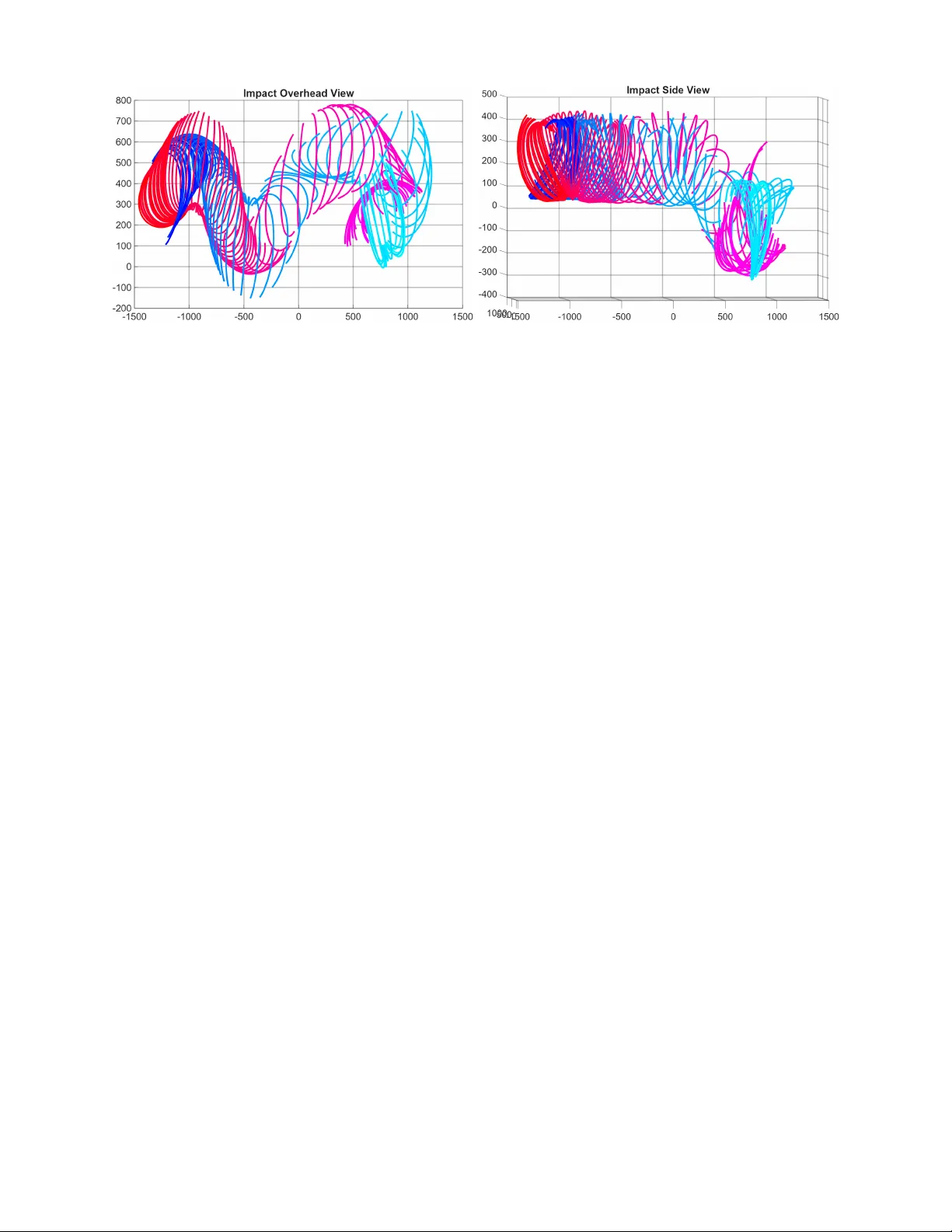
When Rolling Gets W eird: A Curv ed-Link T ensegrity Robot f or Non-Intuitiv e Beha vior Lauren Ervin 1 , Harish Bezaw ada 1 , and V ishesh V ikas 1 Abstract — Con ventional mobile tensegrity robots constructed with straight links offer mobility at the cost of locomotion speed. While spherical robots provide highly effective rolling behavior , they often lack the stability requir ed for navigating unstruc- tured terrain common in many space exploration envir onments. This resear ch presents a solution with a semi-cir cular , curved- link tensegrity robot that strikes a balance between efficient rolling locomotion and controlled stability , enabled by disconti- nuities present at the arc endpoints. Building upon an existing geometric static modeling framework [1], this work presents the system design of an improved T ensegrity eXploratory Robot 2 (T eXploR2). Inter nal shifting masses instantaneously r oll along each curved-link, dynamically altering the two points of contact with the ground plane. Simulations of quasistatic, piecewise continuous locomotion sequences reveal new insights into the positional displacement between inertial and body frames. Non- intuitive rolling behaviors are identified and experimentally validated using a tetherless prototype, demonstrating successful dynamic locomotion. A preliminary impact test highlights the tensegrity structure’ s inherent shock absorption capabilities and conformability . Future work will focus on finalizing a dynamic model that is experimentally validated with extended testing in real-world en vironments as well as further refinement of the prototype to incorporate additional curved-links and subsequent ground contact points f or increased controllability . I . I N T RO D U C T I O N Much of the motiv ation for adopting semi-circular, rigid links as the structural foundation of the proposed tensegrity structure lies in the goal of enhancing locomotion speed of tensegrity systems. Improved speed is particularly beneficial for increasing potential data acquisition efficienc y during science missions in certain unstructured en vironments of interest such as the lunar surf ace. T raditionally , the v ast ma- jority of mobile tensegrity robots utilize rigid, straight links arranged in icosahedrons [2]–[9]. These designs typically rely on active shape morphing through cable lengthening and shortening to achiev e movement. While incorporating multiple actuators can enhance controllability , this actuation strategy introduces significant coordination complexity . The need for precise synchronization among numerous actuators often leads to increased latency in mov ement sequences *This work was supported in part by USD A/NIF A A ward #2023-67022- 40918. The material contained in this document is based upon work sup- ported in part by a National Aeronautics and Space Administration (N ASA) grant or cooperative agreement. Any opinions, findings, conclusions, or recommendations expressed in this material are those of the authors and do not necessarily reflect the views of N ASA. This work was supported through a N ASA grant awarded to the Alabama/NASA Space Grant Consortium. 1 Lauren Ervin, Harish Bezawada, and V ishesh V ikas are with the Agile Robotics Lab, Uni versity of Alabama, T uscaloosa, AL 35487, USA { lefaris, hbezawada } @crimson.ua.edu, vvikas@ua.edu where the actuators must coordinate with one another in unison. If cable length changing does not occur simultane- ously , it will add ev en more time to movement sequences. The combination of the straight, rigid bars held together with changing cable lengths generally produces toppling- like gaits, further slowing down planar locomotion compared to smooth rolling. An example of this slowed behavior is shown in Fig. 1. The four prototypes designed with straight links [6]–[9] hav e reported trav el speeds ranging from 0.021 and 0.268 body lengths per second (BL/s). In contrast, the prototype designed with curved-links [10] achieved a speed of up to 0.71 BL/s, or nearly three times faster than the fastest straight-link design. Fig. 1: T ensegrity robot locomotion speed comparison among fiv e different mobile tensegrity robots with published ex- perimental speeds [6]–[10]. The four straight-link designs are significantly slo wer than the curv ed-link design when normalized to body lengths per second (BL/s). Speed is not the only critical factor . Otherwise, a wheeled or spherical design would be preferable; spherical robots with internal mass movement can exhibit incredibly efficient and smooth rolling behavior [11], [12]. Although spherical robots excel at rolling speed, they lack additional points of contact with the ground plane to quickly stop. Inno vati ve designs that strike a balance between speed and adaptation to non- uniform terrains are attractiv e for those in the space, water , and search and rescue communities. A curved-link tensegrity design can yield efficient rolling behavior while introducing stability at arc endpoints that can handle inclines. Additional conformability and compliance inherent to the structure can tolerate sharp edges and unev en surfaces. Regardless of the geometry of the rigid elements used, modeling the connections between members and cables in tensegrity systems remains an open challenge and understud- ied area of research due to their non-linear characteristics. Although dynamic modeling is still an ongoing effort within the field, the geometric nature of these systems lends itself well to advanced mathematical tools such as Screw Theory and Lie groups, which offer robustness against singularities [13]–[15]. Building upon a previously developed static mod- eling frame work that le verages geometric representations and Screw Theory [1], this work introduces an analysis of qua- sistatic and non-intuitiv e behaviors. This non-intuiti ve con- trol enables faster transitioning between locomotion states, further increasing the controllability of the system. The latest iteration of the T eXploR prototype is presented on the left in Fig. 2. This design is a ne wer version than the previous tetherless prototype [1] shown on the right and takes inspiration from [10] and [16]. The new robot demon- strates smoother movement capable of dynamic rolling, and a larger open central area is included to accommodate future additions such as suspended gimbals and science payloads. Fig. 2: T eXploR prototype on the right (red) and T eXploR2 on the left (black). The two curved arcs in each iteration are held together with a network of 12 elastic cables. Rolling is achiev ed via internal mass shifting along the arcs, which shifts the overall CoM of T eXploR2. T eXploR2 is signficantly lar ger and weighs nearly triple that of T eXploR. Contributions. This work presents a design methodology for a T ensegrity eXploratory Robot 2 (T eXploR2) capable of dynamic mov ement. Simulations show a quasistatic rolling sequence where T eXploR2 switches between four states in a piecewise continuous path. Non-intuitiv e behavior for switching states is analyzed, and rolling e xperiments with the tetherless prototype show successful validation. V icon motion capturing data of the experiments further highlight the added impact test to show the resilience of the system and the inherently compliant tensegrity design. Paper Organization. The next section discusses the sys- tem design of the improv ed, tetherless T eXploR2 prototype along with design requirements. The third section briefly vis- its the geometric relationship between the two arcs and shows quasistatic simulation for a full rolling sequence between four states of locomotion. Section four sho ws a dynamic rolling experiment with the physical prototype that utilizes non-intuitiv e behavior for more efficient state jumping and an impact test. Finally , the Conclusions section discusses the findings in this work as well as next steps for the research. I I . S Y S T E M D E S I G N This v ersion represents an improv ement o ver the previous tetherless prototype depicted in Fig. 2. Each shifting mass, m i , in the updated design weighs 1,150g which is nearly three times heavier than that of the earlier prototype. Similarly , the semi-circular curved arc weighs approximately 1,300g, which is slightly more than triple the mass of the pre vious arcs. While the current shifting mass to arc mass ratio is approximately 0.88:1, this can easily be adjusted to reach a 1:1 ratio or beyond by adding supplemental mass as needed. Howe ver , based on experimental testing, the 0.88:1 ratio was found to be sufficient. The new prototype also features larger dimensions: the arc diameter has increased from 403mm to 585mm, and similarly the width has grown from 83mm to 98mm. T o improve durability and flexural strength, the arcs are fabricated using On yx TM (from Markforged) via additive manufacturing, replacing the tough PLA used in the previous design. F or future deployments in extreme environments such as the arctic, alternativ e materials may be required to ensure structural compliance and performance reliability . A. Design Requir ements Follo wing the de velopment and e v aluation of the initial prototype, se veral improvements were identified and incor- porated into the updated design. Based of f those lessons learned, a refined set of design requirements for the second generation T eXploR2 are as follows. 1) Shifting mass smoothness: Reg ardless of the orientation of the two masses, they must maintain continuous contact and proper alignment along the track throughout dynamic motion. This includes minimizing any rotation, rocking, or gaps between the shifting mass assembly and the arc track during dynamic movement. Preliminary manual alignment tests hav e demonstrated consistent and smooth rolling beha vior along the arc reg ardless of shifting mass location. Howe ver , to further quantify this, an onboard IMU will measure the acceleration in future experiments to ensure there are no sudden unintended accelerations or decelerations. 2) Ar c symmetry: Both the curved arcs and the integrated gear racks must be designed to prioritize geometric and mass symmetry . This ensures consistent center of mass mov ement, regardless of which side of the arc faces the ground. This is intended to reduce potential discrepan- cies between the arc mass in the model and the mass distribution along the physical arc in the prototype. This is opposed to the initial design, where mass distribution along an arc was not e venly distributed along the cir - cumference of the arc, leading to discrepancies between modeled and actual behavior . 3) Scale: The structure must reserve at least 10 cm 3 of open space in the center between the two arcs to allow for fu- ture integration of additional payloads, e.g., a suspended vision system or science payload. 4) Modular and adaptable: The overall design should sup- port modular expansion and adaptability; it should be in v ariant to the specific primiti ve. Specifically , it must ac- commodate an increased number of curved links without requiring a fundamental redesign. Adding more curved links will expand the number of ground contact points, thereby increasing the number of hybrid system states and improving system controllability . Additionally , the arc-to-arc connection points (nodes) are also modular . Although only eight node positions are required to com- plete the cable routing, each arc includes a total of 48 holes, providing flexibility for future reconfiguration and adjustments as needed. B. Motor Carriage Design As previously described, actuation of the system is achiev ed through controlled mo vement of a shifting mass along each curved arc. This mov ement is facilitated by a dual-shaft NEMA23 stepper motor assembly that traverses each arc in a coordinated manner . T o maintain proper tension and alignment across all potential configurations, se veral crit- ical design choices were implemented. The motor carriage, shown in Fig. 3, latches onto an internal T -track that defines the inner curvature of each arc. T o guide the carriage and minimize unwanted motion, the sides and underside of the top of the track include four strategically placed triangular protrusions. The protrusion geometry matches eight v-groove bearings, i.e. four oriented horizontally and four oriented vertically . The horizontal bearings mitigate torsional rotation that might otherwise occur from the motor’ s tilted mounting angle of approximately 45 ◦ relativ e the ground plane move- ment due to the motor laying at an approximate 45 ◦ from the ground plane. Meanwhile, the vertical bearings secure the carriage when hanging upside down along the arc. Six embedded ball bearings on the underside of the carriage contribute to smooth rolling along the top of the T -track with a matching arc geometry , as illustrated in Fig. 4. Fig. 3: Motor carriage design. a) Cross-section view of the v-groov e and ball bearing configuration in the motor carriage that grip the T -track. b) Isometric vie w of the motor carriage attached to the T -track. This view emphasizes the v-groov e bearing attachments at both ends of the motor carriage, prev enting motor rocking during increased velocity . C. Ar c Design Each semi-circular arc contains two internal gear racks positioned parallel to each other along the arc’ s inner curv a- ture. A dual-shaft NEMA23 stepper motor driv es matching pinion gears that engage simultaneously with both gear racks on a single arc. Both the gear racks and pinions feature a herringbone teeth design that was deliberately selected to increase the contact ratio and encourage smooth po wer transmission, ev en at high velocity or under significant loads. Fig. 4: Curved arc with motor assembly . a) Motor carriage underside with matching arc curvature for smooth rolling along the top of the T -track. Six embedded ball bearings promote smoothness. Pinion gears are connected via bolts anchored into heat set inserts on the underside and sides of the carriage. b) The motor carriage fixed to the curved arc. c) Internal geometry of the sister gear racks. Partial assembly highlights the connection points. The symmetrical design ensures consistent mass distri- bution from the arcs, regardless of the robot’ s orientation. This consistency helps minimize discrepancies between the modeled behavior and physical prototype. The width of each arc is tightly coupled to the stepper motor’ s dimensions; the stepper motor width dictates the arc’ s minimum width. For example, the NEMA23 stepper motor , mounted at the center of the arc, measures 56mm in width. An additional 13mm on each side accounts for the pinion gears fixed to the motor’ s dual shafts. The arc’ s outer walls are 5mm wide, and a 3mm clearance is maintained between the inner wall of the arc and the gear rack to prev ent unintended friction. In the prototype presented, these constraints result in a minimum viable arc width of 98mm to preserve symmetry . Although the arc width could be expanded beyond this and adapted into v arious shapes, maintaining a balanced weight distribution is essential; a higher ratio of shifting mass to arc mass allows for reduced displacement of the shifting mass to achiev e rolling motion. In other words, lighter arcs enhance power efficienc y . Additionally , the arcs are designed to be relati vely flat rather than fully curved, as shown in Fig. 3. This geometry promotes rolling along a defined edge that is hypothesized to reduce discrepancies with the model that assumes a single point per ground contact point. More prototypes that alter the defined edge thickness as a control parameter could further v alidate this idea. The model can also account for arc width during state transitions, i.e. changes in the pivot point. D. Electr onics All electronics onboard T eXploR2 interface with a Rasp- berry Pi Zero 2W and a custom PCB. The system actuators are dual shaft NEMA23 bipolar stepper motors capable of ex erting up to 1.85Nm of torque and rotating 200 steps per rev olution in full-step mode. Six full rotations are required to trav el one semi-circular arc. The holding torque of one motor is significantly higher than what is required to shift the mass of the system; this ensures payloads can be added in the future without the need for swapping in stronger actuators. They are each controlled via high-current TB67S128FTG motor driv er carrier boards. These driv ers support Acti ve Gain Control (AGC) which automatically reduces the current when the maximum torque is not required, further reducing power consumption. Microstepping is also supported to en- able finer resolution in motor control. Each shifting mass is equipped with a 9-axis BNO085 IMU capable of capturing both orientation and acceleration data that is communicated via I2C at a rate of 200Hz. Most electronic components are mounted on a single motor assembly , with the exception of one IMU and two limit switches. T eXploR2 is operated remotely by establishing an SSH connection to the Pi via a shared network. Through this interface, various commands are issued to control the two stepper motors. Currently , the system uses open loop control with a set of predefined rolling sequences in which only one motor actuates at a time. The entire system is powered by a single 11.4V 1.5Ah LiPo battery , enabling tetherless capabilities. Fig. 5: T eXploR2 electronics. All electronics are rigidly connected to an electronics mount that sits on top of a motor . E. Shock Absorption Due to the compliance of the system, T eXploR2 has a lev el of shock absorption built into the mechanical structure. The compressed members are connected with a network of tensioned cables and springs that absorb collisions or drops with minimal impact to the system. Fig. 6 highlights acceleration readings from an accelerometer connected to one of the shifting masses while T eXploR2 drops off of a platform during a rolling sequence. When T eXploR2 hits the ground, there are oscillations from the shock absorption that subside after roughly 5 seconds. Notably , the driving shifting mass continues to move during this recov ery time. Fig. 6: BNO085 acceleration collected during an impact. It is absorbed within 5 seconds and does not impact mass shifting. F . Further Design Impr ovements The arc design can, and should, be further adapted for spe- cific surface trav ersal scenarios and specialized applications. For instance, when operating on granular terrains such as sand or lunar regolith, it is necessary to incorporate grousers into the outer surface of the arcs. This feature will help pre- vent e xcessi ve sinking by concentrating the robot’ s mass onto discrete contact points, rather than distributing it across the full arc. As a result, localized penetration into the granular surface may occur without necessarily submerging the whole arc into the medium. Corresponding adjustments to the robot model would be required to accurately reflect these changes, which would likely shrink the number of stable configura- tions av ailable to T eXploR2. In scenarios in volving steep inclines, the integration of directional or non-directional microspines along the arc surface could enhance traction and grip stability . These microspines passiv ely latch onto surface asperities, potentially increasing T eXploR2’ s ability to navig ate irregular or non-uniform terrain. Both grousers and microspines represent forms of embodied intelligence and offer promising avenues for expanding T eXploR2’ s capabilities in unstructured and/or extreme environments. Future enhancements to the electronics of T eXploR2 may be added to e xpand the system’ s capabilities. While most tensegrity robots achie ve activ e shape morphing through the alteration of cable segment lengths, T eXploR2 currently relies on internal mass shifting. T o incorporate active shape morphing into the existing design, linear actuators would need to be integrated into each of the twelve connecting cable segments. Although this would add complexity into the system, it would also provide greater controllability and maneuverability . Notably , the current design already supports passive shape morphing. By manually detaching the twelve connecting cable se gments, the structure can collapse from a spatial configuration to a planar one, reducing its size to approximately 1/6th of its deployed volume. This transformation significantly decreases the system’ s physical footprint and associated transportation expenses, particularly for costly space deployment scenarios. Additionally , scaling up the system, i.e. increasing the arc size, creates more open volume at the robot’ s center when fully deployed. This space could be utilized in future iterations to suspend payloads such as sensors for obstacle av oidance, path plan- ning, SLAM, etc. Howe ver , such upgrades would introduce new challenges, particularly in accurately estimating the transformation matrix between the sensor payload, robot, and the global inertial frames. Specifically , projecting sensor data into a global frame will require precise tracking of a suspended payload’ s motion relati ve to both the robot’ s center of mass as well as reference frames fixed to the two arcs. Future implementations will incorporate closed loop feedback control for more precise and adaptive navigation. Addressing these challenges will be crucial in incorporating closed loop feedback control for more precise and adapti ve navigation and advanced perception in future versions of T eXploR2. I I I . Q UA S I S T A T I C A NA L Y S I S The kinematics of T eXploR2 closely match the static modeling frame work presented in the previous work [1]. The two semi-circular arcs L 1 , L 2 are represented with radii r = 272 . 5 mm and masses m 1 , m 2 = 1 , 300 g . The origin of the two coordinate systems { 1 } , { 2 } are fixed at the base of the center of the arc, such that the x axis is parallel to the line running through the arc endpoints and the z axis is normal to the arc plane as shown in Fig. 7. Each motor consists of mass M i = 1 , 150 g that travels along one of the arcs. At any instance in time, the moving mass’ s location about the arc is gi ven by p i and the angle at which it has traveled relative to the center of the arc is θ i . The instantaneous point of contact the arc makes with the ground plane is represented by q i . Similarly , the angle of the point of contact relativ e to the center of the arc is giv en by φ i . Consequently , the points p i , q i can be represented as p p p b 1 = r cos ( θ 1 ) sin ( θ 1 ) 0 , p p p b 2 = o o o 12 + R 12 p p p 2 2 = r 0 − sin ( θ 2 ) cos ( θ 2 ) q q q b 1 = r cos ( φ 1 ) sin ( φ 1 ) 0 , q q q b 2 = o o o 12 + R 12 q q q 2 2 = r 0 − sin ( φ 2 ) cos ( φ 2 ) (1) Fig. 7: V isualization of the relationship between arcs L 1 and L 2 . The robot body { b } coordinate frame coincides with { 1 } . where R 12 ∈ SO ( 3 ) and o o o 12 ∈ R 3 × 1 are the rotation matrix and the displacement vector between the origins of the reference frames { 1 } , { 2 } . R 12 and o o o 12 combine to make the transformation matrix T 12 ∈ S E ( 3 ) that changes the representation of a point from coordinate system { 2 } to { 1 } . T 12 = R 12 o o o 1 12 0 0 0 1 × 3 1 , R 12 = 0 0 1 0 − 1 0 1 0 0 , o o o 1 12 = 0 0 0 (2) Fig. 8: Quasistatic locomotion simulation. The magenta lines show the mov ement during state 1, blue lines show the mov ement during state 4, green lines show the movement during state 2, and red lines show the movement during state 3. The rolling sequence trav erses state 1 → state 4 → state 2 → state 3. The dots represent the points of contact, and the black crosses represent the center of mass. From the static modeling framework, it is defined that T eXploR2 is a hybrid system consisting of four states of locomotion for a rolling sequence. These states are dictated by an arc endpoint contact point acting as a pivot while the other contact point rolls along the ground until it reaches its respectiv e arc endpoint. Instantaneously , this is the new piv ot point that stays fixed to the ground plane as the opposing contact point changes due to its internal mass shifting along the entirety of the arc. This continues back and forth with two arcs that each contain two endpoints to result in four states producing a piecewise continuous motion. State 1 : φ 1 ∈ ( 0 , 180 ◦ ) , φ 2 = 0 ◦ , roll about L 1 State 2 : φ 1 ∈ ( 0 , 180 ◦ ) , φ 2 = 180 ◦ , roll about L 1 State 3 : φ 1 = 0 ◦ , φ 2 ∈ ( 0 , 180 ◦ ) , roll about L 2 State 4 : φ 1 = 180 ◦ , φ 2 ∈ ( 0 , 180 ◦ ) , roll about L 2 For further details and diagrams of the geometric relation- ship of the system, we encourage the reader to reference the Robot Kinematics section in the authors’ prior work [1]. A. Simulation Quasistatic simulations in Fig. 8 show T eXploR2 in a full rolling sequence trav eling from state 1 → state 4 → state 2 → state 3. Within each state in increments of 10 ◦ , the control input of one of the shifting masses, θ i , increases or decreases to reach either 0 ◦ or 180 ◦ depending on the starting angle while the other control mass, θ i ± 1 , remains stuck to the piv ot point (0 ◦ or 180 ◦ depending on the state). The robot equilibrium position represented through ground contact angles ( φ 1 , φ 2 ) is found for each of these input combinations. Additionally , the original static modeling framew ork generates a closed form solution for T sb ∈ S E ( 3 ) which transforms a point from a fixed inertial frame to the body frame using a rotation matrix, R sb ∈ SO ( 3 ) , and a translation vector , o o o sb ∈ R 3 . Howe ver , the previous static modeling framew ork assumed that only the z component of o o o sb could be found analytically from r and x , y remained free positions an ywhere along the ground plane. For the quasistatic case, it is instead found that x , y components are also dependent on the changing mass positions. Using this information, o o o sb = [ cos ( θ i ) , sin ( θ i ) , √ r / 2 ] T is found. Notably , once a ground contact point reaches the end of one of the arcs (equi valently , a transition between the four states), the arc endpoint associated with that robot orientation now acts as a piv ot, i.e. that position must be combined with the following displacement vectors. For instance, traveling in a sequence from state 1 → state 4 → state 2 → state 3 w ould result in the following displacement vectors. State 1 → 4 : o o o sb = [ cos ( θ 1 ) , sin ( θ 1 ) , √ r / 2 ] T at φ 2 State 4 → 2 : o o o sb = [ cos ( θ 2 ) , − sin ( θ 2 ) , √ r / 2 ] T at φ 1 State 2 → 3 : o o o sb = [ cos ( θ 1 ) , sin ( θ 1 ) , √ r / 2 ] T at φ 2 State 3 → 1 : o o o sb = [ cos ( θ 2 ) , − sin ( θ 2 ) , √ r / 2 ] T at φ 1 The robot configurations for the full sequence rolling between the four states are sho wn in Fig. 8. Here, the magenta lines show the movement during state 1, green lines show the movement during state 2, red lines show the mov ement during state 3, and blue lines sho w the movement during state 4. The dots represent q 1 , q 2 , and the black crosses show how the center of mass shifts during a rolling sequence. I V . N O N - I N T U I T I V E DY NA M I C R E S U L T S In quasistatic robot configurations, two types of behavior can be exploited when switching states: intuiti ve and non- intuitiv e behavior . Non-intuiti ve behavior occurs when the shifting mass associated with the moving ground contact point does not trav el to an arc endpoint before transitioning states. This is shown in two different examples in Fig. 9a. Here, the red dotted lines represent the state transition boundaries for the non-intuitive beha vior described. A start- ing position, x 0 , trav els to location x 1 where it sits in state 1. It can travel directly upwards, passing the boundary line, to land at x 2 in state 3. Similarly , it could instead travel to the right, passing another boundary line, to land at x 3 in state 4. The alternati ve option is to tra vel along the black perimeter lines as shown in Fig. 9b . Here, x 0 trav els the entire state 1 to x 1 before entering state 4 at x 2 . It is clear that trav eling along the non-intuitive boundary lines can achiev e state jumping more ef ficiently than the traditional method. In Fig. 9a, trav eling along the non-intuitiv e path from x 0 → x 1 → x 3 for state 1 → 4 would require θ 1 trav ersing a total of 162 . 81 ◦ ( 50 . 31 ◦ from x 0 → x 1 , then 112 . 5 ◦ from x 1 → x 3 ) . Alternativ ely , the intuiti ve path in Fig. 9b from x 0 → x 1 would require θ 1 to trav el the full 180 ◦ to transition from state 1 → 4. Ne xt, a dynamic rolling sequence with this non- intuitiv e behavior is experimentally shown. Fig. 9: Static equilibrium positions of the four states. a) T wo quasistatic control path sequences highlight the state transi- tion boundaries (dotted red line) for non-intuitiv e beha vior: x 0 → x 1 → x 2 for state 1 → 3 and x 0 → x 1 → x 3 for state 1 → 4. b) An intuiti ve state transition from x 0 → x 1 → x 2 for state 1 → 4 along the black dotted perimeter line. A. Real-world experiments The T eXploR2 prototype used for experiments sho wn abov e is also captured in the supplemental video. In Fig. 10, a dynamic rolling sequence traveling from state 1 → state 4 → state 2 is shown. Catching occurred on the internal gear racks that prev ented the shifting masses from trav eling the entirety of the arcs. This enabled a modified rolling sequence with non-intuitive switching behavior where state jumping occurred along a red boundary line. Instead of the typical rolling behavior where the shifting masses take turns trav eling the entirety of their respectiv e arc, non-intuitiv e jumping between states is exhibited. This shows jumping between states is achiev able faster than is possible with the intuitiv e state switching discussed in the quasistatic analysis. (a) t=1 (b) t=3 (c) t=5 (d) t=7 (e) t=8 (f) t=8.5 (g) t=9 (h) t=9.5 Fig. 10: A dynamic rolling sequence of T eXploR2 traversing along a stationary treadmill with a successful impact test at the end on a rubber mat. It can also result in faster velocity; during the non-intuitiv e rolling, T eXploR2 rolled up to 1.88 BL/s. Additional dynamic sequences other than rolling are also achiev able. The specified rolling sequence produces move- ment in a straight trajectory . Howe ver , when tra veling be- tween waypoints, the trajectory of T eXploR2 can change with jumping motions, e.g., directly from state 1 → state 2 without entering state 4 as previously described. This could be done by moving one mass partially along its arc, stopping, and shifting the other mass from one endpoint to another . Depending on the position of the first mass, this will alter the trajectory of T eXploR2. In Fig. 10g and Fig. 10h, T eXploR2 underwent an impact test. It hit a rubber mat head on that was at a roughly 600mm lower elev ation than the stationary treadmill. During this impact, T eXploR2 experienced a slight deformation upon impact due to the compliant nature of the tensegrity primitiv e design. Critically , the arcs absorbed the shock without damaging any components. Fig. 11 shows reconstructed points of the dynamic rolling sequence in Fig. 10 from a V icon motion capturing system. The V icon system is accurate up to 0.3mm with dynamic mov ement [17]. Since a test of general trajectory shape was the outcome of this dynamic test, this lev el of error could hav e gone up se veral orders of magnitude and not contributed heavily to the outcome of the experiment. The overhead vie w is provided to sho w that the rolling movement before the impact is similar to about half of the quasistatic simulation in Fig. 8 (state 1 → state 4). When a shifting mass caught on the internal gear rack after that point, initial rocking back and forth occurred before tra veling in a modified path to the next state, state 2. Then, T eXploR2 entered a short period of free fall before impacting the lower rubber mat. The side view offers a better perspectiv e of this drop. The impact test shows that T eXploR2 is capable of successfully withstanding changes in high acceleration without damage, and further testing in real-world en vironments is planned. V . C O N C L U S I O N A N D F U T U R E W O R K The system design for an improv ed tetherless T eXploR2 capable of dynamic movement sequences via internal mass (a) Ov erhead vie w (b) Side view Fig. 11: Reconstructed points of the dynamic rolling sequence with T eXploR along a stationary treadmill with a successful impact test at the end on a rubber mat. The ov erhead and side views are provided to showcase the winding rolling as well as the impact test. The two arcs are represented by the red to magenta lines and blue to cyan lines. shifting is detailed. MA TLAB simulations of a four-state, quasistatic piece wise continuous rolling sequence are sho wn along with solved x , y positions in the displacement vec- tor o o o sb that were previously thought to be free positions. A modified rolling sequence successfully exhibiting non- intuitiv e behavior is performed e xperimentally with the teth- erless prototype. An impact test sho ws the resilience of the platform and highlights the importance of shock absorption capabilities of the compliant tensegrity primitiv e design. The results of a V icon motion capturing system provide ground truth positioning to further analyze the experimental data. Future works include integrating an additional arc to make T eXploR2 a three point-of-contact hybrid system. This will increase both the controllability and maneuverability of the system which will be critical in constrained, highly tortuous en vironments that demand physical intelligence. Ho we ver , to achieve this environmental adaptability , feedback control will be necessary . In these conditions, low sensing latency and path planning will play a large role in mission success. By scaling up and leaving a large open area in the center of the robot, a future direction of this research includes suspending a camera or LiD AR to increase the computational intelligence and sensing capabilities of T eXploR2. AC K N OW L E D G M E N T The authors thank Michael Faris for his thoughtful discus- sions and input on the T eXploR2 design. R E F E R E N C E S [1] L. Ervin and V . V ikas, “Geometric static modeling framework for piecewise-continuous curved-link multi point-of-contact tensegrity robots, ” IEEE Robotics and Automation Letters , vol. 9, no. 12, pp. 11 066–11 073, 2024. [2] A. P . Sabelhaus, J. Bruce, K. Caluwaerts, P . Manovi, R. F . Firoozi, S. Dobi, A. M. Agogino, and V . SunSpiral, “System design and locomotion of superball, an untethered tensegrity robot, ” in 2015 IEEE International Confer ence on Robotics and Automation (ICRA) , 2015. [3] K. Caluwaerts, J. Despraz, A. Is ¸c ¸ en, A. P . Sabelhaus, J. Bruce, B. Schrauwen, and V . SunSpiral, “Design and control of compliant tensegrity robots through simulation and hardware validation, ” Journal of the Royal Society Interface , Sep. 2014. [4] G. Pietila and K. Cohen, “Dynamic Modeling of Morphing T ensegrity Structures, ” in Infotech@Aer ospace 2011 . St. Louis, Missouri: American Institute of Aeronautics and Astronautics, Mar. 2011. [5] S. Hirai and R. Imuta, “Dynamic simulation of six-strut tensegrity robot rolling, ” in 2012 IEEE International Confer ence on Robotics and Biomimetics (R OBIO) , Dec. 2012, pp. 198–204. [6] C. Paul, F . V alero-Cuevas, and H. Lipson, “Design and control of tensegrity robots for locomotion, ” IEEE T ransactions on Robotics , vol. 22, no. 5, pp. 944–957, Oct. 2006. [7] L.-H. Chen, K. Kim, E. T ang, K. Li, R. House, A. M. Agogino, A. Agogino, V . Sunspiral, and E. Jung, “Soft Spherical T ensegrity Robot Design Using Rod-Centered Actuation and Control, ” in V olume 5A: 40th Mechanisms and Robotics Conference . Charlotte, North Carolina, USA: American Society of Mechanical Engineers, 2016. [8] K. Kim, A. K. Agogino, D. Moon, L. T aneja, A. T oghyan, B. De- hghani, V . SunSpiral, and A. M. Agogino, “Rapid prototyping design and control of tensegrity soft robot for locomotion, ” in IEEE Interna- tional Confer ence on Robotics and Biomimetics (ROBIO) , 2014. [9] L.-H. Chen, B. Cera, E. L. Zhu, R. Edmunds, F . Rice, A. Bronars, E. T ang, S. R. Malekshahi, O. Romero, A. K. Agogino, and A. M. Agogino, “Inclined surface locomotion strategies for spherical tenseg- rity robots, ” in 2017 IEEE/RSJ International Conference on Intelligent Robots and Systems (IR OS) , 2017. [10] V . B ¨ ohm, T . Kaufhold, F . Schale, and K. Zimmermann, “Spherical mobile robot based on a tensegrity structure with curved compressed members, ” in 2016 IEEE International Confer ence on Advanced Intelligent Mechatr onics (AIM) , Jul. 2016, pp. 1509–1514. [11] T . Dewi, P . Risma, Y . Oktarina, L. Prasetyani, and Z. Mulya, “The kinematics and dynamics motion analysis of a spherical robot, ” in 2019 6th International Conference on Electrical Engineering, Computer Science and Informatics (EECSI) , 2019, pp. 101–105. [12] A. Morinaga, M. Svinin, and M. Y amamoto, “ A motion planning strategy for a spherical rolling robot driven by two internal rotors, ” IEEE T ransactions on Robotics , vol. 30, no. 4, pp. 993–1002, 2014. [13] M. Liu, D. Qu, F . Xu, F . Zou, J. Song, C. T ang, Z. Ma, and L. Jiang, “Dynamic Modeling of Quadrupedal Robot Based on the Screw Theory , ” in 2019 Chinese Automation Congress (CA C) , Nov . 2019, pp. 5540–5544, iSSN: 2688-0938. [14] A. M ¨ uller , “Screw and lie group theory in multibody kinematics, ” Multibody System Dynamics , vol. 43, pp. 37–70, May 2018. [15] A. Muller, “Screw and lie group theory in multibody dynamics, ” Multibody System Dynamics , vol. 42, pp. 219–248, May 2018. [16] K. G. Gim and J. Kim, “Ringbot: Monocycle Robot W ith Legs, ” IEEE T ransactions on Robotics , vol. 40, pp. 1890–1905, 2024. [17] “How accurate / precise are your systems?” Jun 2020. [Online]. A vailable: https://www .vicon.com/support/faqs/ how- accurate- precise- are- your - systems/
Original Paper
Loading high-quality paper...
Comments & Academic Discussion
Loading comments...
Leave a Comment