The Port-Hamiltonian Structure of Vehicle Manipulator Systems
This paper presents a port-Hamiltonian formulation of vehicle-manipulator systems (VMS), a broad class of robotic systems including aerial manipulators, underwater manipulators, space robots, and omnidirectional mobile manipulators. Unlike existing L…
Authors: Ramy Rashad
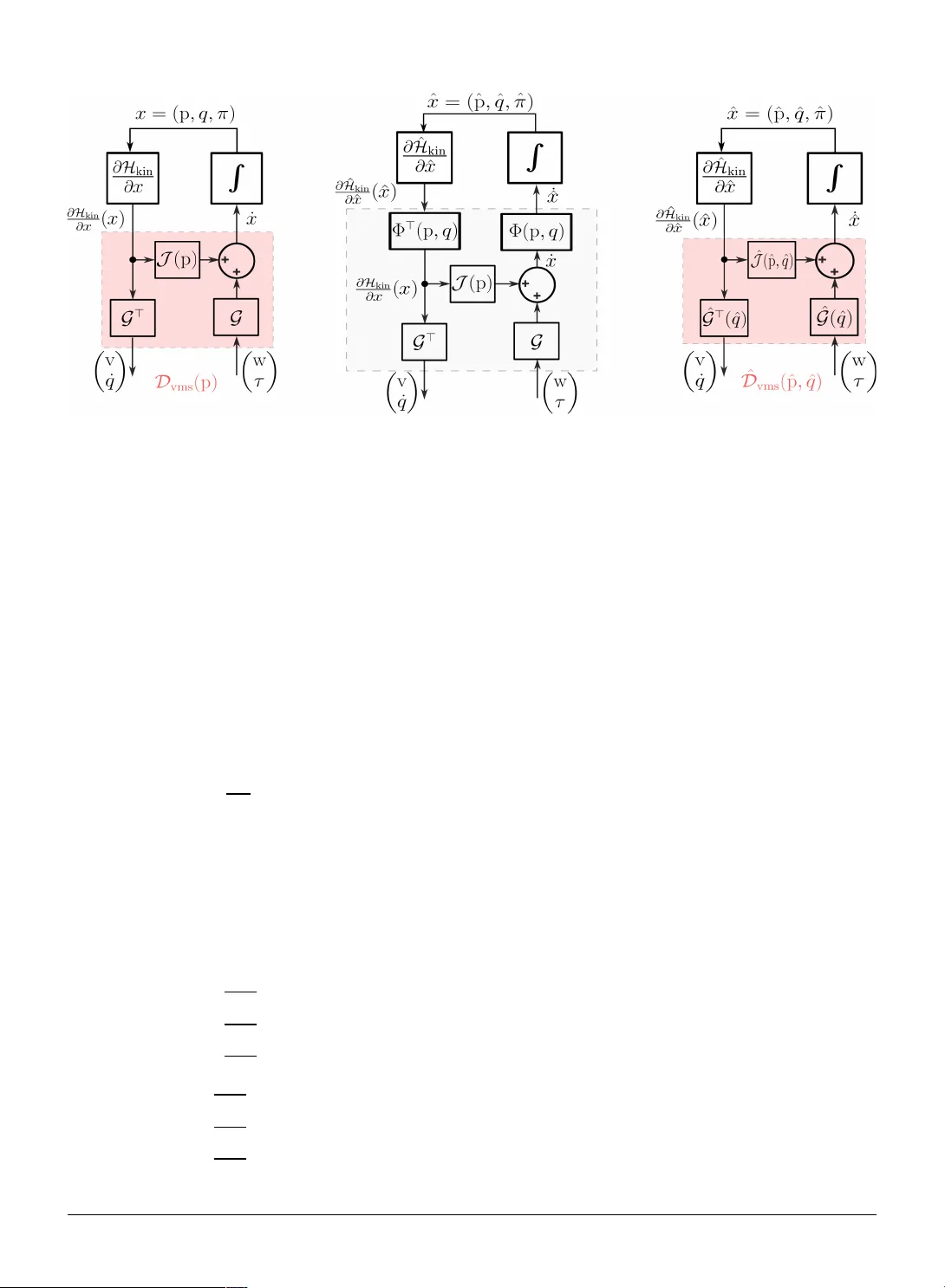
The P or t-Hamiltonian Structure of V ehicle Manipulator Sys tems Ram y Rashad a , ∗ ,1 (Researc her) a Control and Instr umentation Engineering department and Interdisciplinary Resear c h Center for Smart Mobility and Logistics, King F ahd Univ ersity of P etr oleum and Minerals, Dhahran, 34464, Saudi Arabia A R T I C L E I N F O Keyw ords : port-Hamiltonian, geometric mechan- ics, v ehicle-manipulator sy stems, floating- base manipulators, mobile manipula- tors. A B S T R A C T This paper presents a port-Hamiltonian formulation of vehicle-manipulator systems (VMS), a broad class of robotic systems including aerial manipulators, underwater manipulators, space robots, and omnidirectional mobile manipulators. Unlike existing Lagrangian formulations t hat obscure the underlying energe tic structure, t he proposed port-Hamiltonian formulation explicitly rev eals the energy flow and conser vation proper ties of t hese complex mechanical systems. W e der ive the port-Hamiltonian dynamics from first pr inciples using Hamiltonian reduction theory . T wo complementary formulations are presented: a standard f orm that directly exposes the energy structure, and an inertially-decoupled form that leverag es the principal bundle structure of t he VMS configuration space and is par ticularl y suit able for control design and numer ical simulation. The coordinate-free geometric approach we follow avoids singularities associated with local parameterizations of the base or ientation. W e rigorously establish the mathematical equiv alence between our por t-Hamiltonian formulations and existing reduced Euler-Lagrange and Boltzmann-Hamel equations found in the robotics and geome tric mechanics literature. 1. Introduction V ehicle manipulator systems (VMS) are a broad class of robotic systems that consist of a manipulator mounted on a mobile base. Ex amples of VMS include aerial manipulators [ 1 ], under water manipulators [ 2 ], space robots [ 3 ], and omnidirectional mobile manipulators [ 4 ]. The equations of motion of VMS hav e been e xtensiv ely studied in t he robotics and geometric mechanics literature and are indespensable for analysis, model-based control, parameter identification, and numerical simulation. In the robotics community , the equations of motion of a VMS are typically derived by the recursiv e Newton-Euler approach starting from the gov er ning equations of a single rigid body [ 5 ]. In the geometric mechanics community , the equations of motion are usually derived using variational principles on t he tang ent bundle of the configuration space. The equations of motion of a VMS possess several hidden structures that can be e xploited f or different robotics applications. On one hand, there is the kinematic tree structure of manipulators that can be exploited f or computational efficiency in calculating the mass and Cor iolis-centrifugal matr ices as well as their der ivativ es needed for model- based control and optimization [ 6 , 7 ]. Another aspect is the geometric str ucture given by t he non-Euclidean nature of the configuration space which is fundamental to modern treatments of r igid-body dynamics and robotics [ 8 , 9 ]. In particular, the configuration space of a VMS has a pr incipal bundle structure which has been e xploited for anal ysis [ 10 ], control [ 3 ] and locomotion planning [ 11 ]. There is one s tructure though that has not been fully exploited in the robotics literature, namely the energ etic structure of the equations of motion. Most exis ting w orks f or mulate the equations of motion using the Lagrangian approach which usuall y obscures suc h underl ying str ucture. The energetic str ucture is usuall y represented using symplectic or Poisson structures in t he Hamiltonian framew ork, cf. [ 12 ]. Ho we ver , the Hamiltonian approach is not widely used in robotics due to its inapplicability to control synthesis as most Hamiltonian systems represent isolated systems that preserve ener gy . On t he other hand, the por t-Hamiltonian frame w ork [ 13 , 14 ] e xtends the Hamiltonian approach (using port-based modeling) to open dynamical systems that can ex change energy with their en vironment through pow er por ts. The por t-Hamiltonian framew ork has the ability to highlight the energe tic and g eometr ic structure of complex mechanical systems (e.g., [ 15 , 16 , 17 , 18 ]), which can then be exploited f or new insights in anal ysis, simulation and control (e.g., [ 19 , 20 , 21 ]). In the robotics and control communities, there ha ve been many successful stories of the This work has been funded by King Fahd University of Pe troleum and Minerals under Project EC251005. ramy.rashad@kfupm.edu.sa (R. Rashad) OR CID (s): 0000-0002-9083-0504 (R. Rashad) R. Rashad: Pr epr int submitted to Elsevier Page 1 of 28 P o rt-Hamiltonian VMS insight that energy-based thinking has brought to t he field, such as impedance and admitt ance control [ 22 ], energy - shaping control [ 23 ], virtual energy tanks [ 24 ], control by interconnection [ 25 ], and learning robot dynamics [ 26 ]. The main goal of this paper is to present a port-Hamiltonian formulation of VMS dynamics that reveals the underl ying energ etic str ucture of these sy stems. T o the best of the authors’ kno wledg e, this is the first w ork that systematicall y derives the port-Hamiltonian dynamics of VMS from first pr inciples using Hamiltonian reduction theor y . W e present tw o complement ar y port-Hamiltonian f or mulations of the VMS dynamics: one form in the standard velocity variables and another iner tiall y-decoupled form in the pr incipal bundle v ariables. Our work relies on the geometric formulation of robotic systems using Lie group theor y pioneered by Brock ett [ 27 ] and evol ved o ver the years b y many researchers [ 8 , 9 ]. In particular, our work was inspired by t he recent w orks of Mishra et al. [ 28 ] and Moghaddam and Chhabra [ 29 ] t hat derived t he Lagrangian equations of motion on the principal bundle configuration space. In the por t-Hamiltonian literature, Duindam and Stramigioli [ 30 ] presented a port-Hamiltonian f ormulation of gener ic open-chain mec hanisms, wit h generic holonomic and nonholonomic joints, using the Boltzmann-Hamel equations. Their w ork considered g eneric quasi-v elocities and neit her considered the principal bundle str ucture of VMS nor a systematic der iv ation of t he por t-Hamiltonian dynamics from first principles. The main contributions of t his work can be explicitly summar ized as f ollo w s: 1. Formulate the VMS dynamics in t he port-Hamiltonian framew ork. 2. Derive t he por t-Hamiltonian f orm from first pr inciples using Hamiltonian reduction and not by manipulating the Lagrangian equations of motion. 3. Present an iner tiall y-decoupled port-Hamiltonian formulation t hat lev erages the principal bundle str ucture of the configuration space. 4. Show the equivalence between the proposed dynamic models and Lagrangian formulations in the literature. 5. Consider symmetry-breaking generalized f orces (suc h as gra vity , actuator torques, and end effector wrenches) which are usually neglected in geome tric mechanics treatments but essential f or robotics applications. The remainder of t his paper is organized as follo w s. Section 2 introduces preliminar ies and establishes t he notation used throughout the paper . W e derive the por t-Hamiltonian f or mulations of a fixed-base manipulator and mo ving-base separately in Sections 3 and 4 , respectiv ely , as inter mediate steps to w ards t he full VMS dynamics. In Section 5 , we present our tw o proposed f ormulations for VMS dynamics. Section 6 demons trates the equiv alence betw een our proposed formulations and existing ones in the literature. Section 7 discusses the implications and potential applications of the proposed framew ork. Finally , we conclude in Section 8 . 2. Mathematical Preliminaries 2.1. Rigid Body Kinematics and Dynamics on (3) Let { } denote an ort honor mal frame with origin at point and ax es aligned wit h unit v ectors { , , } . The relativ e pose of frame { } with respect to frame { } is r epresented by t he pair ( , ) ∈ (3) , where ∈ (3) denotes the relative or ientation of t he two frames and ∈ ℝ 3 denotes the position of the origin expressed in frame { } . W e shall use the homogeneous transformation matr ix to represent the relative pose of frame { } with respect to frame { } as = 0 1×3 1 ∈ (3) . (1) With an abuse of notation, we shall also denote the space of homog eneous transf ormation matr ices as (3) , the special Euclidean group in three dimensions. The relativ e twist (generalized velocity) between any two frames { } and { } is represented by , = , , 0 1×3 0 ∶= ∈ (3) , (2) , = , , 0 1×3 0 ∶= ∈ (3) , (3) R. Rashad: Pr epr int submitted to Elsevier Page 2 of 28 P o rt-Hamiltonian VMS where both twists represent the same physical quantity , but expressed in different frames, while (3) deno tes the Lie algebra associated with (3) . W e denote b y , ∈ ℝ 3 the linear velocity component of the twist and by , ∈ (3) the sk e w -symmetric matrix representing the angular v elocity component of the twist, where indicates the frame in which the twist is expressed. W e can associate to an y ∈ (3) the vector ∈ ℝ 3 defined such that ∀ ∈ ℝ 3 , = × , i.e., the cross product of with . Consequentl y , a twist , can then be represented as a 6-dimensional vector as , = , , ∈ ℝ 6 . (4) With an abuse of notation, we shall refer to both , ∈ (3) and , ∈ ℝ 6 as the twist, representing the relative generalized velocity betw een frames { } and { } . Consider a spatial (inertial) ref erence frame, denoted b y { } , and a body -fixed frame att ached to a r igid body , denoted by { } . W e shall ref er to the relative twist , as t he body twis t of that r igid body . The equations of motion of the r igid body are given by the Euler-Poincar é equations [ 31 ] as , = , , + , (5) where ∈ ℝ 6×6 denotes the generalized iner tia matrix of t he rigid body expressed in frame { } , ∈ ( ℝ 6 ) ∗ denotes the external wrench acting on the rigid body expressed in frame { } , and ∈ ℝ 6×6 denotes the dual to the adjoint operator ∈ ℝ 6×6 associated with the Lie algebra (3) , defined as ∶= 0 3×3 , = ∈ ℝ 6 . (6) T wists and wrenches transf or m between different frames according to the adjoint and co-adjoint maps of the Lie group (3) , respectivel y , given by , = , , = − , (7) where = 0 3×3 , (8) which highlights ho w twists and wrenches belong to different spaces. W e emphasize this b y indicating the space of wrenches as ( ℝ 6 ) ∗ . It is worth noting that ( 5 ) is inv ar iant under coordinate chang es of the body-fix ed frame [ 8 , 32 ]. 2.2. Joint Kinematics and Dynamics on Lie Subgroups of (3) Subgroups of (3) represent constrained displacements of a r igid body that arise due to the presence of joints. W e introduce in t his section t he minimum geometric background required to descr ibe kinematics and dynamics of relev ant joints that ar ise in common VMS. The reader is referred to [ 33 , 34 ] f or a detailed treatment of t his geometric approach for global parametrization of joints. Consider a joint connecting two r igid bodies, denoted b y body and body , respectivel y . The displacement subgroup of (3) associated with t he joint connecting body to body is denoted b y (3) , and r epresents the set of all possible relativ e poses of body with respect to body that are allowed by the joint. W e hav e that is a -dimensional Lie subg roup of (3) , where ≤ 6 denotes t he number of degrees of freedom (DoF) of the joint. W e denote b y ∈ the joint configuration of joint connecting body to body , where denotes the configuration manif old of joint and is a -dimensional Lie group isomor phic to . The isomophism between and is denoted by ∶ → such t hat t he relativ e pose of body with respect to body is given by = ( ) ∈ . (9) Let 𝔤 (3) and 𝔤 denote the Lie alg ebras associated wit h the Lie g roups and , respectivel y . An element in 𝔤 can be identified with the joint v elocity v ector of joint , denoted by v ∈ ℝ , while an element in 𝔤 can be R. Rashad: Pr epr int submitted to Elsevier Page 3 of 28 P o rt-Hamiltonian VMS Figure 1: Illustration of vehicle-manipulato r systems. Left figure shows a floating-base manipulato r ∈ = (3) while the right figure sho ws a ground mobile manipulato r ∈ = 𝕊 1 × ℝ 2 . identified with the relativ e twist , ∈ ℝ 6 allow ed by the joint. For simplicity of notation, we shall simply sa y that v ∈ 𝔤 and , ∈ 𝔤 from now on. W e ha v e that v is related to the time der ivativ e of the joint configuration by the map ∶ 𝔤 → , such t hat = ( v ) ∈ . (10) The induced Lie algebra isomor phism that relates the joint velocities v to the relative twist , of body with respect to body is denoted by ∶ 𝔤 → 𝔤 such t hat , = ( v ) = , v ∈ 𝔤 , (11) where is a linear map that can be represented b y the configuration-independent matr ix , ∈ ℝ 6× . The dual map ∗ ∶ ( 𝔤 ) ∗ → 𝔤 ∗ relates the wrenches ∈ ( 𝔤 ) ∗ ≅ ( ℝ 6 ) ∗ acting on body to the joint ’ s generalized forces w ∈ 𝔤 ∗ ≅ ( ℝ ) ∗ such that ( ) , = ( w ) v . For the reader ’ s con venience, w e present in Appendix A the kinematics and dynamics of common joints used in VMS systems, including 1-DoF rev olute and pr ismatic joints, 3-DoF planar, and 6-DoF floating joints. 2.3. Standard F ormulation of VMS Dynamics W e consider a VMS composed of a robo tic mo ving base and a serial kinematic chain consis ting of rigid links connected by actuated 1 DoF joints. W e consider the case where the base is free to translate and rotate without any kinematic cons traints. The base mo vement is modeled either wit h a 6-DoF floating or a 3-DoF planar (virtual) joint. This f or mulation allow s for modeling a wide range of VMS, including aer ial, underwater , space, or omnidirectional ground bases. For ease of presentation, w e consider only single-arm VMS, ho wev er, t he presented f ormulation is extendible to multi-ar m manipulators. W e deno te b y { } the body-fix ed fr ame attac hed to the mo ving base and b y { } the body-fixed frame attached to link of the manipulator, f or = 1 , … , . W e denote b y { } and { } the spatial (inertial) and end effector reference frames, respectiv ely , as illustrated in Fig. 1 . The configuration of the manipulator subsystem is described by the pair ∶= ( 1 , ⋯ , ) ∈ , such that ∈ denotes the joint configuration of joint connecting link to its parent link − 1 , wit h {0} = { } . W e denote the manipulator configuration space by ∶= 1 × 2 × ⋯ × . The configuration of the moving base is described by ∈ , such that the pose of the base frame { } wit h respect to the spatial frame { } is given by = ( ) . The ov erall configuration of the VMS is t hen given by the pair ( , ) ∈ ∶= × . By a left trivialization of the tang ent bundle , the g eneralized velocity of t he VMS can be represented by the pair ( v , ) ∈ 𝔤 × , such that = ( v ) ∈ , where 𝔤 denotes t he Lie algebra associated wit h t he Lie g roup , W e deno te by v ∈ 𝔤 the twist of the moving base and b y ∈ the joint v elocities of the manipulat or . N ote that we ha ve that ≅ ℝ and 𝔤 ≅ ℝ , where = 3 or 6 depending on whether the base’ s motion is planar or floating, respectiv ely . R. Rashad: Pr epr int submitted to Elsevier Page 4 of 28 P o rt-Hamiltonian VMS 2.3.1. F orward Kinematics The f orward kinematics of all bodies in t he VMS can be computed recursivel y using t he f ollowing equations: = ( ) , = , = −1 −1 , = 1 , … , , where −1 = ( ) ∈ denotes t he relative pose of link with respect to its parent link − 1 allo wed b y joint . Note that in general depends on and can be computed using t he product of exponentials f ormula [ 8 ]. 2.3.2. Differential Kinematics The body twist of the moving base is given by , = , v , (12) with , ∈ ℝ 6× denoting the matr ix represent ation of the mapping . The body twist of each link { } can be expressed as , = , ( ) v , (13) where , ( ) ∶ 𝔤 × → 𝔤 denotes the geome tric Jacobian of link with respect to the spatial frame { } , expressed in frame { } , which can be e xpressed as , ( ) = Ad ( ) , , , ( ) , (14) with , ( ) ∶ → 𝔤 denoting the g eometric Jacobian of link wit h respect to the base frame { } , expressed in frame { } , which can be computed as , ( ) = Ad 1 ( ) 1 , 0 1 , Ad 2 ( ) 2 , 1 2 , ⋯ , , −1 , 0 6×( − ) , with , −1 ∈ ℝ 6 denoting t he matrix representation of t he mapping , f or = 1 , … , . 2.3.3. Equations of Motion The total kine tic energy of the VMS is giv en b y the sum of the kine tic energies of the moving base and eac h link as kin = 1 2 ( , ) , + 1 2 =1 ( , ) , , (15) where ∈ ℝ × denotes the generalized iner tia matr ix of the moving base e xpressed in frame { } , while ∈ ℝ 6×6 denotes the generalized inertia matr ix of link e xpressed in frame { } . Using ( 12 ) and ( 13 ) and t he par tioning in ( 14 ), the kinetic energy can be expressed in the standard quadratic form as [ 28 , 29 ] kin = 1 2 v ( ) v , (16) where ( ) ∶ 𝔤 × → 𝔤 ∗ × ∗ denotes t he mass matrix of the VMS given by ( ) = ( ) ( ) ( ) ( ) , (17) with ( ) = ( , ) + =1 Ad ( ) Ad ( ) , , (18) R. Rashad: Pr epr int submitted to Elsevier Page 5 of 28 P o rt-Hamiltonian VMS Map/V a riable Co o rdinate-free Co o rdinate-based ( v , ) 𝔤 × ℝ × ℝ ( w , ) 𝔤 ∗ × ∗ ℝ × ℝ , ( ) 𝔤 × → 𝔤 ℝ 6×( + ) , ( ) → 𝔤 ℝ 6× ( ) 𝔤 → 𝔤 ∗ ℝ × ( ) → 𝔤 ∗ ℝ × ( ) → ∗ ℝ × ( ) , ( v , , ) 𝔤 × → 𝔤 ∗ × ∗ ℝ ( + )×( + ) T able 1 Co ordinate-free and co ordinate-based rep resentations of maps and variables in ( 21 ) ( ) = =1 ( , ) Ad ( ) , ( ) , (19) ( ) = =1 ( , ( )) , ( ) , (20) ref er red to as the locked, coupling, and manipulator iner tia matrices, respectivel y . The equations of motion of the VMS can then be derived using the recursive Ne wton-Euler algorit hm [ 8 ] and expressed in the Lag rangian form as ( ) v + ( v , , ) v = w , (21) where ( v , , ) ∶ 𝔤 × → 𝔤 ∗ × ∗ contains the Coriolis and centr ifugal ter ms, w ∈ 𝔤 ∗ denotes the external wrench acting on the moving base expressed in frame { } , and ∈ ∗ denotes the joint generalized f orces. The explicit expression of t he Coriolis matr ix ( v , , ) can be f ound in [ 28 ]. The abo v e equations of motion lack str ucture t hat is essential f or model-based control design and analysis. For instance, it is not ev en straightforw ard to show , without tedious f actorization of , conser vation of energy or passivity properties from ( 21 ) due to the lack of this str ucture. The main contribution of this paper is to rev eal this str ucture by f ormulating the dynamics of VMS in t he port-Hamiltonian framew ork. Remar k 2.1. No te that wor king directly wit h the pair ( v , ) ∈ 𝔤 × allow s us to a v oid the use of local coordinates f or representing the configuration ( , ) ∈ of the VMS. This singularity-free representation is par ticularl y useful when dealing with lar ge ro tational mo tions of the floating base, as it av oids the ambiguities associated wit h local coordinate representations such as Euler angles. Remar k 2.2. W e ha v e opted to present the geometric f or mulation using coordinate-free no tation to highlight the underl ying geome tric str ucture of each map. How ever , it is more common in the robotics literature to present these maps using matrix and vector represent ations in a specific coordinate system. Therefore, we provide t he representations f or maps and variables introduced in this section in Table 1 and we shall do the same in the subsequent sections whenev er applicable. 3. Manipulator P or t-Hamiltonian Dynamics In this section we present the por t-Hamiltonian f ormulation of a fix ed-base manipulator dynamics including the effects of gravity , actuator torq ues, and interaction wrenches acting on the end-effector . This section and the next serve as a star ting point to ease the subsequent derivation of the por t-Hamiltonian dynamics of VMS in Sec. 5 as well as to contrast t he port-Hamiltonian formulation of VMS with that of t he base or manipulat or alone. From the geometric mechanics perspectiv e, the s tar ting point is t he kinetic energy of an -DoF manipulator which defines a Lagrangian sy stem on the t angent bundle of the -dimensional configuration manif old . The Lagrangian function kin ∶ → ℝ is given by kin ( , ) = 1 2 ( ) , (22) R. Rashad: Pr epr int submitted to Elsevier Page 6 of 28 P o rt-Hamiltonian VMS where the iner tia matr ix ( ) is given by ( 20 ). The standard equations of motion of the manipulator are given by t he Euler -Lagrange equations cor responding to the Lagrangian kin . Alter nativel y on the cotangent bundle ∗ ≅ ℝ 2 , t he manipulator dynamics can be equiv alentl y represented in port-Hamiltonian form as [ 33 , 14 ] = sym kin kin + , = kin kin , (23) where ∈ ∗ denotes e xternal torques acting on the manipulator joints, ∈ ∗ ≅ ℝ denotes the generalized momenta conjugate to , defined as ∶= kin ( , ) = ( ) , (24) while represents the input matr ix, and sym = − sym characterizes the canonical symplectic str ucture on ∗ given by ∶= 0 × 𝕀 , sym ∶= 0 × 𝕀 − 𝕀 0 × . Moreov er, kin ∶ ∗ → ℝ denotes the kinetic Hamiltonian function of the manipulator given by kin ( , ) = 1 2 −1 ( ) , (25) derived from the Legendre transf or m of the Lagrangian kin . It follo w s that the partial gradients of t he Hamiltonian kin with respect to and , respectivel y are given by kin ( , ) = − ( , ) ∈ ∗ (26) kin ( , ) = ∈ (27) which are expressed as functions of and through the relation = −1 ( ) , while ( , ) ∶ → ∗ denotes t he canonical Coriolis-centr ifugal matr ix of the manipulator satisfying ( ) = ( , ) + ( , ) . Remar k 3.1. W e shall sometimes omit the functional dependencies of gradients of functions on t heir variables f or the sake of readability , e.g., wr iting kin instead of kin ( , ) as in ( 23 ) when the context is clear . The conser vation of kinetic energy is straightf orward to verify as follo w s. Let ⋅ ⋅ ∶ 𝕍 ∗ × 𝕍 → ℝ denote the dual pairing be tween elements of an y vector space 𝕍 and its dual 𝕍 ∗ . If we denote by ∶= ( , ) ∈ ∗ the state of the manipulator, t he rate of c hange of the Hamiltonian ( 25 ) along trajectories of the sys tem dynamics ( 23 ) can be expressed as kin = kin = kin sym kin + = kin = = , (28) which follo ws directly from the skew -symmetr y of sym . The pair ( , ) defines a pow er port which can change the kinetic energy of the system. A typical manipulator’ s kinetic energy w ould change due to t he pow er supplied by the actuators, po wer due to w ork done b y wrenc hes acting on the end effector, and conser v ativ e torques due to potential energy fields such as gravity . Consequentl y , we ha v e that = act + int , − pot ( ) , (29) R. Rashad: Pr epr int submitted to Elsevier Page 7 of 28 P o rt-Hamiltonian VMS Figure 2: Po rt-Hamiltonian formulation of fixed-base manipulator dynamics. where act ∈ ∗ denotes the actuator torques, int ∈ ( ℝ 6 ) ∗ denotes the wrench acting on the end-effector , , ∈ ℝ 6 denotes the end-effector’ s body twist defined by , = ( ) , (30) with ( ) ≡ , ( ) denoting the manipulator Jacobian of t he end-effector, and pot ∶ → ℝ denotes t he potential energy function of t he manipulator. Proposition 3.2. The torq ue ∈ ∗ in t he por t-Hamiltonian dynamics ( 23 ) that c haracterizes the pow er balance ( 29 ) is given by = act + ( ) int − ( ) , (31) where ( ) ∶= pot ( ) ∈ ∗ denotes the generalized gra vitational torque acting on the manipulator . Furt hermore, the por t-Hamiltonian dynamics ( 23 ) and ( 31 ) is equivalent to the standard manipulator equations of motion giv en by ( ) + ( , ) + ( ) = act + ( ) int . (32) Pr oof. The expression f or the torque in ( 31 ) follo w s directly from subs tituting ( 30 ) into ( 29 ) and rearranging ter ms as: = act + int ( ) − pot , = act + ( ) int − ( ) = act + ( ) int − ( ) , which holds f or all ∈ . T o show the equiv alence betw een the por t-Hamiltonian dynamics ( 23 ) and ( 31 ) and the standard manipulator equations of motion ( 32 ), we substitute ( 31 ) into ( 23 ) and use the relations for the partial gradients of the Hamiltonian kin with respect to and to obtain = − ( , ) + act + ( ) int − ( ) . Using the relation = ( ) + ( ) and rear ranging terms t hen yields the standard manipulator eq uations of motion ( 32 ). ■ R. Rashad: Pr epr int submitted to Elsevier Page 8 of 28 P o rt-Hamiltonian VMS W e conclude this section with a number of remar ks that highlight the im port ance of the abo ve constr uctions and their relev ance to t he subsequent dev elopments in this paper . 1. The por t-Hamiltonian model pro vides a ph ysically meaningful representation of t he manipulator dynamics by highlighting power conjugate variables that define so called power por ts. Each power por t consists of a pair of v ariables whose product has the phy sical dimension of mec hanical po w er , as depicted in Fig. 2 . In particular, ( kin , ) ∈ ∗ ( ∗ ) × ( ∗ ) characterizes t he rate of change of the kinetic energy of the manipulator , ( pot , ) ∈ ∗ × characterizes t he rate of change of t he potential ener gy of the manipulator , ( int , , ) ∈ ( ℝ 6 ) ∗ × ℝ 6 characterizes the power supplied from the en vironment to the end- effector ,and ( act , ) ∈ ∗ × characterizes the pow er supplied to t he manipulator t hrough t he actuators. 2. Combining ( 28 ) and ( 29 ) then yields kin ( , ) + pot ( ) = act + int , , (33) which expresses the power balance of t he manipulator system, stating that the rate of chang e of the total energy (kinetic + potential) of the manipulator is equal to the total po w er supplied to the manipulator through the actuators and interaction. In f act, ( 33 ) also highlights the fact t hat the manipulator system is passive with respect to the input-output pair ( act , ) and ( int , , ) . Suc h property is crucial f or designing stable ener gy-based controllers f or manipulators [ 23 , 35 ]. 3. The port-Hamiltonian model ( 23 ) and ( 31 ) extends the standard Hamiltonian formulation to include external pow er ports t hat allow for energy exc hange with the envir onment. This extended pow er balance ( 33 ) is characterized by the Dirac str ucture ( ) identified by , = sym − ( ) ⋅ ⋅ ⋅ ⋅ ⋅ ⋅ ( ) ⋅ ⋅ ⋅ kin pot act int where the dots represent zero blocks of appropriate dimensions, omitted for brevity . The com position of Dirac s tructures through power por ts preser ves the Dirac str ucture property [ 35 ], which is a pow erful proper ty of por t-Hamiltonian systems t hat allow s for modular modeling of complex systems and systematic design of energy-based controllers [ 36 , 37 ]. 4. Base P ort-Hamiltonian Dynamics Follo wing the same line of t hought in the previous section, we no w derive the por t-Hamiltonian f or mulation of the moving base dynamics (wit hout a manipulator) treated as a single r igid body . The kinetic energy of t he base defines a Lagrangian given by kin ( v ) = 1 2 v v , (34) where ∶ 𝔤 → 𝔤 ∗ is the projected inertia tensor of the base defined by ∶= ( , ) , . The abov e Lagrangian defines a Lagrangian system on t he tangent bundle of the base configuration manif old using the map in ( 10 ) relating v ∈ 𝔤 to ( , ) ∈ . Using the Legendre transformation, we define the Hamiltonian of the base as kin ( p ) = 1 2 p −1 p , (35) where the generalized momentum of t he base p ∈ 𝔤 ∗ is given by p ∶= kin v ( v ) = v . (36) R. Rashad: Pr epr int submitted to Elsevier Page 9 of 28 P o rt-Hamiltonian VMS Figure 3: Po rt-Hamiltonian formulation of moving-base dynamics. The abov e Hamiltonian can also be e xtended to a function on the cotangent bundle ∗ using the dual map ∗ ∶ 𝔤 ∗ → ∗ . Due to t he in variance of the Hamiltonian ( 35 ) under the left action of on ∗ , w e can reduce the canonical Hamiltonian equations to the dual Lie algebra 𝔤 ∗ . The reduced Hamiltonian equations of motion of the base are given by the Lie-Poisson equations [ 38 ], which can be extended using D’ Alembert principle to include external wrenches acting on the base as [ 39 ]: p = ∼ p kin p + w , v = kin p , (37) where w ∈ 𝔤 ∗ denotes the external wrench acting on the base, ∼ p ∶ 𝔤 → 𝔤 ∗ is t he skew -symmetr ic operator defined as ∼ p v = v p , ∀ v ∈ 𝔤 , (38) that represents t he Lie-Poisson str ucture on 𝔤 ∗ , and kin p ( p ) = −1 p = v ∈ 𝔤 . The power balance of t he abov e port-Hamiltonian system is given by kin ( p ) = kin p p = v w , (39) which follo ws fr om the skew -symmetr y of ∼ p . The external wrenc h w can be used to model pow er supplied due to actuators or gra vitational potential energy such that w v = w act v − pot ( ) . (40) Proposition 4.1. The base wrench w ∈ 𝔤 ∗ in the por t-Hamiltonian dynamics ( 37 ) that characterizes the power balance ( 40 ) is given by w = w act − ∗ pot . (41) R. Rashad: Pr epr int submitted to Elsevier P age 10 of 28 P o rt-Hamiltonian VMS Pr oof. The proof follo w s by subsituting pot ( ) = pot and = ( v ) into ( 40 ) and rearranging ter ms as: w v = w act v − pot = w act v − ∗ pot v = w act − ∗ pot v , which holds for all v ∈ 𝔤 . ■ The total pow er balance of t he port-Hamiltonian system ( 37 ) with the base wrench ( 41 ) is giv en by kin ( p ) + pot ( ) = w act v , (42) stating that t he rate of change of the total energy (kinetic + potential) of t he base is equal to the total pow er supplied to it through its actuators. By assuming t he potential energy of the base is bounded from below , the abov e po wer balance implies that the base por t-Hamiltonian system ( 37 ) is passive wit h respect to t he input-output pair ( w act , v ) . The Dirac structure ( , p ) associated with the base port-Hamiltonian system ( 37 ) and ( 41 ) characterizing the pow er balance ( 42 ) is identified by p v = ∼ p − ∗ 𝕀 ⋅ ⋅ 𝕀 ⋅ ⋅ kin p pot w act , (43) and graphically represented in Fig. 3 . 5. V ehicle-Manipulator Port-Hamiltonian Dynamics With t he abov e constr uctions, we can no w present t he main contr ibutions of this work which is the por t-Hamiltonian f ormulation of the dynamics of VMS. 5.1. P ort-Hamiltonian f or mulation Our star ting point is t he kinetic energy function of a VMS ( 16 ) which defines a reduced Lagrangian on 𝔤 ∗ × ∗ ≅ given by kin ( v , , ) = 1 2 v ( ) v , (44) which leads to the conjugate momentum variables p ∈ 𝔤 ∗ and ∈ ∗ defined by p ∶= kin v ( v , , ) = ( ) v + ( ) , (45) ∶= kin ( v , , ) = ( ) v + ( ) . (46) Remar k 5.1. Note t hat in contrast to t he manipulator momentum ( 24 ) which depends only on the joint v elocities , the conjugate momentum variable f or a VMS ( 46 ) depends on both the base v elocity v and joint velocities due to the presence of t he coupling inertia matrix ( ) . The same applies to ( 45 ) in contrast to the base momentum ( 36 ) of a mo ving base. Fr om this point onw ards, w e will denote by p and t he base and manipulator momenta of a VMS as defined in ( 45 ) and ( 46 ), respectivel y . The por t-Hamiltonian dynamics of a VMS that characterize the conservation of kinetic energy in the presence of external wrenches on the base and actuator torques is given by t he f ollowing theorem. R. Rashad: Pr epr int submitted to Elsevier P age 11 of 28 P o rt-Hamiltonian VMS Map/V a riable Co o rdinate-free Co o rdinate-based ( p , kin p ) 𝔤 ∗ × 𝔤 ℝ × ℝ ( , kin ) × ∗ ℝ × ℝ ( , kin ) ∗ × ℝ × ℝ ∼ p 𝔤 → 𝔤 ∗ ℝ × ( p ) ∗ → ℝ ( +2 )×( +2 ) 𝔤 ∗ × ∗ → ℝ ( +2 )×( + ) T able 2 Co ordinate-free and co ordinate-based rep resentations of maps and variables in ( 47 ) Theorem 5.2. Let ∶= ( , , ) ∈ denote the state of a VMS, with the state space denoted by ∶= 𝔤 ∗ × ∗ ≅ ℝ +2 The equations of motion gov erning the st ate ∈ in por t-Hamiltonian form are giv en by p = ( ) kin p kin kin + w , v = kin p kin kin , (47) where ( p ) ∶= ∼ p ⋅ ⋅ ⋅ ⋅ 𝕀 ⋅ − 𝕀 ⋅ , ∶= 𝕀 ⋅ ⋅ ⋅ ⋅ 𝕀 , (48) denote the interconnection and input matrices, respectivel y , w ∈ 𝔤 ∗ denotes the resultant wrench ( 41 ) acting on the base, and ∈ ℝ denotes t he resultant torques ( 31 ) applied at the manipulator’ s joints. The Hamiltonian function kin ∶ → ℝ is given b y the Legendr e transf or m of the reduced kinetic energy Lagrangian ( 44 ) as kin ( p , , ) = 1 2 p −1 ( ) p . (49) Pr oof. See Appendix C . ■ Corollary 5.3. The Hamiltonian ( 49 ) satisfies along trajectories ( p ( ) , ( ) , ( )) ∈ of the por t-Hamiltonian dynamics ( 47 ) the pow er balance = w v + , (50) stating that t he rate of change of the total kinetic energy of the VMS is eq ual to the total po wer supplied to it through the base wrench and joint torques. Pr oof. See Appendix C . ■ The interconnection and input matrices of the por t-Hamiltonian dynamics ( 47 ), der iv ed from first principles using reduction, can be seen to be a direct combination of t hose of the base port-Hamiltonian dynamics ( 37 ) and manipulator port-Hamiltonian dynamics ( 23 ). This is a direct consequence of the f act that the Dirac structure of the coupled system is the direct product of the Dirac structures of the individual subsystems and is independent from t he Hamiltonian function. The only source of coupling between the base and manipulator dynamics in ( 47 ) is through the configuration- dependent inertia matr ix ( ) defining the Hamiltonian ( 49 ). R. Rashad: Pr epr int submitted to Elsevier P age 12 of 28 P o rt-Hamiltonian VMS se Space T otal Space External Motion Internal Motion Figure 4: Principal bundle structure of the VMS configuration space = × . The port-Hamiltonian dynamics ( 47 ) is useful f or analysis purposes (e.g., to sho w passivity) but no t suitable f or control design or numer ical implementation due to t he coupling between t he base and manipulator momenta. This source of difficulty is mainly reflected in the Hamiltonian gradients appear ing in ( 47 ) which can be expressed in terms of the velocities v and as kin p ( v , , ) = v , kin ( v , , ) = , kin ( v , , ) = − 1 2 v ( ) v + 2 v ( ) + ( ) . W riting the gradients in terms of the momenta p and requires the computation of the in verse of t he inertia matrix −1 ( ) with respect to which is cumbersome and computationally expensiv e due t o the coupling iner tia matr ix ( ) . In principle, one should be able to show that the por t-Hamiltonian dynamics ( 47 ) is equivalent to t he standard equations of motion of VMS given in ( 21 ) by per f or ming the in verse Legendre transform and substituting the definitions of t he momenta. How ever , this process is quite tedious again due to ( ) and we shall not pursue it here. Instead, we will present in the coming subsection an alter native por t-Hamiltonian formulation that is more suitable for control design and simulation and show its equiv alence to t he reduced Euler -Lagrange equations and other formulations in the literature. 5.2. Inertially -decoupled por t-Hamiltonian formulation The configuration space = × of a VMS has the special structure of a trivial principal bundle with base manif old and structure group , as depicted in F ig. 4 . This special str ucture allo ws us to define a new set of momentum variables that decouple the base and manipulator dynamics iner tiall y (i.e., at the acceleration lev el). Specifially , we can decompose a tangent v ector ( , ) ∈ ( , ) , or equivalentl y ( v , ) ∈ 𝔤 × , into vertical motions along t he fibers (loc ked manipulator wit h = 0 ) and hor izontal motions defined such t hat ( , , , ) = 0 , (51) where ∶ → 𝔤 is the natural mechanical connection on the pr incipal bundle defined by [ 38 ] ( , , , ) ∶= v + ( ) , (52) where v is related to ( , ) via and ( ) ∶ → 𝔤 is the local connection form defined by ( ) ∶= −1 ( ) ( ) . (53) Thus, the pr incipal bundle structure of provides a natural wa y to decompose t he mo tion of a VMS into internal motions, defined b y the manipulator joints ∈ , and e xternal motions, defined b y the so called locked velocity (twist) of t he base giv en by v ∶= v + ( ) ∈ 𝔤 . (54) R. Rashad: Pr epr int submitted to Elsevier P age 13 of 28 P o rt-Hamiltonian VMS Map Co o rdinate-free Co o rdinate-based ( ) → 𝔤 ℝ × Φ( p , ) → ℝ ( +2 )×( +2 ) ( p , ) → ∗ ℝ × ( p , ) → 𝔤 ℝ × ( , ) → ∗ ℝ × ( p , ) → ∗ ℝ × ( p , ) ∗ → ℝ ( +2 )×( +2 ) ( ) 𝔤 ∗ × ∗ → ℝ ( +2 )×( + ) T able 3 Co ordinate-free and co ordinate-based rep resentations of maps in ( 59 ) It is straightf or w ard to see that the Lagrangian ( 44 ) can be rewritten in ter ms of ( v , , ) ∈ 𝔤 × as [ 29 ] kin ( v , , ) = 1 2 v ( ) v + 1 2 ( ) , (55) where ( ) ∶= ( ) − ( ) ( ) denotes the Schur complement of ( ) in ( ) . In what f ollo w s, we shall chang e t he coordinates of the port-Hamiltonian dynamics to be represented in the conjugate momenta associated with the Lag rangian ( 55 ) with respect to t he variables ( v , , ) . For t hat, we shall need the follo wing two lemmas. Lemma 5.4. Let ( ) ∶ → denote the diffeomor phism mapping ∶= ( p , , ) to ∶= ( p , , ) defined by p ∶= p , = , ∶= − ( ) p + , (56) where p ∶= kin v ∈ 𝔤 ∗ and ∶= kin ∈ ∗ are the conjugate momenta associated with t he Lagrangian ( 55 ) with respect to the variables v and , respectivel y . Pr oof. The proof follo w s directly by substituting the definitions of p and in ter ms of ( v , , ) into the definitions of p and . For brevity , we shall drop the dependence of the maps on in the rest of the proof. W e hav e p = kin v = v = ( v + ) = v + −1 = p , = kin = = − −1 = − = − ( p − v ) = + v − p = − p , which prov es t he lemma. ■ Lemma 5.5. The tangent map of t he diffeomor phism ( ) at a point , denoted by Φ( p , ) ∶= ( ) , is given b y the map Φ( p , ) ∶ → expressed as Φ( p , ) = 𝕀 ⋅ ⋅ ⋅ 𝕀 ⋅ − ( ) − ( p , ) 𝕀 , (57) where ( p , ) ∶ → ∗ is defined by ( p , ) ∶= 1 ( ) p , ⋯ , 2 ( ) p . (58) R. Rashad: Pr epr int submitted to Elsevier P age 14 of 28 P o rt-Hamiltonian VMS Figure 5: The p rop osed p o rt-Hamiltonian formulations of VMS dynamics and their co rresp onding Dirac structures. Left figure shows the p o rt-Hamiltonian formulation ( 47 ) while the right figure shows the inertially-decoupled p ort-Hamiltonian fo rmulation ( 59 ) . The intermediate figure illustrates the change of coordinates ( ) . Pr oof. Let ( p , , ) ∈ be arbitrary variations at = ( p , , ) ∈ . The tangent map Φ( ) is defined by the relation p = Φ( p , ) p , where ( p , , ) ∈ are the v ar iations induced b y ( p , , ) through t he diffeomorphism ( ) . The first two ro ws of the t angent map Φ( p , ) follo w directly from the first two equalities in ( 56 ). T o der iv e the third row , we compute the differential of the third equality in ( 56 ) as follo ws: = − ( ( ) p ) = − ( ) p − ( ) p , Using ( ) = =1 ( ) , we can wr ite ( ) p = ( p , ) , which prov es t he lemma. ■ Theorem 5.6. The iner tially -decoupled equations of motion gov er ning the state ∶= ( p , , ) ∈ of a VMS in port-Hamiltonian form are given by p = ( p , ) kin p kin kin + ( ) w v = ( ) kin p kin kin , (59) R. Rashad: Pr epr int submitted to Elsevier P age 15 of 28 P o rt-Hamiltonian VMS where the Hamiltonian function kin ∶ → ℝ is defined b y kin ∶= kin ◦ −1 ( ) and expressed as kin ( p , , ) = 1 2 p −1 ( ) p + 1 2 −1 ( ) , (60) and the gradients are expressed as kin p ( p , , ) = −1 ( ) p , (61) kin ( p , , ) = ( p , ) p + ( , ) (62) kin ( p , , ) = −1 ( ) , (63) where ( p , ) ∶ → 𝔤 and ( , ) ∶ → ∗ are defined by ( p , ) ∶= 1 2 −1 1 ( ) p , ⋯ , −1 ( ) p , (64) ( , ) ∶= 1 2 −1 1 ( ) , ⋯ , −1 ( ) . (65) The interconnection and input matrices are defined by the relations ( p , ) ∶=Φ( p , ) ( p )Φ ( p , ) , (66) ( ) ∶=Φ( p , ) . (67) with = and p = p, and expressed as ( p , ) ∶= ∼ p ⋅ − ∼ p ( ) ⋅ ⋅ 𝕀 − ( ) ∼ p − 𝕀 − ( p , ) , (68) ( ) ∶= 𝕀 ⋅ ⋅ ⋅ − ( ) 𝕀 , (69) where ( p , ) ∶ → ∗ is the skew -symmetric map defined by ( p , ) ∶= − ( ) ∼ p ( ) + ( p , ) − ( p , ) . (70) Pr oof. See Appendix D . ■ Corollary 5.7. The Hamiltonian ( 60 ) satisfies along trajectories ( p ( ) , ( ) , ( )) ∈ of the por t-Hamiltonian dynamics ( 59 ) the pow er balance kin = w v + , (71) stating that the rate of change of the total kinetic energy of the VMS is eq ual to the total pow er supplied due to the resultant base wrench and joint torques. The pow er balance can also be expressed equiv alentl y as kin = w v + , (72) where w ∈ 𝔤 ∗ and ∈ ∗ are defined by w ∶= w , ∶= − ( ) w , (73) and represent the pow er conjugate variables to the locked velocity v and joint velocities , respectivel y . Pr oof. See Appendix D . ■ R. Rashad: Pr epr int submitted to Elsevier P age 16 of 28 P o rt-Hamiltonian VMS 6. Lagrangian Counterparts of VMS Dynamics In this section we show the equiv alence between the por t-Hamiltonian formulation of t he iner tially -decoupled VMS dynamics ( 59 ) and its Lagrangian counter parts given in the wor ks of [ 38 , 40 , 28 , 29 ]. W e shall star t by t he follo wing Lemmas that establish a number of proper ties of the mass matrices and as well as the relation between t he gradients of the Hamiltonian ( 60 ) and t he velocity variables ( v , , ) used in Lagrangian f ormulations. Lemma 6.1. The mass matrices and defined in ( 18 , 20 ) satisfy the follo wing proper ties: ( ) = ( , ) + ( , ) (74) ( ) = 2 ( , ) (75) ( ) v = ( v , ) + ( , ) v (76) v ( ) v = 2 ( v , ) v (77) where ( , ) ∶ → ∗ denotes t he canonical Cor iolis matrix associated to , while ( v , ) ∶ → 𝔤 is defined by ( v , ) ∶= 1 2 1 ( ) v , ⋯ , ( ) v , (78) and ( , ) ∶ 𝔤 → 𝔤 is defined by ( , ) ∶= 1 2 =1 ( ) . (79) Pr oof. The proof in this lemma will be presented using index notation f or clarity and compactness. Fur ther more, repeated indices imply summation ov er their range f ollo wing Einstein ’ s summation conv ention. The r ange for indices , , is from 1 to while for indices , it is from 1 to . i) W e ha v e t hat in component form, the time derivativ e of can be expressed as [ ] = , where denote t he components of and is short for ( ) . The components of are giv en by the Chr istoffel symbols of the first kind as [ ] = 1 2 + − . (80) It is straightforw ard to verify t hat [ ] = ( − 1 2 ) and that [ ] = 1 2 . Therefore, adding these two expressions yields ( 74 ). ii) The gradient of the quadratic f orm ( ) with respect to can be computed as ( ) = , (81) which is clearly equal to 2 [ ] iii) In component f or m, the time derivativ e of can be e xpressed as [ ] = , where denote the components of the matrix . The components of are defined as [ ] = 1 2 v . It is straightf or w ard to verify that [ ] = 1 2 v and that [ v ] = 1 2 v . Theref ore, adding t hese two e xpressions yields ( 76 ). iv) Finally similar to ii), the gradient of the quadratic form v ( ) v with respect to has components v v which is equal to 2 [ v ] . ■ R. Rashad: Pr epr int submitted to Elsevier P age 17 of 28 P o rt-Hamiltonian VMS Map Co o rdinate-free Co o rdinate-based ( , ) 𝔤 → 𝔤 ℝ × ( v , ) → 𝔤 ℝ × ( , ) → ∗ ℝ × ( v , ) → ∗ ℝ × , 1 , 2 𝔤 × → 𝔤 ∗ × ∗ ℝ ( + )×( + ) T able 4 Co ordinate-free and co ordinate-based rep resentations of maps in ( 85 ) Lemma 6.2. The gradients of the Hamiltonian ( 60 ) given in ( 61 - 63 ) are giv en in terms of ( v , , ) ∈ 𝔤 × as kin p ( v , , ) = v , (82) kin ( v , , ) = − ( v , ) v − ( , ) , (83) kin ( v , , ) = . (84) Pr oof. The proof of ( 82 ) and ( 84 ) follo w directly from v = −1 ( ) p and = −1 ( ) . As for the first ter m in ( 62 ), using the symmetry of and the proper ty −1 = − −1 −1 we hav e t hat 2[ p ] = p −1 p = v −1 v = − v v , which in index notation reads as 2[ p ] = − v v . Similar to the proof of Lemma 6.1 (iv), we ha v e that p = − v. The second term in ( 62 ) can be shown in the same manner as a result of = − . ■ 6.1. Equiv alence with Reduced Euler-Lagrang e equations of [ 28 , 29 ] Proposition 6.3. The por t-Hamiltonian dynamics of the VMS giv en in ( 47 ) are equivalent to the reduced Euler - Lagrange equations of motion of a VMS given by ( ) v + 1 ( v , , ) v + 2 ( v , ) v = w (85) where ( ) ∶= ( ) 0 × 0 × ( ) , (86) 1 ( v , , ) ∶= ( , ) ( v , ) − ( v , ) ( , ) , (87) 2 ( v , ) ∶= − ∼ ( ) v ∼ ( ) v ( ) ( ) ∼ ( ) v ( v , ) , (88) while w and are defined in ( 73 ) and is defined from ( 70 ) such that ( v , ) ∶= ( ( ) v , ) . Pr oof. See Appendix E . ■ R. Rashad: Pr epr int submitted to Elsevier P age 18 of 28 P o rt-Hamiltonian VMS 6.2. Equiv alence with Boltzmann-Hamel’s equations of [ 40 ] Proposition 6.4. The por t-Hamiltonian dynamics of VMS given in ( 59 ) are eq uivalent to the Boltzmann-Hamel equations given by v + v + v = w , − + v + v = , (89) where the indices , , range from 1 to while the indices , range from 1 to . The Hamel coefficients are defined as ∶= , (90) ∶= − ∶= − , (91) ∶= + − , (92) while ∶ 𝔤 × → ℝ is given b y ( 55 ) and are the s tructure constants of t he Lie algebra 𝔤 defined b y = f or a basis { } of 𝔤 . Pr oof. See Appendix F . ■ Remar k 6.5. Equations ( 89 ) hav e been ref er red to the Lagrange-Poincar e equations in [ 41 , 42 ] as well as the reduced Euler -Lagrange equations in [ 38 ]. 7. Discussion In this section, we highlight t he merits of the port-Hamiltonian f or mulation der ived in this paper by comparing it with its Lagrangian counter par ts and discussing sev eral directions f or future researc h to e xploit the proposed framew ork. • W e show ed in several s teps where does each term in ( 85 ) come from in the pH f ormulation. In par ticular , we ha v e shown which terms come from the symplectic str ucture of the manipulator , which terms come from the Lie-Poisson str ucture of the base, and which terms appear due to the tangent and cotangent maps of ( ) that represents a change of coordinates to the principal bundle coordinates. In the Lagrangian formulation ( 85 ), these terms are all mixed toge ther in the Cor iolis matrices 1 and 2 , making it difficult to identify their or igins. • W e sho wed that the port-Hamiltonian f ormulation is efficient in sho wing energy conser v ation and passivity properties, thanks to its explicit identification of the interconnection structure that simply does not affect any stability or passivity analysis. Doing the same using t he Lagrangian f or mulation is more tedious as it uses the relations between and giv en in Lemma 6.1 . Performing more advanced control synthesis (e.g. adaptive control, observer -based control, etc.) is also expected to be more straightf or w ard compared to the Lagrangian framew ork. In f act, by using bond graph representations of the por t-Hamiltonian system, one can perform passivity analy sis simpl y by visual inspection [ 36 ]. • In the der iv ation of the pH formulation presented in Theorem 5.6 , we hav e reached it in stages by first deriving the port-Hamiltonian dynamics in terms of the original velocity variables ( v , ) in Theorem 5.2 and then performing a change of coordinates to the inertially -decoupled velocities ( v , ) . W e hav e also excluded potential energy from the reduction process by adding it later as an e xternal input to the pH system, allo wing us to utilize symmetry and perform Hamiltonian reduction f or kinetic energy only . This approac h contrasts wit h [ 29 ] where the eq uations were der iv ed in one step in locked velocity f orm with respect to variations of v. • The Lagrangian equations ( 85 ) cor respond to the ones derived in [ 28 ] for the case of a floating base manipulator . A slight difference is that in [ 28 ] the skew -symmetric par t of 1 in v ol ving w as included in 2 . How ever , we choose to keep it in 1 to highlight its origin from the time derivativ e of mass matr ices and to highlight t he or igin of 2 from the interconnection matrix ( 68 ). R. Rashad: Pr epr int submitted to Elsevier P age 19 of 28 P o rt-Hamiltonian VMS • In [ 29 ] the same equations ( 85 ) were presented. Ho wev er, the term in ( 87 ) w as missing a minus sign, which lead the authors to f or mulate the dynamics using a symmetric matrix inv olving and instead of the skew -symmetric form in ( 87 ) consistent with [ 28 ]. This in fact can be shown to violate physical la ws since a symmetric f or m would imply that the pow er associated with these terms is alwa ys positive or alw ays negativ e. Thus, it would impl y t hat energy is alw ay s injected into or alwa ys dissipated from the system b y these ter ms. How ever , an energy analy sis was not included in [ 29 ] to re v eal this issue. This highlights the insight that the port-Hamiltonian framewor k pro vides into t he energ etic str ucture of the system. The proposed por t-Hamiltonian framewor k opens several a venues for future research, including but not limited to: • The passivity proper ty of the por t-Hamiltonian dynamics can be exploited to design energy-based controllers f or ph ysical interaction using systematic control methods such as energy-balancing passivity-based control [ 43 ], interconnection-damping-assignment passivity-based control [ 44 ], and control by interconnection [ 36 ]. • The e xplicit energ etic structure of the port-Hamiltonian f ormulation can be used to dev elop energy -preser ving numerical integration schemes t hat yield physicall y accurate computer simulations of VMS dynamics by preserving energy and momentum [ 45 , 46 ]. • In this w ork we ha ve focused onl y on unconstrained base mo v ement. The use of Dirac str uctures in the port- Hamiltonian framew ork allow s the straightf or ward incor poration of holonomic and non-holonomic constraints [ 33 ], enabling the modeling and control of VMS with legged- and wheeled- locomotion [ 47 , 48 ]. 8. Conclusion This paper presents a systematic por t-Hamiltonian f ormulation f or v ehicle-manipulator systems, pro viding a unified framew ork that encompasses aer ial manipulators, underwater manipulators, space robots, and omnidirectional mobile manipulators. The key contr ibution lies in deriving the por t-Hamiltonian dynamics from first principles using Hamiltonian reduction theory , which e xplicitly reveals the underl ying energ etic structure that is obscured in more common Lag rangian f ormulations. W e hav e r igorousl y demonstrated the mathematical equiv alence between our por t- Hamiltonian framew ork and existing reduced Euler-Lagrang e and Boltzmann-Hamel formulations, while highlighting how t he port-Hamiltonian structure makes the or igins of various ter ms transparent. The proposed iner tially -decoupled f ormulation lev erages the pr incipal bundle structure of t he configuration space, a voiding singular ities associated with local parameterizations and pro viding a natural f oundation for contr ol synthesis and energy -preser ving numerical integration schemes in futur e w ork. A. Global Parame trization of Joints 1. 1-DoF Rev olute Joint: For the case of a 1-DoF re v olute joint, we hav e that = 1 , = (2) , = 𝕊 1 , and 𝔤 = ℝ . The joint configuration ∈ 𝕊 1 represents the ro tation angle of t he joint, while v ∈ ℝ represents its angular velocity . The map is given by the identity map, i.e. = ( v ) = v . The relative twist , allow ed by the joint is given by , = ( v ) = , v , , ∶= × where ∈ 𝕊 2 denotes the unit vector along t he axis of ro tation of the joint and ∈ ℝ 3 denotes a vector from the origin of { } to any point on the joint axis. The joint ’s generalized f orce w ∈ ℝ represents the torque applied by the joint, and is related to t he wrench ∈ ( ℝ 6 ) ∗ acting on body by w = ( , ) . The map can be expressed in ter ms of the matrix exponential map [ 8 ] as ( ) = (0) exp( , ) , (93) where (0) ∈ (3) denotes the relative pose of body with respect to body when the joint angle is zero. R. Rashad: Pr epr int submitted to Elsevier P age 20 of 28 P o rt-Hamiltonian VMS 2. 1-DoF Prismatic Joint : For the case of a 1-DoF pr ismatic joint, we ha ve that = 1 , = ℝ , = ℝ , and 𝔤 = ℝ . The joint configuration ∈ ℝ represents the linear displacement of the joint, v ∈ ℝ represents its linear v elocity , and w ∈ ℝ represents the f orce applied b y the joint. The same construction as in t he re volute joint case holds here, with the only difference that , ∈ ℝ 6 is given by , ∶= 0 3×1 where ∈ 𝕊 2 denotes the unit vector along the direction of translation of the joint. 3. 3-DoF Planar Joint: A planar joint allow s for 2 translational DoFs and 1 rotational DoF about an axis ∈ 𝕊 2 normal to t he plane of motion of t he joint. Thus, we hav e t hat = 3 , = (2) , = 𝕊 1 × ℝ 2 , and 𝔤 = ℝ 3 . Assuming f or simplicity , that is aligned with t he axis of the joint frame { } . The joint configur ation is then given by = ( , , , , ) ∈ 𝕊 1 × ℝ 2 where ∈ 𝕊 1 denotes the ro tation angle of t he joint about the axis and ( , , , ) ∈ ℝ 2 denote the translational components. The joint velocity is given by v = ( , , , , ) ∈ ℝ 3 where ∈ ℝ denotes the angular velocity of the joint and ( , , , ) ∈ ℝ 2 denote the linear velocity components. The map is given by = ( v ) = 1 0 0 0 − 0 , , , (94) where ∶= cos( ) and ∶= sin( ) . The map characterizing the relative twist , ∈ ℝ 6 allow ed by the joint is given by , = ( v ) = 0 0 0 0 0 0 1 0 0 0 1 0 0 0 1 0 0 0 , , , while the map can be expressed as ( ) = − 0 , 0 , 0 0 1 0 0 0 0 1 (95) 4. 6-DoF Floating Joint : A floating joint allow s for 3 translational DoFs and 3 rotational DoFs. Thus, we ha ve that = 6 , = (3) , = (3) , and 𝔤 is isomor phic to ℝ 6 . The map and are given by t he identity maps, i.e. the joint configuration is given by = ∈ (3) while the joint velocity is given by v = , ∈ ℝ 6 and the joint’ s generalized for ce is given by w = ∈ ( ℝ 6 ) ∗ . The map is given explicitl y by = ( ) −1 , . (96) B. Reduced V ariational Principle Theorem [ 38 ] Let ∶= × be a smooth manifold and let be a Lie group acting freely and properly on . W e denote b y 𝔤 the Lie algebra associated with the Lie group . W e hav e that the tangent bundle is diffeomorphic to × which in tur n is diffeomorphic to × 𝔤 × by the lef t trivialization of the t angent bundle . Let points of be denoted by 𝔮 = ( , ) with ∈ and ∈ . Let L ∶ → ℝ be a -in variant Lagrangian. Then L satisfies the variational pr inciple ∫ L ( 𝔮 , 𝔮 ) d = 0 , R. Rashad: Pr epr int submitted to Elsevier P age 21 of 28 P o rt-Hamiltonian VMS f or variations 𝔮 ∈ 𝔮 vanishing at the endpoints if and only if the reduced Lagrangian ∶ 𝔤 × → ℝ defined by ( v , , ) ∶= L ( , , , ) with v = −1 ( ) ∈ 𝔤 satisfies the reduced variational principle ∫ ( v , , ) d = 0 , (97) f or v ariations ∈ vanishing at the endpoints and variations v ∈ 𝔤 of the form v = + v , where is an arbitrar y cur ve in 𝔤 vanishing at the endpoints and ∶ 𝔤 × 𝔤 → 𝔤 is the adjoint operator of t he Lie algebra 𝔤 . C. Derivation of the port-Hamiltonian dynamics ( 47 ) C.1. Proof of Theorem 5.2 The derivation of the por t-Hamiltonian dynamics ( 47 ) of a VMS follo ws from Appendix B using ( 44 ) as the reduced Lagrangian. The variational pr inciple ( 97 ) can be rewritten as ∫ kin v v (i) + kin + kin (ii) d = 0 , (98) By applying the Legendre transf ormation, we define the g eneralized momenta p ∶= kin v ( v , , ) ∈ 𝔤 ∗ and ∶= kin ( v , , ) ∈ ∗ conjugate to the g eneralized velocities v ∈ 𝔤 and ∈ , respectivel y . The Hamiltonian kin ∶ 𝔤 ∗ × ∗ → ℝ is then defined as t he total energy of the system giv en by kin ( p , , ) ∶= p v + − kin ( v , , ) , (99) where the generalized v elocities v and are expr essed in terms of the generalized momenta p and via the inv erse Legendre transformation. By construction, it follo w s that kin p = v , kin = , kin = − kin . (100) It is straightf or w ard to sho w that ( 99 ) can be expressed as ( 49 ). The term (i) in ( 98 ) can be rewritten using t he definition of p and integrated by parts as ∫ p v d = ∫ p + v d = ∫ − p + v p d = ∫ − p + ∼ p v d , where we hav e used t he expression of v from Appendix B . Similarl y , the ter m (ii) in ( 98 ) can be rewritten using the definition of and integrated by parts as ∫ kin + d = ∫ kin − d Combining the two terms and using the definition of t he Hamiltonian gradients ( 100 ), the variational pr inciple ( 98 ) becomes ∫ − p + ∼ p kin p + − − kin d = 0 , f or arbitrary variations and vanishing at the endpoints. Since and are arbitrary , the integrand must vanish, which gives the equations of motion p = ∼ p kin p , = kin , = − kin . R. Rashad: Pr epr int submitted to Elsevier P age 22 of 28 P o rt-Hamiltonian VMS which can be compactly written as = ( ) kin . (101) which prov es ( ) = ( p ) in ( 47 ). T o include the e xternal forces and torques acting on t he VMS, it directl y follo ws from the Lagrange-d’ Alember t principle t hat t he momentum equations are modified to p = ∼ p kin p + w , = − kin + . C.2. Proof of Corollary 5.3 It follo w s from the skew symmetry of ∼ p that ( ) is skew -symmetric. Therefore, we hav e that along trajectories ( ) = ( p ( ) , ( ) , ( )) of t he port-Hamiltonian dynamics ( 101 ), the Hamiltonian satisfies kin = kin = kin ( ) kin = 0 . (102) Adding the external forces and torques, we hav e t he power balance ( 102 ) to be extended as kin = kin w = kin w = v w = v w + . D. Derivation of the inertially decoupled port-Hamiltonian dynamics ( 59 ) D.1. Proof of Theorem 5.6 The e xpression of the Hamiltonian ( 60 ) in t he iner tially -decoupled coordinates follo ws directly from Lemma 5.4 as f ollo ws. Let the map Ψ( ) ∶ 𝔤 × → 𝔤 × be defined as Ψ( ) ∶= 𝕀 ( ) 0 × 𝕀 , (103) such that t he v elocities and corresponding moment a transf or m as v = Ψ( ) v , p = Ψ − ( ) p . (104) Using ( 103 ), we can express ( ) in ( 44 ) as ( ) = Ψ ( ) ( )Ψ( ) . Consequentl y , its inv erse is given by −1 ( ) = Ψ −1 ( ) −1 ( )Ψ − ( ) , (105) with ( ) defined in ( 86 ). Substituting ( 104 ) and ( 105 ) into ( 49 ), we obt ain the Hamiltonian in the iner tially -decoupled coordinates as kin ( p , , ) = 1 2 p −1 ( ) p = 1 2 p Ψ −1 ( ) −1 ( )Ψ − ( ) p , = 1 2 p −1 ( ) p = 1 2 p −1 ( ) p + 1 2 −1 ( ) , which prov es ( 60 ). The gradients of the Hamiltonian ( 61 ) and ( 63 ) follo w directl y from its e xpression. As f or the gradient ( 62 ), it f ollo w s from the definition of the Hamiltonian ( 60 ) that kin = 1 2 p −1 ( ) p + −1 ( ) . (106) R. Rashad: Pr epr int submitted to Elsevier P age 23 of 28 P o rt-Hamiltonian VMS The first ter m in ( 106 ) can be expressed, using t he symmetr y of , as p −1 ( ) p = p −1 1 ( ) ⋮ p −1 ( ) p = ( p , ) p , with ( p , ) defined as in ( 64 ). Similarly , the same procedure can be applied to the second term in ( 106 ) to obt ain −1 ( ) = ( , ) . The der ivation of the por t-Hamiltonian dynamics ( 59 ) follo ws from Lemma 5.5 whic h establishes the coordinate transf ormation fr om ∶= ( p , , ) to ∶= ( p , , ) and, b y duality , the coordinate transf or mation of t he gradients of any function ∶ → ℝ as p = Φ( p , ) p , p = Φ ( p , ) p , (107) with ∶ → ℝ defined by ∶= ◦ −1 ( ) such t hat p p + + = p p + + , or equiv alentl y = = = . (108) No w if we combine ( 47 ) with ( 107 ), we obtain = Φ( p , ) ( p )Φ ( p , ) kin + Φ( p , ) w . It can be shown by introducing ( 66 ), ( 67 ) and ( 70 ) that the interconnection and input matrices in ( 68 ) and ( 69 ) follo w by direct computation. D.2. Proof of Corollary 5.7 The pow er balance ( 71 ) of the port-Hamiltonian dynamics ( 59 ) follo ws directly from ( 108 ) wit h = kin and = kin , and the skew -symmetry of ( ) . The equivalent expression ( 72 ) f ollows directly from kin = kin = kin w = v w = v w + . E. Proof of Pr op. 6.3 First, we differentiate the momentum relations p = v and = to obt ain: p = v + v , = + . Using t he mass matrix properties from Lemma 6.1 , we hav e: v = + v and = + . Substituting these into the momentum time der ivativ es: p = + v + v , (109) R. Rashad: Pr epr int submitted to Elsevier P age 24 of 28 P o rt-Hamiltonian VMS = + + , (110) Then using the gradient relations from Lemma 6.2 , we substitute t hem in t he first equation of ( 59 ) to get p = ∼ p v − ∼ p + w , (111) which can be rewritten using ( 109 ) as v = − v − + ∼ v v − ∼ v + w , (112) Similarl y , f or the third equation in ( 59 ), we hav e t hat = − ∼ p v + + v − + , (113) which can be rewritten using ( 110 ) as = − − v − ∼ v v − + . (114) Collecting terms and using t he definitions of 1 and 2 from the proposition concludes the proof. F . Proof of Pr op. 6.4 First of all, we star t by expressing the momentum dynamics in ( 111 ) and ( 113 ) in component form using ( 83 ) as: p =[ ∼ p ] v − [ ∼ p ] + w , (115) = − [ ∼ p ] v − [ ( p , )] − kin + , (116) where denotes the components of the matr ix ( ) and we used the fact that p = p. From the definition of structural constants , it follo w s that t he com ponents of t he adjoint operator v can be expressed as [ v ] = v . Consequentl y , the components of the map ∼ p , defined in ( 38 ), can be expressed as [ ∼ p ] = − p . (117) Then from the definitions of ( p , ) in ( 58 ) and ( p , ) in ( 70 ), it f ollows that t heir components can be expressed using ( 117 ) as [ ( p , )] = p , [ ( p , )] = + − p . Using the momenta definitions in Lemma 5.4 , we can replace p and in ( 115 ) and ( 116 ) using v and , respectiv ely , as well as kin using − . Finally , using the ske w-symmetry of the str uctural constants = − and by introducing ( 90 - 92 ), we can rear range the terms to obt ain the Boltzmann-Hamel equations ( 89 ). R. Rashad: Pr epr int submitted to Elsevier P age 25 of 28 P o rt-Hamiltonian VMS Ref erences [1] G. Na va, Q. Sablé, M. T ognon, D. Pucci, A. Franchi, Direct f orce f eedback control and online multi-task optimization f or aerial manipulators, IEEE Robotics and A utomation Letters 5 (2) (2020) 331–338. doi: 10.1109/LRA.2019.2958473 . [2] E. Simetti, R. Campos, D. D. Vito, J. Quint ana, G. Antonelli, R. Garcia, A. T uretta, Sea mining e xploration with an uvms: Experiment al validation of the control and perception frame w ork, IEEE/ASME Transactions on Mechatronics 26 (3) (2021) 1635–1645. doi:10.1109/TMECH.2020.3025973 . [3] A. M. Giordano, D. Calzolar i, M. De Stefano, H. Mishra, C. Ott, A. Albu-Schäffer , Compliant floating-base control of space robots, IEEE Robotics and Automation Letters 6 (4) (2021) 7485–7492. [4] S. Kim, K. Jang, S. P ark, Y . Lee, S. Y . Lee, J. Park, Whole-body control of non-holonomic mobile manipulator based on hierarchical quadratic programming and continuous task transition, in: 2019 IEEE 4th international conf erence on advanced robotics and mechatronics (ICARM), IEEE, 2019, pp. 414–419. [5] H. Huang, Q. Tang, H. Li, L. Liang, W . Li, Y . Pang, V ehicle-manipulator system dynamic modeling and control f or underwater autonomous manipulation, Multibody System Dynamics 41 (2) (2017) 125–147. doi: 10.1007/s11044- 016- 9538- 3 . [6] G. Garofalo, C. Ott, A. Albu-Schaffer, On t he closed f or m comput ation of the dynamic matrices and their differentiations, IEEE Inter national Conf erence on Intelligent Robots and Sys tems (2013) 2364–2369 doi: 10.1109/IROS.2013.6696688 . [7] S. Echeandia, P . M. W ensing, Numerical methods to compute the Cor iolis matr ix and Christoffel symbols f or rigid-body systems, Jour nal of Computational and Nonlinear Dynamics 16 (9) (2021) 1–9. , doi:10.1115/1.4051169 . [8] K. M. L ynch, F . C. Park, Moder n robotics, Cambr idge Univ ersity Press, Cambridge, 2017. [9] R. M. Mur ra y , Z. Li, S. S. Sastry , A mat hematical introduction to robotic manipulation, CR C press, Boca Raton, FL, 2017. [10] A. Saccon, S. T rav ersaro, F . N ori, H. Nijmei jer, On Centroidal Dynamics and Integ rability of A verag e Angular V elocity , IEEE R obotics and Aut omation Letters 2 (2) (2017) 943–950. , doi:10.1109/ LRA.2017.2655560 . [11] R. L. Hatton, H. Choset, Nonconservativity and noncommutativity in locomotion: Geometr ic mechanics in minimum-perturbation coordinates, The European Physical Jour nal Special T opics 224 (17) (2015) 3141–3174. [12] R. Chhabra, M. R. Emami, Symplectic reduction of holonomic open-chain multi-body systems wit h constant momentum , Journal of Geometr y and Phy sics 89 (2015) 82–110. doi:10.1016/j.geomphys.2014.12.011 . URL http://dx.doi.org/10.1016/j.geomphys.2014.12.011 [13] A. V an Der Schaft, D. Jeltsema, et al., Port-hamiltonian systems theor y: An introductor y o verview , Foundations and Tr ends ® in Systems and Control 1 (2-3) (2014) 173–378. [14] V . Duindam, A. Macchelli, S. Stramigioli, H. Br uyninckx, Modeling and control of complex physical systems: the por t-Hamiltonian approach, Springer Science & Business Media, London, 2009. [15] R. Rashad, S. S tramigioli, The P ort-Hamiltonian Str ucture of Continuum Mechanics , Journal of Nonlinear Science 35 (2) (2025) 35. doi:10.1007/s00332- 025- 10130- 1 . URL https://doi.org/10.1007/s00332- 025- 10130- 1https://link.springer.com/10.1007/ s00332- 025- 10130- 1 [16] S. Raf ee Nekoo, R. Rashad, C. De W agter, S. B. Fuller , G. de Croon, S. Stramigioli, A. Ollero, A revie w on flapping-wing robots: Recent progress and challenges, 2025. doi:10.1177/02783649251343638 . R. Rashad: Pr epr int submitted to Elsevier P age 26 of 28 P o rt-Hamiltonian VMS [17] C. P once, Y . Wu, Y . Le Gorrec, H. Ramirez, A systematic methodology f or por t-hamiltonian modeling of multidimensional fle xible linear mec hanical systems , Applied Mathematical Modelling 134 (2024) 434–451. doi:https://doi.org/10.1016/j.apm.2024.05.040 . URL https://www.sciencedirect.com/science/article/pii/S0307904X24002750 [18] A. W arsew a, M. Böhm, O. Saw odny , C. Tarín, A por t-hamiltonian approach to modeling the str uctural dynamics of complex systems , Applied Mathematical Modelling 89 (2021) 1528–1546. doi:https://doi.org/10. 1016/j.apm.2020.07.038 . URL https://www.sciencedirect.com/science/article/pii/S0307904X20304030 [19] C. Ponce, Y . Wu, Y . Le Gor rec, H. Ramirez, A port-hamiltonian framew ork for the modeling and fem discretization of hyperelas tic sy stems , Applied Mathematical Modelling 150 (2026) 116403. doi:https: //doi.org/10.1016/j.apm.2025.116403 . URL https://www.sciencedirect.com/science/article/pii/S0307904X25004779 [20] S. Dong, R. Kuzuno, K. Otsuka, K. Makihara, R educed-order modeling of hamiltonian f or mulation in fle xible multibody dynamics: Theor y and simulations , Applied Mathematical Modelling 144 (2025) 116055. doi: https://doi.org/10.1016/j.apm.2025.116055 . URL https://www.sciencedirect.com/science/article/pii/S0307904X25001301 [21] S. De Jong, A. Brugnoli, R. Rashad, Y . Zhang, S. Stramigioli, A domain decomposition strategy for natural imposition of mixed boundary conditions in por t-hamiltonian systems , Applied Mathematical Modelling 156 (2026) 116775. doi:https://doi.org/10.1016/j.apm.2026.116775 . URL https://www.sciencedirect.com/science/article/pii/S0307904X26000363 [22] N. Hogan, Impedance control: An approach to manipulation: Part itheor y , Journal of Dynamic Systems, Measurement, and Control 107 (1) (1985) 1–7. [23] R. Or tega, A. J. V an Der Schaft, I. Mareels, B. Masc hke, Putting ener gy bac k in control, IEEE Control Systems Magazine 21 (2) (2002) 18–33. [24] F . Califano, R. Rashad, C. Secchi, S. Stramigioli, On t he use of energy tanks f or robo tic sys tems, in: Inter national W orkshop on Human-Fr iendly Robotics, Spr inger , 2022, pp. 174–188. [25] R. Ortega, A. V an Der Schaft, F . Castanos, A. Astolfi, Control by interconnection and standard passivity -based control of port-hamiltonian systems, IEEE T ransactions on Automatic control 53 (11) (2008) 2527–2542. [26] T . Duong, A. Alt a waitan, J. Stanle y , N. A tanasov , P ort-hamiltonian neural ode networks on lie groups for robot dynamics learning and control, IEEE Transactions on R obotics 40 (2024) 3695–3715. doi:10.1109/TRO. 2024.3428433 . [27] R. W . Brock ett, R obotic manipulators and the product of exponentials f or mula, in: P . A. Fuhr mann (Ed.), Mathematical Theor y of Netw orks and Systems, Spr inger Berlin Heidelberg, Berlin, Heidelberg, 1984, pp. 120– 129. [28] H. Mishra, G. Garofalo, A. M. Giordano, M. De Stefano, C. Ott, A. Kugi, Reduced Euler-Lagrange Equations of Floating-Base R obots: Computation, Properties, & Applications, IEEE Transactions on Robo tics 39 (2) (2023) 1439–1457. doi:10.1109/TRO.2022.3206716 . [29] B. M. Moghaddam, R. Chhabra, Singularity-Free Lag rang e-Poincaré Equations on Lie Groups for V ehicle- Manipulator Systems, IEEE T ransactions on Robotics 40 (2024) 1393–1409. doi:10.1109/TRO.2023. 3347136 . [30] V . Duindam, S. Stramigioli, Singular ity-fr ee dynamic equations of open-chain mechanisms with general holo- nomic and nonholonomic joints, IEEE Transactions on Robotics 24 (3) (2008) 517–526. doi:10.1109/TRO. 2008.924250 . R. Rashad: Pr epr int submitted to Elsevier P age 27 of 28 P o rt-Hamiltonian VMS [31] F . Bullo, A. D. Lewis, Geometric control of mechanical systems: modeling, analysis, and design f or simple mechanical control systems, V ol. 49, Spr inger , New Y ork, 2019. [32] Y . Hong, R. Rashad, S. Noh, T . Lee, S. Stramigioli, F . C. Park, A geometric f ormulation of multirotor aerial vehicle dynamics , Nonlinear Dynamics 107 (1) (2022) 495–513. doi:10.1007/s11071- 021- 07042- 6 . URL https://doi.org/10.1007/s11071- 021- 07042- 6 [33] V . Duindam, S. Stramigioli, Modeling and control f or efficient bipedal walking robo ts: A por t-based approac h, V ol. 53, Spr inger Science & Business Media, London, 2009. [34] R. Chhabra, A unified geome tric frame w ork f or kinematics, dynamics and concur rent control of free-base, open- chain multi-body systems with holonomic and nonholonomic constraints, Ph.D. thesis (2014). [35] A. V an der Schaft, L2-gain and passivity techniq ues in nonlinear control, Spr inger , London, 2000. [36] R. Rashad, D. Bicego, J. Zult, S. Sanchez-Escalonilla, R. Jiao, A. Franchi, S. Stramigioli, Energy A ware Impedance Control of a Flying End-Effector in the Port-Hamiltonian Framew ork, IEEE Transactions on Robo tics 38 (6) (2022) 3936–3955. doi:10.1109/TRO.2022.3183532 . [37] S. Stramigioli, Energy -aw are robotics, in: Mat hematical control theory I: Nonlinear and hybrid control systems, Springer, New Y ork, 2015, pp. 37–50. [38] J. Marsden, J. Scheurle, The reduced Euler -Lagrange equations, Dynamics and Contr ol of Mechanical Systems: The Falling Cat and Related Problems (1993) 139–164 doi:10.1090/fic/001/07 . [39] R. Rashad, Energy-based modeling and control of interactive aer ial robots: a geometric port-hamiltonian approach (2021). [40] A. Müller, Hamel’ s equations and g eometric mechanics of constrained and floating multibody and space systems, Proceedings of the R o yal Society A: Mathematical, Phy sical and Engineering Sciences 479 (2273) (2023). doi:10.1098/rspa.2022.0732 . [41] H. Cendra, J. E. Marsden, T . S. Ratiu, Geometric Mechanics, Lagrangian Reduction, and N onholonomic Systems, Mathematics Unlimited 2001 and Beyond (2001) 221–273 doi:10.1007/978- 3- 642- 56478- 9_10 . [42] A. M. Bloch, B. Brogliato, Nonholonomic mechanics and control, Appl. Mech. Rev . 57 (1) (2004) B3–B3. [43] R. Rashad, F . Calif ano, S. Stramigioli, Port-Hamiltonian Passivity -Based Control on SE(3) of a Full y Actuated U A V f or Aerial Physical Interaction Near-Ho vering, IEEE Robotics and Automation Letters 4 (4) (2019) 4378– 4385. doi:10.1109/LRA.2019.2932864 . [44] B. Y üksel, C. Secc hi, H. H. Bült hoff, A. Franchi, Aerial physical interaction via ida-pbc, The Inter national Jour nal of Robo tics Researc h 38 (4) (2019) 403–421. [45] P . Betsc h, S. Uhlar, Energy-momentum conser ving integ ration of multibody dynamics , Multibody System Dynamics 17 (4) (2007) 243–289. doi:10.1007/s11044- 007- 9043- 9 . URL https://doi.org/10.1007/s11044- 007- 9043- 9 [46] B. W ang, D. Shi, Z. An, Efficient hamel’ s integrator f or v ehicle-manipulator sy stems , Applied Mat hematical Modelling 154 (2026) 116708. doi:https://doi.org/10.1016/j.apm.2025.116708 . URL https://www.sciencedirect.com/science/article/pii/S0307904X2500770X [47] M. Hamad, A. Kurdas, N. Mansfeld, S. Abdolshah, S. Haddadin, Modular ize-and-Conquer: A Generalized Impact Dynamics and Saf e Precollision Control Framew ork for Floating-Base Tree-Like Robots, IEEE Transactions on Robo tics 39 (4) (2023) 3200–3221. doi:10.1109/TRO.2023.3257515 . [48] M. Kora yem, A. Shafei, Motion equation of nonholonomic wheeled mobile robotic manipulator wit h rev olutepris- matic joints using recursive gibbsappell f ormulation , Applied Mathematical Modelling 39 (5) (2015) 1701–1716. doi:https://doi.org/10.1016/j.apm.2014.09.030 . URL https://www.sciencedirect.com/science/article/pii/S0307904X1400465X R. Rashad: Pr epr int submitted to Elsevier P age 28 of 28
Original Paper
Loading high-quality paper...
Comments & Academic Discussion
Loading comments...
Leave a Comment