Volatility Spillovers in China's Real Estate Crisis: A Network Approach
Sentiment towards the Chinese real estate sector has deteriorated following the introduction of financing constraints in 2020 with the ''three red lines." Forcing developers to restructure their debt, the policy triggered a cascade of financing troub…
Authors: Julia Manso
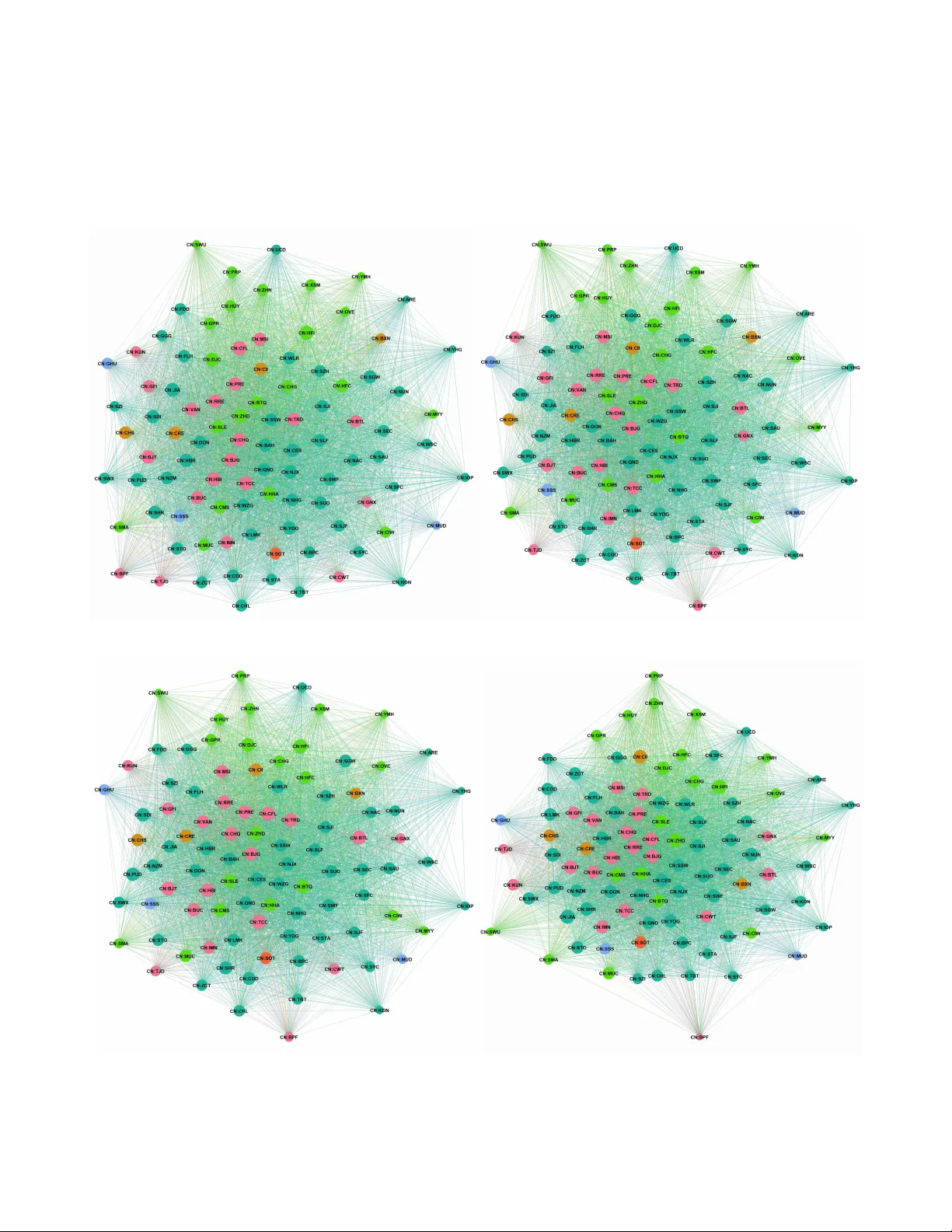
V olatilit y Spillo v ers in China’s Real Estate Crisis: A Net w ork Approac h Julia Manso ∗ Dep artment of Statistics and Nuffield Col le ge, University of Oxfor d, Oxfor d, U.K. Abstract Ov er the past six years, sen timent to wards the Chinese real estate sector has deteriorated sharply following the in tro duction of financing constraints in 2020 with the “three red lines.” F orcing developers to restructure their debt, the p olicy triggered a cascade of financing troubles, defaults, and reduced housing demand, ultimately culminating in a prolonged real estate crisis. This pap er utilizes a netw ork approach in line with Demirer et al. (2018) and Dieb old and Yilmaz (2014) to measure daily time-v arying connectedness in the sto ck return v olatilities of ma jor Chinese real estate dev elop ers throughout the crisis. Particularly fo cusing on spillo v er b et ween real estate companies as reflected by mark et p erception, this pap er examines how connectedness ev olves o ver time across firms with different regional exp osures and state-o wnership statuses, filling a gap in the literature to elucidate where property demand and real estate firm trust w orthiness ha ve deteriorated most. An ev ent-study analysis of four k ey momen ts of the crisis outlines distinct phases of market sen timent: with the introduction of the three red lines, connectedness primarily reflects shared exposure to the sector and a uniform sho ck to the market. Then, the early unrest surrounding Ev ergrande exp oses strong regional differentiation, with firms concentrated in less dev elop ed regions receiving significant spillo ver. By one year in to the crisis, previously stable regions receiv e higher levels of spillov er, and there is evidence of a substitution effect tow ards priv ate developers. Tw o y ears into the crisis, the market has m uc h less homogeneity in effects across regions and state-o wnership status: ma jor sho cks induce minimal net work c hanges, reflecting how inv estors ha v e already priced in their b eliefs. This pap er also offers one of the most extensiv e timelines of the Chinese real estate crisis to date, and a new R pack age, GephiForR , w as created for the netw ork visualization in this pap er. Keyw ords— Chinese real estate, connectedness, volatilit y , spillo v er, net w orks, v ariance decomp o- sition 1 In tro duction In March of 2019, Ev ergrande—China’s largest real estate dev elop er and one of the largest companies in the w orld—w as riding high, like muc h of the Chinese real estate sector. It had just announced ∗ Corresp ondence: Julia Manso, Departmen t of Statistics, 24-29 St Giles’, Oxford OX1 3LB, United Kingdom. Email: jumanso@stats.ox.ac.uk. I thank Stev e Bond, F rank Windmeijer, and David Steinsaltz for their advice and feedbac k on this pap er. 1 that its 2018 core profit rose 93.3 p ercent compared to the previous year, a “record high” as the compan y delivered more prop erties while cutting costs. Some inv estors w ere concerned ab out the compan y’s leverage ratio and other p erformance indicators, but the outlo ok w as largely p ositive (Jim and Siu 2019). F ast-forw arding to 29 January 2024, after losing 99% of its share v alue and struggling to mak e debt paymen ts, China Evergrande was ordered to wind up by a Hong Kong court—a far cry from the rosy exp ectations of just five years earlier (Hoskins and Oi 2021; Jim and Y u 2024). While Ev ergrande has b een the most prominent Chinese dev elop er to struggle on the global stage, problems in the Chinese real estate mark et run m uch deep er: gov ernmen t p olicies limiting ann ual debt growth hav e handicapp ed the b orro wing-dep endent industry , creating a massive credit crunc h that threatens to exp ose even the most financially reticent parties. As trouble built and in vestors realized the exten t of their exp osure, dev elop ers w ere hit b y share selloffs, declines in credit ratings, and few er willing lenders, further imp eding their abilit y to raise cash. Y et, these massiv e and decisive share selloffs also offer an opp ortunit y to examine spillov er effects in the industry and map the pattern of contagion. The existing literature on the Chinese real estate crisis focuses on spillo v er from the real estate sector to the broader economy (Hu, Pang, and Li 2024), the financial sector (Huangfu et al. 2024; Ouy ang and Zhou 2023; Xu et al. 2021; Nong, Y u, and Li 2024), the industrial/man ufacturing sector (Xie and W ei 2025), and the energy market (Xie, W ang, and W ang 2025). This pap er thus fills an imp ortan t gap in the literature, analyzing spillov er patterns among developers themselves across differen t ev en ts/phases of the real estate crisis. F ollowing the work of Demirer et al. (2018) and Dieb old and Yilmaz (2014), this pap er uses a netw ork approach to measure the daily time- v arying connectedness of ma jor real estate companies’ sto ck return volatilities. Examining how spillo ver patterns differ b y region and state-o wnership status, it maps how firms with sp ecific regional fo cuses are impacted, w orking to understand where demand for prop erty and real estate firm trust worthiness ha ve deteriorated most—as well as whether state o wnership impacts these p erceptions. In terms of metho dology , this paper follows Demirer et al. (2018), first fitting a rolling windo w v ector autoregression (V AR) to sto c k return volatilit y data for the Chinese real estate mark et. After using the elastic net for shrink age and selection and estimating the V AR with a 100-da y rolling windo w to capture the dynamism of developer relationships, a v ariance decomp osition is then p erformed to determine how m uc h of a firm’s forecast error v ariance is attributable to sho c ks from other developers, summing these to obtain the directional Dieb old-Yilmaz measures of connectedness. These directional connectedness measures are then plotted as a net work to understand ho w connections betw een firms ev olve across different even ts. An ev ent study is p erformed on four key even ts that signal differen t phases of the crisis: the 2 announcemen t of the “three red lines,” the first release of insider news ab out Evergrande’s cash crunc h, the initial susp ension of share trading by Chinese dev elop er Kaisa, and a key profit warning issued b y Country Garden. Indeed, I ultimately discern ho w inv estor sentimen t has evolv ed as the real estate crisis progressed. First illustrating evidence of an external sho ck to the netw ork with the announcement of the three red lines, connectedness primarily reflects shared exp osure to real estate and an exp erience of a uniform, external sho c k. Then, analyzing the netw ork’s b eha vior surrounding the release of news ab out Evergrande’s cash crunc h reveals in v estors’ immediate reactions to mark et exp osure: when the news broke, in vestors’ instincts w ere link ed with the regional developmen t pattern of China, as they exp ected stronger con tractions in less dev elop ed regions and shifted their in vestmen ts aw a y . There is also evidence that state-owned firms are seen as slightly more insulated from market sho cks than their priv ately-owned counterparts during this early p erio d. One y ear in to the crisis, net w ork b ehavior during the susp ension of share trading b y Kaisa offers up dated insigh t into inv estors’ b eliefs: now, regions that were regarded as relatively stable earlier in the crisis are increasingly at risk as the do wn turn contin ues. The netw ork also reflects a c hange in sen timent surrounding the relativ e stability of state-o wned enterprises, exhibiting a substitution effect to wards priv ate developers. Then, fast-forwarding to nearly tw o years later, b y the time of Country Garden’s profit warning in August 2023, the netw ork captures just how muc h in vestor sentimen t has c hanged. Unlike in earlier p erio ds, there is m uch less homogeneit y across regions and state-o wnership status, likely reflecting ho w dev elop ers ha ve adapted to inv esting amidst the crisis. No w, when a “shocking” ev ent o ccurs, the netw ork change is minimal b ecause in v estors hav e already priced in their b eliefs. Nev ertheless, there is evidence of a substitution effect tow ards state-owned en terprises—the rev erse of that seen under the Kaisa case—reflecting the market sentimen t that state-owned developers are no w “safer” bets for inv estmen t. In the pro cess of this analysis, I also develop one of the most comprehensiv e timelines of the Chinese real estate crisis to date, as well as an R pack age for graphing net works using Gephi-based la yout orientations (Manso 2024). 1 This pap er first offers a brief primer on the Chinese real estate market, d iscussing state ownership in China (Section 2). Next, after in tro ducing the data (Section 3), as w ell as the metho dology and visualization process (Section 4), Section 5 discusses the results. Section 6 concludes. The comprehensiv e timeline of the real estate crisis can b e found in App endix A.1. 1 Gephi is a p opular netw ork visualization soft w are. The R pac k age ( GephiForR ) can be found at https://CRAN.R-project.org/package=GephiForR . 3 2 Bac kground The Chinese real estate mark et is unique not only given the depth of State ownership, but also b ecause it is a largely nascen t industry that b o omed within the past 30 years. Most imp ortan tly , though, housing in China is first and foremost a commodity , and the prop erty mark et is distinctly sp eculativ e, with property dev elop ers wielding significan t mark et p ow er and housing prices increasing exp onen tially since 2000 (Zhao et al. 2017). While incredibly complex with many lo cal disparities, the real estate market is the in teraction of four groups who collectively influence price mov ement: lo cal gov ernments, real estate developers, banks, and sp eculators (Liu, Liu, and Ren 2018). First, lo cal go vernmen ts gain “land rev enue” b y selling commercial and residen tial land use rights (W u, Gy ourk o, and Deng 2016). High land costs are subsequen tly transferred to high real estate prices, and real estate developers often engage in prop erty hoarding and price discrimination to further increase real estate prices and create artificial scarcit y (Zhou et al. 2021). Lo cal go vernmen ts then b orro w hea vily from banks b y mortgaging land use rights and using the funds to supp ort infrastructure dev elopmen t, which further drives up its p otential for land rev enue (Liu, Ren, et al. 2022). Dev elop ers also b orro w hea vily , not only obtaining funds from banks and other financial institutions, but from shado w banks, priv ate financing, and even illegal fundraising channels (Liu, Ren, et al. 2022). Another key source of developer income is presales, wherein buyers pay for properties b efore their construction has concluded (sometimes even b efore construction has started), often through mortgages. Lending to all parties inv olv ed, banks offer excessiv e credit supp ort to the real estate industry; this b ehavior in turn drives prices higher as developers b orro w more to build, and buyers b orro w more to pay . Indeed, buy ers often act as sp eculators, purchasing prop erty and selling it after prices rise. They to o help supp ort a cycle wherein all parties inv olv ed hav e an incentiv e to increase land v alue as m uch as p ossible, creating an o v erheating market and a prop erty bubble. Prior to 2020, the State’s attempts to curb this cycle had b een half-hearted: prop erty has been one of the driving forces of China’s econom y , and to truly curb rising house prices w ould harm this gro wth (T an, T ang, and Meng 2022). F urther, the onus had traditionally b een on lo cal gov ernments to reform their p olicies and low er land sale prices—a difficult thing for them to do when 59.8 p ercen t of rev en ue from property sales go es to the gov ernment, and combined reven ues from land transfers and sp ecial taxes on real estate accoun t for 37.6 p ercen t of lo cal go vernmen t rev enue as of 2020 (Zhang 2024; Ren 2021). When the central go vernmen t shifted tow ards p ersisten t tigh tening with the “three red lines” in 2020, sp eculators, developers, and banks all thought the go v ernment w ould bac k do wn from its measures. Y et, as the real estate crisis began to spiral during 2021, the public did not realize ho w deep that commitmen t to tigh tening—and its implications—ran. When the three red lines p olicy was imp osed, it was done as a pilot program for 12 dev elop ers 4 and essen tially restricted their ability to b orrow capital/grow their debt sub ject to meeting three limits (“red lines”) on the liabilit y-to-asset ratio, the liabilit y-to-equity ratio, and the cash-to-short- term-debt ratio. The maximum allow able ann ual gro wth in debt was restricted to 15% if no lines w ere crossed, dropping by 5% based on the num b er of lines violated. If a developer failed to meet all three criteria, it could not gro w its debt ann ually at all. Realistically , the structure of the mark et ensured that almost all developers were violating the first red line on the liability-to-asset ratio, but others lik e Ev ergrande were in violation of all three at the time of announcement. The three red lines pressured firms to in ternally restructure in order to meet gov ernment guidelines, and stress p ercolated in to the market as internal do cumen ts—often describing just how badly firms were violating the red lines—were leak ed to the public. As the situation escalated and the three red lines w ere expanded to all dev elop ers in Jan uary 2021, any actions by dev elop ers that hinted at financial trouble were met with sharp tumbles in sto c k price (White and Y u 2021). Dev elop ers th us to ok great pains to pro ject images of financial stability and securit y , often liquidating assets b ehind the scenes to mak e b ond pa yment deadlines. By early 2022, the situation w as untenable, with leading firm Evergrande susp ending trading of its shares, citing its inabilit y to pro duce audited results (Jim 2022; Stev enson 2022). 2 Sev eral other struggling firms—China Ao yuan, Kaisa, F antasia, Modern Land, and Sunac—follo wed almost immediately . Since then, sho c k after shock has impacted the mark et—and trouble con tin ues still to this day . A comprehensiv e timeline of the even ts of the real estate crisis, from the three red lines to Evergrande’s liquidation in early 2024, is included in the Appendix (A.1), offering one of the most comprehensive timelines on the topic to date. Also note that one additional factor further complicates firm behavior in this analysis—the prev alence of State ownership. F ollowing Chow (2024), a State-o wned en terprise (SOE) is defined here as a company whose largest shareholder is the State. Conv ersely , priv ately-o wned enterprises (POEs) are understo o d as companies where the largest shareholder is a priv ate compan y or individual. In China, these SOEs are legally recognized as corp orate en tities (rather than gov ernmen t en tities) and are managed by State-o wned Assets Supervision and Administration Commissions (SASACs). The literature suggests that Chinese SOEs are numerous and p ow erful enterprises, but less effectiv e and profitable than their POE p eers, limited b y their ability to engage with and resp ond to market forces (and therein increase profitabilit y). See, for instance, Mei 2022. 3 2 On the Sto ck Exc hange of Hong Kong, listed companies can suspend for up to 18 consecutive mon ths, by which time they m ust supply results and b e relisted or b e delisted from the exchange altogether. Susp ension is also a type of stop-gap mechanism that preven ts the sto ck from falling in v alue while giving the company some time to rectify its struggling financial p osition, such that it can hop efully return to trading in a m uc h stronger p osition (Leung and Lu 2024). 3 Ho w ev er, viewing POEs as indep endent of state influence is essentially a false dichotom y . Milhaupt and Zheng (2015) argue that in China, virtually all large and successful firms hav e “close connections to state actors and agencies, access to state largesse, and a role in carrying out the p olicies of the ruling p olitical party”; in essence, no 5 3 Data In line with Dieb old and Yilmaz (2014), I use high-frequency stock mark et returns and return v olatilities to estimate connectedness. This approac h is quite in tuitive, as those with the most kno wledge ab out the connections under in vestigation are those financially inv olved. The data encompass real estate companies domiciled and op erating in China from the Shanghai and Shenzhen sto c k exc hanges; data collection and handling pro cedures are describ ed in App endices A.2 and A.5. With this ra w data, volatilit y—the “disp ersion from an exp ected v alue, price or mo del” (Daly 2008, p. 2379)—is calculated via the estimator dev elop ed b y Garman and Klass (1980), whic h applies Bro wnian motion principles to sto c ks to estimate daily stock return volatilit y as a function of the natural logarithms of daily high, lo w, op ening, and closing prices for sto ck i on da y t . This sp ecification is used broadly in the literature (as in Ji et al. 2019, Dieb old and Yilmaz 2015, and Longstaff et al. 2011) and is “nearly as efficien t as realized volatilit y based on high-frequency [fiv e-minute] intrada y sampling” while still b eing robust under several conditions including microstructure noise (Demirer et al. 2018, Alizadeh, Brandt, and Dieb old 2002). 4 Metho dology 4.1 Estimating high-dimensional V ARs I follow Demirer et al. (2018)’s methodology , first basing my v ariance decomposition on an N-v ariable v ector autoregression, V AR(d) l og ( σ 2 t ) = d X ℓ =1 ϕ ℓ l og ( σ 2 t − ℓ ) + ε t (1) where ε t ∼ (0 , Σ) . ℓ is the lag order of the autoregressive terms, d is the n umber of lags, ϕ ℓ is the N × N co efficien t matrix for lag ℓ , and ε t is the disturbance vector whose co v ariance matrix is Σ. Finally , σ 2 t and σ 2 t − ℓ are N × 1 v ectors of sto ck return v olatilities calculated abov e, and the logarithm of all volatilit y terms ( σ 2 ) is taken to normalize their distribution and remov e the skew. This V AR is inten tionally nonstructural, as, lik e Dieb old and Yilmaz (2015), I do not seek to define exactly ho w connectedness arises. 4 firm is wholly autonomous (p. 668). Indeed, the POEs who most em brace the State’s in v olvemen t often b ecome the largest and most successful firms b ecause State supp ort can increase market acces s and yield business adv antage through proximit y to state p ow er, among other b enefits. Y et, clever real estate firms hav e also tapp ed into additional dimensions of State supp ort: the State can provide stability amid high risk-taking and has a deep-seated in terest in protecting its o wn en terprises—and deep coffers to accompan y it. 4 Note that I use the V AR with the rolling windo w specification rather than another version of the V AR from the literature (e.g., the time-v arying parameter V AR, TVP-V AR), b ecause it b est fits this use case. The leading 6 T o estimate the V AR in such high dimensions, I utilize the elastic net, in line with Demirer et al. (2018). 5 P erforming simultaneous selection and shrink age like the lasso, the elastic net includes b oth ridge and lasso penalties, with a regularization parameter λ and an adjustable parameter α that balances the lasso and ridge p enalties. Imp ortan tly , the elastic net can also select groups of correlated v ariables since the p enalty term is strictly conv ex for all α ϵ (0 , 1) and λ > 0, a particularly v aluable feature in this con text giv en that real estate firms’ v olatilities are often highly correlated (Zou and Hastie 2005; Hastie, Tibshirani, and W ainwrigh t 2015). α is regarded as a “higher-lev el” tuning parameter that is often set on sub jectiv e grounds (Hastie, Tibshirani, and W ainwrigh t 2015). I conduct a sensitivity analysis to in v estigate how sensitive the results are to differen t α v alues in the elastic net estimations. The main sp ecification, whose results are shown in Section 5, uses α = 0.5, in line with Demirer et al. (2018). 6 4.2 Mo ving from the V AR to the v ariance decomp osition matrix F ollowing Demirer et al. (2018), I estimate an elastic net-p enalized regression with ten-fold cross- v alidation, extracting the co efficien ts from the mo del whic h minimize the cross-v alidation error and iterating through the columns to generate the ϕ ℓ matrices referenced in (1). The impulse resp onse function is then calculated, iterating through the lag p erio ds and horizon H . The impulse resp onse can b e viewed as the effect of a hypothetical N × 1 v ector of sho cks impacting the market at time t compared with a baseline profile at time t + H , giv en the mark et’s history . Imp ortan tly , these impulse resp onses and v ariance decomp ositions allow estimates of connect- alternativ e candidate, TVP-V AR, uses a Kalman filter, and its results are thus sensitive to priors and forgetting factors (Antonak akis, Chatziantoniou, and Gabauer 2020). In particular, in Antonak akis, Chatziantoniou, and Gabauer (2020), the TVP-V AR is initialized with the V AR estimate of the first 60 p erio ds, which can bias the results dep ending on whether this is a calm or turbulen t p erio d: a calm pre-p erio d could bias the mo del to interpret sho cks as outliers, while a turbulent pre-p erio d ma y cause the mo del to ov erreact to noise. In addition, hyperparameter selection can also bias the results. In light of these issues, the 100-day rolling window is preferred in this con text giv en the focus is meaningful b efore and after windows and a mo del that p erforms w ell in the presence of a large n um b er of shocks. 5 Note also that while other to ols like the adaptive elastic net may be an improv emen t ov er the elastic net, they cannot b e calculated for the rolling windo w estimation due to data limitations: the window size of 100 is just e nough for the elastic net calculations giv en the num b er of developers (97 Chinese firms). Given the num b er of firms in the sample, there are m ore regressors than observ ations when lags are included, and it is th us not p ossible to use the adaptiv e elastic net to giv e dynamic up dates without a window of size equal to or greater than N × ℓ . This muc h larger windo w (in this case, equal to or greater than 291) inherently loses most of the sensitivit y that the narrow 100-da y one offers, so I utilize the elastic net with 100-da y rolling window estimations for the bulk of the analysis. App endix A.3 offers an example of a net work generated under the adaptiv e elastic net with a larger window size. 6 It is also imp ortant to note that while I seek sparsity in the appro ximating mo del, I do not necessarily wan t to imp ose sparsity in the estimated real estate firm netw ork. In line with Demirer et al. (2018), this shrink age and selection is thus p erformed on the approximating V AR rather than the v ariance decomposition netw ork directly . While p erforming shrink age and selection on the V AR, the v ariance decomp osition matrix that is used to calculate connectedness measures is a “nonlinear transformation of the V AR co efficients and is therefore generally not sparse” (Demirer et al. 2018, p. 5). In the Chinese real estate case, the netw ork remains fully connected. 7 edness at differen t time horizons H , with shorter time horizons lik e 1 or 2 days ( H = 1 and H = 2, resp ectiv ely) picking up immediate mark et reactions while longer horizons like 30 days ( H = 30) reflect more fundamen tal dependencies or economic relationships. This analysis uses a horizon H v alue of 10 days to balance longer- and shorter-term v olatilit y comov ements; a lag p erio d of 3 is used b ecause the V AR mo del often selects coefficients for several firms on the third lagged day . 7 Aggregating this information, the generalized forecast error v ariance decomp ositions ( θ ij ( H )), whic h provide firm j ’s con tribution to firm i ’s H -step-ahead generalized forecast error v ariance, can b e calculated: the numerator effectively sums up and then squares the sho cks from v ariable j on firm i o ver all horizons up to H − 1. This represen ts the cum ulativ e effects of sho c ks in v ariable j on the forecast error v ariance of v ariable i up to horizon H . The denominator reflects the total forecast error v ariance, summing the contribution to the forecast error v ariance from all sho c ks affecting v ariable i ; then, it is normalized by the standard deviation of the disturbance of the j -th equation. Subsequently , follo wing Demirer et al. (2018), each θ ij of the generalized v ariance decomp osition matrix is normalized b y the ro w sum to obtain d H ij = θ ij ( H ) P H − 1 j =1 θ ij ( H ) . (2) This normalization means that P N j =1 d H ij = 1 and P N i,j =1 d H ij = N , allo wing for the resulting d H ij to b e comparable across differen t time horizons H . 8 These d H ij v alues form the matrix D H , whic h is the core of Demirer et al. (2018) and Dieb old and Yilmaz (2014)’s connectedness measures (Section 4.3). 4.3 Connectedness measures Demirer et al. (2018)’s connectedness estimation metho d makes it p ossible to decomp ose how muc h of firm i ’s future uncertaint y at a sp ecified horizon H is due to sho cks arising not from en tity i itself, but from each other entit y j in the sample. As described ab o ve, it relies up on d H ij , the fraction of i ’s H -step forecast error v ariance due to sho cks in firm j , where D H = [ d H ij ]. This full set of v ariance decomp ositions is the core of Diebold and Yilmaz (2014)’s connectedness table, whic h is in effect an augmented v ariance decomp osition matrix, as sho wn in T able 1. 7 When a longer lag p eriod (e.g., 5 da ys) w as tested, the mo del selected very limited n umbers of co efficients from the additional da ys. 8 As will b e described in Section 4.3, these d H ij v alues are measures of pairwise directional connectedness. 8 T able 1: Connectedness T able x 1 x 2 · · · x N F rom others x 1 d H 11 d H 12 · · · d H 1 N P N j =1 d H 1 j , j = 1 x 2 d H 21 d H 22 · · · d H 2 N P N j =1 d H 2 j , j = 2 . . . . . . . . . . . . . . . . . . x N d H N 1 d H N 2 · · · d H N N P N j =1 d H N j , j = N T o others P N i =1 d H i 1 P N i =1 d H i 2 · · · P N i =1 d H iN 1 N P N i,j =1 d H ij i = 1 i = 2 i = N i = j The upp er left blo ck of T able 1 is the standard N × N v ariance decomp osition matrix D comp osed of the connectedness b etw een each firm i and j for time horizon H , with D H = [ d H ij ]. This D H is augmented with a column of ro w sums in column N + 1 and a row of column sums in ro w N + 1, b oth for i = j . The v alue in cell [ N + 1 , N + 1] is the grand av erage, again for i = j . The off-diagonal en tries of the N × N v ariance decomp osition matrix reflect the pairwise directional connectedness from firm j to firm i . That is, C H i ← j = d H ij . (3) This means, for example, that d H 21 is the pairwise directional connectedness from firm 1 to firm 2 while d H 12 is the pairwise directional connectedness from firm 2 to firm 1. These v alues will not necessarily b e equal as firms do not often impact each other symmetrically . F or instance, if firm 1 is a massiv e price mak er in the market but firm 2 is a small and relativ ely isolated firm, sho c ks to firm 1 ma y also ha v e significant effects on firm 2, but conv ersely , sho c ks to firm 2 will not likely affect the p ow erful firm 1 in the same w ay . Thus, generally , C H i ← j = C H j ← i . There are consequen tly N 2 − N separate pairwise directional connectedness measures. 9 Dieb old and Yilmaz (2014) th us defines net pairwise directional connectedness as C H ij = C H j ← i − C H i ← j , and there are N 2 − N 2 net pairwise directional connectedness measures. When the diagonal entry is excluded ( d H ij , where i = j ), aggregating across each row yields the share of the H -step forecast error v ariance of firm j that comes from sho c ks arising in all other firms. In line with Diebold and Yilmaz (2014), this total directional connectedness fr om others to 9 N is subtracted as we exclude the diagonal elements (which effectively represent self-spillov er). 9 j (“from” connectedness) can b e represented mathematically as C H j ←• = N X i =1 ,i = j d H j i . (4) The same reasoning is applied to off-diagonal column sums: for eac h column, excluding d H ij when i = j and summing the rest of the column yields the share of the H -step forecast error v ariance that firm j , when sho ck ed, giv es to all other firms. This is referred to as “to” connectedness. This Dieb old-Yilmaz approach to net work connectedness is app ealing b ecause it bridges the V AR v ariance-decomp osition and the net work literature, essentially p ositing that “a v ariance decomp osition is a net w ork” (Dieb old and Yilmaz 2023). The V AR can capture the dynamic in teractions among multiple lagged v ariables without imp osing strong a priori restrictions or requiring a structural mo del. At the same time, it assumes linear relationships among v ariables, and the subsequent impulse resp onse function and generalized forecast error v ariance decomp osition are sensitiv e to the sho ck co v ariance matrix derived from the V AR, whic h Demirer et al. (2018) do not c ho ose to regularize. 4.4 Visualizing the net w ork F or the results shown in this pap er, netw ork lay out is determined by Gephi’s F orceA tlas2, created b y Jacomy et al. (2014), which calculates the “net forces” acting on eac h no de by summing the no de’s attraction to and repulsion from each other no de it connects to. 10 F or clarity , assume that all v ariables take on new meanings (as defined) unless explicitly sp ecified. The form ulas for each are ro oted in Eades (1984) and his application of physics principles to net works; the attraction formula is an altered version of Ho oke’s la w, which reflects the compression b eha vior of a spring ( F = − k × x ), where F is the spring force, k is the spring constant, and x is the spring compression. In Gephi, the attractiv e force F a is the pro duct of the edge weigh t w ( e ) δ b et ween each pair of no des, multiplied by the geometric distance b et w een them, as shown b elow: F a = w ( e ) δ d ( n 1 , n 2 ) , (5) where δ is the binary v ariable “Edge W eigh t Influence,” set to either 0 or 1. Repulsion is based on Coulom b’s law, which calculates forces b etw een electrically charged particles ( F = k n 1 n 2 d ( n 1 ,n 2 ) 2 ). Here, F is the resulting force; n 1 and n 2 are the p oin t charges of particles 1 and 2, resp ectively; d ( n 1 , n 2 ) is the distance b et w een the tw o particles n 1 and n 2 ; and k is the Coulom b’s law constan t. In Gephi, repulsion F r is calculated b y a sligh tly mo dified v ersion of 10 Note that Gephi is a p opular softw are used for visualizing netw orks. 10 Coulom b’s law where no de degree tak es the place of p oint charges, the constant b ecomes scalable rather than fixed, and distance is no longer squared. The k ey developmen t from previous node repulsion calculations w as the addition of “+1” to the degree, as Jacomy et al. wan ted to ensure that no des with degrees of zero still hav e repulsiv e force. The formula is thus F r = S ( deg ( n 1 ) + 1)( deg ( n 2 ) + 1) d ( n 1 , n 2 ) . (6) This calculation is rep eated b etw een ev ery p ossible no de pair in the data. Thus, d ( n 1 , n 2 ) is the distance b et ween the t w o no des n 1 and n 2 in the pair, deg ( n 1 ) and deg ( n 2 ) are the degrees of each of the t wo no des, and S is a scalable constant that influences the repulsion level in the graph, with higher repulsion making a sparser graph. This combination of “spring-like” attractiv e forces and “particle-like” repulsive forces has p ersisted, with several authors offering slightly mo dified equations o ver the past 40 years. In Gephi, the attraction and repulsion forces can b e decomp osed into vector form and summed to calculate the net forces on eac h no de ( F = F r + F a ); this v alue is then used to find the resulting displacement. The actual displacemen t of a no de ∆( n ) is then calculated by the formula: ∆( n ) = s ( n ) ∗ F ( n ) , (7) where s ( n ) is the sp eed of no de n . T o calculate the sp eed, Jacomy et al. use t wo factors—irregular mo vemen t (“swinging”) and useful mo v ement (“effective traction”); in effect, they calculate how m uch the forces on a no de compare betw een t w o sequen tial p erio ds and (usually) use lo w er speeds to up date a no de’s p osition if there is a large c hange in forces. Over several iterations calculating eac h node’s displacement and updating its position, netw orks conv erge to a stable p osition. A full explanation of the form ulas b ehind this, as w ell as a toy example, can b e found in App endix A.4. All net w ork figures in this pap er are created with the GephiForR pac k age (Manso 2024), whic h implemen ts the F orceAtlas2 lay out algorithm in R and offers sev eral other netw ork visualization to ols. 5 Results The figures below are color-co ded b y the region where the dev elop er is primarily fo cused: pink is the north, ligh t green is the south, teal is the east, bronze is the southw est, ligh t blue is the north west, and red-orange (of whic h there is only one no de, CN:SOT) is the northeast. As is apparen t in Figure 1, the bulk of the no des are eastern-fo cused (teal), with a significan t amount fo cused in the north (pink) and the south (light green). Only four firms hav e their primary business 11 in the south west (bronze) and three in the northw est (light blue). These business-cen tricities reflect the dev elopmen t pattern of China, as coastal regions tended to develop first and b ecame richer (east and south). The north is developing more at presen t but has the adv an tage of the Beijing and Tianjin m unicipalities b eing within its b ounds. The northeast, south w est, and northw est are emerging regions with large areas of sparsely p opulated land (F elice, Odoardi, and D’Ingiullo 2023). Unless otherwise sp ecified, no de size is determined by “to” connectedness, meaning that no des with higher levels of to connectedness are larger. No de size is set as to connectedness b oth b ecause to connectedness is more v ariable than from connectedness (as explored later) and b ecause it offers a helpful wa y to understand how connectedness ev olv es o v er time. Stressed net w orks are indicated b y no des b eing dra wn more tigh tly together, a clear core forming, and (sometimes) more regional clustering; the App endix’s Figure A4 offers a visual comparison b et ween an unstressed and stressed net work, for reference. I also clarify ho w sparse the ϕ ℓ matrices from the V AR are in App endix A.6. 5.1 Three red lines I first fo cus on the (informal) announcement of the three red lines. While the three red lines were formally announced at a meeting on 20 August 2020, there had b een rumors ab out them in the mark et starting one w eek earlier (13 August, after close of business). I compare plots from 13 and 14 August in Figure 1 b elo w. This first case pro vides a litm us test of net w ork sensitivit y since the rumor of an imminen t p olicy coincides with a noticeable net work contraction as the no des draw closer together. This is imp ortan t to see given that this is a rolling windo w estimation, meaning that the V AR is estimated on 100 days of data. Thus, the net w ork should not (and indeed, do es not) oscillate wildly betw een da ys due to the carry-ov er of the previous 99 days in the window, but should simultaneously allo w for c hanges to appear sensitive to the most recent day . 12 Figure 1: Netw ork b efore and after news of the three red lines Note: The left graph shows the business day b efore the announcemen t (13 August 2020), while the righ t graph sho ws the business day after the announcement (14 August 2020). Here, the colors are determined by the region where the dev elop er is primarily fo cused: pink is the north, ligh t green is the south, teal is the east, bronze is the south w est, ligh t blue is the northw est, and red-orange (of which there is only one no de, CN:SOT) is the northeast. No de size is determined by to connectedness; larger no de size thus implies a higher level of to connectedness for the no de. As is apparent in the images ab o ve, the netw ork contracts slightly with the first news of the three red lines p olicy . In particular, most of the no des are drawn in more to w ard the core of the net work—a simple visual insp ection reveals that the netw ork on 14 August app ears smaller in size than that on 13 August. F or the most part, no des are not making radical mov es, with many sta ying near their relative initial p ositions but pulling in slightly . This b ehavior suggests that the news of the three red lines indeed impacts the entire market rather than one segmen t disprop ortionately , and most no des (80/97) exp erienced a decrease in “from” connectedness. The ma jority of no des (61/97) also exp erienced a decrease in “to” connectedness when compared to the previous p erio d (13 August 2020). This relatively uniform b ehavior likely reflects the impact of the p olicy change, as the estimate suggests that the ma jorit y of firms hav e a low er level of spillov er to and from each other in this p erio d. Simultaneously , the force calculations in F orceA tlas2 register higher attractive forces across the netw ork (meaning some edge weigh ts are stronger), which suggests increased in terdep endencies b etw een no des, as is often the case when a market exp eriences a sho ck. Both factors are consistent with a sho ck originating outside of the netw ork, such that the connectedness 13 of most no des b ehav es similarly while higher edge weigh ts reflect how ties b et ween firms ha ve strengthened, pulling no des closer together. 11 Here, firm interactions by region do not change significantly: no region is suddenly pulled into the core or ejected from it. Rather, as describ ed ab o ve, no des of all colors are pulled tow ards the cen ter, and the a verage no de’s “to” connectedness decreases. Likewise, as I seek to examine the impact of state-ownership on firms, I also generate plots of the netw ork where the no des are colored based on their state-ownership status. I include these state-ownership plots for this even t only in the App endix (Section A.7.2) as they are not particularly insightful: there is no evidence of differing b eha vior b etw een SOEs and POEs with the announcement of the three red lines. 5.2 Ev ergrande letter to Guangdong go vernmen t I next examine the first significant sho c k to the market from a real estate developer, which o ccurred when the letter from Evergrande to the Guangdong gov ernmen t circulated on Chinese so cial media and then in the news. A letter dated 24 August 2020—just four days after the gov ernmen t’s meeting with developers where the three red lines w ere officially announced—b egan to circulate online roughly one mon th later on 22 September, b ecoming viral on 24 Septem b er. Declaring that Ev ergrande’s capital was significantly reduced and that its cash flow had been disrupted, the letter warned of a possible default (China Evergrande Group Co. 2020). Within a few hours of the letter going viral, Evergrande swiftly denounced it, but the damage was done (Zhou 2020; China Evergrande Group Co. 2020). Figure 2 sho ws the netw ork at four times: just b efore the news brok e out (21 September 2020), when it had circulated partially (23 September 2020), when it w en t fully viral (24 Septem b er 2020), and approximately tw o weeks afterward (9 October 2020). 11 It ma y seem coun terin tuitiv e for most no des to exp erience decreases in “to” and “from” connectedness while the netw ork exp eriences higher attractive forces. How ever, b oth the distribution and magnitude of the edge weigh ts ( d ij ), as w ell as the normalization, make this result p ossible, and I explain the phenomenon fully in App endix A.4. In this case, when examining the edge weigh ts of the netw ork, roughly half of directional no de pairs hav e stronger magnitudes of pairwise directional c onnectedness on 14 August than on 13 August, and their magnitude and distribution is imp ortan t as well—70% of the node pairs hav e one or b oth edges with higher edge weigh ts on 14 August than on 13 August, causing nearly the en tire net w ork to dra w more tigh tly together. At the same time, to and from connectedness do not necessarily increase b ecause they dep end on the ov erall distribution of influence patterns in the netw ork: when d ij are summed down a column or row to calculate “to” or “from” c onnectedness, resp ectiv ely , the total is low er on av erage on 14 August than on 13 August. Certainly , this is not the case for every firm, as some exp erience increases in “to” and/or “from” connectedness, but this asymmetry , coupled with the normalization, helps lead to a decrease in “to” and “from” connectedness on av erage, as the increase in weigh ts is not prop ortionate across the net w ork. 14 Figure 2: Netw ork b efore, during, and after news of Evergrande’s letter (a) Before news circulation (21 Septem b er 2020) (b) Partially circulated (23 September 2020) (c) Letter go es viral (24 Septem b er 2020) (d) Two weeks later (9 Octob er 2020) Note: The upp er left graph sho ws the business day b efore the news (21 September 2020), while the upp er righ t graph shows the netw ork c hange when the news had b een partially circulated (23 Septem b er 2020). The b ottom left sho ws the day the news wen t viral (24 September 2020), and the b ottom righ t shows the net work roughly tw o weeks later (9 Octob er 2020). As ab o ve, the colors are determined by the region where the developer is primarily fo cused: pink is the north, light green is the south, teal is the east, bronze is the southw est, light blue is the northw est, and red-orange (of which there is only one no de, CN:SOT) is the northeast. As b efore, no de size is determined by to connectedness; larger no de size thus implies a higher lev el of to connectedness for the no de. 15 The net work in Figure 2a already shows some clustering, with no des in the center of the net work grouping lo osely b y region and having relativ ely high “to” connectedness lev els. When the news has b een partially circulated (Figure 2b), no des closer to the core hav e an increase in to connectedness, while those at the top and righ t sides of the netw ork remain pushed out with low er lev els of to connectedness. P articularly , teal no des (eastern-cen tric firms) in the core tend to shrink sligh tly while their pink coun terparts (north-centric firms) in the core grow, meaning that their to connectedness is increasing. This b eha vior con tinues in Figure 2c as the news go es viral; the to connectedness of several no des in the core increases significan tly as the core no des pull closer together. At the same time, sev eral nodes at the periphery (particularly on the top and righ t) remain imm une to the attractive forces pulling the other no des in. Noticeably , to connectedness (and th us no de size) increases less on av erage for firms with a predominantly eastern fo cus (teal no des) and southern focus (light green nodes) than those from the other regions. In particular, firms with a northern fo cus (pink nodes) and southw estern fo cus (bronze no des) seem to exp erience the largest increases in to connectedness, suggesting that market sp ectators expect some dimension of regional spillo v er. This higher level of spillo v er to northern- and south w estern-centered companies th us likely reflects that inv estors p erceive these regions to b e less stable and comparatively less insulated from a real estate sho c k. 12 This result is esp ecially in teresting b ecause there are no comparative increases in “to” connect- edness for southern-fo cused developers: one would exp ect that since Evergrande’s headquarters and the ma jorit y of its prop erties are there, the dev elop ers most exp osed to an Evergrande cash crunc h w ould likely b e those it interacts with most (i.e., also southern dev elop ers). It is then particularly fascinating not to see this effect immediately , as its absence suggests that inv estors initially an ticipate effects at the regional level rather than the developer level. This b ehavior ties bac k to entrenc hed ideas ab out China’s path of dev elopment and the prop ert y market in China, deriving from housing as a commodity , as discussed in Section 2. As housing is highly speculative, demand is then linked to sp eculators’ exp ectations ab out the broader mark et—they exp ect that demand will dip most in less developed regions lik e the north, southw est, and north w est, and in turn, their o wn demand for prop erty in those regions dips, creating a self-fulfilling prophecy . Sim ultaneously , the contin ually distanced no des on the top and right peripheries, apparent in Figures 2b and 2c, suggests that sev eral no des remain less connected with the core and are th us contin ually pushed out wards as they exp erience high repulsive forces from the other no des. This implies a degree of segmentation in the market such that in v estors b elieve some real estate companies are particularly w ell insulated from Evergrande and the sho ck its default would generate, 12 Indeed, the raw stock mo vemen ts confirm that the increased to connectedness of these firms is not a substitution effect wherein inv estors view these firms as more stable (whic h would drive higher prices) but that of a knock-on effect that causes in vestors to div est from these sto cks, which they view as less stable. 16 b ey ond the regional dimension. Inv estigating the profiles of companies on the p eriphery that remain pushed out rev eals that they are more diversified than the dev elop ers in the core. In addition, state o wnership also appears to pla y a role in pushing certain no des further out than others. In particular, a plot color-coded for state o wnership, sho wn in Figure 3, illustrates that in the initial sho ck, non-state-owned companies (pink no des) on the p eriphery of the netw ork tend to b e pulled in, while their state-owned counterparts (teal no des) tend to remain pushed out (Figures 3b and 3c). Indeed, most of the no des that remain close to their initial p ositions farthest out on the p eriphery are state-owned companies rather than priv ately held ones; this b eha vior suggests that in vestors also hold an underlying b elief ab out state o wnership’s role in firm stabilit y—that state-o wned firms are more stable than their priv ately o wned coun terparts. Tw o w eeks after the sho ck, the netw ork has conv erged tow ard a new base state: the core of the net work has dra wn inw ard, and most of the no des on the p eriphery ha ve drawn in as w ell. Instead, the net work seems to hav e contracted more tightly than it was originally , with several firms (particularly northern ones) ha ving higher lev els of to connectedness; indeed, the to connectedness is so high in the core of the netw ork that the no des are almost ov erlapping. 13 The regional dimension still seems to play a role, as the to connectedness has increased for northern-centric firms more on a verage than any other region. Likewise, firms in the southw est (bronze no des) end up pulled m uch closer to the core of the netw ork than they w ere originally . Some southern-centric (ligh t green no des) and eastern-centric (teal no des) firms hav e also b een pulled tow ards the cen ter. How ever, for b oth these southern- and eastern-centric firms, the magnitude of to connectedness is not as significan t as that of the northern firms. This b eha vior do es suggest that in vestors no w ha ve a more n uanced view of what sp ecific firms will be most impacted, but there nev ertheless seems to still be a regional slan t to w ards northern firms, the bulk of whic h still ha v e higher levels of to connectedness than b efore the news was released. F rom the state-ownership persp ective (Figure 3d), the no des furthest out on the p eriphery are mostly state-o wned companies (teal no des), and several priv ate companies (pink no des) hav e p enetrated the core of the net w ork, whic h w as previously comp osed of mostly state-o wned companies. This b ehavior again reflects how in v estors view priv ate ownership as less stable in times of high risk, when the market is dominated b y state-owned companies. Certainly , though, b eing state-o wned do es not make a firm wholly protected from an y financial sho ck: state in terv ention tak es time and is not p erfectly efficient, meaning one w ould not exp ect all state-owned firms to simultaneously exit the core and ha ve very low levels of “to” connectedness: these firms are still market participants, and their profit will dip in the ev ent of a market con traction, regardless of the contraction’s origin8. 13 This apparen t ov erlapping is due to high levels of to connectedness; the p ositions prescribed by F orceAtlas2 ha v e separation b etw een the no des, and the no des do not inherently ov erlap, only doing so here b ecause no de size is to connectedness. 17 Figure 3: Netw ork b efore, during, and after news of Evergrande’s letter: Color b y state ownership (a) Before news circulation (21 Septem b er 2020) (b) Partially circulated (23 September 2020) (c) Letter go es viral (24 Septem b er 2020) (d) Two weeks later (9 Octob er 2020) Note: The upp er left graph sho ws the business day b efore the news (21 September 2020), while the upp er righ t graph sho ws the netw ork change when the news had b een partially circulated (23 September 2020). The b ottom left sho ws the day the news wen t viral (24 September 2020), and the b ottom right shows the net work roughly t wo w eeks later (9 Octob er 2020). In this series, the colors are determined b y state ownership status: pink no des are not state-o wned while teal reflects state ownership. As b efore, no de size is determined by to connectedness; larger no de size th us implies a higher lev el of to connectedness for the no de. 18 5.3 Kaisa susp ension While these t wo even ts hav e a relatively clear-cut impact on the netw ork giv en that it w as not in distress b efore, later ev en ts are more complex as the market b ecame constantly stressed. After the previously discussed Evergrande letter, the market spiraled through v arious cycles and contractions as more developers faced financial trouble—and it is these ev ents, in which new dev elop ers ha ve their first ma jor loss of public confidence, that allow us to understand spillo ver patterns that emerge when the net w ork is sho ck ed. I th us analyze the susp ension of Kaisa on 5 No vem b er 2021, whic h o ccurred a day after one of its affiliates missed a pa ymen t to onshore in v estors (Galbraith, Jim, and Kw ok 2021). Kaisa b ecame the first Chinese dev elop er to default on its dollar b onds in 2015 but had largely recov ered since then; how ev er, combining the bad market with rating downgrades, the dev elop er was under pressure and struggling (Jim and W u 2021). The shares were susp ended p ending the release of “inside information” with the resumption of trading ultimately occurring 17 da ys later (Zhu, Dong, Cho ong Wilkins, et al. 2021). Figure 4 b elow illustrates the net w ork around this c hange, with Figure 4a depicting the netw ork on 3 Nov em b er 2021, the day b efore the missed pa yment to onshore in vestors and t w o days b efore the susp ension. Figure 4b illustrates the netw ork the da y the susp ension is announced and b egins (5 No v ember 2021). 19 Figure 4: Netw ork b efore and after Kaisa susp ension: Color by region (a) Before susp ension (3 Nov ember 2021) (b) After susp ension (5 Nov ember 2021) Note: The left graph shows the business day b efore the missed paymen t to onshore in v estors, t w o da ys b efore the susp ension (3 Nov ember 2021). The right graph shows the netw ork change on the day of the susp ension (5 Nov ember 2021), as the sto ck susp ended at 9 am—the time the exchange op ens for the da y . The colors are determined by the region where the developer is primarily fo cused: pink is the north, green is the south, teal is the eas t, bronze is the south w est, ligh t blue is the northw est, and red-orange (of which there is only one no de, CN:SOT) is the northeast. No de size is determined by “to” connectedness. The core of the net work contracts, with several no des pulling in tow ards the core while those on the p eriphery remain on the edge of the netw ork. There are a few in teresting observ ations here: first, unlik e previous p erio ds, the companies at the core of the net work with the highest lev els of connectedness are now eastern-centric companies (teal no des) rather than northern- or southern-cen tric ones (pink or light green no des, resp ectively). Certainly , there are still pink and ligh t green nodes in the core and many that are dra wn in from b eing more tow ards the p eriphery b et ween Figures 4a and 4b. Y et, the bulk of no des that exp erience an increase in to connectedness in Figure 4b are eastern-centric. Contrarily , the no des on the p eriphery , even those that are teal, exp erience a decrease in to connectedness on a verage and thus shrink; 20/31 p eriphery no des shrink, with 12/17 of teal no des on the p eriphery exp eriencing decreases in to connectedness. “F rom” connectedness is largely the same across b oth p erio ds; excluding the seven firms who hav e larger increases in from connectedness as they are pulled in from the p eriphery , most firms exp erience a negligible from connectedness increase of 0.51 b et w een 3 and 5 Nov em b er. In earlier p erio ds (suc h as when Evergrande’s letter to the Guangdong go vernmen t w as exp osed), 20 eastern-cen tric companies w ere largely grouped to one side of the netw ork and comprised most of the p eriphery . Their new p osition—pulled more to w ards the center of the netw ork and largely surrounded b y their southern and northern peers, rather than vice-v ersa—suggests in vestors ha ve an up dated b elief ab out regional spillo v er: the areas that were initially regarded as comparatively more stable are now muc h more at risk, manifesting in the new node p osition apparent in Figures 4a and 4b. This b eha vior is interesting giv en Kaisa has the bulk of its prop erties in the south, east, and south west of China: certainly , the southw estern- and southern-cen tric companies (bronze and light green, resp ectiv ely) are dra wn in slightly , but again, neither comprise the bulk of the core. The sho c k of the susp ension is thus felt through increasing to connectedness mainly in eastern-centric dev elop ers as well as increasing pairwise connections b et w een these developers and those around them, as reflected b y the con traction of the la yout and the increase in attractive force betw een nearb y core no des. In terms of state ownership (Figure 5), several priv ate firms remain pulled into the core, as in Figure 2d. While most of the p eriphery is comp osed of priv ate firms in Figure 5a, these firms are largely pulled tow ards the core in 5b, suc h that even though they mostly remain on the p eriphery after the susp ension, their pairwise connectivit y with the core no des increases, resulting in closer p ositions. Noticeably , most of the priv ate firms that are pulled to wards the core (such as CN:HHA, CN:SWX, CN:HBR, and CN:COD) exp erience very small or no increases in to connectedness; comparativ ely , those that are state-owned in the core, like CN:JIA, CN:SJI, and CN:TCC, and ev en state-o wned firms on the edges of the core, lik e CN:PRP , CN:DON, and CN:BJG, exp erience increasing to connectedness, as reflected by a larger no de size. 14 Underpinning this b ehavior is an in teresting substitution effect to w ards priv ate firms: returning to the raw sto c k return data reveals that the ma jority of priv ately owned firms on the periphery (10/17) exp erience increases in closing price for their stocks on 5 No v em b er, compared to 3 No vem b er. Mean while, most state-owned companies on the periphery (11/16) exp erience price decreases, lik e the nodes in the core; only a select few state-o wned companies, mostly on the right edge of the p eriphery , exp erience price increases. App endix A.7.4 contains plots showing p eriphery no des with this color co ding. This b eha vior suggests inv estors implicitly consider state o wnership in their risk calculations: unlik e in earlier p erio ds, state-o wned firms app ear riskier than their priv ate coun terparts, and with the sho ck to Kaisa, inv estors seem to div ert funds a w ay from state-o wned firms and tow ards 14 The full company names of the no des mentioned are as follows: the priv ate firms pulled tow ards the core are CN:HHA (Hub ei F uxing Science and T ec hnology Co.), CN:SWX (Shanghai Shimao ‘A’), CN:HBR (Hangzhou Binjiang Real Estate Group Co.), and CN:COD (Dima Holdings ‘A’). The state-owned firms in the core are CN:JIA (Greenland Holdings ‘A’), CN:SJI (Everbrigh t Jiabao ‘A’), and CN:TCC (Tianjin Tianbao Infrastructure ‘A’). The state-o wned firms on the edges of the core are CN:PRP (Shenzhen Prop erties & Resources Developmen t Group Ltd.), CN:DON (Brigh t Real Estate), and CN:BJG (Beijing North Star ‘A’). 21 priv ately held ones. This is a fascinating effect that runs coun ter to standard exp ectations; it is lik ely b ecause at this p oin t, state-bac ked dev elop ers w ere asked to purc hase or take on some pro jects of struggling priv ate dev elop ers, whether through buying the prop erty outright or increasing their stak e to b e the ma jorit y shareholder in a dev elopment (Cho w 2024). These deals often w ere designed to give the struggling priv ate developer a substan tial cash injection and/or a share of the future rev enue of the prop ert y , meaning the deal was often not profitable for the SOE buyer (Jim and Xu 2021). Figure 5: Netw ork b efore and after Kaisa susp ension: Color by SOE status (a) Before susp ension (3 Nov ember 2021) (b) After susp ension (5 Nov ember 2021) Note: The left graph shows the business day b efore the missed paymen t to onshore in v estors, t w o da ys b efore the susp ension (3 Nov ember 2021). The right graph shows the netw ork change on the day of the susp ension (5 Nov ember 2021), since the sto c k susp ended at 9 am—the time the exchange op ens for the day . In this series, no de colors are determined by the state ownership status: pink no des are not state-owned while teal reflects state ownership. No de size is determined b y “to” connectedness. Th us, these plots seem to reflect inv estor sentimen t that with p olicy changes in 2021, state- o wned firms are no longer the safest b et—and may even b e riskier b ecause of the sub optimal bailout in vestmen ts they are made to tak e on. The priv ate firms on the p eriphery are mostly those with div ersified inv estmen ts and op erating sectors, factors which lik ely catalyze the substitution effect apparen t ab ov e. 22 5.4 Coun try Garden’s profit warning As the crisis dragged on, a new phase emerged in mid-2023: developers who had previously a voided financial trouble were now getting dragged in to the fra y , chief among them Coun try Garden. In early August, Country Garden—at this p oint the largest priv ate prop ert y developer in China, with four times as man y p ending developmen ts as Evergrande—began to exhibit signs of financial trouble (Liu and Curran 2023; Choi and Ao 2023; Jim 2023a). I analyze t wo parts of this ev ent: the scrapping of a share sale (1 August 2023) and the issuing of a profit warning (10 August 2023). The ab orted US $ 300 million share sale happ ened at the last min ute on 1 August 2023 as Coun try Garden shared that it had not reac hed a “‘final agreemen t’ for the deal to go ahead” (Jim and Murdo ch 2023). Then, after a relativ ely calm couple of da ys, rumors b egan to quietly circulate again: Coun try Garden had apparently missed a pa yment that w as due on 8 August, and then, after close of business on 10 August, it issued a profit w arning. 15 The company revealed that it exp ected to record a net loss b etw een US $ 6.24-7.63 billion for the first 6 mon ths of 2023 (unlike its net profit of US $ 265 million for the first 6 months of 2022) (Country Garden Holdings Company Ltd. 2023a). In Figure 6, I thus include 4 dates: the business day b efore any Country Garden-related news circulates (31 July 2023), the day the news of the ab orted share sale breaks (1 August 2023), the business da y b efore the profit w arning w as issued (10 August 2023), and the da y after the profit w arning was released (11 August 2023). 16 15 I do not include the net w orks b efore and after the 8 August news in the bo dy of the text, largely b ecause, as with the case of the profit w arning on 10 August, there is little change in the net w ork. They are included in the App endix, Section A.7, for reference. 16 Note that 10 August is the “b efore” p eriod for the profit warning b ecause Country Garden only issued it after close of business; the ab orted share sale news broke early in the morning, so 1 August 2023 is the appropriate “after” p eriod for the share sale news. 23 Figure 6: Netw ork b efore and after Country Garden news: Color by region (a) Before any news circulates (31 July 2023) (b) News of ab orted share sale breaks (1 August 2023) (c) Day b efore profit warning (10 August 2023) (d) Day after profit warning (11 August 2023) Note: The upp er left graph sho ws the business day b efore any Country Garden-related news circulates (31 July 2023), while the upp er right graph sho ws the netw ork change when the news of the ab orted share sale breaks (1 August 2023). The b ottom left shows the business day b efore the profit w arning w as issued (10 August 2023), and the b ottom right shows the netw ork the day after the profit warning w as issued (11 August 2023). No de colors are determined by a developer’s region of primary fo cus: pink is the north, green is the south, teal is the east, bronze is the southw est, light blue is the northw est, and red-orange is the northeast. No de size is determined b y to connectedness. 24 As is apparen t in Figure 6, the netw ork has a larger reaction to the news of the ab orted share sale than to the profit w arning—an interesting result giv en that ab orting the share sale do es not in itself imply financial struggle. Indeed, Country Garden’s rhetoric around the canceled share sale to ok great pains to emphasize that it was not the buyers who bac ked out, but Coun try Garden itself who prev en ted the deal (Jim and Murdo c h 2023). The ab ov e plots indicate that market participan ts were not entirely convinced that the firm was free from trouble as it claimed. The effect on the netw ork comparing Figure 6a and 6b, then, is more obvious than that b etw een 6c and 6d but, at the same time, is no where near the larger-scale c hanges seen in earlier plots like Figure 2. Indeed, with the news breaking out on 1 August, only 56/97 firms exp erience increases in to connectedness, and for all but t w o firms, this increase is very minor. Compared to other ev ents suc h as Evergrande’s letter to the Guangdong go v ernmen t and Kaisa’s susp ension, this is the first time that a southw estern-centric firm (bronze no de) has b een in the very core of the net work. Indeed, tw o of these no des are in the core in Figure 6a and get pushed out sligh tly b et w een 31 July and 11 August. The core is thus extremely diverse; southern-fo cused, northern-fo cused, eastern-fo cused, and no w south western-focused companies all o ccup y k ey positions in the core. While southern companies (ligh t green no des) seem to get pushed sligh tly aw ay from the net work’s core with the news of the aborted share sale, no des at the cen ter are drawn closer as the core tigh tens, and some of the p eriphery no des b ecome dra wn in as w ell, particularly on the b ottom and the left of Figure 6b. Ov erall, though, the netw ork is remark ably stable. No w lo oking at the announcement of the profit warning, the stability of the netw ork b et ween p erio ds is ev en more apparent b et w een Figures 6c and 6d; apart from some sligh t mov emen t around the core, most no des remain relatively close to their initial p ositions—even the p eriphery has minimal mo v ement. In terms of to connectedness, only 44 firms exp erience an increase in to connectedness b et ween 10 and 11 August, and the magnitudes of increase are relatively small across the b oard. Both of these ev en ts were accompanied by sharp drops in Coun try Garden’s share price, p er the raw sto ck data, with the sto ck dropping to a “record low” after the 10 August profit w arning—making the net work’s stability that m uch more interesting (Lim 2023). Indeed, analyzing these t wo closely related even ts in tandem reveals an interesting picture: more so than in other p erio ds, there is less concern ab out regional spillov er and more emphasis on sp ecific firm attributes. The firms who do exp erience increases in to connectedness and main tain p ositions in the net w ork’s core are a sp ecific subset with no cen tral geographic fo cus or SOE vs. POE status: they instead seem to b e those with the most p erceived exp osure to Country Garden, like China V anke (CN:V AN) and Dima Holdings (CN:COD). Indeed, one of the most critical things to observe here is that no de mo v ement and to con- nectedness changes are m uch more limited than in the previous even ts. This is lik ely b ecause 25 in vestors hav e b een forced to b ecome more reticent ab out their in vestmen ts as the real estate crisis has dragged on: gone are the immediate, region-based, knee-jerk reactions to the three red lines (2020) or the emergency sho c k susp ensions of developers like Kaisa (2021). Now, a full tw o y ears later, in vestors hav e examined company financials, p erformed their due diligence, and mapped exp ected exp osure patterns. The result is that there is less sensitivity to “sho c king” news b ecause the ma jority of market participants ha v e already “priced in” the information: at the first hint of concern, price-mak ers quic kly div est from exposed developers, such that when ma jor ev ents o ccur—lik e the ab orted share sale or the profit w arning announcing an expected loss of ov er US $ 6 billion—the net work do es not exp erience a quick and drastic change like b efore. This is ev en the case for ma jor, mark et-making ev en ts such as the liquidation of Evergrande in January 2024 and the susp ension of Country Garden in March 2024; I include plots of these in the App endix (Section A.7). Examining state ownership status also provides insigh t in to a fascinating dynamic o ccurring in Figures 7a and 7b. On the surface, nearly all of the state-owned enterprises hav e initial p ositions more tow ards the core than the p eriphery . Indeed, in Figure 7a, there are few SOEs at the outskirts of the netw ork compared to POEs. As time passes, sev eral POEs tend to b e pulled more to w ards the core of the net work—particularly those on the b ottom of the netw ork, as is most apparent in Figure 7d. 26 Figure 7: Netw ork b efore and after Country Garden news: Color by state-ownership (a) Before any news circulates (31 July 2023) (b) News of ab orted share sale breaks (1 August 2023) (c) Day b efore profit warning (10 August 2023) (d) Day after profit warning (11 August 2023) Note: The upp er left graph sho ws the business day b efore any Country Garden-related news circulates (31 July 2023), while the upp er right graph sho ws the netw ork change when the news of the ab orted share sale breaks (1 August 2023). The b ottom left shows the business day b efore the profit w arning w as issued (10 August 2023), and the b ottom right shows the netw ork the day after the profit warning was circulated (11 August 2023). Colors are determined b y the state ownership status: pink no des are not state-owned while teal are state-owned. As b efore, no de size is determined by to connectedness; larger node size thus implies a higher lev el of to connectedness. 27 On the surface, this b ehavior suggests that priv ate firms are seen as more exp osed than state- o wned ones, but the effect is not uniform. Instead, returning to the ra w price data offers further insigh t. In fact, the substitution effect of the Kaisa suspension has reversed: in that case, the to connectedness measures and netw ork la yout suggested that priv ate firms w ere seen as more stable than their state-owned counterparts, likely due to in v estor exp ectations ab out state-o wned firms b eing comp elled to enter in to disadv antageous agreements with failing priv ate developers. No w, there is prominent evidence of the opp osite happ ening: when the first signs of trouble are apparen t at Coun try Garden, there is a shift to state-owned developers. Of the companies on the p eriphery—whose p osition further aw a y from the core suggests that they are more insulated from real estate sho c ks—the bulk of those who exp erience a price increase (7/10) are state-owned. In fact, this seems to b e the prev ailing sen timen t among market participan ts, as 2023 land mark et data suggest a prominen t shift tow ard state-o wned developers: the top six Chinese dev elop ers of 2023 in terms of home sales all had state-bac king, and man y of the most prominent priv ate dev elop ers slid do wn the rankings (Jim 2024a). Some predictions even exp ect real estate troubles will last for the next ten years, p ositing that priv ate dev elop ers will con tinually struggle to make debt pa yments as sales remain sluggish (Ao 2024). In the face of these recen tly emerging exp ectations, this substitution to wards state-owned developers is largely exp ected. Certainly , many more developers exp erience decreases in share v alue than increases b et ween 31 July and 1 August, but the pattern is prominen t among those who do exp erience increases in share v alue. The b ehavior again reflects ho w firms of a certain regional fo cus or state-ownership status are not homogeneous in the eyes of inv estors: the balance sheet trumps all, and discerning in vestors will work to uncov er where exp osure lies. 6 Conclusion Offering evidence of an external sho c k to the net work with the announcemen t of the three red lines, the 100-day rolling windo w estimation allows insigh t in to the more nuanced b eha vior of sp eculators and in vestors as the real estate crisis progressed. F urther, it confirms there is a basic lev el of connectedness that comes from being listed on a Chinese exchange and having real estate exp osure. In one of the first ma jor even ts of the real estate crisis—the release of Evergrande’s letter to the Guangdong go vernmen t—inv estors immediately exp ected stronger contractions in less developed regions. There is also evidence that state-o wned firms are seen as sligh tly more insulated from sho c ks than their priv ately owned counterparts. As usual, the most diversified companies took up p ositions on the p eriphery , while those most exp osed to real estate tended to b e dra wn tow ards the core. 28 One y ear in to the crisis, net work b ehavior during the susp ension of share trading for Kaisa offers up dated insight into inv estors’ b eliefs: unlike b efore, eastern-centric firms are dra wn most hea vily into the core of the netw ork, capturing ho w areas that were regarded as relativ ely stable earlier in the crisis are now increasingly at risk—it is not just the less developed regions of China feeling pressure on real estate, but the ric hest and most developed as well. The netw ork also reflects a c hange in sen timent surrounding the relativ e stability of state-o wned enterprises, exhibiting a fascinating substitution effect to wards priv ate dev elop ers. This b ehavior is lik ely reflectiv e of the recen t failure of prominent SOEs, as w ell as knowledge ab out ho w SOEs were forced to bail out priv ate dev elop ers in disadv antageous deals. Then, fast-forwarding to nearly tw o years later, b y the time of Country Garden’s profit warning in August 2023, the netw ork captures just how muc h in vestor sentimen t has c hanged. Unlike in earlier p erio ds, there is m uch less homogeneit y across regions and state-o wnership status, likely reflecting how developers hav e adapted to inv esting amidst the crisis. A t this p oint, lik ely because they ha ve delved in to the financial statements of companies, conducted their due diligence, and mapp ed exp osure patterns, companies b eha ve in more nuanced w ays: this means that when a “sho c king” ev en t o ccurs, the net w ork c hange is minimal b ecause in vestors ha ve already priced in their b eliefs. Nevertheless, there is evidence of a substitution effect to w ards state-owned enterprises—the rev erse of that seen under the Kaisa case—and this seems to reflect the mark et sentimen t that state-o wned developers are no w “safer” b ets for in vestmen t. T aken together, these cases offer insigh t into how in vestor b eha vior and spillov er patterns ha ve changed as the real estate crisis ev olv ed. No longer expecting spillo ver b y region or state- o wned status, inv estors activ ely conduct dynamic, nuanced market research. Moreo ver, with the V AR estimation appearing to b e relativ ely consisten t and robust across sequential rolling windo w sp ecifications, the most significan t implication of these findings and metho dology is the insigh t they can offer active market participants—those inv estors themselv es who ha v e become reticent. If the relev an t data could be pulled daily and the estimation recalculated for each real-time windo w, in vestors could ha v e an up-to-date picture of firm connectedness and general mark et sen timent; it is certainly p ossible to determine firms “less exp osed” to the real estate crisis based on the net work results and connectedness measures, as well as those most at risk of b eing net receivers of spillov er. F uture extensions of this pap er will delve into more complex mo difications to increase the robustness of estimation and circumv en t net w ork size limitations, but this sp ecification apply- ing Demirer et al. (2018) in a new con text still highlights the p otential gains from analyzing connectedness—and just ho w m uc h it can capture market sentimen t. 29 App endix A.1 Dated timeline • 31 August 2021- Ev ergrande warns it may default on its debt if it cannot raise cash in an in terim earnings statement (Hale 2021b). • 22 September 2021- Dev elop er Sunac bought bac k US $ 34 million of its bonds and denied requesting assistance from the State. Despite claiming to meet tw o out of the three red lines at the b eginning of the month, an internal “draft” letter from Sunac surfaced online whic h revealed that recen t gov ernment regulations controlling prop erty prices had left some prop erties unable to break ev en, sending the sto c k tumbling (Li 2021). • 4 Octob er 2021- Ev ergrande susp ends trading of shares in Hong Kong (ultimately resuming trading on 21 Octob er), citing a “p ossible general offer,” but did not initially mak e any announcemen ts ab out the offer. It was rep orted that riv al Hopson Dev elopment was set to buy a 51 p ercen t stak e in Ev ergrande’s prop erty services subsidiary for US $ 5 billion (Jim, Y u, et al. 2024; W estbro ok, Kw ok, and John 2021). • 5 October 2021- Dev elop er F an tasia missed a pa yment on a US $ 206 million b ond that matured the da y b efore, triggering a default. While a relatively small developer with a market v alue of only $ 415 million, F antasia had rep orted “no liquidity issues” just w eeks prior (W estbro ok, Kw ok, and John 2021; Heng 2021). • 7 Octob er 2021- The Shanghai-based developer Sinic Holdings warned in a filing to the Sto c k Exc hange of Hong Kong that it was unlikely to b e able to repay a US $ 250 million b ond due on 18 Octob er, after missing earlier domestic paymen ts in September. At the time, it had US $ 694 million of outstanding b onds (Huang and Cho ong Wilkins 2021). • 8 Octob er 2021- US la w firm Kirkland and Ellis and inv estmen t bank Mo elis, who were hired b y international b ondholders leading up to Evergrande’s failed in terest paymen t, informed b ondholders that they exp ected Evergrande’s default to b e imminent and that the company had failed to engage with them meaningfully (Hale 2021a). • 11 Octob er 2021- Beijing-based Dev elop er Mo dern Land attempted to extend the maturity of a US $ 250 million bond due later in the month, noting it ma y not b e able to repa y the b ond in full (Laforga 2021). • 15 Octob er 2021- The Chinese gov ernmen t offered a rare (rep ortedly , the first) comment on the Ev ergrande situation, attributing it to p o or management, imprudent business practices, 30 and a blind diversification strategy . They stated that financial con tagion was controllable and that financial institutions had limited exp osure to Evergrande (Galbraith 2021). • 16 Octob er 2021- The Chinese go vernmen t was considering implementing a nation wide real estate tax in the b elief it w ould bring do wn prices. Ho wev er, there w as strong push back, with man y officials arguing that it could cause a precipitous drop in consumer sp ending and harm the econom y . The proposal was rep ortedly moving forw ard in a muc h more limited scop e than originally planned, with Presiden t Xi Jinping writing in the 16 Octob er “issue of the part y’s top theoretical journal, Qiushi , ‘W e should activ ely and steadily promote the legislation and reform of real-estate tax, and do a go o d job in the pilot work’” (W ei 2021). • 19 Octob er 2021- Sinic defaulted on US $ 246 million worth of bonds (Hale, Xueqiao, and Langley 2021). The same day , official figures sho w ed real estate output in China was down 1.6% in the third quarter y ear-on-year, the first time it has b een negativ e since b efore the CO VID-19 pandemic (Liu 2021). • 20 October 2021- Hopson Dev elopment announced that the p ossible deal with Ever- grande—wherein Hopson would buy the 51% stake in Ev ergrande’s prop ert y service di- vision—fell through. Ev ergrande applied to the Sto c k Exchange of Hong Kong to reop en trading on its shares (resuming 21 Octob er). Except for a stake in a regional bank, as of this date, “there has b een no material progress on [the] sale of assets of the group” according to Ev ergrande. Shares dropp ed 13.6% in resp onse. On this same da y , new data from the National Bureau of Statistics of China indicated that home prices had dropp ed month-on-mon th for the first time since April 2015, dropping in more than half of the 70 cities survey ed (Hale, Langley , and Lin 2021). • 23 October 2021- A five-y ear trial of the proposed prop ert y tax w as authorized for select regions with high real estate prices, likely Shenzhen, Hangzhou, and Hainan (“China to Pilot Levying Prop ert y T ax in Selected Cities” 2021). • 25 Octob er 2021- Mo dern Land defaults on the b ond it had previously asked for an extension on, due to a cash crunc h and credit do wngrade (Laforga 2021). • 5 No vem b er 2021- Kaisa susp ends its sto ck due to cash flow concerns (Zh u, Dong, Cho ong Wilkins, et al. 2021). • 10 No vem b er 2021- After missing b ond pa yments on nearly US $ 280 million offshore b onds on 23 and 29 Septem b er and 11 Octob er, Ev ergrande a voided default on the three b onds and made an interest paymen t within the 30-day grace perio d (“Evergrande Av erts Default with In terest Pa yment – Rep orts” 2021; Dong et al. 2021). 31 • 19 No v ember 2021- It was announced that Ev ergrande w ould b e remov ed from Hong Kong’s Hang Seng China Enterprises Index. The index do es not usually give reasons for delisting (and did not in Ev ergrande’s case), but it is typically due to p o or company performance (John and Siu 2021). • 24 No v ember 2021- Kaisa resumes trading (Zhu, Dong, Cho ong Wilkins, et al. 2021). • 25 No v ember 2021- Evergrande chairman and founder Xu Jiayin sells 9% of his stake in the compan y for US $ 344 million (Jim 2021a). • 7 Decem b er 2021- Evergrande officially defaulted for the first time, failing to make US $ 82.5 million in in terest pa ymen ts that were due last mon th before the end of the 30-da y grace p erio d; the default could cause up to US $ 19 billion in cross-defaults (Jim 2021b; Cho ong Wilkins 2021). • 8 Decem b er 2021- T rading in shares of Kaisa Group—the second-largest offshore debt holder among Chinese developers—was susp ended after an anon ymous source said that Kaisa would lik ely not meet a deadline for a US $ 400 million offshore debt paymen t (Roantree and Kwok 2021). • 9 Decem b er 2021- Fitch downgrades Ev ergrande and Kaisa from “C” to “RD” (restricted default). Shares fell to their low est lev el since Evergrande w as first listed on the market. Ev ergrande, meanwhile, promised to negotiate a restructuring plan with ov erseas creditors ( Fitch Downgr ades Ever gr ande and Subsidiaries, Hengda and Tianji, to R estricte d Default 2021; Fitch Downgr ades Kaisa to R estricte d Default After Missing Payment 2021; W ebb and Bao 2021). • 14 December 2021- News circulates of the dev elop er Shimao’s recent asset sales and cancelled apartmen t deals, sending b ond prices tum bling. Shimao w as one of China’s top-ten developers during 2020 and w as in vestmen t-grade rated until Nov em b er (Jones 2021). • 15 Decem b er 2021- Guangzhou R&F seeks to extend the maturity of a US $ 725 million offshore b ond due in January b y six mon ths. The trouble came on the heels of rating downgrades catalyzed b y the tigh tening mark et (Galbraith and Jim 2021). • 17 Decem b er 2021- Credit rating agency S&P declares Ev ergrande in selective default for its failed coup on pa yments (Kingsbury 2021). • 27 Decem b er 2021- Chinese officials announced that the Danzhou city gov ernment ordered Ev ergrande to demolish 39 buildings in one of its uncompleted pro jects. The pro ject (Ocean 32 Flo wer Island) was one of Ev ergrande’s flagship dev elopments, and the action thoroughly undermined in v estor confidence, with many considering it a signal of declining State support (Y u, Zhu, et al. 2022). • 3 January 2022- T rading of Ev ergrande’s shares w as halted for the second half of the da y p ending an announcemen t “containing inside information” (Stevenson 2022). • 4 January 2022- Evergrande, as its shares were set to resume trading, announced that the demolition order w ould not affect the rest of its pro ject at the Ocean Flow er Island. Shares rose almost 10% as trading resumed; Ev ergrande noted that its 2021 sales w ere US $ 70 billion, do wn 39% from 2020 (Sweney 2022). • 6 Jan uary 2022- Sev eral large dev elop ers receiv e a notice from the gov ernment that “the merger-and-acquisition loan could b e excluded from their declared debt level,” and they could further increase their debt lev el b y 5 percent” (Zhang 2024; Huld 2022). • 11 Jan uary 2022- Shimao files a letter of clarification to the Sto ck Exchange of Hong Kong after news circulated that it defaulted on a trust loan pa yment of US $ 101 million, causing S&P to dow ngrade its credit rating to B-. The letter stated that it was not selling its flagship Shimao In ternational Plaza in Shanghai and denied having missed any paymen t. It, how ever, w as planning fire asset sales to make future pa yments (Shimao Group Holdings Ltd. 2022). Only three mon ths b efore, it w as one of the few Chinese developers to meet all three red lines (F arrer 2022a). Shimao also recently announced that it missed its low ered 2021 sales guidance b y 7%, with December’s sales tum bling 68% y ear-ov er-year and by 25% sequentially , according to data from the China Real Estate Information Corp oration (Chui 2022). • 8 F ebruary 2022- China eased a year-long restriction “on loans for the real-estate sector to fund public ren tal housing” (Liu and Liu 2022; Zh u, Dong, and Liu 2022). This w as just one of the p olicies it implemen ted to a v oid a “collapse in credit” and the resulting financial sho c k; others included an interest rate cut and a promise to “op en its monetary p olicy to ol b o x wider” (Liu 2021). • 16 F ebruary 2022- Several Ev ergrande subsidiaries rep orted that assets worth ov er US $ 150 million (including bank dep osits and real estate) had b een frozen due to Chinese court orders (Jim 2022). • 18 F ebruary 2022- Lo cal media rep ort that banks in several cities across China hav e cut mortgage do wn-paymen ts for some homebuy ers in an effort to supp ort the sector (Winters and Dong 2022). 33 • 15 Marc h 2022- Evergrande’s stock sinks to a new all-time lo w of US $ 0.15 p er share (HK $ 1.16) ( China Ever gr ande Gr oup Pric e Data 2024). That same day , China’s third largest dev elop er Sunac is downgraded to a “B-” credit rating from “BB-” by Fitc h Ratings due to the compan y’s limited ability to access capital markets and falling contracted sales, coupled with heft y debt paymen ts (nearly US $ 4 billion) for 2022 ( Fitch Downgr ades Sunac to ‘B-’; Plac es on R ating Watch Ne gative 2022). • 16 Marc h 2022- The gov ernmen t announces its decision not to expand the property tax trial conducted in selected cities across China b et ween late 2021 and early 2022 (Win ters and Dong 2022). • 22 Marc h 2022- Ev ergrande susp ends trading of its shares, citing b oth its inability to pro duce audited yearly results b efore the Sto ck Exc hange of Hong Kong’s 31 Marc h deadline and the recen tly launched inv estigation into its prop ert y services unit. This in vestigation led banks to confiscate nearly US $ 2 billion in dep osits as the money was pledged as security for third part y guarantees “without the prop erty services unit’s knowledge” (F arrer 2022b; Jim, Y u, et al. 2024). • 1 April 2022- Developers China Ao yuan, Kaisa, F an tasia, Mo dern Land, and Sunac susp end their shares after failing to pro duce y early audited results b y the Sto c k Exc hange of Hong Kong’s 31 Marc h deadline (Yiu 2022). • 6 April 2022- News breaks that o ver 60 municipal gov ernmen ts across China ha v e relaxed restrictions on home buying in the first quarter (Winters and Dong 2022). This is one of the b ehind-the-scenes steps the gov ernmen t has b een taking in the spring of this y ear to quietly try to increase housing demand and ease the loan stress of developers (Winters and Dong 2022). • 11 Ma y 2022- Sunac defaults on a US $ 29.5 million coupon on a dollar b ond (Huang and Ma 2022). • 24 June 2022- One of Ev ergrande’s top in vestors, T op Shine Global, files a liquidation suit to the Hong Kong court on the basis of Ev ergrande’s inabilit y to repay debts of US $ 110 million (Laforga 2022). • 3 July 2022- Shimao defaults on its first debt pa ymen t, failing to repay a US $ 1 billion b ond with no grace p erio d (He 2022). • 11 July 2022- This is roughly the b eginning of the p opular mortgage b oycott, wherein Chinese homebuy ers started b oycotting mortgage paymen ts on prop erties that w ere not yet 34 constructed or had p o or construction. On 11 July , the n um b er of prop erties b oycotted was only 28, growing to 58 on 12 July , and then more than 100 in 50 cities on 13 July (F rost 2022). By the end of July , the n um b er grew to 301 pro jects (Cho ong Wilkins 2022). Data from the w ebsite “W eNeedHome” (later mov ed to GitHub) show ed that homebuyers were b oycotting pa yments for 343 pro jects in o ver 100 cities in mid-September 2022 ( WeNe e dHome 2022). • 27 July 2022- The Chinese State Council appro ved a plan inv olving the P eople’s Bank of China issuing roughly US $ 148.2 billion in lo w-in terest loans to State commercial banks to help “refinance stalled real estate pro jects” (Leng and Y u 2022). • 31 July 2022- Evergrande promised to ha ve a preliminary debt restructuring plan b y the end of July but failed. The deadline was pushed back to “within 2022” (Zhu, Dong, Huang, et al. 2022). It w as also recen tly forced to sell shares in Sheng jing Bank, which it had largely o wned and used as a source of cheap loans o ver the years (Cho w 2024; Zhu, Dong, Huang, et al. 2022). • 6 September 2022- Dev elop er Jiayuan International Holdings is served with a winding-up p etition for failing to pa y a US $ 14.5 million debt (Jia yuan In ternational Group Ltd 2022). • 14 No vem b er 2022- Beijing stepp ed up its financial in terv entions in the crisis, issuing a 16- p oin t plan to financial institutions with instructions to supp ort struggling prop erty dev elop ers. The plan detailed that lenders should supp ort SOEs and POEs equally , prioritizing developers that fo cus on their core business and hav e sound gov ernance—in other w ords, the plan w as not a blank et bailout (“Goldman Questions China Prop erty Rescue Pac k age” 2022). Indeed, leading inv estment firms to ok this as a signal that Evergrande and the other most o ver-lev eraged firms w ould not b e able to access the funds, which was rep ortedly the case (Cho w 2024; Hale, Wiggins, and Chan 2023). • 20 Decem b er 2022- Ev ergrande announces that it has resumed work on 631 pre-sold and previously undeliv ered pro jects (Sridharan 2022). • 6 January 2023- News circulated that the gov ernment would relax the three red lines, easing caps on dev elop er b orro wing and pushing bac k the grace p erio d for complying with the p olicy’s debt targets. Man y viewed the action as an attempt to “restore market confidence” (Cai, Li, et al. 2023). • 17 January 2023- PwC resigns as Evergrande’s auditor, noting that it did not receive sufficien t information on k ey matters from 2021 (particularly relating to an in v estigation into the compan y’s electric vehicle unit) (Leng and Hale 2023). 35 • 22 Marc h 2023- Evergrande announced plans for the restructuring of its offshore debt, worth US $ 22.7 billion, and offers holders could sw ap their debt into new b onds and equit y-link ed instrumen ts back ed by the group’s listed subsidiaries (Evergrande Prop ert y Services Group and Ev ergrande New Energy V ehicle Group) (Jim and Y u 2023a). • 3 April 2023- Ev ergrande and key b ondholders reached an agreement, signing a restructuring deal that was said to pa ve the w ay for later agreemen ts with other b ondholders (Huang, Y ang, and T am 2023). • 2 Ma y 2023- Jia yuan International Group is liquidated by order of the Hong Kong court (Ma and Dong 2023). • 17 July 2023- Ev ergrande rep orts huge net losses: in 2021 they totaled US $ 66.36 billion, and in 2022, they were US $ 14.76 billion. In 2020, the group comparativ ely generated US $ 1.13 billion in profits. The firm said the losses w ere caused b y diminished land returns, the “write-do wn of prop erties, loss on financial assets and finance costs” (Jim 2023c). • 10 August 2023- The largest priv ate prop erty dev elop er in China at the time, Country Garden, w arned of a large net loss for the first six mon ths of 2023 due to “impairment on prop ert y pro jects and declining profit margins” (Choi and Ao 2023). It exp ected a loss upw ards of US $ 6.25 billion, compared to a net profit in the same p erio d in 2022. The company’s shares fell up to 14.4% to a record low on the day follo wing the profit warning, closing b elo w HK $ 1 for the first time since it w as listed. The actual loss for the first half year announced on 30 August 2023 w as US $ 6.7 billion (Jim 2023a). • 18 August 2023- Ev ergrande filed for Chapter 15 bankruptcy protection in a New Y ork court to protect its assets in the U.S. while structuring a deal (Jim, Stemp el, and Knauth 2023). • 28 August 2023- Evergrande resumes trading after a 17-month susp ension, tum bling by 79% (equiv alently , dropping in v alue b y US $ 2.2 billion) to a share price of US $ 0.04 (Jim 2023b). • 14 August 2023- state-back ed dev elop er Sino-Ocean announced that it had missed almost US $ 21 million in in terest pa yments (Monahan 2023). On the same da y , Country Garden sough t to extend the maturit y of a b ond for the first time and susp ended trading of 11 onshore notes it had issued (Cai, She, et al. 2023). • 30 August 2023- Country Garden warned it was on the “brink” of default in a filing to the Sto c k Exchange of Hong Kong, as it had “failed to grasp and react to the risks of the ongoing real estate slump, most notably in smaller cities that are home to most of its developmen ts” (Kuo 2023; Coun try Garden Holdings Company Ltd. 2023b). 36 • 28 Septem b er 2023- Evergrande’s debt restructuring agreemen t with b ondholders fell through after its c hairman and founder Xu Jiayin w as placed under “‘mandatory measures’ on suspicion of in volv emen t in ‘illegal crimes’” (Hale and Leng 2023). The company then susp ended its sto c k again in the wak e of Xu and other top Evergrande officials’ arrests, attempting to renegotiate an agreement with its offshore bondholders to av oid liquidation (W ard and Dong 2023). • 10 Octob er 2023- Country Garden announced that it had failed to mak e a US $ 60.04 million pa yment on debt by its due date. The company shared that it did not exp ect to b e able to fulfill all its offshore paymen t obligations in the coming days, including its dollar-denominated b onds. The company’s shares slump ed ov er 10% following the statemen t (Murdo c h et al. 2023). • 25 Octob er 2023- Country Garden defaults on its dollar b onds for the first time, missing the grace p erio d to pa y US $ 15.4 million in interest on a dollar b ond that was due (Ma 2023). • 30 Octob er 2023- Ev ergrande was given another chance to negotiate with its offshore b ond- holders as the Hong Kong High Court adjourned its wind-up hearing to 4 Decem b er 2023 (Jim and Y u 2023b). • 4 Decem b er 2023- Although the previous extension was reported to b e the last opp ortunity for Ev ergrande to reach an agreemen t with its debtors, Evergrande w as giv en another extension to negotiate un til 29 January 2024 (Jim and Y u 2023b; Jolly 2023). • 5 Jan uary 2024- Chinese shadow banking gian t Zhongzhi En terprise Group Co. filed for bankruptcy; the firm had very strong ties to the real estate sector, with rep ortedly ov er half its assets being link ed to real estate. Its downfall “marks one of China’s biggest-ev er bankruptcies” and illustrates the stress the r eal estate do wnturn brings to the broader Chinese financial system (Liu, Zhang, et al. 2024). • 8 Jan uary 2024- Ev ergrande rev eals the vice c hairman of its electric v ehicle subsidiary has b een detained and is under “criminal in v estigation” (Jim and Kwok 2024). • 16 Jan uary 2024- Ping An Bank—one of the ma jor lenders in China—placed 41 real estate dev elop ers on a list as those eligible for funding support (Cai, Zhang, and Dong 2024). Ov er half w ere state-back ed. These companies likely ov erlap hea vily with the companies whose pro jects are on the “whitelist”—State-designated prop erties eligible for funding (Zhu and Dong 2024a). 37 • 29 January 2024- Unable to reach an agreemen t with its b ondholders, Evergrande was liquidated b y a Hong Kong court, permanently halting trading of its shares (Jim and Y u 2024). • 28 F ebruary 2024- A creditor (Ev er Credit) filed a winding-up p etition against Country Garden in an attempt to force a quick er restructuring. Country Garden had failed to repay a loan w orth ab out US $ 204 million (Hale and Chan 2024). • 11 March 2024- China has ask ed banks to “enhance financing supp ort for state-back ed [dev elop er] China V anke and called on creditors to consider [a] priv ate debt maturit y extension” in an un usual direct interv ention from Beijing to aid struggling dev elop ers (Jim 2024b). In vestors, meanwhile, had b een dumping V ank e b onds and shares in the w eeks prior to this announcemen t given concerns ab out the compan y’s liquidit y (Jim 2024b). • 11 Marc h 2024- Mo o dy’s was the first ratings agency to withdra w V ank e’s BAA3 rating, mo ving it to BA1 and marking it as “review for downgrade” (Liu and Y u 2024). Fitch, mean while, only downgraded V anke from “BB+” to “BB-” on 23 Ma y ( Fitch Downgr ades China V anke to ‘BB-’; Outlo ok Ne gative 2024). • 13 March 2024- Coun try Garden missed its first yuan-denominated b ond paymen t, on a b ond of 96 million yuan (US $ 13 million). The b ond, how ev er, had a 30 trading-day grace p erio d that w as set to expire in May (Zhu, Dong, and Jing 2024). • 19 March 2024- Ev ergrande stated that the China Securities Regulatory Commission had found that the company ov erstated its rev enue by US $ 29.7 billion in 2019 and b y US $ 48.6 billion in 2020 since it recognized sales in adv ance. This amounts to ov erstating yearly sales b y 63% and 87%, resp ectively (Y u and Gu 2024). • 28 Marc h 2024- Country Garden announces its exp ected susp ension on 2 April after saying it w ould not publish its annual rep ort b y the Sto c k Exc hange of Hong Kong’s 29 March deadline (Zh u and Dong 2024b). • 8 April 2024- State-o wned bank China Construction Bank (Asia) filed a liquidation suit against dev elop er Shimao o v er unpaid debts of US $ 201.75 million. This was the first time a domestic bank, rather than o verseas-based creditors, had b een the party to instigate legal pro cesses against a ma jor Chinese developer (Murdo ch 2024). • 11 May 2024- Coun try Garden repa ys the domestic b onds it had previously defaulted on, five da ys b efore the end of the grace p erio d (Cash 2024). 38 • 23 Ma y 2024- Fitch downgrades V anke from “BB+” to “BB-,” citing weak er than exp ected sales y ear-to-date, despite strong gov ernment supp ort ( Fitch Downgr ades China V anke to ‘BB-’; Outlo ok Ne gative 2024). 39 A.2 Data cleaning pro cedures I remo ve dep ository receipts. In the mainland Chinese and Hong Kong markets, there are three t yp es of shares, “A”, “B”, and “H.” “A” shares are shares of companies incorp orated in the P eople’s Republic of China and traded on the Shanghai Sto ck Exc hange (SSE) or the Shenzhen Sto c k Exchange (SZSE) (Richardson 2016). “B” shares are secondary sto c ks of a listed compan y designed to attract foreign in v estment; they are traded on the SSE in US dollars (USD) or on the SZSE in Hong Kong dollars (HKD). Originally , only offshore inv estors or domestic in v estors in the secondary market with foreign currency accounts were able to in vest in “B” shares (Richardson 2016). How ev er, Sto ck Connect, which links the HKSE with the SSE and the HKSE with the SZSE, w as launc hed in 2016 and effectiv ely allo ws offshore inv estors to purchase “A” shares through qualified brok ers/intermediaries. “B” shares hav e, in effect, lost muc h of their original function, causing man y companies to shift their “B”-share sto ck to the HKSE to b ecome an “H”-share sto ck denominated in HKD. F or those that remain on the SSE or SZSE, “B” shares often hav e low er mark et v aluation and p o orer liquidit y than their “A”-share counterparts, making them unattractiv e in vestmen t options for foreign inv estors (Ma and Shi 2024). In m y analysis, I th us remov e all “B” share listings, keeping only “A” share listings for each compan y . F or instance, in the case of Shanghai W aigao qiao F ree T rade Zone group, whic h has t w o listed sto c ks on the SSE (CH600648 and CH900912) with one in USD and one in CNY, the USD denominated sto c k is excluded from analysis. Similarly , for those companies with active “H” and “A” share listings, I select the stock with the highest v olume: in all cases, volumes in the primary currency w ere significantly larger (often at the ratio of 10:1). This means, for instance, that real estate companies with their corp orate address in Hong Kong had higher volumes for their “H” share listing than their “A” share listing, while those headquartered in mainland China had higher “A” share v olumes than “H” share v olumes. In each case, I kept the primary . There were other unique cases; for instance, sev eral companies ha ve multiple branches that manage differen t facets of a group’s prop ert y business. F or example, P oly Prop ert y Group (HK0119) is the parent company of P oly Property Services (HK6049) and Poly Developmen ts and Holdings Group (CH600048), with eac h p erforming distinct functions. In these cases, to a void cutting distinct but connected companies from the data, I keep all entities included, but mark the paren t/child relationship. I only giv e the paren t/c hild relationship marker to those with truly dep endent relationships (i.e., the “c hild” is a legal subsidiary of the “parent” or the ma jorit y owner of the “parent” is also the ma jorit y owner of the “c hild”). These filtering steps ensure that no company has m ultiple exchange listings for the same enterprise but at the same time allow for relationships betw een meaningfully separate companies to b e mark ed and preserv ed for analysis. I also remov e listed closed-end funds and bank-managed Real Estate Inv estment T rusts (REITs) of other listed real estate companies to ensure that the companies included reflect sov ereign 40 en tities indep endently maximizing profit. I remo v e infrastructure public REITs, which are REITs established b y the China Securities Regulatory Commission and the National Dev elopment and Reform Commission to fo cus on a single specific infrastructure pro ject in a giv en area, suc h as an expressw a y or an industrial park ( First Batch of Five Infr astructur e Public R EITs Pr oje cts Appr ove d by CSR C for R e gistr ation 2021). Ultimately , all sto cks included in the data are either in Hong Kong dollars for those on the SEHK or in Chinese yuan (CNY) for those listed on the SSE or SZSE. I do not con v ert either to a common currency , given inv estors often mak e implicit decisions about currency v alue when buying sto c ks. I also drop all dates that are either a Hong Kong or mainland Chinese public holiday . This is b y necessit y , as the exchanges in mainland China (SSE and SZSE) are connected with Hong Kong’s (SEHK) via the aforemen tioned Sto c k Connect, a “m utual sto ck mark et access mec hanism” allowing “in ternational and mainland Chinese in v estors to trade securities in eac h other’s markets through the trading and clearing facilities of their home exc hange” ( Shanghai-Hong Kong/Shenzhen-Hong Kong Sto ck Conne ct 2024). There are t wo groups of Sto c k Connects: Northbound, wherein in vestors from Hong Kong and abroad inv est in the SZSE and SSE, and Southbound, wherein in vestors from mainland China in vest in the SEHK. While China and Hong Kong hav e shared cultural heritage and ha v e man y of the same holidays, the duration of the festivities is often different, b oth b ecause Hong Kong has the autonomy to set its own public holiday schedule and b ecause reforms of the public holida y system in mainland China ha v e changed the duration of holida ys (Bao et al. 2023). This means, for instance, that while National Day is just a 1-day holida y in Hong Kong, it is a 7-day holiday in mainland China. While the Hong Kong market w ould be op en for the other trading da ys that are not public holida ys, in vestors from mainland China would b e unable to in vest due to the closure of the Sto ck Connect. Prior to 2023, inv estors could buy and sell shares through Sto c k Connect on trading day T only when b oth the Hong Kong and mainland China mark ets are op en for trading and banking services are av ailable “in b oth markets on the corresponding money settlemen t days” (T+1) ( HKEX Welc omes Enhanc ement to Sto ck Conne ct T r ading Calendar 2022). These trading rules are designed to preven t day trading, as one cannot sell a share b ought on da y T b efore the money settlemen t da y (T+1) ( Sto ck Conne ct Northb ound T r ading Servic e ). It is imp ortant to note, though, that the Northbound and South b ound trading services are separate and b eha ve differently: for instance, if there is a public holiday in Hong Kong but not mainland China on day T+1, on day T, the Northbound Stock Connect (wherein Hong Kong and in ternational inv estors buy or sell shares in mainland China) w ould b e closed, as the originator exc hange (Hong Kong) w ould not b e op en on the money settlement day T+1 to facilitate the trade. The South b ound Stock Connect w ould be op en on da y T as the SZSE and SSE are both open on the money settlemen t day T+1. On the da y of the holiday (T+1), b oth the Northbound and 41 South b ound Sto ck Connects w ould b e closed ( Shanghai-Hong Kong/Shenzhen-Hong Kong Sto ck Conne ct 2024). In 2023, how ev er, the Sto c k Connect p olicy was up dated such that on da ys b efore a public holiday , money settlement is carried out on the evening of day T; this means that b oth Sto ck Connects w ould b e op en the da y b efore a public holida y in either country ( Sto ck Conne ct A nother Milestone F A Q 2023). 17 This kind of b eha vior makes for very complex dynamics and no static holida y schedule year-to-y ear. Thus, in my data handling, I drop trading da ys where the SEHK, SSE, or SZSE are closed (implying the North b ound and South b ound Connects would b e closed) and an y trades will only reflect the behavior of a small cross-section of market participan ts. 18 I do include pre-holida y da ys where at least one of the North b ound or Southbound Sto ck Connects are op en. This strik es an imp ortant balance b et w een excluding days where only part of the market participates and including days wherein nearly all mark et participants are activ e and executing their pre-holida y trades. In general, I drop the observed holidays for the New Y ear (early Jan uary), Chinese New Y ear (late Jan uary or early F ebruary), the Ching Ming F estiv al (April), Lab our Da y (early May), the T uen Ng F estiv al (June), Hong Kong Sp ecial Administrative Region (HKSAR) Establishment Day (early July), the Mid-Autumn F estiv al (September), National Da y (Octob er), and Christmas (Late Decem b er) ( T r ading Calendar 2024). There are also a small num b er of days where an exc hange had an unplanned closure, such as due to a t ypho on (see Zhang (2023) and Li (2023), for instance). I omit these dates as wel l giv en the Sto c k Connect w ould also b e closed. I also briefly note that Sto c k Connect has a daily quota for Northbound trades (those on Chinese exc hanges from Hong Kong) and Southbound trades (trades on the Hong Kong exchange from China). As of 4 July 2022, the Northbound daily quota is set at 52 billion CNY for eac h of Shanghai and Shenzhen, and the Southbound daily quota is set at 42 billion CNY for each of Shanghai and Shenzhen ( Sto ck Conne ct A nother Milestone F AQ 2023). Imp ortan tly , this is a buy-only quota; there is no limit on v olume of sales, though they must, of course, b e conducted when the exc hange (and Sto ck Connect, if applicable) is op en. After remo ving holidays and dropping “B” shares, duplicates across “A” and “H” listings, and REITs among other unique cases, I remo ve some listings with v ery lo w frequency of trading. On the SEHK, SSE, and SZSE, there w ere sev eral companies among the original real estate list with relativ ely lo w trading frequency , such that the sto ck w ent man y days on end without changes in opening, closing, high, and lo w price. These w ere often stocks with v alues less than 1 USD. Unlik e sto c ks that were susp ended, these companies’ sto cks w ere av ailable for trading but did 17 Alternativ ely , if the money settlemen t is not made in the ev ening of the day T b efore the public holida y , the money is settled b efore 12:30 pm on the first trading da y after the public holiday . 18 Imp ortan tly , volatilit y estimates for companies with their exc hange closed would need to b e imputed based on information from other days, presenting a statistical challenge that w ould in tro duce a large amoun t of bias. I thus refrain from this imputation and drop holida ys as describ ed. 42 not exp erience enough trades for the price to change. As I ultimately use the logarithm of daily high, lo w, op ening, and closing price information to calculate volatilit y and subsequently tak e the logarithm of these v olatilities in my V AR estimation, I cannot ha ve days with volatilit y σ 2 = 0. Rather than imputing volatilit y or carrying do wn the last non-zero σ 2 v alue for several weeks in a ro w, I drop those companies with sev eral p erio ds of extended lo w frequency . F or those with smaller gaps (from skipping 1-4 da ys to a rare 8- or 9- day gap), I carry down the most recent non-zero σ 2 v alue, as is standard in the literature and financial analysis; this metho d has further b een pro ven to offer similar results to more complex generalized linear mixed mo del (GLMM) imputations (Overall, T onidandel, and Starbuck 2009). Ultimately , I strive to find a balance b etw een keeping companies that ha ve the ma jority of days with non-zero volatilities and dropping those with significant gaps due to no trading: I exp ect that some of the companies with some σ 2 = 0 v alues are often seen as more stable than their p eers and/or less sensitive to the price mo v ements of their p eers, and dropping the most stable or insulated companies w ould likely increase the connectedness of the net work, biasing the results. It is also the case that some of the companies hav e consisten t daily returns in the b eginning of the date range but hav e a sharp decrease in v alue and ultimately hav e da ys with σ 2 = 0 tow ards the end of the date range. With these drops in v alue and demand lik ely reflecting financial trouble, scandal, or mismanagemen t, these cases are like wise imp ortant to include in the sample to capture net w ork connectedness. I ultimately find this metho dology allo ws me to drop companies with massive gaps but at the same time keep ones with o ccasional gaps in the sample, reflecting the true Chinese real estate netw ork as m uch as possible. It is also imp ortan t to note that mainland Chinese exc hanges ha ve minimum trading volume requiremen ts for “A” share sto cks. The Shanghai exc hange minim um, for instance, is 3.75 million yuan o ver 90 consecutive trading days; sto c ks trading b elo w 1 yuan for 10 consecutive da ys are at risk of b eing delisted by the exchange ( Rules Governing the Listing of Sto cks on Shanghai Sto ck Exchange 2023). This is helpful as well b ecause it ensures that there is a minimum level of transaction v olume that inheren tly limits the amoun t of imputation needed. 43 A.3 Static windo w adaptiv e elastic net results As describ ed in Section 4, I include the static adaptive elastic net estimation for the three red lines ev ent. Sp ecifically , Figure A1a sho ws the static net w ork estimation from 2 Jan uary 2019 to 13 August 2020, while Figure A1b illustrates the static netw ork estimation for 14 August 2020 to 19 April 2024. Given the larger window sizes, the adaptive elastic net can no w b e used instead of the elastic net. Figure A1: Static estimation b efore and after news of the three red lines: Color by region (a) 2 January 2019 to 13 August 2020 (b) 14 August 2020 to 19 April 2024 Note: The left graph shows the static netw ork estimation from 2 January 2019 to 13 August 2020, while the righ t static netw ork estimation for 14 August 2020 to 19 April 2024. The colors are determined by the region where the dev elop er is primarily fo cused: pink is the north, light green is the south, teal is the east, bronze is the southw est, ligh t blue is the northw est, and red-orange (of whic h there is only one no de, CN:SOT) is the northeast. No de size is determined b y to connectedness; larger no de size thus implies a higher lev el of to connectedness for the no de. As is apparen t, the regional clustering effect is m uch stronger, as no des are separated largely by color. In Figure A1a, the bulk of the northern-centric firms (pink no des) are on the upp er left, while the bulk of the eastern-centric firms (teal no des) are on the b ottom half of the netw ork. In Figure A1b, the northern-centric firms ha v e mo v ed almost exclusively to the top right, while the ma jority of the eastern-fo cused companies o ccupy the b ottom left of the net work. This b eha vior suggests that o ver longer timescales, the pairwise directional connectedness b etw een firms within a region are generally stronger, lik ely reflecting strong price como v ement. This is particularly true for northern- 44 and eastern-fo cused firms, but less so for southern-, northw estern-, and south western-focused ones, who exp erience some regional clustering but tend to be interspersed throughout the net w ork. F urther, Figure A1b certainly shows the netw ork is more stressed in the later perio d (as exp ected), giv en its high clustering and the relativ ely larger degrees of to connectedness for nodes in the core. Ho wev er, it is difficult to declare the effect as deriving from the three red lines giv en the date range is so large, and the data are completely non-ov erlapping, unlike that for the rolling window estimations (wherein the ma jority of dates carry o ver b etw een sequen tial windows). These plots th us allo w more for a comparison of the “b efore” vs. “after” p erio ds, rather than showing sp ecific information ab out an ev ent. 45 A.4 Visualizing the net w ork A.4.1 F orceA tlas2 algorithm T o calculate the speed, it is first critical to understand the t w o k ey metrics that shape it: irregular mo vemen t (“swinging”) and useful mo v emen t (“effective traction”). Swinging is defined as the “div ergence b et ween the force applied to [a no de] n at a given step and the force applied to n at the previous step” (Jacomy et al. 2014, p. 7). sw g ( t ) ( n )—the swinging of no de n at time t —is th us calculated as the difference betw een the net force at time t applied to no de n ( F ( t ) ( n )) and the net force applied to no de n at time t − 1 ( F ( t − 1) ( n )): sw g ( t ) ( n ) = | F ( t ) ( n ) − F ( t − 1) ( n ) | . (A.1) As Jacomy et al. highligh t, for a no de moving tow ard its balancing position, sw g ( n ) is close to 0, but a no de that exp eriences forces significantly different from the previous p erio d has a high swinging v alue. Subsequen tly , the global swinging v alue sw g ( G ) can b e calculated by summing the lo cal swinging v alues, weigh ted by the degree of each no de; like in equation (6), Jacom y et al. add 1 to each no de’s degree to accoun t for no des of 0 degree. Global swinging is thus sw g ( G ) = P n ( deg ( n ) + 1) sw g ( n ). On the other hand, the effective traction tr a ( n ) of a no de is the amount of “useful force” applied to that no de—that is, forces that con tribute to the no de’s con vergence. It is calculated as the a verage of the net force applied to no de n in time t and that applied in the previous p erio d ( t − 1): it is therefore tr a ( t ) ( n ) = | F ( t ) ( n ) + F ( t − 1) ( n ) | 2 . (A.2) This form ula means that no des who k eep their course ha v e tr a ( n ) = F ( n ) and those that revert to their former p ositions (a p erfect swing) ha ve tr a ( n ) = 0. Global effectiv e traction tr a ( G ) is the sum of lo cal effective traction v alues, w eigh ted by the degree of eac h no de, again adding 1 to eac h degree in order to account for p ossible no des of degree 0. It is therefore calculated as tr a ( G ) = P n ( deg ( n ) + 1) tr a ( n ). Global sp eed s ( G ) “k eeps the global swinging sw g ( G ) under a certain ratio τ of the global effectiv e traction tr a ( G )” (Jacomy et al. 2014, p. 9). It is th us defined as s ( G ) = τ tr a ( G ) sw g ( G ) . (A.3) τ , the tolerance to swinging, can b e set b y the user, but Gephi also includes an algorithm to calculate it based on the density of the netw ork and the v alue in previous iterations. The sp eed of 46 eac h no de is then calculated as: s ( n ) = k s s ( G ) (1 + s ( G ) p sw g ( n )) , (A.4) where k s is a constan t set to 1, unless the user requires a mo de (like no no de ov erlap) which sets it to 0.1 in Gephi’s implementation. As Jacom y et al. (2014) describe, the logic of ha ving a lo cal sp eed for eac h no de s ( n ) rather than just ha ving a global sp eed s ( G ) is ro oted in pro viding more precision for no des that struggle to con verge. The global sp eed is as high as p ossible while b eing limited b y the tolerance τ ; the lo cal sp eed, on the other hand, can slow no des do wn but cannot sp eed them up. Putting this behavior together means that the “local sp eed regulates the swinging while the global sp eed [indirectly] regulates the conv ergence” (Jacom y et al. 2014, p. 9). Ultimately , the more a no de swings, the slow er it mov es, while no des with very little swinging mo ve at rates near the global sp eed. Finally , with the speed s ( n ) calculated, the displacement ∆( n ) can b e computed p er equation (7). Final no de p osition p in each iteration r is thus p r ( n ) = p r − 1 ( n ) + ∆ r ( n ), and it is ultimately a reflection of the forces acting on the no de and the sp eed at whic h each no de mov es, with the netw ork gradually con verging tow ard a stable p osition across iterations for each time p erio d. In m y pac k age, the built-in v alue is iterations = 100 , although I do more in m y o wn calculations, as describ ed in A.4.2. Imp ortan tly , one of the key mo difications of m y algorithm from the Gephi original is that it allo ws la yout contin uity across p erio ds: while Gephi randomly assigns each no de a p osition for the first iteration, my R function allows the beginning p osition for eac h no de to b e determined b y a la yout that has already been calculated. In practice, this means the previous day’s la yout can b e passed in as the initial position, so it is possible to directly observ e the mov emen t of no des across the netw ork contin uously from day-to-da y . This b ehavior do es not ha v e m uc h effect on an y of the calculations describ ed ab ov e but do es hav e the added b enefit of stabilization across p erio ds for no des who do not exp erience significant c hanges in F r and F a —and facilitates the detection of those who do ha v e large changes in position. A.4.2 Con textualizing these form ulas in the V AR In my net work, as all nodes are fully connected, these formulas simplify slightly . F or repulsion, equation (6) essen tially simplifies to a constant o v er the distance b etw een tw o no des, as the n umerator is the same for all cases (given all no des hav e the same degree): F r = C /d ( n 1 , n 2 ), where C = S ( deg ( n 1 ) + 1)( deg ( n 2 ) + 1) = 10(98)(98) = 96040. As I calculate the sequence of rolling windo ws for the entire date range under examination (2 Jan uary 2019 to 29 March 2024), for eac h date in the rolling windo w estimation, the initial p osition for the first iteration ( p 1 ) is the final lay out from the previous da y . That is, going into the first iteration on da y t , p 1 ,t ( n 1 ) = 47 p 1 ,t − 1 ( n 1 ). 19 In each sequen tial iteration r on a giv en da y t , the p osition is then p r,t ( n ) = p r − 1 ,t ( n ) + ∆( n ). In each iteration r , the distance b etw een tw o no des d ( n 1 , n 2 ) is calculated by the Euclidean distance form ula ( d = p ( n 2 x − n 1 x ) 2 + ( n 2 y − n 1 y ) 2 , where the x and y subscripts reflect the x and y co ordinates, resp ectiv ely). F or the attraction form ula, equation (5), the distance b et ween tw o nodes ( d ( n 1 , n 2 )) is also included, this time in the n umerator. The distance is multiplied by the edge weigh ts w ( e ) δ , and b ecause I include edge weigh ts in my attraction form ula (as is standard), δ = 1. In my sp ecification, follo wing Demirer et al. (2018), the edge w eights are the pairwise directional connectedness measures; that is, using the terminology and notation of equation (3), the edge weigh t from firm j to firm i is d ij from matrix D H . Each of these edges weigh ts are directional, suc h that the edge weigh t from firm j to firm i ( d ij ) is not equal to the edge weigh t from firm i to firm j ( d j i ): that is, d ij = d j i . My edge weigh t matrix th us has N 2 − N en tries, as the diagonal entries of D H are excluded. When F orceAtlas2 is called, it keeps the directionality of the edges, meaning that it computes separate F a and F r calculations for each edge b etw een firms i and j separately . 20 Figure A2 illustrates the t wo edges b etw een no des i and j , as well as the edge weigh ts b et ween them. Figure A2: Pairwise directional connectedness as edge weigh t diagram Because all non-diagonal v alues in the D H matrix are preserved as edge weigh ts, it is therefore p ossible to ha v e the following features at the same time: 1) the netw ork can hav e higher attractive forces (meaning higher edge weigh ts), which also causes no des to pull closer together, while 2) “to” and “from” connectedness decrease on av erage. This b ehavior is highly dep enden t on the distribution of higher d ij v alues: going back to the connectedness table (T able 1), “to” connectedness for a firm j is computed by summing the j -th column (excluding when i = j ) while “from” connectedness is calculated for a firm j b y summing the j -th ro w (excluding when i = j ). It is therefore p ossible that a subset of d ij v alues in each column increase while the total column sum decreases. If the magnitude of increase for these selected d ij v alues is high, F a w ould b e muc h stronger for these edges. In turn, even if d j i exp eriences a slight decrease, if the magnitude of d ij is greater, the tw o no des will ultimately pull closer together. If this b eha vior rep eats across the matrix, with either d ij or d j i increasing while the other remains roughly constant or drops slightly , the netw ork can b ecome 19 Note that the initial p ositions on the first day 2 January 2019 are randomly assigned a 1000x1000 region of the co ordinate plane. All other p erio ds ha ve the previous da y’s final la y out passed in as the initial p osition in the first iteration suc h that p 1 ,t ( n ) = p 1 ,t − 1 ( n ). 20 Note that the F r calculation result w ould not change since d ( n j , n i ) w ould b e the same for each of these tw o edges. 48 more dense as attraction b etw een a no de pair increases, b ecoming tighter. At the same time, “to” and “from” connectedness can decrease on av erage b ecause they dep end on the o v erall distribution of influence patterns in the netw ork: some no de pairs can hav e low er edge w eigh ts while others increase. Then, since b oth to and from connectedness are the results of normalized v alues—the θ ij of the generalized forecast error v ariance decomp osition is normalized to then b ecome d ij —this normalization pro cess can lead to a decrease in to connectedness when there is asymmetry in w eights across the netw ork. It need not be every mo de pair that exp eriences greater attraction for the net work to pull tigh ter, so this b eha vior is entirely p ossible, though initially counterin tuitiv e. Then, as detailed in Section 4.4, F a and F r for each no de are summed, and displacement is subsequen tly calculated, along with sp eed s ( n ). I include an example of how sp eed is calculated in the to y example b elow, clarifying what swinging and traction can lo ok like in practice. F or each da y in my analysis, I set iterations = 600 to ensure a stable p osition is reached in ev ery p erio d, but the bulk of adjustmen ts o ccur within the first 100 iterations. A.4.3 A simple example As this is a tec hnical series of form ulas, I pro vide a simple example of four fully-connected no des, lik e those in my netw ork. Assigning random initial p ositions for the first p erio d yields the lay out sho wn in Figure A3a on a 1000x1000 co ordinate plot. I also include the result after the first iteration for comparison in Figure A3b, as well as the result after 39 iterations (Figure A3c) and the final la yout after all 80 iterations (Figure A3d). Figure A3: Lay out plots of a simple example: r = 0, r = 1, r = 39, and r = 80 (a) Initial Position (r = 0) (b) 1 Iteration (r = 1) (c) 39 Iterations (r = 39) (d) 80 Iterations (r = 80) Note: Mo ving from left to righ t, the ab ov e graphs shows the net w ork’s randomly assigned initial p osition (r = 0), its p osition after one up date (r = 1), its p osition after 39 iterations (r = 39), and its final p osition after 80 iterations (r = 80). No des are lab eled N1-N4, and all hav e directional connections with each other, as reflected by the arro ws. A simple visual insp ection of the ab ov e Figures A3a and A3b rev eals that the p osition up date that o ccurs in the first iteration (r = 1) is quite small: as is apparent in Figure A3b, N2 and 49 N4 mov e up slightly , but the c hange is very minimal. This is largely because the F ( t − 1) used in equations (A.1) and (A.2) are b oth 0 given this is the first p osition up date, s o according to these form ulas, the swinging v alue is double the traction. Using the dynamically calculated τ v alue, this means that the global speed s ( G ) is very small at 0.005. Applying the sp eed formula to each no de yields that the speeds for eac h no de range from 0.0009 to 0.0016, me aning that the actual p osition up dates are v ery small (ranging from a 1.37 to 3.69 unit mo vemen ts, when the distance b et ween no des 3 and 4, for reference and scale, is around 215). In the next sev eral iterations, now that F ( t − 1) is not 0, the ratio of global traction to global swinging is m uc h closer, as highligh ted b y equation (A.3). With τ again b eing dynamically calculated, s ( G ) gro ws but remains relatively low, often b etw een 0.024 and 0.05, and the av erage no de mo v es at a speed of 0.01. By the 39th iteration, the lay out still lo oks quite similar, as shown in Figure A3c. 21 Bet ween up date r = 1 and r = 25, the distance b et ween N3 and N1 decreased from nearly 400 to around 45. The change in distance b etw een N2 and N4 is ev en greater, moving from o ver 800 in r = 1 to around 130 in r = 25. A t the same time, the vectors b etw een the no des largely main tain the same ratios: comparing Figures A3b and A3c, the no des do not app ear to hav e mov ed m uc h, with N3 b eing the exception. Relativ e to N2 and N4, N3 has dra wn closer to N1, as is apparen t in Figure A3c. N3 is also slightly closer to N4 than N2, unlike b efore. As highlighted by equations (A.1) and (A.2), the swinging is m uch higher than the traction during these iterations since the change in forces on eac h no de is sizeable when moving such large distances across the Cartesian plane in each up date. Because the swinging is high giv en the amount of distance cov ered, the av erage no de sp eed throughout these up dates remains quite lo w, ranging from 0.008 to 0.012 for most up dates. Then, in subsequen t up dates, as the no des hav e dra wn closer together across the Cartesian plane, they b egin to update their p ositions relativ e to one another. In the iterations follo wing r = 39 (Figure A3c), N2 and N4 shift do wnw ard while main taining roughly the same distance from each other. Indeed, it is only at iteration 48 when global traction is greater than global swinging ( tr a ( G ) > sw g ( G )), and as the ratio approac hes this p oin t, the no des begin to adjust their p ositions relativ e to each other more quickly after iteration r = 39. The final p osition is apparen t in Figure A3d. Even if more iterations are p erformed afterwards, the no des do not up date their p ositions further; they ha v e conv erged tow ards the equilibrium. This b ehavior helps to clarify why not all no de mo v ement is effectiv e traction: with each up date step, eac h no de exp eriences different magnitudes and directions of forces, even in a small netw ork suc h as this one. In this case, the bulk of the first several iterations are comp osed of adjusting the geo desic distances b et ween the nodes, with little updates to the positions of the nodes relativ e to eac h other—it is this b ehavior that causes the plots in Figure A3a to lo ok similar to A3b and 21 Note that this is easier to visualize in scaled plots, but it is still happening here. 50 A3c. It is only when nodes become close enough to ha v e F t and F t − 1 stabilize b etw een p erio ds (approac hing the point where tr a ( G ) > sw g ( G )) that the no des up date their p ositions relative to eac h other. This effect is even more magnified when there are several hundred no des in the netw ork. In my m uch larger net w ork of Chinese real estate firms, given the previous p erio d’s p osition is passed in as the initial p osition for each rolling windo w estimation, no des b egin up dating their positions relativ e to other no des righ t aw ay . That is, unlik e the simple example describ ed here, the initial p osition is not randomly assigned, and there is no need to sp end the first 30+ iterations moving the no des closer together across space. There is still swinging, though, because each no de is adjusting to the new forces acting on it as it mov es, and with forces adjusting significantly in the early iterations, not all of that mo v ement is smooth conv ergence to a no de’s final p osition. A.5 Region assignmen t and State-ownership status A.5.1 Region assignmen t As masters of diversification, Chinese real estate dev elop ers frequen tly ha v e properties in multiple regions of the country , spanning pro vinces and tiered cities. Selecting the region where they are fo cused is a c hallenge simply b ecause each has so muc h exp osure and can exp erience spillo v er from an y region disprop ortionately at times of lo cal sho ck. Th us, in assigning region of fo cus, for eac h dev elop er, I developed a list of regions where they had some prop erties. Nearly half (42/97) had some degree of exp osure to more than 1 region, and 16 had exp osure to three or more regions. F or these companies, I then inv estigated further, lo oking at the dev elop er’s w ebsite and prop erty list to see where their prop erties were concentrated, assigning their region of fo cus based off this. F or a few developers that still remained hard to classify due to substantial inv estmen t in multiple regions (less than five), I examined the net work graphs ov er time to get a sense of where the dev elop er was concen trated, reasoning that mark et participan ts lik ely had the greatest knowledge of where the company’s regional exp osure laid and that it should b e apparent in the net work as w ell. In each case, the developer in question was surrounded by no des of a certain regional fo cus; for instance, developer i with exposure in the north, south, and east w ould app ear surrounded b y no des with eastern-centric businesses, moving with them across large ch unks of time. I thus follo w this classification when necessary . Once a “x-region-centric” classification is assigned, it is main tained throughout all netw ork graphs for consistency . Ho wev er, I recognize that because of the div ersification of firms, this method of “x-region-cen tric” is not an ironclad classification metho d. While I considered classifying by tiered cities, this pro v ed to o challenging to do, as nearly ev ery developer had at least tw o tiers of prop erties, if not all three, and since there are only three tiers, there is less ro om for firm differentiation than from 51 the 6 regions. I th us monitor regional spillo ver ov er time b y generating sev eral netw ork graphs segmen ted by regional exp osure, coloring the no des by whether the firm has an y exp osure to the region. F or example, I generate a set of netw orks ov er time that sho w exp osure to the north; a firm with an y prop erties in the north is colored pink while those without any northern prop erties are colored teal. I then generate these sets of plots for every region in China, working to see if there is an y asymmetric spillo v er to a certain region for one of the even ts that I analyze, for instance, as reflected in “to” or “from” connectedness changing rapidly or in no de mo v ement across the net work. More often than not, there is no such disprop ortionate regional spillo v er, and the no de seems to mov e according to its “x-region-cen tric” classification. This result does make sense giv en ho w the classifications w ere dev elop ed. It also suggests that ev en dev elop ers with some exp osure to a region ma y not b e sho ck ed when a mini-crisis disprop ortionately impacts that region—b ecause the firm’s div ersified business effectively insulates it from reactive market forces. A.5.2 State-o wnership status assignmen t T easing out state-ownership status in China can b e an incredibly complex pro cess since there are m ultiple levels of state o wnership (i.e., at the district lev el, the city level, the m unicipality level, the province level, or at the national lev el). F urther, when lo oking at companies’ o wnership records and shareholders, state-ownership will not alwa ys show as something obvious lik e “Go v ernment of the Cit y of Hefei” or “Gov ernmen t of Jiangsu Province,” rather reflecting a nondescript-sounding compan y name that is in fact owned by the State. T o determine state-ownership, I rely up on the family tree to ol of Eik on’s Refinitiv softw are, which traces ownership through shell companies to find the ultimate o wner of an enterprise: those that Eikon iden tifies as state-o wned are classified as suc h, and those that Eikon did not sho w state-o wnership of are not classified as state-o wned (although I v erify these latter cases manually to confirm). Certainly , this means there are gradien ts of state-ownership that are difficult to capture in a binary v ariable, and some edge cases exist. V anke (CN:V AN), for instance, is one such case: it is a “state-bac ked developer” where 33.4% of the company is owned by Shenzhen Metro, whic h is o wned b y Shenzhen’s State asset regulator (Jim 2024b). F ollowing Chow (2024)’s broader definition of SOEs—whic h defines a SOE to b e a compan y whose largest shareholder is the State—I include V anke as a SOE since the State is indeed the single largest shareholder of the company . 52 A.6 Numerical results from the V AR I first aim to give a sense of how sparse the ϕ ℓ matrices from the V AR are. As I ha ve three lags throughout m y analysis, I inv estigate the non-zero v alues in ϕ 1 , ϕ 2 , and ϕ 3 . Beginning in the pre-COVID era (12 June-24 July 2019), the maxim um num b er of non-zero co efficien ts p er firm is 33, on a v erage. The mo del generally finds higher num b ers of non-zero co efficien ts p er firm in ϕ 1 and ϕ 3 , while ϕ 2 tends to ha v e a slightly low er n um b er. In terms of the maxim um n umber of non-zero coefficients p er firm in a ϕ ℓ , the maxim um in ϕ 3 is usually at or ab o ve the maximum in ϕ 1 ; this is lik ely b ecause longer-term trends are captured in this third lag. F or instance, for a rolling windo w in this date range, the maximu m n umber of non-zero co efficients for a firm is 35 in ϕ 1 , 29 in ϕ 2 , and 37 in ϕ 3 . The median num b er of non-zero co efficients p er firm tends to b e higher for ϕ 1 and often constan t b etw een ϕ 2 and ϕ 3 . F or example, for the same window, the median n umber of non-zero co efficients for a firm is 8 for ϕ 1 , 5 for ϕ 2 , and 5 for ϕ 3 . There are p ersisten tly some firms in each p erio d which hav e all zero co efficien ts in a giv en ϕ ℓ . Ho wev er, examining the non-zero co efficien ts across ϕ ℓ for a giv en rolling window reveals that firms with all zeros in one ϕ ℓ almost alw a ys ha v e non-zero co efficients in another ϕ ℓ . F or these firms (of whic h there are consistently three), compan y profiles reveal that they are relatively diversified firms who ha v e exposure to real estate, in addition to another sector. This b ehavior suggests that their price mo v ements are most correlated with their other exp osure rather than real estate, as their sto c k volatilities seem less sensitive to p eer firms wholly in the real estate industry . Ultimately , in the net w ork results in Section 5, these firms are consisten tly p ositioned on the p eriphery b y F orceAtlas2, reflecting their weak er link ages with other firms. F ast-forwarding to the era of the three red lines and Ev ergrande’s letter to the Guangdong go vernmen t, I examine ϕ ℓ matrices for 29 July-30 No vem b er 2020, and find roughly the same pattern. How ever, as the real estate crisis in tensifies, the median n umber of non-zero co efficients p er firm rises. F or dates later in the crisis (August 2021 and after), the median n umber of non-zero coun ts p er firm for ϕ ℓ is closer to 10; for instance, for one later rolling windo w, the median n umber of non-zero co efficien ts is 10 for ϕ 1 , 9 for ϕ 2 , and 9 for ϕ 3 . I also inv estigate the correlation matrices of ϕ ℓ across time to see ho w consisten t the co efficient s selected b y the elastic net are across sequential rolling windo ws. Compared to the pre-CO VID and early COVID p erio ds (June/July 2019 and June/July 2020), I find that the selected co efficien ts for eac h firm b ecome noticeably smo other da y-to-day starting with the three red lines ev ent, with each firm ha ving less fluctuation betw een consecutiv e windows. That is, compared to the earlier p erio d, the elastic net seems to b e selecting the same lagged data across sequen tial windo ws with more consistency . 22 This pattern con tin ues for the rest of the data under in vestigation (until March 22 In the rolling window estimation, b etw een sequential dates, only tw o days are different from the previous perio d as the window shifts o ver: the first date of the previous perio d is cut off, the next 99 days are the same, and the last 53 2024). A.7 Additional plots The follo wing plots are included for reference, with only brief descriptions of what is observed. A.7.1 Net work b efore and after CO VID-19 outbreak It is first imp ortant to briefly note the changes that CO VID-19 brough t to the net work, already shifting the landscap e b efore the first of the p olicy c hanges that sho ok the real estate market. Belo w in Figure A4 is the netw ork shortly b efore CO VID-19 b ecame a serious concern (17 Jan uary 2020) and a few mon ths after (14 April 2020). 23 date is new. It is thus a p ositiv e sign to see this increased stability of the co efficien ts selected b y the elastic net, as it seems to select most of the same predictors across nearb y dates in the window. 23 17 Jan uary 2020 is an appropriate b efore date giv en that the first Chinese province to launch a public health w arning for COVID-19 did so shortly thereafter, on 22 January 2020 ( 湖 北 省 人 民 政 府 关 于 加 强 新 型 冠 状 病 毒 感 染 的 肺 炎 防 控 工 作 的 通 告 - 湖 北 省 人 民 政 府 门 户 网 站 [A nnounc ement of the Pe ople’s Government of Hub ei Pr ovinc e on str enghtening the pr evention and c ontr ol of pneumonia c ause d by new c or onavirus infe ction] 2020). 54 Figure A4: Netw ork b efore and during COVID-19 outbreak (a) 17 January 2020 (b) 14 April 2020 Note: The left graph shows the net w ork shortly before COVID-19 b ecame a serious concern (17 January 2020) while the right graph shows the netw ork a few months later (14 April 2020). Here, the colors are determined by the region where the dev elop er is primarily fo cused: pink is the north, ligh t green is the south, teal is the east, bronze is the south w est, ligh t blue is the northw est, and red-orange (of which there is only one no de, CN:SOT) is the northeast. No de size is determined by “to” connectedness; larger no de size thus means that the no de has a higher level of to connectedness. As is apparent ab ov e, the net work b efore COVID-19 is comparativ ely unstressed: no des are relativ ely far apart, the core is very lo ose and not dense, and those no des on the p eriphery hav e small v alues of “to” connectedness. 24 “T o” connectedness ranges from 22 to 136 while “from” connectedness ranges from 43 to 98. In con trast, the netw ork in Figure A4b (depicting 14 April 2020) is muc h more stressed, with no des b eing drawn more tightly together, a clear core forming, and more regional clustering, particularly with pink nodes gathering to w ards the left side of the net work. This 14 April net w ork has “to” connectedness ranging from 23 to 197 and “from” connectedness from 63 to 98. While the to connectedness range has gro wn significan tly , the from connectedness range narro ws. As discussed in Section 5.1, this indeed confirms the observ ation that there is a minim um lev el of connectedness that comes from b eing a listed dev elop er with some real estate exp osure; as time passes and stress increases, this minim um from connectedness increases as well. 24 While not apparen t in Figure A4, the “from” connectedness of nodes on the p eriphery is low as well. 55 Certainly , there are man y more things to analyze here, but I only offer the ab ov e as an orien tation to the reader for understanding these netw orks, as well as a comparison of unstressed vs. stressed p erio ds of the netw ork. Indeed, as will b e apparent in Section 5.1, a somewhat stressed net work will b e the base state for the three red lines announcement, one that lo oks more like the 14 April 2020 netw ork than the 17 January netw ork. Ev en b efore the three red lines, the Chinese real estate industry w as already under pressure. A.7.2 Net work b efore and after news of the three red lines Figure A5: Netw ork b efore and after news of the three red lines: Color by state-ownership Note: The left graph shows the netw ork b efore news of the three red lines circulated (13 August 2020) while the righ t graph shows the netw ork the day after (14 August 2020). Here, the colors are determined by state-ownership status: teal no des are SOEs, and pink nodes are POEs. No de size is determined by “to” connectedness. As is apparent in Figure A5, there do es not seem to b e different b eha vior b etw een state-owned and priv ate-o wned en terprises. Both SOEs and POEs are pulled in tow ards the core of the netw ork, and firms of b oth types ha v e p ositions on the p eriphery as well. Additionally , to connectedness do es not increase or decrease more for one group than another. 56 A.7.3 Net work b efore, during, and after news of Ev ergrande’s letter Figure A6: Netw ork b efore, during, and after news of Evergrande’s letter: Color b y region, no de size b y “from” connectedness (a) Before news circulation (21 Septem b er 2020) (b) Partially circulated (23 September 2020) (c) Letter go es viral (24 Septem b er 2020) (d) Two weeks later (9 Octob er 2020) 57 Note: The upp er left graph sho ws the business day b efore the news (21 September 2020), while the upp er righ t graph sho ws the netw ork change when the news has b een partially circulated (23 Septem b er 2020). The b ottom left sho ws the day the news wen t viral (24 September 2020), and the b ottom right shows the net work roughly t wo w eeks later (9 Octob er 2020). No de size is determined by from connectedness; larger no de size th us implies a higher lev el of from connectedness for the no de. The colors are determined by the region where the developer is primarily fo cused: pink is the north, green is the south, teal is the east, bronze is the southw est, light blue is the northw est, and red-orange (of whic h there is only one no de, CN:SOT) is the northeast. A.7.4 Net work b efore and after Kaisa susp ension Figure A7: Net w ork b efore and after Kaisa susp ension: Color b y region, no de size by “from” connectedness (a) Before susp ension (3 Nov ember 2021) (b) After susp ension (5 Nov ember 2021) Note: The left graph shows the business day b efore the missed paymen t to onshore in v estors, t w o da ys b efore the susp ension (3 Nov ember 2021). The right graph shows the net work change on the day of susp ension (5 Nov ember 2021), as the sto ck suspended at 9 am—the op ening of the exchange for the day . The colors are determined by the region where the developer is primarily fo cused: pink is the north, ligh t green is the south, teal is the east, bronze is the south west, ligh t blue is the northw est, and red-orange (of which there is only one no de, CN:SOT) is the northeast. No de size is determined by from connectedness, meaning larger no des hav e higher levels of from connectedness. As is highlighted in the note b elo w Figure A8, the no de colors are determined by the state- o wnership status of each firm and whether there w as a price increase: bronze no des are firms that are priv ately-o wned and exp erience a decrease in closing price on 5 No vem b er, compared to 3 58 No vem b er. Light green no des are POEs who experience a price increase across the tw o days. T eal no des are SOEs who experience a price decrease, and pink nodes are SOEs who experience a price increase b et w een the 3 No v ember and 5 No v em b er. The grey no des in the middle are those not on the p eriphery (regardless of state ownership or price increase status). The plot is colored this wa y to allo w for an easy visualization of the p eriphery b eha vior; it is m uc h harder to isolate it when examining the full colored plot. I include b oth the da y b efore the susp ension (3 No vem b er 2021) as Figure A8a and the day after the susp ension (5 No vem b er 2021) as Figure A8b for comparison, but the main plot of interest is A8b. Figure A8: Net w ork b efore and after Kaisa susp ension: Color by SOE status and price mov emen t (a) Before susp ension (3 Nov ember 2021) (b) After susp ension (5 Nov ember 2021) Note: The left graph shows the business day b efore the missed paymen t to onshore in v estors, t w o da ys b efore the susp ension (3 Nov ember 2021). The right graph shows the netw ork change on the day of the susp ension (5 Nov ember 2021), since the sto c k susp ended at 9 am—the time the exchange op ens for the day . The colors are determined by the state-ownership status of each firm and whether there was a price increase: bronze no des are firms that are not SOEs and exp erience a decrease in closing price on 5 No vem b er compared to 3 Nov ember. Light green no des are non-SOEs who exp erience a price increase across the tw o da ys. T eal no des are SOEs who exp erience a price decrease, and pink no des are SOEs who exp erience a price increase b etw een the 3 No v em b er and 5 Nov ember. The gra y no des in the middle are those not on the p eriphery; I color the plot this wa y to allow for an easy visualization of the p eriphery b ehavior, as it is muc h harder to isolate it when examining the full colored plot. No de size is determined b y “to” connectedness. As is apparent in Figure A8, of the nodes on the p eriphery , the ma jority of priv ate enterprises exp erience price increases (10/17), and the ma jorit y of state-owned en terprises exp erience decreases 59 in share price (11/16). There is a small cluster of pink no des (SOEs with price increases) on the righ t p eriphery; given the consistent p ositions of these no des on the p eriphery in these p erio ds and after, as w ell as their close relative distances to each other, it is lik ely that these firms are relativ ely consisten tly insulated from inv estor sen timen ts. Indeed, the three firms clustered together on the left are CN:SLF (Shanghai Lujiazui Finance & T rade Zone Dev elopment), CN: STO (Shanghai T ong ji Science & T echnology Industrial), and CN:SWF (Shanghai W aigao qiao F ree T rade Zone Dev elopment ‘A’). All three firms hav e nearly all of their prop erties in Shanghai—one of the largest cities in China and one least likely to exp erience decreases in demand or prop erty price declines. It th us mak es sense that these select firms experience price increases during times of risk, as they are comparativ ely more stable, but lik e most other state-o wned firms, likely less profitable as well. Ultimately , though, this example helps to illustrate that firms are not homogeneous across their SOE or region-cen tric status, since there is an inherent degree of v ariation. A.7.5 Net work b efore and after news of Country Garden’s missed paymen ts As highligh ted in Section 5.4, there is no serious change in the net w ork b etw een the tw o da ys. While the “to” connectedness of some of the core no des increases sligh tly , this is only the case for a few no des, and it is natural to exp ect some nodes will c hange size on an y giv en day in the mark et. Most no des exp erience v ery small adjustmen ts in p osition, and the p eriphery is quite stable. 60 Figure A9: Net work b efore and after news of Country Garden’s missed paymen t: Color by region (a) Before news circulated (7 August 2023) (b) After news circulated (8 August 2023) Note: The left graph shows the business day b efore news of Country Garden’s missed debt paymen t (7 August 2023). The right graph shows the netw ork c hange on the day that the news of the missed paymen t circulated (8 August 2023). The colors are determined by the region where the developer is primarily fo cused: pink is the north, ligh t green is the south, teal is the east, bronze is the southw est, light blue is the northw est, and red-orange (of whic h there is only one no de, CN:SOT) is the northeast. No de size is reflective of “to” connectedness. A.7.6 Net work b efore and after news of Evergrande’s liquidation As highligh ted in Section 5.4, there is a muc h less serious change in the netw ork b et ween the tw o da ys than one would exp ect, giv en that Evergrande was the first ma jor Chinese dev elop er to b e liquidated (and is seen as a bellwether of the Chinese real estate industry). Certainly , many no des in the core exp erience increases in to connectedness, but the la yout of the netw ork is largely the same: there is no ma jor contraction or expansion. The p eriphery is also quite stable. This b ehavior again suggests that the liquidation of Evergrande was largely expected b y the mark et and was already “priced in,” resulting in relativ ely stable no de b ehavior (“Reactions: Hong Kong court orders liquidation of China Ev ergrande” 2024). 61 Figure A10: Netw ork b efore and after news of Evergrande’s liquidation: Color by region (a) Before news circulated (26 Jan uary 2024) (b) After news circulated (29 Jan uary 2024) Note: The left graph shows the business da y b efore news of Evergrande’s liquidation (26 January 2024). The right graph shows the netw ork change on the day that the liquidation w as announced (29 January 2024). The colors are determined b y the region where the developer is primarily fo cused: pink is the north, light green is the south, teal is the east, bronze is the southw est, light blue is the north west, and red-orange (of whic h there is only one no de, CN:SOT) is the northeast. No de size is reflectiv e of “to” connectedness. A.7.7 Net work b efore and after news of Country Garden’s susp ension As highligh ted in Section 5.4, there is a muc h less serious change in the netw ork b et ween the tw o da ys than one would exp ect, given that Coun try Garden is one of the largest developers in China. It is also imp ortan t to note, though, that 29 March and 1 April 2024 w ere holida ys for the Hong Kong exc hange, so in accordance with the data cleaning mec hanisms describ ed in Section A.2, these da ys are dropp ed. Thus, the tw o windows shown are from 28 Marc h 2024, the business day b efore the announcement, and 2 April, the first trading day after the announcemen t included in the sample. This also means that trading still o ccurred domestically in China on 29 March and 1 April (since the holida y w as not celebrated in mainland China), so the comparison is not p erfect. Ho wev er, it is ev en more mark ed that tw o trading da ys after the announcement, the netw ork has c hanged so little. Certainly , some no des hav e exp erienced increases in to connectedness, but the la yout of the netw ork is largely the same: no ma jor contraction or expansion o ccurs, and the p eriphery is also quite stable. This b eha vior again suggests that the susp ension of Coun try Garden 62 w as largely expected by the mark et and was already “priced in,” resulting in relatively stable node b eha vior, as in the Ev ergrande liquidation case. Figure A11: Netw ork b efore and after news of Country Garden’s susp ension: Color by region (a) Before news circulated (28 Marc h 2024) (b) After news circulated (2 April 2024) Note: The left graph shows the business day before Country Garden announced it would not hav e its financials completed in time for the Sto ck Exchange of Hong Kong’s 31 Marc h deadline and would likely b e susp ended (28 Marc h 2024). The righ t graph shows the netw ork change on the next trading day in the sample after the suspension w as announced (2 April 2024). The colors are determined b y the region where the developer is primarily fo cused: pink is the north, light green is the south, teal is the east, bronze is the southw est, light blue is the northw est, and red-orange (of which there is only one no de, CN:SOT) is the northeast. No de size is reflective of “to” connectedness. 63 References Alizadeh, Sassan, Mic hael Brandt, and F rancis Dieb old (2002). “Range-Based Estimation of Sto c hastic V olatilit y Models”. In: The Journal of financ e 57.3, pp. 1047–1091. issn : 0022-1082. doi : 10.1111/1540- 6261.00454 . An tonak akis, Nikolaos, Ioannis Chatziantoniou, and David Gabauer (2020). “Refined Measures of Dynamic Connectedness based on Time-V arying P arameter V ector Autoregressions”. In: Journal of R isk and Financial Management 13.4, p. 84. issn : 1911-8074. doi : 10.3390/jrfm13040084 . Ao, Y ulu (Jan. 2024). “China’s once-might y developers face brutal y ears after end of ‘golden age’”. en. In: South China Morning Post . url : https://www.scmp.com/business/china- business/ article/ 3249066 / china- property- once - mighty - developers - strain - lifelines - state - support- after- end- sectors- golden- age (visited on 07/04/2024). Bao, W ei et al. (2023). “T rading Gap in Holida ys and Price T ransmission: Evidence from Cross- Listed Sto cks on the A-Share and H-Share Mark ets”. In: International r eview of financial analysis 87, p. 102616. issn : 1057-5219. doi : 10.1016/j.irfa.2023.102616 . Cai, Jac kie, Zheng Li, et al. (Jan. 2023). “China May Ease ‘Three Red Lines’ Prop erty Rules in Big Shift”. en. In: Blo omb er g . url : https://www.bloomberg.com/news/articles/2023 - 01- 06 / china - may - ease - three - red - lines - property - rules - in - drastic - shift (visited on 06/11/2024). Cai, Jackie, Qingqi She, et al. (Aug. 2023). “Country Garden Aims to Extend Maturing Bond in First Amid Crisis”. en. In: Blo omb er g . url : https: / /www .bloomberg .com / news/ articles/ 2023 - 08 - 14 / country - garden - seeks - to - extend - maturing - bond - in - first - for - firm (visited on 06/13/2024). Cai, Jac kie, Dingmin Zhang, and Emma Dong (Jan. 2024). “China’s Ping An Bank Names 41 Dev elop ers in F unding Supp ort List”. en. In: Blo omb er g . url : https://www.bloomberg.com/ news/articles /2024- 01- 16/ china- s- ping- an- bank - names - 41 - developers - in - funding - support- list (visited on 06/17/2024). Cash, Jo e (Ma y 2024). “China’s Country Garden repays onshore coup ons within grace p erio d”. en. In: R euters . url : https : / / www . reuters . com / world / china / chinas - country - garden - repays- onshore- coupons- within- grace- period- 2024- 05- 11/ (visited on 06/13/2024). China Ev ergrande Group Co. (Sept. 2020). China Ever gr ande Gr oup Solemn De clar ation . url : https://www1.hkexnews.hk/listedco/listconews/sehk/2020/0924/2020092401313.pdf . China Ever gr ande Gr oup Pric e Data (June 2024). en. url : https : / / www . marketwatch . com / investing/stock/3333/download- data?countrycode=hk (visited on 06/13/2024). “China to Pilot Levying Prop ert y T ax in Selected Cities” (Oct. 2021). In: Glob al Times . url : https://www.globaltimes.cn/page/202110/1237082.shtml (visited on 06/12/2024). 64 Choi, Martin and Y ulu Ao (Aug. 2023). “Coun try Garden warns of large first-half loss amid real estate sector pressures”. en. In: South China Morning Post . url : https : / / www . scmp . com/ business / article/ 3230692 /country - garden- issues- first - half - profit - warning - amid- impairment- property- projects- and- declining- real (visited on 06/13/2024). Cho ong Wilkins, Reb ecca (Dec. 2021). “Evergrande Declared in Default as Huge Restructuring Lo oms”. en. In: Blo omb er g . url : https : / / www . bloomberg . com / news / articles / 2021 - 12 - 09 / evergrande - defaults - for - first - time - as - china - debt - strains - spread (visited on 06/12/2024). — (July 2022). “Xi F aces Surprise Revolt F rom Chinese Homebuy ers on Mortgage Bo ycott”. en. In: Blo omb er g . url : https: // www. bloomberg. com/ news/ articles/ 2022- 07 - 19 / xi - faces- surprise- revolt- from- china- homebuyers- seeking- justice (visited on 06/13/2024). Cho w, Y un Kei (Jan. 2024). “The Evergrande Story: A Lo ok into Chinese Corporate Law and the Redefinition of Priv ately Owned Enterprises and Their Relationship to State-Owned Enterprises in the Chinese Economy”. In: The Chinese Journal of Comp ar ative L aw 12, cxae005. issn : 2050-4810. doi : 10 . 1093 / cjcl / cxae005 . url : https : / / doi . org / 10 . 1093 / cjcl / cxae005 (visited on 05/16/2024). Ch ui, Crystal (Jan. 2022). “Prop erty Sto c ks Sink After Demolition Order: Evergrande Up date”. en. In: Blo omb er g . url : https://www.bloomberg.com/news/articles/2022- 01- 03/shares- suspended- from- trading- in- hong- kong- evergrande- update (visited on 06/12/2024). Coun try Garden Holdings Company Ltd. (Aug. 2023a). Pr ofit Warning: Inside Information A nnoun c ement . en. url : https : / / www1 . hkexnews . hk / listedco / listconews / sehk / 2023 / 0810/2023081001200.pdf . — (Aug. 2023b). 截 至 2023 年 6 月 30 日 止 六 月 [Interim R esults for the Six Months Ende d June 30, 2023] . Chinese. url : https://www1.hkexnews . hk/listedco/listconews/sehk/2023 /0830/ 2023083002514_c.pdf (visited on 06/11/2024). Daly , Kevin (Apr. 2008). “Financial volatilit y: Issues and measuring tec hniques”. In: Physic a A: Statistic al Me chanics and its Applic ations 387.11, pp. 2377–2393. issn : 0378-4371. doi : 10 . 1016 / j . physa . 2008 . 01 . 009 . url : https : / / www . sciencedirect . com / science / article/pii/S0378437108000216 . Demirer, Mert. et al. (2018). “Estimating Global Bank Netw ork Connectedness”. In: Journal of Applie d Ec onometrics . NBER working pap er series no. w23140 33, pp. 1–15. url : https: //doi.org/10.1002/jae.2585 . Dieb old, F rancis and Kamil Yilmaz (2014). “On the Netw ork T op ology of V ariance Decomp ositions: Measuring the Connectedness of Financial Firms”. In: Journal of Ec onometrics 182.1, pp. 119– 134. issn : 0304-4076. doi : 10.1016/j.jeconom.2014.04.012 . 65 Dieb old, F rancis and Kamil Yilmaz (2015). Financial and Macr o e c onomic Conne cte dness: A Network Appr o ach to Me asur ement and Monitoring . 1st ed. New Y ork: Oxford Universit y Press. isbn : 978-0-19-933829-0. doi : 10.1093/acprof:oso/9780199338290.001.0001 . — (2023). “On the P ast, Presen t, and F uture of the Dieb old–Yilmaz Approac h to Dynamic Net work Connectedness”. In: Journal of Ec onometrics 234, pp. 115–120. issn : 0304-4076. doi : 10.1016/j.jeconom.2023.01.021 . Dong, T ong jian et al. (Nov. 2021). “Evergrande Set to Av oid Default After Pa ying Overdue In terest”. en. In: Blo omb er g . url : https : / / www . bloomberg . com / news / articles / 2021 - 11 - 10 / evergrande - said - to - pay - delayed - interest - on - at - least - two - bonds (visited on 06/12/2024). Eades, P eter (1984). “A Heuristic for Graph Dra wing”. In: Congr essus Numer antium 42.11, pp. 149– 160. url : https://www.cs.ubc.ca/ ~ will/536E/papers/Eades1984.pdf . “Ev ergrande Av erts Default with In terest P aymen t – Rep orts” (Oct. 2021). en-GB. In: The Guar dian . issn : 0261-3077. url : https://www.theguardian.com/business/2021/oct/29/evergrande- averts- default- with- interest- payment- reports (visited on 06/12/2024). F arrer, Martin (Jan. 2022a). “Chinese dev elop er Shimao plans fire sale after downgrade and missed pa yment”. en-GB. In: The Guar dian . issn : 0261-3077. url : https://www.theguardian.com/ world / 2022 / jan / 11 / chinese - developer - shimao - plans - fire - sale - after - downgrade - and- missed- payment (visited on 06/12/2024). — (Mar. 2022b). “Evergrande delays publishing ann ual results ov er ‘drastic change’ in prosp ects”. en-GB. In: The Guar dian . issn : 0261-3077. url : https://www.theguardian.com/business/ 2022 / mar / 23 / evergrande - delays - publishing - annual - results - over - drastic - change - in- prospects (visited on 06/13/2024). F elice, Eman uele, Iacop o Odoardi, and Dario D’Ingiullo (July 2023). “The Chinese Inland-Coastal Inequalit y: The Role of Human Capital and the 2007–2008 Crisis W atershed”. In: Italian Ec onomic Journal 9.2, pp. 761–788. issn : 2199-3238. doi : 10 . 1007 / s40797 - 021 - 00169 - w . url : https://doi.org/10.1007/s40797- 021- 00169- w . First Batch of Five Infr astructur e Public REITs Pr oje cts Appr ove d by CSRC for R e gistr ation (2021). url : http://english.sse.com.cn/news/newsrelease/c/5482710.shtml (visited on 02/26/2024). Fitch Downgr ades China V anke to ‘BB-’; Outlo ok Ne gative (May 2024). url : https : / / www . fitchratings . com / research / corporate - finance / fitch - downgrades - china - vanke - to - bb- outlook- negative- 23- 05- 2024 (visited on 06/13/2024). Fitch Downgr ades Ever gr ande and Subsidiaries, Hengda and Tianji, to R estricte d Default (Dec. 2021). en-US. Section: Rating Action Commentary. url : https:/ /www. fitchratings.com / 66 corporate - finance / fitch - downgrades - evergrande - subsidiaries - hengda - tianji - to - restricted- default- 09- 12- 2021 (visited on 06/12/2024). Fitch Downgr ades Kaisa to R estricte d Default After Missing Payment (Dec. 2021). url : https: / / www . fitchratings . com / research / corporate - finance / fitch - downgrades - kaisa - to - restricted- default- after- missing- payment- 09- 12- 2021 (visited on 06/12/2024). Fitch Downgr ades Sunac to ‘B-’; Plac es on R ating Watch Ne gative (Mar. 2022). url : https : //www.fitchratings.com/research/corporate- finance/fitch- downgrades- sunac- to- b- places- on- rating- watch- negative- 15- 03- 2022 (visited on 06/13/2024). F rost, Richard (July 2022). “China Prop ert y Crisis Is Spiraling With Homebuy ers’ Boycott”. en. In: Blo omb er g . url : https : / / www . bloomberg . com / news / articles / 2022 - 07 - 14 / china - s - troubled- property- market- has- global- investors- on- edge (visited on 06/13/2024). Galbraith, Andrew (Oct. 2021). “Evergrande debt woes are manageable, China central bank official sa ys”. en. In: R euters . url : https://www.reuters.com/world/china/china- central- bank- says- evergrande- debt- woes- are- manageable- 2021- 10- 15/ (visited on 06/12/2024). Galbraith, Andrew and Clare Jim (Dec. 2021). “Dev elop er Guangzhou R&F seeks to extend offshore b ond maturity”. en. In: R euters . url : https: //www .reuters . com/ markets/rates - bonds / developer - guangzhou - rf - seeks - extend - offshore - bond - maturity - 2021 - 12 - 15/ (visited on 06/12/2024). Galbraith, Andrew, Clare Jim, and Donny Kwok (No v. 2021). “Kaisa, units trading suspended as China prop erty debt crisis routs developers’ shares”. en. In: R euters . url : https : / / www . reuters . com / business / trading - shares - chinese - developer - kaisa - group - units - suspended- 2021- 11- 05/ (visited on 06/08/2024). Garman, Mark B. and Michael J. Klass (1980). “On the Estimation of Securit y Price V olatilities from Historical Data”. In: The Journal of business (Chic ago, Il l.) 53.1, pp. 67–78. issn : 0021-9398. doi : 10.1086/296072 . “Goldman Questions China Prop ert y Rescue Pac k age” (Nov. 2022). en-US. In: Mingtiandi . url : https : / / www . mingtiandi . com / real - estate / research - policy / goldman - questions - china- property- rescue- package/ (visited on 06/11/2024). Hale, Thomas (Oct. 2021a). “Advisers say Evergrande failing to engage with inv estors as default lo oms”. In: Financial Times . url : https : / / www . ft . com / content / 4061a26a - 2b73 - 4b85 - b9a6- bf05551c2655 (visited on 06/11/2024). — (Aug. 2021b). He avily indebte d Chinese develop er Ever gr ande warns of default risk . url : https: //www.ft.com/content/e870dd10- 223c- 411e- 9e72- 53c3b8e609b6 (visited on 05/23/2024). Hale, Thomas and Ho-him Chan (F eb. 2024). “Chinese developer Coun try Garden hit by winding-up p etition”. In: Financial Times . url : https: / /www .ft . com / content/ de9dde79- c0da- 4e4d- ba31- 4a2a711520cc (visited on 06/11/2024). 67 Hale, Thomas, William Langley, and Andy Lin (Oct. 2021). “China new home prices hit by first mon th-on-month fall since 2015”. In: Financial Times . url : https://www.ft.com/content/ 2764776a- 2ee6- 4cb2- 94f8- 05c4603dc6d5 (visited on 06/12/2024). Hale, Thomas and Cheng Leng (Sept. 2023). “Ev ergrande chair put under ‘mandatory measures’ on suspicion of crimes”. In: Financial Times . url : https://www.ft.com/content/582e10a1- 6e3a- 489c- b03d- 1f3b8cfbf0ba (visited on 06/11/2024). Hale, Thomas, Kay e Wiggins, and Ho-him Chan (Dec. 2023). “Restructure or liquidate? Deadline lo oms for China’s Ev ergrande”. In: Financial Times . url : https : / / www . ft . com / content / afcd14d7- 4461- 4bd7- 8b1f- b42dc4748bbf (visited on 06/13/2024). Hale, Thomas, W ang Xueqiao, and William Langley (Oct. 2021). “Chinese developer Sinic defaults as Ev ergrande deadline lo oms”. In: Financial Times . url : https : / / www . ft . com / content / 1e79c466- c813- 41de- a0b3- cbd27a983aaa (visited on 06/12/2024). Hastie, T rev or, Robert Tibshirani, and Martin (Martin J.) W ain wright (2015). Statistic al L e arning with Sp arsity: The L asso and Gener alizations . 1st. Monographs on Statistics and Applied Probabilit y. Bo ca Raton: CRC Press. isbn : 0-429-17158-7. doi : 10.1201/b18401 . He, Laura (July 2022). “China’s real estate crisis deep ens as big Shanghai developer defaults — CNN Business”. en. In: CNN . url : https: / /www . cnn. com /2022 / 07 / 04/ economy /chinese - developer- shimao- default- intl- hnk/index.html (visited on 06/17/2024). Heng, Cheryl (Nov. 2021). Chinese develop er F antasia’s b ond default sinks its Hong Kong-liste d shar es . en. Section: Business. url : https: / /www .scmp. com/business /companies / article/ 3155503/fantasias- shares- sink- after- developer- founded- former- chinese (visited on 06/11/2024). HKEX Welc omes Enhanc ement to Sto ck Conne ct T r ading Calendar (Aug. 2022). en. url : https: / / www . hkex . com . hk / News / News - Release / 2022 / 220812news ? sc _ lang = en (visited on 03/21/2024). Hoskins, Peter and Mariko Oi (Sept. 2021). “Ev ergrande: Why should I care if China prop erty gian t collapses?” en-GB. In: BBC News . url : https : / / www . bbc . com / news / business - 58579833 (visited on 06/27/2024). Hu, W enhua, Jing P ang, and W ei Li (2024). “The Risk Spillo ver Effects and Net work Connectedness Bet ween Real Estate and Other Sectors in China”. In: SA GE op en 14.2. issn : 2158-2440. doi : 10.1177/21582440241240866 . Huang, Alice and Reb ecca Cho ong Wilkins (Oct. 2021). “Chinese Developer Sinic W arns of Default as Hidden Risks Mount”. en. In: Blo omb er g . url : https : / / www . bloomberg . com / news / articles/ 2021 - 10- 12 /another- china - developer - warns- of - default - as- hidden - risks- mount (visited on 06/11/2024). 68 Huang, Alice and Dorothy Ma (Ma y 2022). “Ma jor China Developer Sunac Misses Pa yment as Crisis Spreads”. en. In: Blo omb er g . url : https://www.bloomberg.com/news/articles/2022- 05 - 11 / bondholders - of - major - chinese - developer - sunac - yet - to - get - coupon (visited on 06/17/2024). Huang, Alice, Y uling Y ang, and F elix T am (Apr. 2023). “Ev ergrande Signs Restructuring Agree- men t With Ma jor Creditors”. en. In: Blo omb er g . url : https :/ / www . bloomberg . com / news / articles / 2023 - 04 - 03 / evergrande - signs - restructuring - agreement - with - major - creditors (visited on 06/13/2024). Huangfu, Y ubin et al. (2024). “Researc h on the Risk Spillo v er among the Real Economy, Real Estate Market, and Financial System: Evidence from China”. In: L and 13.6, p. 890. issn : 2073-445X. doi : 10.3390/land13060890 . Huld, Arendse (Jan. 2022). Explainer: What’s Going on in China’s Pr op erty Market? en-US. url : https : / / www . china - briefing . com / news / explainer - whats - going - on - in - chinas - property- market/ (visited on 06/15/2024). Jacom y , Mathieu et al. (June 2014). “F orceA tlas2, a Con tinuous Graph Lay out Algorithm for Handy Net work Visualization Designed for the Gephi Soft ware”. In: PL oS ONE 9.6. doi : 10 . 1371 / journal . pone . 0098679 . url : https : / / journals . plos . org / plosone / article ? id=10.1371/journal.pone.0098679 (visited on 06/21/2024). Ji, Qiang et al. (2019). “Dynamic connectedness and integration in crypto currency markets”. In: International r eview of financial analysis 63, pp. 257–272. issn : 1057-5219. doi : 10.1016 /j. irfa.2018.12.002 . Jia yuan In ternational Group Ltd (Sept. 2022). A nnounc ement . url : https://www1.hkexnews.hk/ listedco/listconews/sehk/2022/0909/2022090900831.pdf . Jim, Clare (No v. 2021a). “Evergrande founder sells 9% stake for $ 344 mln amid debt crunch”. en. In: R euters . url : https : / / www . reuters . com / markets / europe / evergrande - founder - sells- 9- stake- 344- mln- amid- debt- crunch- 2021- 11- 26/ (visited on 06/11/2024). — (Dec. 2021b). “Explainer: What’s next for China Evergrande after missing coup on paymen ts”. en. In: R euters . url : https://www.reuters.com/markets/rates- bonds/whats- next- china- evergrande- after- missing- coupon- payments- 2021- 12- 07/ (visited on 06/12/2024). — (F eb. 2022). “China courts freeze $ 157 mln of Ev ergrande assets o ver missed construction pa yments”. en. In: R euters . url : https://www.reuters.com/markets/rates- bonds/china- courts - freeze - 157 - mln - evergrande - assets - over - missed - construction - payments - 2022- 02- 16/ (visited on 06/13/2024). — (Aug. 2023a). “Country Garden w arns of default risks, ’deeply remorseful’ for record loss”. en. In: R euters . url : https://www.reuters.com/world/china/country- garden- posts- 67- bln- net- loss- h1- 2023- 08- 30/ (visited on 06/13/2024). 69 Jim, Clare (Aug. 2023b). “Evergrande loses $ 2 bln in v alue as trade resumes; extends creditor v oting”. en. In: R euters . url : https : / / www . reuters . com / business / china - evergrande - shares - plunge - more - than - 80 - trade - resumes - after - 17 - months - 2023 - 08 - 28/ (visited on 06/13/2024). — (July 2023c). “Evergrande’s ov erdue results show steep losses, liabilities”. en. In: R euters . url : https : / / www . reuters . com / markets / asia / evergrandes - overdue - results - show - steep - losses- market- eyes- liquidity- update- 2023- 07- 17/ (visited on 06/13/2024). — (Jan. 2024a). “China’s state-owned developers dominate sales, land markets in 2023 - surveys”. en. In: R euters . url : https : / / www . reuters . com / world / china / chinas - state - owned - developers - dominate - sales - land - markets - 2023 - surveys - 2024 - 01 - 02/ (visited on 06/15/2024). — (Mar. 2024b). “Exclusive: Chinese regulators ask large banks to step up supp ort for V anke”. en. In: R euters . url : https :/ / www .reuters . com / business/ chinese - regulators - ask- large - banks- step- up- support- vanke- sources- say- 2024- 03- 11/ (visited on 06/13/2024). Jim, Clare and Donny Kwok (Jan. 2024). “China Evergrande’s electric car unit says vice c hairman detained, sto ck slides”. en. In: R euters . url : https://www.reuters.com/world/china/china- evergrande- ev- unit- says- trade- shares- halted- 2024- 01- 08/ (visited on 06/13/2024). Jim, Clare and Scott Murdo c h (Aug. 2023). “Country Garden ab orts $ 300 million share sale, saying deal not finalised”. en. In: R euters . url : https://www.reuters.com/world/china/country- garden- shares- slump- after- share- sale- scrapped- 2023- 08- 01/ (visited on 07/04/2024). Jim, Clare and Twinnie Siu (Mar. 2019). “China Evergrande 2018 core profit nearly doubles as prop ert y sales rise”. en. In: R euters . url : https : / / www . reuters . com / article / markets / china - evergrande - 2018 - core - profit - nearly - doubles - as - property - sales - rise - idUSL3N21D23P/ (visited on 07/01/2024). Jim, Clare, Jonathan Stemp el, and Dietric h Knauth (Aug. 2023). “Ev ergrande files for US bankruptcy protection as China economic fears moun t”. en. In: R euters . url : https : / / www . reuters . com / world / china / china - evergrande - files - protection - us - court - part - 32- bln- debt- overhaul- 2023- 08- 18/ (visited on 06/13/2024). Jim, Clare and Kane W u (Oct. 2021). “Exclusiv e: China’s Kaisa plans to sell prop ert y manage- men t unit, Hong Kong sites”. en. In: R euters . url : https : / / www . reuters . com / business / exclusive - chinas - kaisa - plans - sell - property - management - unit - hong - kong - sites - 2021- 10- 29/ (visited on 06/08/2024). Jim, Clare and Jing Xu (Sept. 2021). “China asking state-back ed firms to pic k up Evergrande assets - sources”. en. In: R euters . url : https : / / www . reuters . com / world / china / china - asking - state - backed - firms - pick - up - evergrande - assets - sources - 2021 - 09 - 28/ (visited on 06/09/2024). 70 Jim, Clare and Xie Y u (Mar. 2023a). “China Ev ergrande offers b ond and equit y swaps in debt restructuring”. en. In: R euters . url : https : / / www . reuters . com / world / china / china - evergrande- set- unveil- offshore- debt- restructuring- proposal- 2023- 03- 22/ (visited on 06/13/2024). — (Oct. 2023b). “China Ev ergrande winding-up hearing adjourned as it seeks new debt deal”. en. In: R euters . url : https : / / www. reuters . com / world /china / china - evergrande - faces - winding- up- challenge- hong- kong- court- 2023- 10- 29/ (visited on 06/13/2024). — (Jan. 2024). “China Evergrande ordered to liquidate in landmark moment for crisis-hit sector”. en. In: R euters . url : https://www.reuters.com/business/embattled- china- evergrande- back- court- liquidation- hearing- 2024- 01- 28/ (visited on 06/11/2024). Jim, Clare, Xie Y u, et al. (Jan. 2024). “Timeline: W orsening Crisis at Ev ergrande”. en. In: R euters . url : https:/ /www. reuters.com /business/ worsening- crisis- evergrande - worlds - most- indebted- developer- 2024- 01- 29/ (visited on 05/23/2024). John, Alun and Twinnie Siu (Nov. 2021). “Evergrande to b e remov ed from Hang Seng China En- terprises Index”. en. In: R euters . url : https://www.reuters.com/markets/us/evergrande- be- removed- hang- seng- china- enterprises- index- 2021- 11- 19/ (visited on 06/12/2024). Jolly , Jasp er (Dec. 2023). “China’s Ev ergrande wins more time to restructure debts”. en-GB. In: The Guar dian . issn : 0261-3077. url : https:/ /www. theguardian.com /business/ 2023/dec / 04/china- evergrande- restructure- debts- property- developer (visited on 06/13/2024). Jones, Marc (Dec. 2021). “Shimao share price slump rekindles China prop erty concerns”. en. In: R euters . url : https : / / www . reuters . com / markets / europe / chinese - developer - shimao - shares- debt- slump- focus- turns- repayment- 2021- 12- 14/ (visited on 06/12/2024). Kingsbury , Kevin (Dec. 2021). “Ev ergrande Declared in Default by S&P for F ailed Coup on P aymen ts”. en. In: Blo omb er g . url : https://www.bloomberg.com/news/articles/2021- 12- 17/ evergrande- declared- in - default- by- s - p- for - failed- coupon- payments (visited on 06/12/2024). Kuo, Lily (Sept. 2023). “China’s largest prop erty dev elop er at risk of default”. en-US. In: Washington Post . issn : 0190-8286. url : https: //www .washingtonpost .com/ world/ 2023/08 /31 /china - country- garden- default- warning/ (visited on 06/11/2024). Laforga, Beatrice (Oct. 2021). “Mo dern Land (China) F ails to Repay $ 250M Bond”. en-US. In: Mingtiandi . url : https : / / www . mingtiandi . com / real - estate / finance / modern - land - china- fails- to- repay- 250m- bond/ (visited on 06/12/2024). — (June 2022). Ever gr ande to ‘Vigor ously’ Fight Winding-up Petition File d by Disguntle d Investor . url : https : / / www . mingtiandi . com / real - estate / finance / evergrande - to - vigorously - fight- winding- up- petition- filed- by- disgruntled- investor/ (visited on 05/27/2024). 71 Leng, Cheng and Thomas Hale (Jan. 2023). PwC r esigns as indebte d Chinese develop er Ever gr ande’s auditor . url : https : / / www . ft . com / content / 625450b5 - 1440 - 4720 - 99d0 - 02144ae13281 (visited on 05/27/2024). Leng, Cheng and Sun Y u (July 2022). “China’s central bank seeks to mobilise $ 148bn bailout for real estate pro jects”. In: Financial Times . url : https : / / www . ft . com / content / 777fc269 - e54f- 442e- 8b43- 115c4937b421 (visited on 06/11/2024). Leung, F rankie and Lucia Lu (Ma y 2024). The R ar e Wave of T r ading Susp ension in the His- tory of Hong Kong Sto ck Exchange - Chal lenges F acing Comp anies Amidst the Wave of Susp ensions . url : https : / / www . hk - lawyer . org / content / rare - wave - trading % C2 % A0 - suspension - history - hong - kong - stock - exchange - challenges - facing - companies (vis- ited on 06/17/2024). Li, Jiaxing (Sept. 2023). “Hong Kong halts full-day sto ck mark et trading for the second time this mon th as severe rainstorm brings city to standstill — South China Morning P ost”. In: South China Morning Post . url : https : / / www . scmp . com / business / markets / article / 3233800 / hong - kong - halts - stock - derivative - trading - black - rainstorm - warning - imposes - second- weather- disruption (visited on 03/27/2024). Li, Sandy (Sept. 2021). “Sunac shares see-saw ov er its Shaoxing unit’s struggle to collect US $ 619 million in sales pro ceeds”. en. In: South China Morning Post . url : https://www.scmp.com/ business /article / 3150314 /sunac - chinas - unit - shaoxing - faces - liquidity - pressure - government- cooling (visited on 06/11/2024). Lim, Hui Jie (Aug. 2023). “Coun try Garden shares hit record low after profit warning as debt fears lo om”. en. In: CNBC . url : https:/ /www. cnbc.com / 2023/08 /11/ country- garden- shares- hit- record- low- after- profit- warning.html (visited on 07/04/2024). Liu, F engyun, Chuanzhe Liu, and Honghao Ren (2018). “Urban Housing Price Fluctuations and Regional Systemic Financial Risks: Panel Spatial Economic Models in Jiangsu, China”. In: Sustainability 10.10, p. 3452. issn : 2071-1050. doi : 10.3390/su10103452 . Liu, F engyun, Honghao Ren, et al. (2022). “F ormation of financial real estate risks and spatial in teractions: Evidence from 35 cities in China”. In: Journal of risk and financial mana gement 15.12. Place: Basel, pp. 1–21. issn : 1911-8074. doi : 10.3390/jrfm15120576 . Liu, John and Y ujing Liu (F eb. 2022). “China’s Stimulus Filters Through Economy as Loans Hit Record”. en. In: Blo omb er g . url : https : / / www . bloomberg . com / news / articles / 2022 - 02 - 10 / china - s - credit - growth - accelerates - as - banks - extend - record - loans (visited on 06/17/2024). Liu, John, Dingmin Zhang, et al. (Jan. 2024). “T roubled China Shadow Bank Zhongzhi Files for Bankruptcy”. en. In: Blo omb er g . url : https: / /www . bloomberg. com / news /articles / 2024- 72 01 - 05 / troubled - china - shadow - bank - zhongzhi - files - for - bankruptcy (visited on 06/17/2024). Liu, P earl (Oct. 2021). “China’s Septem b er home price index falls, the first mon thly drop in 6 y ears and sign of the coming winter for the real estate mark et”. en. In: South China Morning Post . url : https: / /www . scmp. com /business / china- business / article/ 3152972 /chinas - september- home- price- index- falls- first- monthly- drop (visited on 06/12/2024). Liu, P earl and Enda Curran (Sept. 2023). “Ho w Coun try Garden Pla ys In to China’s Prop ert y Mess”. en. In: Blo omb er g . url : https : / / www . bloomberg . com / news / articles / 2023 - 09 - 13 / what - is- happening- with- country- garden- 2007- hk- and- its- debt (visited on 06/17/2024). Liu, Pearl and Ev elyn Y u (Mar. 2024). “Chinese Developer V anke Cut to Junk T erritory by Mo o dy’s”. en. In: Blo omb er g . url : https : / / www . bloomberg . com / news / articles / 2024 - 03 - 11 / chinese - developer - vanke - cut - to - junk - territory - by - moody - s (visited on 06/13/2024). Longstaff, F rancis A. et al. (2011). “How So vereign Is So vereign Credit Risk?” In: Americ an e c onomic journal. Macr o e c onomics 3.2, pp. 75–103. issn : 1945-7707. doi : 10.1257/mac.3.2.75 . Ma, Doroth y (Oct. 2023). “China Developer Country Garden Deemed in Default on Dollar Bond for First Time”. en. In: Blo omb er g . url : https://www.bloomberg.com/news/articles/2023- 10- 25 /country- garden - default- on- dollar - bond- declared - for- first- time (visited on 06/13/2024). Ma, Dorothy and Emma Dong (May 2023). “China Builder F antasia F aces Key Shareholder Revolt on Debt Plan”. en. In: Blo omb er g . url : https://www.bloomberg.com/news/articles/2023- 05- 12 /china- builder- fantasia- faces- key- shareholder- revolt- on- debt- plan (visited on 06/17/2024). Ma, Y uny an and Zhiheng Shi (2024). Huaxin Cement’s Innovative Solution to the L e gacy Issue of B Shar es . China Business La w Journal. url : https://law.asia/huaxin- cement- bshare- issue- solution/ (visited on 03/16/2024). Manso, Julia (2024). “GephiF orR: An R pack age for creating Gephi-style netw ork visualizations”. In: arXiv pr eprint arXiv:2409.18646 . Mei, Qin (May a) (Oct. 2022). F ortune F avors the State-Owne d: Thr e e Y e ars of Chinese Dominanc e on the Glob al 500 List . en. url : https : / / www . csis . org / blogs / trustee - china - hand / fortune - favors - state - owned - three - years - chinese - dominance - global - 500 - list (visited on 05/22/2024). Milhaupt, Curtis and W en tong Zheng (2015). “Bey ond ownership: State Capitalism and the Chinese Firm”. In: The Ge or getown law journal 103.3, pp. 665–722. issn : 0016-8092. 73 Monahan, Andrew (Sept. 2023). “Chinese Dev elop er Sino-Ocean Suspends Offshore Debt P aymen ts”. en. In: Blo omb er g . url : https://www.bloomberg.com/news/articles/2023- 09- 14/chinese- developer- sino- ocean- suspends- offshore- debt- payments (visited on 06/09/2024). Murdo c h, Scott (Apr. 2024). “China’s Shimao faces liquidation suit ov er failure to pay $ 202 million loan”. en. In: R euters . url : https : / / www . reuters . com / markets / asia / chinas - shimao - faces - liquidation - suit - over - failure - pay - 202 - mln - loan - 2024 - 04 - 08/ (visited on 06/13/2024). Murdo c h, Scott et al. (Oct. 2023). “Coun try Garden says can’t meet all offshore debt pa yments, setting stage for rev amp”. en. In: R euters . url : https : / / www . reuters . com / world / china / country - garden - might - not - be - able - meet - all - offshore - payment - obligations - 2023 - 10- 10/ (visited on 06/13/2024). Nong, Huifu, Ziliang Y u, and Y ang Li (June 2024). “Financia l shock transmission in China’s banking and housing sectors: A netw ork analysis”. In: Ec onomic A nalysis and Policy 82, pp. 701–723. issn : 0313-5926. doi : 10 . 1016 / j . eap . 2024 . 04 . 007 . url : https : / / www . sciencedirect . com/science/article/pii/S0313592624000882 . Ouy ang, Zisheng and Xuewei Zhou (No v. 2023). “In terconnected netw orks: Measuring extreme risk connectedness b etw een China’s financial sector and real estate sector”. In: International R eview of Financial A nalysis 90, p. 102892. issn : 1057-5219. doi : 10 . 1016 / j . irfa . 2023 . 102892 . url : https://www.sciencedirect.com/science/article/pii/S1057521923004088 . Ov erall, John E., Scott T onidandel, and Rob ert R. Starbuck (June 2009). “Last-observ ation- carried-forw ard (LOCF) and tests for difference in mean rates of change in con trolled rep eated measuremen ts designs with drop outs”. In: So cial Scienc e R ese ar ch 38.2, pp. 492–503. issn : 0049-089X. doi : 10. 1016/j .ssresearch. 2009. 01.004 . url : https: //www .sciencedirect. com/science/article/pii/S0049089X09000064 . “Reactions” (Jan. 2024). “Reactions: Hong Kong court orders liquidation of China Evergrande”. en. In: R euters . url : https://www.reuters.com/business/view- china- evergrande- ordered- liquidate- by- hong- kong- court- 2024- 01- 29/ (visited on 07/04/2024). Ren, Zeping (Oct. 2021). 任 泽 平 : 房 地 产 对 经 济 金 融 影 响 的 量 化 测 算 [Quantitative Study on the Imp act of R e al Estate on the Ec onomy and Financ e] . Chinese. url : https://finance.sina. cn/zl/2021- 10- 29/zl- iktzscyy2363864.d.html?vt=4&cid=79615&node_id=79615 (visited on 06/15/2024). Ric hardson, Da vid (2016). Guide to China-Hong Kong Sto ck Conne ct . en. Dorsey & Whitney LLP. url : https :/ / www .dorsey . com/ - /media / files /asia - pacific /dorsey _ guide _hk _ stock _ connect_china_equity_market.pdf . 74 Roan tree, Anne Marie and Donny Kw ok (Dec. 2021). “T rading in shares of Chinese dev elop er Kaisa susp ended -HKEX”. en. In: R euters . url : https://www.reuters.com/world/china/trading- shares- chinese- developer- kaisa- suspended- hkex- 2021- 12- 08/ (visited on 06/12/2024). R ules Governing the Listing of Sto cks on Shanghai Sto ck Exchange (F eb. 2023). en. url : https: //perma.cc/C6YT- QLA5 . Shanghai-Hong Kong/Shenzhen-Hong Kong Sto ck Conne ct (2024). en. China T aiping. url : https: / / www . tpfh . cntaiping . com / en / business / detail / securities - brokerage / shanghai - hong- kong- shenzhen- hong- kong- stock- connect- stock- connect (visited on 03/17/2024). Shimao Group Holdings Ltd. (Jan. 2022). V oluntary Announc ement Clarific ation . url : http : //www.shimaogroup.hk/Upload/DownloadFile/yGHD7lcGzdg1 . Sridharan, Harish (Dec. 2022). “China Ev ergrande resumes work on pre-sold pro jects”. In: R euters . url : https : / / www . reuters . com / article / china - property - debt - evergrande - idUKL4N33A302/ (visited on 05/27/2024). Stev enson, Alexandra (Jan. 2022). “China Evergrande susp ends trading shares in Hong Kong.” en-US. In: The New Y ork Times . issn : 0362-4331. url : https://www.nytimes.com/2022/01/ 03/business/china- evergrande- shares- hong- kong.html (visited on 06/12/2024). Sto ck Conne ct Another Milestone F AQ (Aug. 2023). eng. url : https : / / www . hkex . com . hk/ - /media / HKEX - Market / Mutual - Market / Stock - Connect / Getting - Started / Information - Booklet- and- FAQ/FAQ/FAQ_En.pdf (visited on 04/17/2024). Sw eney , Mark (Jan. 2022). “Evergrande shares r ise as they resume trading after susp ension”. en-GB. In: The Guar dian . issn : 0261-3077. url : https : / / www . theguardian . com / business / 2022 / jan / 04 / evergrande - shares - rise - as - they - resume - trading - after - suspension (visited on 06/12/2024). T an, Zhengxun, Qianqian T ang, and Juan Meng (2022). “The Effect of monetary p olicy on China’s housing prices b efore and after 2017: A dynamic analysis in DSGE mo del”. In: L and Use Policy 113, p. 105927. issn : 0264-8377. doi : 10.1016/j.landusepol.2021.105927 . T r ading Calendar (2024). url : https://www.ciis.com.hk/hongkong/en/aboutus/transactioncalendar/ index.shtml (visited on 04/19/2024). W ard, Russell and Emma Dong (Sept. 2023). “Evergrande Halts T rading After F ounder Put Under P olice Control”. en. In: Blo omb er g . url : https://www.bloomberg.com/news/articles/2023- 09 - 28 / evergrande - suspends - trading - in - hong - kong - along - with - units (visited on 06/13/2024). W ebb, Quentin and Anniek Bao (Dec. 2021). “China Evergrande Requests Help F rom Go v ernment After W arning of New Debt Crunch”. en-US. In: Wal l Str e et Journal . issn : 0099-9660. url : https : / / www . wsj . com / articles / china - evergrande - requests - help - from - government - after- warning- of- new- debt- crunch- 11638545951 (visited on 06/12/2024). 75 W ei, Lingling (Oct. 2021). “In T ac kling China’s Real-Estate Bubble, Xi Jinping F aces Resistance to Prop ert y-T ax Plan”. en-US. In: Wal l Str e et Journal . issn : 0099-9660. url : https://www . wsj . com / articles / in - tackling - chinas - real - estate - bubble - xi - jinping - faces - resistance- to- property- tax- plan- 11634650751 (visited on 06/12/2024). WeNe e dHome (Aug. 2022). en. url : https://github.com/WeNeedHome (visited on 06/13/2024). W estbro ok, T om, Donny Kwok, and Alun John (Oct. 2021). “Everg rande ey eing $ 5 bln prop erty unit sale; riv al F antasia misses paymen t”. en. In: R euters . url : https://www.reuters.com/ business/china- evergrande- share- trading- halted- hong- kong- 2021- 10- 04/ (visited on 06/11/2024). White, Edw ard and Sun Y u (Sept. 2021). “Chinese cities seize Evergrande presales to blo c k p oten tial misuse of funds”. In: Financial Times . url : https://www.ft.com/content/595c3f50- 755d- 4dcc- afc3- 4c993e50a936 (visited on 05/27/2024). Win ters, Patric k and Emma Dong (Ma y 2022). “How China Is Seeking to Revive a $ 2.4 T rillion Prop ert y Mark et”. en. In: Blo omb er g . url : https : / / www . bloomberg . com / news / articles / 2022 - 05 - 25 / how - china - is - seeking - to - revive - a - 2 - 4 - trillion - property - market (visited on 06/15/2024). W u, Jing, Joseph Gyourk o, and Y ongheng Deng (July 2016). “Ev aluating the risk of Chinese housing mark ets: What we know and what w e need to kno w”. In: China Ec onomic R eview 39, pp. 91–114. issn : 1043-951X. doi : 10 . 1016 / j . chieco . 2016 . 03 . 008 . url : https : //www.sciencedirect.com/science/article/pii/S1043951X16300384 . Xie, F usheng, Jingb o W ang, and Chunzi W ang (2025). “Dynamic Spillov er Effects Among China’s Energy, Real Estate, and Sto c k Markets: Evidence from Extreme Even ts”. In: International Journal of Financial Studies 13.2, p. 97. issn : 2227-7072. doi : 10.3390/ijfs13020097 . Xie, F usheng and Hong jie W ei (Sept. 2025). “Characteristics and dynamic evolution of in ter- industry v olatilit y spillo vers in China’s sto ck mark et”. In: PLOS ONE 20.9, e0330599. doi : 10.1371/journal.pone.0330599 . url : https://doi.org/10.1371/journal.pone.0330599 . Xu, Y unsong et al. (2021). “The Risk Spillov er Effects of the Real Estate Industry on the Financial Industry: A GARCH-Time-V arying-Copula-CoV aR Approach on China”. In: SAGE Op en 11.4. doi : 10.1177/21582440211067226 . Yiu, Eno ch (Mar. 2022). “Six Chinese dev elop ers face trading susp ension for missing results deadline”. en. In: South China Morning Post . url : https://www.scmp.com/business/china- business / article / 3172428 / six - chinese - developers - face - indefinite - trading - suspension (visited on 06/17/2024). Y u, Ev elyn and Jacob Gu (Mar. 2024). “Ev ergrande Accused of F alsifying Rev enue b y $ 78 Billion”. en. In: Blo omb er g . url : https: // www. bloomberg. com/ news/ articles/ 2024- 03 - 18/ china- fines- evergrande- s- hui- and- bans- him- from- market (visited on 06/13/2024). 76 Y u, Xie, Julie Zhu, et al. (Jan. 2022). “Insight: Dashed dreams for China Evergrande’s showpiece resort island”. en. In: R euters . url : https : / / www . reuters . com / markets / rates - bonds / dashed- dreams - china- evergrandes- showpiece - resort- island - 2022 - 01- 31/ (visited on 06/11/2024). Zhang, Huyue (2024). High Wir e: How China R e gulates Big T e ch and Governs Its Ec onomy . First edition. New Y ork, NY: Oxford Universit y Press. isbn : 0-19-768228-6. Zhang, Shidong (Sept. 2023). “Hong Kong Halts Sto c k T rading as Sup er T ypho on Saola Ap- proac hes”. en. In: South China Morning Post . url : https://www.scmp.com/business/china- business / article / 3233020 / super - typhoon - saola - hong - kong - halts - stock - trading - citys- t8- storm- warning (visited on 03/27/2024). Zhao, Simon Xiaobin et al. (2017). “Playing Games and Lev eraging on Land: Unfolding the Beijing Olympics and China’s Mega-ev ent Urbanization Model”. In: The Journal of Contemp or ary China 26.105, pp. 465–487. issn : 1067-0564. doi : 10.1080/10670564.2016.1245896 . Zhou, Chao c hen (Sept. 2020). 恒 大 危 矣 ? 恒 大 辟 谣 - 虎 嗅 网 [Is Ever gr ande in danger? Ever gr ande denies the rumor] . Chinese. url : https :/ / m .huxiu . com /article / 384347 . html (visited on 06/05/2024). Zhou, W enw en et al. (Oct. 2021). “Real estate risk measurement and early warning based on PSO-SVM”. In: So cio-Ec onomic Planning Scienc es 77, p. 101001. issn : 0038-0121. doi : 10. 1016 / j . seps . 2020 . 101001 . url : https : / / www . sciencedirect . com / science / article / pii/S0038012120308387 . Zh u, Charlie and Emma Dong (Jan. 2024a). “China to List Prop ert y Pro jects Eligible for F unding b y Jan uary”. en. In: Blo omb er g . url : https : / / www . bloomberg . com / news / articles / 2024 - 01 - 26 / china - to - list - property - projects - eligible - for - funding - by - january (visited on 06/17/2024). — (Mar. 2024b). “Coun try Garden Delays Annual Results, Exp ects T rading Susp ension”. en. In: Blo omb er g . url : https : / / www . bloomberg . com / news / articles / 2024 - 03 - 28 / country - garden- delays- annual- results- expects- trading- suspension (visited on 06/11/2024). Zh u, Charlie, Emma Dong, Reb ecca Cho ong Wilkins, et al. (Nov. 2021). “Kaisa Offers Bond Exc hange to Avoid P otential Default”. en. In: Blo omb er g . url : https://www.bloomberg.com/ news / articles / 2021 - 11 - 25 / kaisa - offers - bond - exchange - on - cash - woes - stock - to - resume- trading (visited on 06/08/2024). Zh u, Charlie, Emma Dong, Alice Huang, et al. (July 2022). “China Evergrande F alls Short of Promised Restructuring Plan”. en. In: Blo omb er g . url : https : / / www . bloomberg . com / news / articles / 2022 - 07 - 29 / evergrande - offers - restructuring - principles - as - debt - crisis- grows (visited on 06/13/2024). 77 Zh u, Charlie, Emma Dong, and Shuiyu Jing (Mar. 2024). “Coun try Garden Misses Y uan Bond Coup on Pa ymen t for First Time”. en. In: Blo omb er g . url : https : / / www . bloomberg . com / news / articles / 2024 - 03 - 13 / country - garden - misses - yuan - bond - coupon - payment - for - first- time (visited on 06/13/2024). Zh u, Charlie, Emma Dong, and Y ujing Liu (F eb. 2022). “China Eases Prop erty Loan Curbs as Housing Mark et Slumps”. en. In: Blo omb er g . url : https : / / www . bloomberg . com / news / articles /2022 - 02 - 08 / china- eases - property - loan - curbs - as - housing- market - slumps (visited on 06/17/2024). Zou, Hui and T rev or Hastie (2005). “Regularization and v ariable selection via the elastic net”. In: Journal of the R oyal Statistic al So ciety. Series B, Statistic al metho dolo gy 67.2, pp. 301–320. issn : 1369-7412. doi : 10.1111/j.1467- 9868.2005.00503.x . 湖 北 省 人 民 政 府 关 于 加 强 新 型 冠 状 病 毒 感 染 的 肺 炎 防 控 工 作 的 通 告 - 湖 北 省 人 民 政 府 门 户 网 站 [A nnounc ement of the Pe ople’s Government of Hub ei P r ovinc e on str enghtening the pr evention and c ontr ol of pneumonia c ause d by new c or onavirus infe ction] (Jan. 2020). url : https://archive.ph/w6BFK (visited on 06/25/2024). 78
Original Paper
Loading high-quality paper...
Comments & Academic Discussion
Loading comments...
Leave a Comment